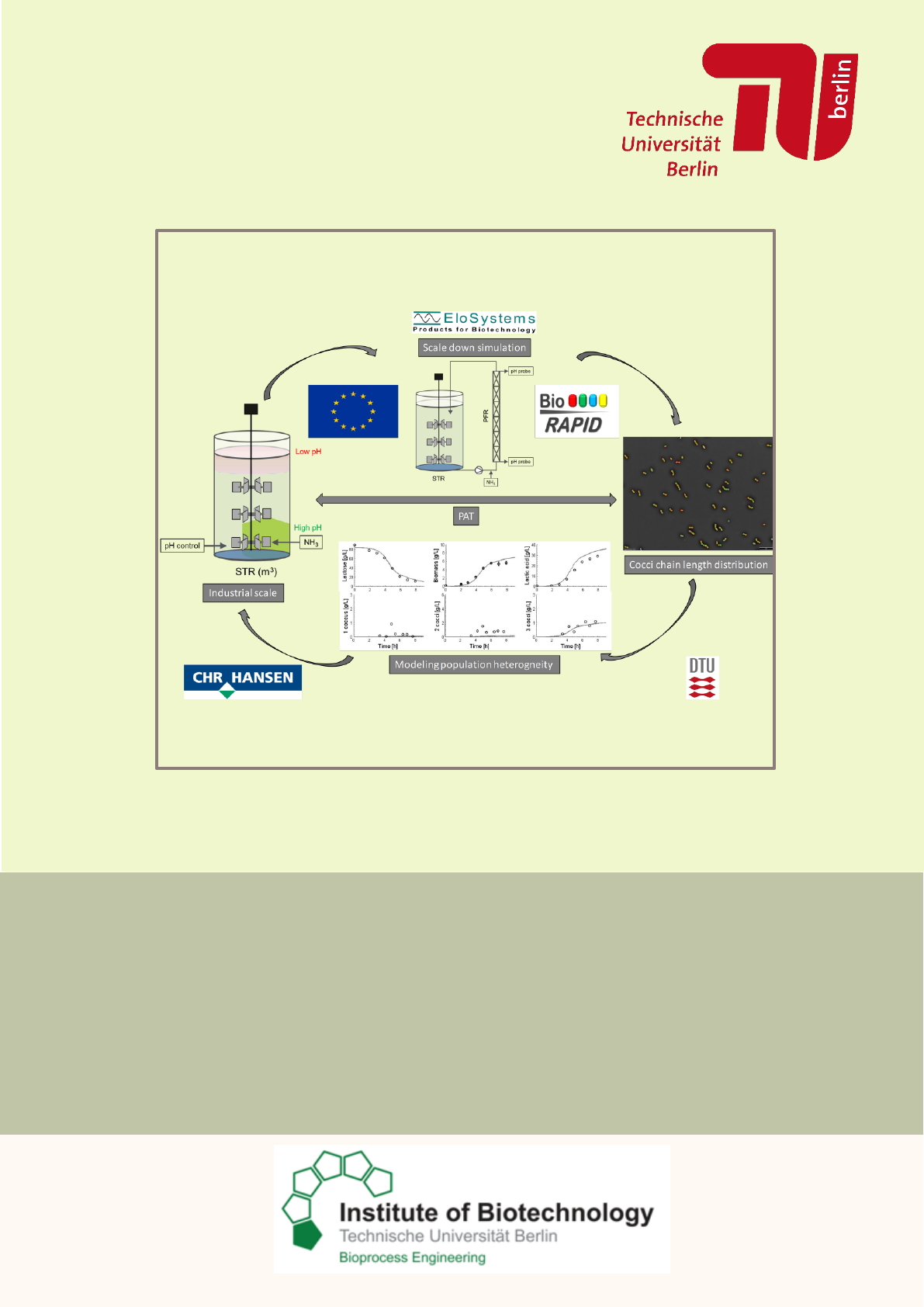
Cocci chain length distribution as
control parameter in scaling lactic acid
fermentations
Klaus Pellicer Alborch - Dissertation


Cocci chain length distribution as control parameter in scaling lactic
acid fermentations
vorgelegt von
M. Sc. Eng.
Klaus Pellicer Alborch
ORCID: 0000-0002-2207-6052
an der Fakultät III-Prozesswissenschaften
der Technischen Universität Berlin
zur Erlangung des akademischen Grades
Doktor der Ingenieurwissenschaften
-Dr.-Ing.-
genehmigte Dissertation
Promotionsausschuss:
Vorsitzender: Prof. Dr. Eng. habil. Rudibert King, School of Process Sciences and Engineering,
Technische Universität Berlin
Gutachter: Prof. Dr. Eng. Frank Delvigne, Gembloux Agro-Bio Tech, University of Liège
Gutachter: Dr. Eng. Alain M. Sourabié, Science Technology & Innovation, Lessafre BU
Procelys
Gutachter: Prof. Dr. rer. nat. Peter Neubauer, Institute of Biotechnology, Technische
Universität Berlin
Tag der wissenschaftlichen Aussprache: 23. Juli 2020
Berlin 2020


Cocci chain length distribution as control parameter in scaling lactic acid fermentations Klaus Pellicer Alborch
I
Abstract
Abstract
The world population is projected to reach 9.7 billion in 2050, which means that the Food and Feed
industry is supposed to keep improving its productivity in order to provide all these people with enough
food at the same pace. The current trend of regulatory authorities toward application of new process
analytical technology tools to improve process understanding as well as reliability and ensure product
quality during the production, has awakened the need of investing in novel analytics, especially in
(bio)pharmaceutical industries, but is being extended to other fields. Moreover, the increasing
acceptance of industrial companies that relevant concentration gradients affecting process
performance as well as product quality appear in production vessels, is turning the scale down
representation of conditions of the large scale in the lab indispensable. Furthermore, the actual
digitalization transformation experienced in everyone´s life is becoming more and more relevant in
industrial manufacturing, with the current tendency to develop a so-called digital twin, which
simulates the (bio)process running in the plant in silico, thus minimizing out-of-specification batches
and allowing near future personnel as well as materials/consumables planning.
In this work, (i) electrooptical measurements of cell polarizability as well as size, (ii) single- and multi-
compartment scale down strategies and (iii) mechanistic modeling of macroscopic variables as well as
population heterogeneity were applied to Streptococcus thermophilus fermentations for the first time.
Firstly, the at-line determination of bacterial polarizability (i.e. orientation under the application of an
electrical field) allowed the elucidation of different growth phases and resulted to be an early indicator
of nutrient imbalance as well as growth cessation. Moreover, the analysis of the mean cell size without
sample preparation with the same device also allowed the monitoring of qualitative morphological
changes during growth. These were verified with parallel flow cytometric analyses, which revealed
calibration issues in the equipment preparation, which should be addressed in future experiments.
Secondly, pH shifts in the range from 5.5 until pH 8.0 (i.e. pH = +2.0;-0.5) were induced in single-
compartment reactor cultivations leading to a 48.5 % biomass productivity loss in the worst case
scenario, while repeated pH pulses in a similar region were performed through ammonia addition in
the plug-flow reactor of multi-compartment reactor experiments which yielded a 20 % less cell
concentration at the end. Importantly, relevant morphologic changes under the different cultivation
conditions were detected: increased chain length under alkali conditions and more homogenous cocci
chain length distribution with shorter chains at low pH values. Nevertheless, computational fluid
dynamic studies of a 700 L pilot scale fermenter revealed that those scale down conditions were
exaggerated in terms of pH-gradients induced: only pH pulses up to 6.3 were monitored throughout a
S. thermophilus fermentation under optimal growth conditions, while the pH never dropped below 5.8
far away from the base addition zone. However, extended mixing times and limited power input in the
industrial scale may lead to higher pH, so that their effect on process performance and product
quality was further assessed. Thirdly, a population balance model based on a mechanistic description
of typical growth metabolites (namely biomass, lactose, lactic acid and galactose concentrations) was
developed, being able to predict the evolution of certain populations (namely 1-coccus, 2-, 3-, 4- and
5 or more cocci chains) during S. thermophilus cultivation under optimal growth conditions and
variable pH-gradients.
Loading more pages...