
https://doi.org/10.1007/s13194-022-00462-0
PAPER IN GENERAL PHILOSOPHY OF SCIENCE
Radical artifactualism
Guilherme Sanches de Oliveira1
Received: 11 March 2021 / Accepted: 8 April 2022 /
©The Author(s) 2022
Abstract
A powerful idea put forward in the recent philosophy of science literature is that
scientific models are best understood as instruments, tools or, more generally, arti-
facts. This idea has thus far been developed in combination with the more traditional
representational approach: accordingly, current artifactualist accounts treat models
as representational tools. But artifactualism and representationalism are independent
views, and adopting one does not require acceptance of the other. This paper argues
that a leaner version of artifactualism, free of representationalist assumptions, is both
desirable and viable. Taking seriously the idea that models are artifacts can help
us philosophically to make sense of how and why scientific modeling works even
without reference to representation.
Keywords Scientific modeling ·Representation ·Tool use ·Material engagement ·
Pragmatism
1 Introduction
A common feature of contemporary science is the use of a wide range of models
and modeling techniques to analyze experimental data and to simulate phenomena
of interest. Consider the examples shown in Fig. 1. Some models are mathemati-
cal objects, such as the Haken-Kelso-Bunz model, or HKB for short (Fig. 1a), an
ordinary differential equation used to model the dynamics of motor coordination in
humans (Haken et al., 1985;Kelso,1995). The Global Forecast System is not a sin-
gle equation or pair of equations, but it is mathematical too: the weather forecast
map (Fig. 1b) is generated based on the numerical simulation of a large set of math-
ematical models that have their parameter values set by current climate data. But not
all of the models are mathematical in any obvious way. Some are agents, creatures
Guilherme Sanches de Oliveira
sanchessanchez@tu-berlin.de
1Department of Psychology & Ergonomics, Technische Universit¨
at Berlin,
Straße des 17. Juni 135, 10623 Berlin, Germany
Published online: 2 June 2022
European Journal for Philosophy of Science (2022) 12: 36
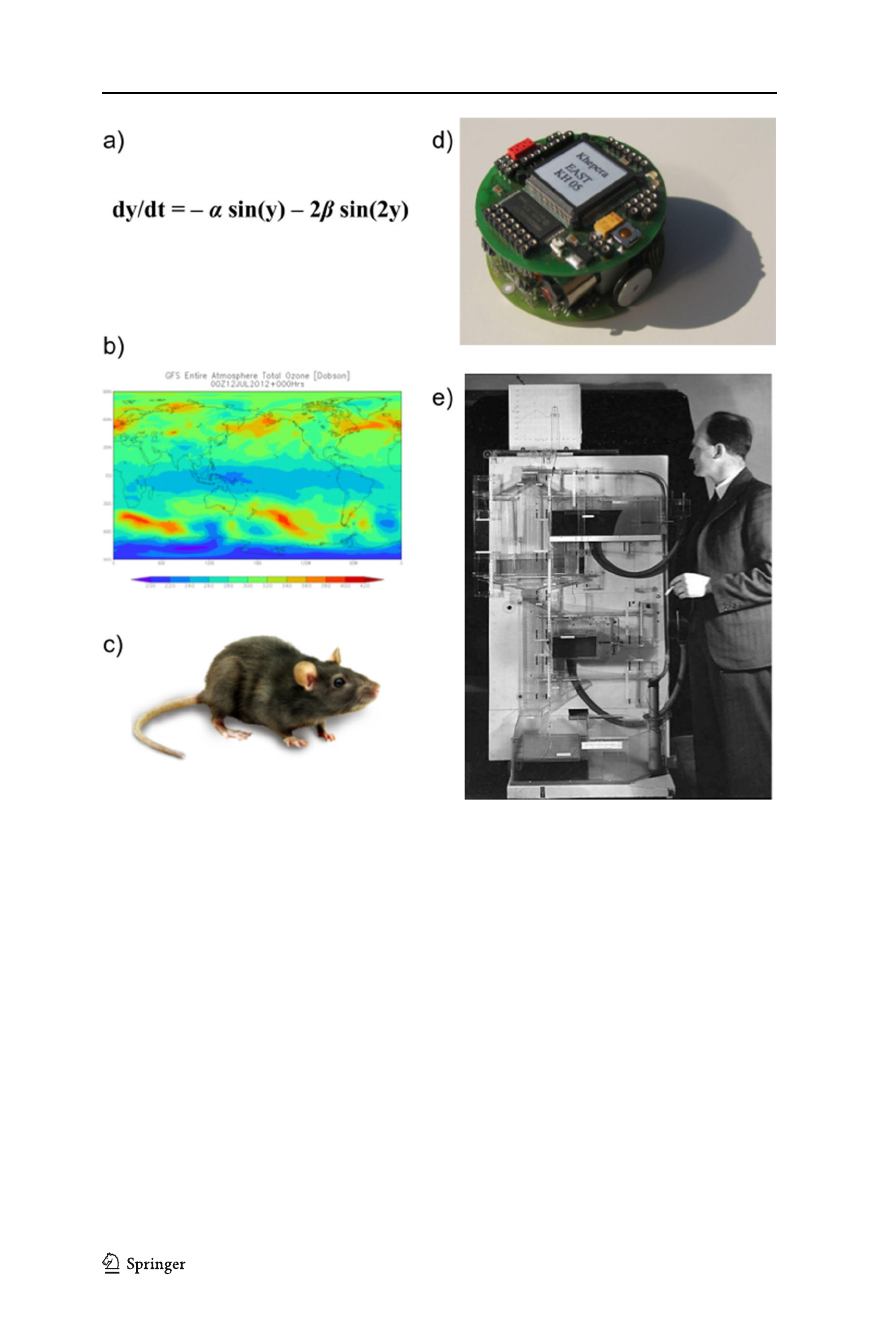
Fig. 1 Examples of models used in scientific research; see main text for description of each (individual
images licensed under Creative Commons or in the public domain)
that move around and do things. The Norwegian rat (Fig. 1c) is a good example of
this. It is one of the most widely used model organisms, and has supported advances
in the scientific understanding of a large number of physiological, pharmacological,
and psychological phenomena. The Khepera robot (Fig. 1d) is similar in this respect:
in the 1990s, it became many roboticists’ go-to platform, being used as a ‘model
organism’ in research on a number of issues relating to natural biological organisms,
including cooperative behavior in ants (Krieger, Billeter, and Keller 2000) and phono-
taxis in crickets (Reeve, Webb, Horchler, Indiveri, and Quinn 2005). Compared to
these models, the Philips Hydraulic Computer (Fig. 1e) seems to belong in a different
category. Also known as MONIAC (which stands for “MOnetary National Income
Analog Computer”), this machine comprises of pipes and tanks through which water
flows, and it was used to model the flow of money in the economy and to study rela-
tions such as the ones between savings, investment, and consumption. The water flow
36 Page 2 of 33 European Journal for Philosophy of Science (2022) 12: 36

relations embodied by the Phillips Hydraulic Computer can be modeled mathemati-
cally, but the machine itself does not perform mathematical calculations in the same
way that climate models do. At the same time, even though there is something that the
Phillips machine does, it is not an agent of the kind that moves around autonomously
like the lab rat and the Khepera robot.
As a brief consideration of the five examples above makes clear, model-based sci-
ence is diverse: scientists create and manipulate a wide range of types of objects as
a means to learning about many different kinds of phenomena. And while there is
often debate about the applicability and limitations of particular modeling techniques
in particular contexts, it’s hard to deny that modeling practices, in general, are epis-
temically successful. In the physical sciences, life sciences and social sciences alike,
model-based research has helped advance our knowledge of the world in ways that
would be unthinkable through more traditional theoretical and experimental means.
The big philosophical question concerns why modeling works: that is, what explains
the fact that objects like the ones mentioned above help advance our understanding
of the world?
In attempting to answer this question, philosophers have developed different theo-
ries of how models represent real-world systems and phenomena. Influential accounts
have described the representational model-target relation as a matter of similarity
(Giere 1988,2010; Weisberg 2012) and isomorphism (van Fraassen 1980,2008),
while others advocate instead a deflationary, non-reductive view of representation
(Suarez, 2015; Morrison, 2015). Accounts such as these disagree about the details of
what representation is and how it works, but they agree in holding that understanding
representation is essential for understanding scientific modeling: according to this
widely accepted ‘representationalist’ perspective, “we need to know the variety of
ways models can represent the world if we are to have faith in those representations
as sources of knowledge” (Morrison 2015, p. 97).
Alongside debates about representation, a powerful idea put forward in the recent
literature is that in order to properly understand model-based scientific research, we
should see models as instruments, tools or, more generally, artifacts. But how does
this approach relate to the traditional representationalist way of thinking about mod-
els? I begin the paper, in Section 2, by introducing this family of views of models as
tools—what I call “artifactualism”—and I highlight some of its virtues. In Section 3
I argue that current accounts of models as tools, instruments and artifacts coincide in
adopting a hybrid construal of artifactualism: as such, these accounts preserve some
key concepts and assumptions from more traditional representational views of mod-
els while advocating for artifactual thinking as a helpful shift in emphasis. I think this
is not the only viable and fruitful way to be an artifactualist about models, and so I
propose a new formulation of artifactualism as a free-standing, non-representational
view I call ‘radical artifactualism’: in this construal of the artifactualist insight,
analyzing models as tools is more than merely a difference of emphasis but a full-
fledged alternative to representationalism. This alternative is explored in Section 4.
There I first present general conceptual foundations I see as crucial for any artifac-
tualist account that intends to be radical (i.e., nonrepresentational) and then, more
specifically but also more speculatively, I sketch what I see as a promising way of
understanding models in a radical artifactualist perspective. Besides being promising
Page 3 of 33 36European Journal for Philosophy of Science (2022) 12: 36

and illuminating in its own right, a radical artifactualist perspective enables circum-
venting questions about representation that are recurrent in the literature but need not
come up in thinking about our use of tools, instruments and artifacts in any domain,
including science.
2 Artifactualism and its virtues
Broadly construed, artifactualism describes scientific models as artifacts in two dis-
tinct but complementary senses. On the one hand, models are akin to ordinary tools in
their practical and functional character. Just as everyday objects help us accomplish
a variety of tasks, scientific models are built and used by scientists to achieve some
goal. This claim draws attention to the ways in which models are “instrumental” to
scientific research, i.e., the ways in which they are useful and important for practi-
cal ends that are scientifically interesting. On the other hand, and less figuratively,
models are not simply like ordinary tools in being useful for some end: models liter-
ally are artifacts created by humans to enable specific forms of manipulation. This
is the case when it comes to scale models, robotic agents, and model organisms—all
clearly concrete—and it’s also the case for supposedly more “abstract” mathematical
models or computer simulations like the ones shown in Fig. 1. In order to be used by
scientists, even these sorts of models must be implemented in some way that enables
interaction and manipulation, including, for instance, as markings and inscriptions
with pen on paper or chalk on a blackboard, or as a programming code typed up and
displayed on a computer screen. It might be tempting to think of “the model” as tran-
scending, or being independent from, any particular physical implementation—still
it’s precisely as some physical implementation or other that the model enables scien-
tists to intervene in some way (e.g., changing parameters, settings or variable values)
and to visualize or otherwise measure the effects of those interventions. It is in this
sense that artifactualism helps us to acknowledge not only the usefulness of models
but also their usableness: besides being similar to tools in the functional and goal-
oriented uses we make of them, models can be seen literally as tools because of their
their workable, manipulable concrete dimension. According to artifactualism, then,
we cannot fully appreciate the role models play in advancing scientific knowledge
until we see models as being on a par with other concrete instruments used in science.
This broad characterization delineates some of the key ideas that constitute the
artifactualist family of views and that artifactualists of different stripes will often
agree on. The different accounts on offer in the literature can be seen as attempts to
flesh out this general artifactualist approach and attitude toward model-based science.
In this section I identify three crucial insights stemming from three different accounts
in the artifactualist family of views. These insights may be in principle available to
philosophers of science who don’t endorse artifactualism; yet, as will be clear, they
are particularly amenable to an approach that takes seriously the idea that models are
in a real sense tools, instruments and artifacts.
The first insight concerns the autonomy or relative independence of modeling
with regard to other dimensions of scientific research. This insight—much like the
artifactualist view itself in its current form—is due to Margaret Morrison and Mary
36 Page 4 of 33 European Journal for Philosophy of Science (2022) 12: 36

Morgan’s (1999) seminal work on modeling. Contrary to the accepted wisdom in
philosophy of science at the time, Morrison and Morgan argued that modeling is
not subordinated to theorizing nor to experimentation: rather, they proposed, models
act autonomously and as “mediating instruments” that connect the two. By this they
meant that modeling is never purely determined by theoretical commitments nor is it
ever the theory-free exploration of data. Sometimes models contribute more directly
to theory building, such as when they aid in investigating the implications of a set
of theoretical assumptions. Other times models assist more directly in experimenta-
tion, as is the case when working with models suggests novel hypotheses to be tested
empirically. Either way, models are partially independent from both scientific theory
and from phenomena/data because, in their construction and functioning, models are
always shaped by extra-theoretical and/or extra-empirical factors.
Philosophers of science now by and large agree that it’s too simplistic to think
of models as straightforward expressions of either theory or data: rather, the rela-
tion between modeling, theorizing and experimentation is recognized as complex and
requiring careful investigation (see, e.g., Peschard and van Fraassen 2018). But even
if this insight now resonates with many philosophers of science, it’s worth noting
how artifactualism provides a particularly fruitful way to make sense of the autonomy
and independence of models. As Morrison and Morgan (1999) propose, models are
autonomous in their functioning because they are tools and have “a life of their own”:
in their view, “what it means for a model to function autonomously is to function like
a tool or instrument” (p. 11).
Along with bringing attention to the complex relation between modeling and other
parts of science, artifactualism also draws attention to complexities internal to model-
based scientific research. In line with this, the second insight relating to a different
formulation of the artifactualist view of models is that matter matters, or, put more
broadly, that the characteristics of particular models and types of models can make
a significant difference to the epistemic outcomes of model-based research. This is
one of the many insights made salient by Tarja Knnuttila’s account of models as
“epistemic artifacts” that are “representationally non-transparent.”
Knuuttila describes models as “intentionally constructed things that are material-
ized in some medium” (2005, p. 1266) and which always have “a material, sensuously
perceptible dimension that functions as a springboard for interpretation, and theoret-
ical or other inferences” (2017, p. 12). In her view, it’s a mistake to think that models
are abstract entities that can be constructed in different ways with no significant loss
or interference from how the model is materially constituted. On the contrary, Knu-
uttila argues that the “representational means” of models are never transparent in
this way: “the wide variety of representational means modelers make use of (i.e. dia-
grams, pictures, scale models, symbols, natural language, mathematical notations,
3D images on screen) all afford and limit scientific reasoning in their characteristic
ways” (2011, p. 268). Thus, even though the Phillips hydraulic machine (Fig. 1e) and
some mathematical model, for example, could both represent the same economic sys-
tem, because the two are built using different representational means, the explanation
of their epistemic import will necessarily differ accordingly. For Knuuttila, models
“can play different epistemic roles (...) depending on the representational means in
Page 5 of 33 36European Journal for Philosophy of Science (2022) 12: 36
Loading more pages...