Appl. Phys. Lett. 97, 251106 (2010); https://doi.org/10.1063/1.3529447 97, 251106
© 2010 American Institute of Physics.
Time-resolved amplified spontaneous
emission in quantum dots
Cite as: Appl. Phys. Lett. 97, 251106 (2010); https://doi.org/10.1063/1.3529447
Submitted: 26 June 2010 • Accepted: 25 November 2010 • Published Online: 21 December 2010
J. Gomis-Bresco, S. Dommers-Völkel, O. Schöps, et al.
ARTICLES YOU MAY BE INTERESTED IN
Dynamics of amplified spontaneous emission in InAs/GaAs quantum dots
Applied Physics Letters 76, 3507 (2000); https://doi.org/10.1063/1.126689
Multidimensional quantum well laser and temperature dependence of its threshold current
Applied Physics Letters 40, 939 (1982); https://doi.org/10.1063/1.92959
From amplified spontaneous emission to microring lasing using nanocrystal quantum dot
solids
Applied Physics Letters 81, 1303 (2002); https://doi.org/10.1063/1.1497708

Time-resolved amplified spontaneous emission in quantum dots
J. Gomis-Bresco,1,a兲S. Dommers-Völkel,2O. Schöps,2Y. Kaptan,2O. Dyatlova,2
D. Bimberg,2and U. Woggon2
1Institut für Optik und Atomare Physik, Technische Universität Berlin, Strasse des 17,
Juni 135, D-10623 Berlin, Germany
2Institut für Festkörperphysik, Technische Universität Berlin, Hardenbergstraße 36,
D-10623 Berlin, Germany
共Received 26 June 2010; accepted 25 November 2010; published online 21 December 2010兲
In time-resolved experiments at InGaAs/GaAs quantum-dots-in-a-well 共DWELL兲semiconductor
optical amplifiers, pump-probe of the ground state 共GS兲population, and complementary
measurement of the amplified spontaneous emission of the excited state 共ES兲population, we are
able to separate the early subpicosecond dephasing dynamics from the later picosecond population
relaxation dynamics. We observe a 10 ps delay between the nonlinear GS pulse amplification and
the subsequent ES population drop-off that supports the dominance of a direct two dimensional
reservoir-GS capture relaxation path in electrically pumped quantum-dot-DWELL structures.
©2010 American Institute of Physics.关doi:10.1063/1.3529447兴
Nowadays many optoelectronic devices1,2use quantum-
dots-in-a-well 共DWELL兲as active media because they pro-
vide faster gain recovery,3lower threshold current,4and pat-
tern free amplification.5An important application of DWELL
quantum dots 共QDs兲is demonstrated in semiconductor opti-
cal amplifiers 共SOAs兲, i.e., in an electrically pumped wave-
guide where the population inversion created in the QDs by
the current is used to amplify the propagating light. To in-
vestigate the ultrafast optical response of SOA-devices, het-
erodyne pump and probe experiments became a standard tool
to study the effect of doping,6optically induced index of
refraction changes,7or the origin and limits of the relaxation
of carriers in QDs.3,8–14 The understanding and control of the
carrier relaxation pathway in DWELL structures are crucial
to achieve large operation bandwidths for telecommunica-
tions and data applications. In particular, at moderate and
high injection currents the dominating relaxation mechanism
is Coulomb-scattering in a carrier reservoir.11,15 For weak
excitation, where carrier-carrier scattering is less efficient,
residual populations in the higher quantum-dot states are
found and explained in terms of both carrier-phonon and
carrier-carrier interactions.16
Subpicosecond pump-probe 共or other nonlinear-optical兲
experiments monitor both the population decay and the de-
coherence process in the QD gain recovery signals within the
first picoseconds. Simulations of the QD ground state 共GS兲
gain dynamics by solving the semiconductor QD-Bloch
equations of a system composed by the QDs, and a two
dimensional 共2D兲-reservoir 共the wetting layer and the quan-
tum well兲evidenced that dephasing, nonthermal carrier
populations, and Coulomb coupling to the reservoir have to
be taken into account,11 although we can simplify the Bloch
approach and use only a laserlike rate equation model to
interpret the experiments after the first picoseconds.12–14 In
the important case of cumulative amplification of pulse
trains, relaxation only through the excited state would pro-
duce an ultimate breakdown of the gain recovery17 which is
not observed in experiments.12
In the ongoing discussion of the nature of carrier relax-
ation pathways we obviously need an alternative experimen-
tal method independent of pump-probe experiments and free
of coherent effects to test directly the excited state 共ES兲
population after the amplification of a pulse resonant to the
QD GS. In this paper, we propose to monitor the time-
resolved luminescence of the ES that is not affected by co-
herent effects but proportional to the instantaneous ES popu-
lation. We introduce an experimental technique which is
based on complementary pump-probe experiments of the
ground state population and time-resolved amplified sponta-
neous emission 共TRASE兲of the excited state population.
This technique is applied to DWELL-SOAs and allows us to
observe changes of the ES population within the time reso-
lution of the light detector 共6ps兲.
The sample studied is a p-i-n structure witha1mmlong,
4
m wide waveguide. The active medium consists of 15
layers of molecular beam epitaxy grown QDs-in-a-well with
a nominal areal density of 2⫻1010 cm−2/layer and a nomi-
nal delta p-doping of 5⫻1017 cm−2 共for further sample de-
tails see Ref. 3兲. When pumped electrically, we observe a 33
meV broad 共inhomogeneous broadening兲GS excitonic emis-
sion peak at EGS=965 meV共=1.285
m兲. A well resolved
p-shell ES emission peak at 70 meV above the ground state
dominated at injection currents above 70 mA.
We used a Ti:sapphire pumped optical parametric oscil-
lator tuned to the GS transition peak, =1.285
m, corre-
sponding to a photon energy of 965 meV with a pulse width
of 150 fs 共full width at half maximum兲and a repetition rate
of 75.4 MHz. First we determine in femtosecond-pump-
probe experiment the gain recovery dynamics of the QD GS
关Fig. 2共a兲兴. For the complementary TRASE measurement we
coupled the beam into the waveguide and sent the light
coupled out to a streak camera. The streak camera, synchro-
nized with the pulsed laser, allowed us to spectrally disperse
and time resolve both the amplified pulse and the electrolu-
minescence of the SOAs. Normal spontaneous processes in
the SOAs are not time-correlated with the pulsed laser and
are statistically averaged. Amplified spontaneous emission
共ASE兲of the SOA generates a constant background, except
for the population changes related to the amplification pro-
a兲Electronic mail: [email protected].
APPLIED PHYSICS LETTERS 97, 251106 共2010兲
0003-6951/2010/97共25兲/251106/3/$30.00 © 2010 American Institute of Physics97, 251106-1
cess. The low light level of the ASE signal and the time
dispersion of the measurement 共we measured only 100 ps out
of 13 ns兲resulted in long acquisition times of typically 30
min.
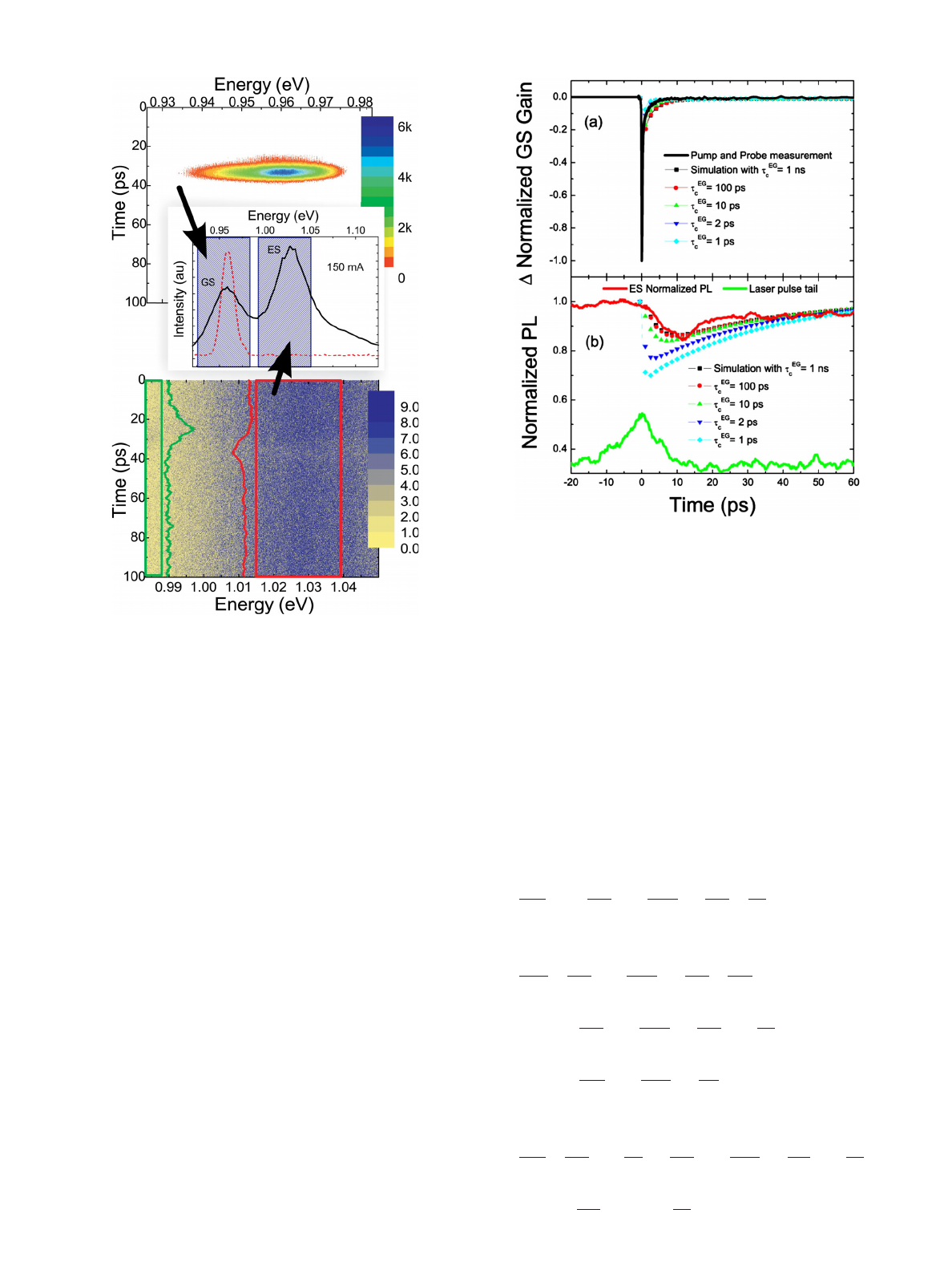
A typical result of the TRASE measurements is shown in
Fig. 1: the upper panel is a streak camera image of an am-
plified pulse measured at injection currents of 150 mA 共lim-
ited by the temporal resolution of 6 ps兲. Both the ultrafast
recovery dynamics of the GS at that injection current3and
the pump pulse itself are below the temporal resolution of
the streak camera. In the lower panel, we show a streak cam-
era image of the ES spectral window 共red centered zone兲of
the QD DWELL SOA pumped with an injection current of
150 mA and being in the saturation regime. The spectral
integration yields the red centered curve, showing the ES
ASE dynamics within the first 100 ps. The arrival time of the
laser pulse is marked by the green left curve obtained from
spectral integration over the tail of the amplified laser pulse
共green left zone兲. Figure 2proves that the streak camera
images are sensitive to the changes in the ES ASE created by
the amplification of the pulse. We observe a pronounced de-
crease of intensity in the ES TRASE, followed by a partial
fast signal recovery up to a value of 16% of the initial ASE
signal lasting then for about 100 ps. The most important
result is, however, that the minimum of the ES TRASE ap-
pears 10 ps after the GS laser pulse amplification. A hypo-
thetical fast relaxation from the ES to the GS, accompanied
by the slower gain recovery of the ES 共see Refs. 3,18, and
22兲, would produce a fast decrease of the ES population
which is not observed in the TRASE experiment of Fig. 2or
any other measurement with less pump power. To explain the
observed ASE dynamics in TRASE experiments, we apply a
population model and compare the signatures of the different
carrier relaxation paths with the experimental data. The de-
veloped rate equation system is given by
NB
t=J−NB
c
WB
冉
1− NW
NW
max
冊
+NW
e
BW −NB
sp
B,共1兲
NW
t=NB
c
WB
冉
1− NW
NW
max
冊
−NW
e
BW −NW
c
WG共1−NG兲
+NE
e
EW
冉
1− NW
NW
max
冊
+NW
c
WE
冉
1−NE
2
冊
+NG
e
GW
冉
1− NW
NW
max
冊
−NW
sp
W,共2兲
NE
t=NW
c
WE
冉
1−NE
2
冊
−NE
e
EW
冉
1− NW
NW
max
冊
+NG
e
GE
冉
1−NE
2
冊
−NE
c
EG共1−NG兲−NE
sp
,共3兲
FIG. 1. 共Color online兲Upper panel: streak camera image of an amplified
pulse resonant to the GS. Middle panel: spectra of the ASE at 150 mA 共solid
black line兲and the pulse coupled in. Left 共right兲patterned zone marks the
spectral range of upper and lower streak images. Lower panel: streak camera
image of the amplified spontaneous emission centered at the ES emission
and showing the ES ASE 共red centered curve兲and the signal tail of the
pump laser 共green left curve兲.
FIG. 2. 共Color online兲共a兲Pump and probe resonant to the GS and 共b兲
TRASE of the ES emission 关upper red curve, corresponding to the red
centered zone in Fig. 1lower panel 共1015–1039 meV兲兴 and temporal posi-
tion of the amplified pulse 关green lower curve, corresponding to the laser tail
seen in the green left zone in Fig. 1lower panel 共983–988 meV兲兴. We plot
simulations of the expected saturation behavior as a function of the intradot
relaxation time for 共a兲GS and 共b兲ES.
251106-2 Gomis-Bresco et al. Appl. Phys. Lett. 97, 251106 共2010兲

NG
t=NE
c
EG共1−NG兲+NW
c
WG共1−NG兲−NG
sp
−NG
e
GW
冉
1− NW
NW
max
冊
−NG
e
GE
冉
1−NE
2
冊
−gP
冉
NG−1
2
冊
.共4兲
We model the experimental data by a four-level system
including the carrier population of the QD ground 共NG兲
and excited 共NE兲states, the 2D-reservoir 共quantum well
and wetting layer NW兲, and the GaAs barrier 共NB兲.We
include as parameters the capture times
c
OriginDestiny.P, the
uncoupled light power, is chosen to satisfy the saturation
regime. The escape times are calculated as
e
OriginDestiny
=
c
DestinyOrigin expEDestiny−EOrigin/kT. The other parameters used
are EG=0 meV, EE=60 meV, EW=120 meV, EB
=130 meV,
C
WE=
C
WG=1 ps,
sp=400 ps,
sp
W=20 ps,
sp
B
=10 ps,
C
BW=300 ps, g=10, NW
max=20 carriers, and J
=1.4 carriers/ps. The carrier/relaxation rates depend on the
carrier population, but for a fixed injection current, we con-
sider them constant.
Supposing that direct capture and cascadelike capture
are both possible, we plot in Fig. 2the simulations for the
time evolution of the GS 共a兲and ES 共b兲populations as a
function of the intradot relaxation time
c
EG, but fixing the
capture times
c
WE and
c
WG to 1 ps, which is mandatory to
reproduce the ultrafast ground state population recovery
found in literature. We show in Fig. 2共a兲a standard one color
ground state pump and probe at the same experimental con-
ditions used in Figs. 1and 2共b兲: the GS population recovers
fully in 5 ps, feature that is well reproduced by the simula-
tions.
C
EG is the modified parameter starting from
C
EG
=1000 ps, i.e., almost completely switching off the intradot,
cascadelike relaxation pathway, and varied then down to
C
EG=100, 10, 2, and 1 ps intradot carrier relaxation times.
The delay found is not compatible with a cascadelike relax-
ation path because in that case, the ES TRASE decrease
should appear almost immediately after pulse amplification.
Good agreement of the simulations and the experimental re-
sults is obtained for an intradot relaxation of
C
EG⬎10 ps,
which is 10 times slower than the direct capture time
C
WG.
Our results contrast with the evidences of cascadelike cap-
ture found in experiments with much lower excitation
density.19,20 Coulomb-scattering is likely to be responsible
for our fast carrier capture and relaxation: the relaxation path
depends on the carrier density.21 It should be mentioned here
that the observed early picosecond ES ASE dynamics in
TRASE experiments differ from the ES-GS pump and probe
results, as, e.g., observed in Ref. 22, confirming the absence
of coherent effects in ASE signals.
In conclusion, in complementary pump-probe experi-
ments of the GS population and TRASE measurement of the
ES population we directly determined the existence of a di-
rect capture relaxation path in a quantum-dot-in-a-well semi-
conductor optical amplifier. We base our conclusion on the
delayed ES population response observed in the saturation
regime and the lack of ultrafast response at lower pump pow-
ers that are incompatible with a dominance of a cascade like
relaxation path.
We acknowledge the funding of this work by Grant No.
SFB 787 of the DFG.
1G. Fiol, D. Arsenijevic, D. Bimberg, A. G. Vladimirov, M. Wolfrum, E. A.
Viktorov, and P. Mandel, Appl. Phys. Lett. 96, 011104 共2010兲.
2C. Meuer, J. Kim, M. Laemmlin, S. Liebich, G. Eisenstein, R. Bonk, T.
Vallaitis, J. Leuthold, A. Kovsh, I. Krestnikov, and D. Bimberg, IEEE J.
Sel. Top. Quantum Electron. 15, 749 共2009兲.
3S. Dommers, V. V. Temnov, U. Woggon, J. Gomis, J. Martinez-Pastor, M.
Laemmlin, and D. Bimberg, Appl. Phys. Lett. 90, 033508 共2007兲.
4D. Bimberg, G. Fiol, M. Kuntz, C. Meuer, M. Laemmlin, and N. N.
Ledentsov, Phys. Status Solidi A 203, 3523 共2006兲.
5T. Akiyama, N. Hatori, Y. Nakata, H. Ebe, and M. Sugawara, Electron.
Lett. 38,1139共2002兲.
6V. Cesari, W. Langbein, P. Borri, M. Rossetti, A. Fiore, S. Mikhrin, I.
Krestnikov, and A. Kovsh, Appl. Phys. Lett. 90, 201103 共2007兲.
7I. O’Driscoll, T. Piwonski, J. Houlihan, G. Huyet, R. J. Manning, and B.
Corbett, Appl. Phys. Lett. 91, 263506 共2007兲.
8P. Borri, F. Romstad, W. Langbein, A. Kelly, J. Mork, and J. Hvam, Opt.
Express 7, 107 共2000兲.
9M. Ishida, N. Hatori, T. Akiyama, K. Otsubo, Y. Nakata, H. Ebe, M.
Sugawara, and Y. Arakawa, Appl. Phys. Lett. 85, 4145 共2004兲.
10T. Piwonski, I. O’Driscoll, J. Houlihan, G. Huyet, R. J. Manning, and A.
V. Uskov, Appl. Phys. Lett. 90, 122108 共2007兲.
11J. Gomis-Bresco, S. Dommers, V. V. Temnov, U. Woggon, M. Laemmlin,
D. Bimberg, E. Malic, M. Richter, E. Schöll, and A. Knorr, Phys. Rev.
Lett. 101, 256803 共2008兲.
12J. Gomis-Bresco, S. Dommers, V. Temnov, U. Woggon, J. Martinez-
Pastor, M. Laemmlin, and D. Bimberg, IEEE J. Quantum Electron. 45,
1121 共2009兲.
13J. Kim, C. Meuer, D. Bimberg, and G. Eisenstein, Appl. Phys. Lett. 94,
041112 共2009兲.
14T. Erneux, E. A. Viktorov, P. Mandel, T. Piwonski, G. Huyet, and J.
Houlihan, Appl. Phys. Lett. 94, 113501 共2009兲.
15R. P. Prasankumar, W. W. Chow, J. Urayama, R. S. Attaluri, R. V. Shenoi,
S. Krishna, and A. J. Taylor, Appl. Phys. Lett. 96, 031110 共2010兲.
16H. Kurtze, J. Seebeck, P. Gartner, D. R. Yakovlev, D. Reuter, A. D. Wieck,
M. Bayer, and F. Jahnke, Phys. Rev. B 80, 235319 共2009兲.
17T. Berg, S. Bischoff, I. Magnusdottir, and J. Mork, IEEE Photonics Tech-
nol. Lett. 13, 541 共2001兲.
18S. Schneider, P. Borri, W. Langbein, U. Woggon, R. Sellin, D. Ouyang,
and D. Bimberg, IEEE Photonics Technol. Lett. 17, 2014 共2005兲.
19T. Müller, F. F. Schrey, G. Strasser, and K. Unterrainer, Appl. Phys. Lett.
83, 3572 共2003兲.
20T. Siegert, S. Marcinkevicius, and Q. X. Zhao, Phys. Rev. B 72, 085316
共2005兲.
21B. Ohnesorge, M. Albrecht, J. Oshinowo, A. Forchel, and Y. Arakawa,
Phys. Rev. B 54, 11532 共1996兲.
22I. O’Driscoll, T. Piwonski, C.-F. Schleussner, J. Houlihan, G. Huyet, and
R. J. Manning, Appl. Phys. Lett. 91, 071111 共2007兲.
251106-3 Gomis-Bresco et al. Appl. Phys. Lett. 97, 251106 共2010兲
Loading more pages...