
TYPE Review
PUBLISHED 14 August 2024
DOI 10.3389/fspas.2024.1422898
OPEN ACCESS
EDITED BY
Josep M. Trigo-Rodríguez,
Spanish National Research Council
(CSIC), Spain
REVIEWED BY
Akos Kereszturi,
Hungarian Academy of Sciences
(MTA), Hungary
Alfonso F. Davila,
National Aeronautics and Space
Administration, United States
*CORRESPONDENCE
Fabian Klenner,
Jean-Pierre Paul de Vera,
jean-pierre.devera@dlr.de
RECEIVED 24 April 2024
ACCEPTED 22 July 2024
PUBLISHED 14 August 2024
CITATION
Klenner F, Baqué M, Beblo-Vranesevic K,
Bönigk J, Boxberg MS, Dachwald B, Digel I,
Elsaesser A, Espe C, Funke O, Hauber E,
Heinen D, Hofmann F, Hortal Sánchez L,
Khawaja N, Napoleoni M, Plesa A-C,
Postberg F, Purser A, Rückriemen-Bez T,
Schröder S, Schulze-Makuch D, Ulamec S and
de Vera J-PP (2024), Icy ocean worlds -
astrobiology research in Germany.
Front. Astron. Space Sci. 11:1422898.
doi: 10.3389/fspas.2024.1422898
COPYRIGHT
© 2024 Klenner, Baqué, Beblo-Vranesevic,
Bönigk, Boxberg, Dachwald, Digel, Elsaesser,
Espe, Funke, Hauber, Heinen, Hofmann,
Hortal Sánchez, Khawaja, Napoleoni, Plesa,
Postberg, Purser, Rückriemen-Bez, Schröder,
Schulze-Makuch, Ulamec and de Vera. This is
an open-access article distributed under the
terms of the Creative Commons Attribution
License (CC BY). The use, distribution or
reproduction in other forums is permitted,
provided the original author(s) and the
copyright owner(s) are credited and that the
original publication in this journal is cited, in
accordance with accepted academic practice.
No use, distribution or reproduction is
permitted which does not comply with
these terms.
Icy ocean worlds - astrobiology
research in Germany
Fabian Klenner1*, Mickael Baqué2, Kristina Beblo-Vranesevic3,
Janine Bönigk4, Marc S. Boxberg5, Bernd Dachwald6, Ilya Digel7,
Andreas Elsaesser8, Clemens Espe9, Oliver Funke10,
Ernst Hauber2, Dirk Heinen11, Florence Hofmann8, Lucía Hortal
Sánchez4, Nozair Khawaja4,12, Maryse Napoleoni4,
Ana-Catalina Plesa2, Frank Postberg4, Autun Purser13,
Tina Rückriemen-Bez2, Susanne Schröder14,
Dirk Schulze-Makuch15,16,17,18, Stephan Ulamec19 and
Jean-Pierre Paul de Vera19*
1Department of Earth and Space Sciences, University of Washington, Seattle, WA, United States,
2Institute of Planetary Research, German Aerospace Center (DLR), Berlin, Germany, 3Institute of
Aerospace Medicine, German Aerospace Center (DLR), Cologne, Germany, 4Institute of Geological
Sciences, Freie Universität Berlin, Berlin, Germany, 5Geophysical Imaging and Monitoring, RWTH
Aachen University, Aachen, Germany, 6Faculty of Aerospace Engineering, FH Aachen University of
Applied Sciences, Aachen, Germany, 7Institut für Bioengineering, FH Aachen University of Applied
Sciences, Jülich, Germany, 8Experimental Space Science and Biophysics, Freie Universität Berlin,
Berlin, Germany, 9GSI - Gesellschaft für Systementwicklung and Instrumentierung mbH, Aachen,
Germany, 10German Space Agency at DLR, German Aerospace Center (DLR), Bonn, Germany, 11Physics
Institute III B, RWTH Aachen University, Aachen, Germany, 12Institute of Space Systems, University of
Stuttgart, Stuttgart, Germany, 13Alfred-Wegener-Institute, Helmholtz Centre for Polar and Marine
Research, Bremerhaven, Germany, 14Institute of Optical Sensor Systems, German Aerospace Center
(DLR), Berlin, Germany, 15Astrobiology Group, Center of Astronomy and Astrophysics, Technische
Universität Berlin, Berlin, Germany, 16Section Geomicrobiology, GFZ German Research Center for
Geosciences, Potsdam, Germany, 17Department of Plankton and Microbial Ecology, Leibniz-Institute
of Freshwater Ecology and Inland Fisheries (IGB), Stechlin, Germany, 18School of the Environment,
Washington State University, Pullman, WA, United States, 19Microgravity User Support Center (MUSC),
Space Operations and Astronaut Training, German Aerospace Center (DLR), Cologne, Germany
Icy bodies with subsurface oceans are a prime target for astrobiology
investigations, with an increasing number of scientists participating in the
planning, development, and realization of space missions to these worlds. Within
Germany, the Ocean Worlds and Icy Moons working group of the German
Astrobiology Society provides an invaluable platform for scientists and engineers
from universities and other organizations with a passion for icy ocean worlds to
share knowledge and start collaborations. We here present an overview about
astrobiology research activities related to icy ocean worlds conducted either
in Germany or in strong collaboration with scientists in Germany. With recent
developments, Germany offers itself as a partner to contribute to icy ocean
world missions.
KEYWORDS
subsurface oceans, space missions, habitability, icy moons, solar system exploration,
Deutsche Astrobiologische Gesellschaft (DAbG), ocean worlds, German Aerospace
Center (DLR)
Frontiers in Astronomy and Space Sciences 01 frontiersin.org

Klenner etal. 10.3389/fspas.2024.1422898
1 Introduction: past and future
exploration of icy ocean worlds
The German space science community and particularly
the German Astrobiology Society (Deutsche Astrobiologische
Gesellschaft; DAbG) has a deep scientific interest in space
exploration. In 2023, the German Government published its space
program strategy (BMWK, 2023) by explicitly mentioning the
value of space research, technology developments and exploration
for the society in general. The strategic view formulated in this
document is to support synergy of different competences, expertise
and resources to allow on the one hand space research and space
exploration leading to international space missions and on the other
hand the use of space related technology via technology transfer
also in society relevant topics such as climate and environmental
protectionas well as discoveringandusing sustainable resources.We
will here start with an overview on the general scientific interest and
space missions as well as showing the German participation and/or
interest in the present and future exploration missions particularly
to the icy moons of Jupiter and Saturn. We further describe the
technology developments and scientific strategy including planetary
analog field research, laboratory experiments, numerical simulation
investigations and even space experiments in Earth’s orbit. At the
end, the context of German space exploration activities to the
German political strategy in reference to the exploration of the
icy ocean worlds will be highlighted. Technology developed for
future missions will be able to be transferred to disciplines related
to polar-, ocean-, deep sea- and climate change-research to address
fundamental scientific questions related to our home planet Earth.
The first enlightening visits of the giant planets and their
moons by spacecraft (Pioneer 10/11 in 1973–1990, Voyager 1/2
in 1979–1989) led to an increasing interest to further investigate
those planetary systems as key elements for understanding the
Solar System as a whole. Measurements by Galileo in the Jovian
(in 1995–2003) and Cassini-Huygens in the Saturnian system (in
2004–2017) revealed the existence of subsurface oceans under the
ice shells of, for example, Jupiter’s moons Europa and Ganymede
as well as Saturn’s moon Enceladus (e.g., Nimmo and Pappalardo,
2016). The Cassini-Huygens mission discovered a plume emanating
from the south pole of Saturn’s moon Enceladus (Porcoetal., 2006).
This plume emerges from cracks in the ice shell and consequent
studies revealed its composition to be mainly water vapor and
ice particles originating from a subsurface ocean, with a salinity
slightly lower than Earth’s oceans (Postbergetal., 2009). Finding
analogue sites for extraterrestrial icy vents and plumes here on
Earth is challenging due to the triple point conditions present inside
the icy vents of Enceladus (Schmidtetal., 2008), derived from the
drastic difference in pressure between the interior and exterior of
the moon. Analogies to the environment near terrestrial, submarine
hydrothermal vents, a potential site for the origin of life on the
early Earth were striking and the icy moons became promising
candidates for habitable worlds and prime targets for astrobiology
investigations.
Alike Enceladus, Europa harbors a global subsurface liquid
water ocean that is in contact with a rocky core (e.g., Kivelsonetal.,
2000). Ganymede’s subsurface ocean is probably sandwiched
between two layers of ice (Vanceetal., 2014;Sauretal., 2015),
making material exchange between the liquid ocean and the core
less likely. The same applies to Jupiter’s moon Callisto (Hartkorn and
Saur, 2017). Saturn’s moon Titan has a liquid, likely stratified (Idini
and Nimmo, 2024), water ocean underneath its organic-covered ice
shell (Goossensetal., 2024). Neptune’s moon Triton is another, yet
widely unexplored, ocean world and a compelling destination for
future space mission (Frazieretal., 2020;Hansenetal., 2021).
Our current understanding of the oceans of the icy moons and
the fascinating discoveries by spacecraft in the recent past (e.g.,
Enceladus’s plume) will be discussed in some detail in the following
chapters. However, many questions could not be answered so far,
which led to the development of numerous mission proposals to
further investigate the oceans of the icy moons (e.g., Howell and
Pappalardo, 2020;Barnesetal., 2021;Mousisetal., 2022).
After the end of the Cassini-Huygens mission in 2017, the flybys
of Ganymede and Europa of the Juno spacecraft in 2022 and 2023,
as part of its extended mission, are the only occasions of a spacecraft
visiting ocean moons in the 2020s. This lack is partially mitigated
by the spectacular observations of the James Webb Space Telescope
of the moons Europa (Villanuevaetal., 2023a;Trumbo and Brown,
2023) and Enceladus (Villanuevaetal., 2023b). Although these
observations yield better data than any other telescopic observation,
the spatial resolution of the James Webb Space Telescope, even for
the Jovian moons, is still four to five orders of magnitude below what
can be achieved with a close flyby.
However, starting in 2030, ocean moons will become more
important targets of both NASA’s and ESA’s space programs. In
2030 and 2031 respectively, two flagship missions - Europa Clipper
(NASA) and the JUpiter Icy Moons Explorer (JUICE; ESA) -
will arrive in the Jovian System to observe Europa, Ganymede,
and Callisto as their prime targets. Both missions Europa Clipper
(Howell and Pappalardo, 2020) and JUICE (Grasset etal., 2013) have
significant German contributions, advancing the research in this
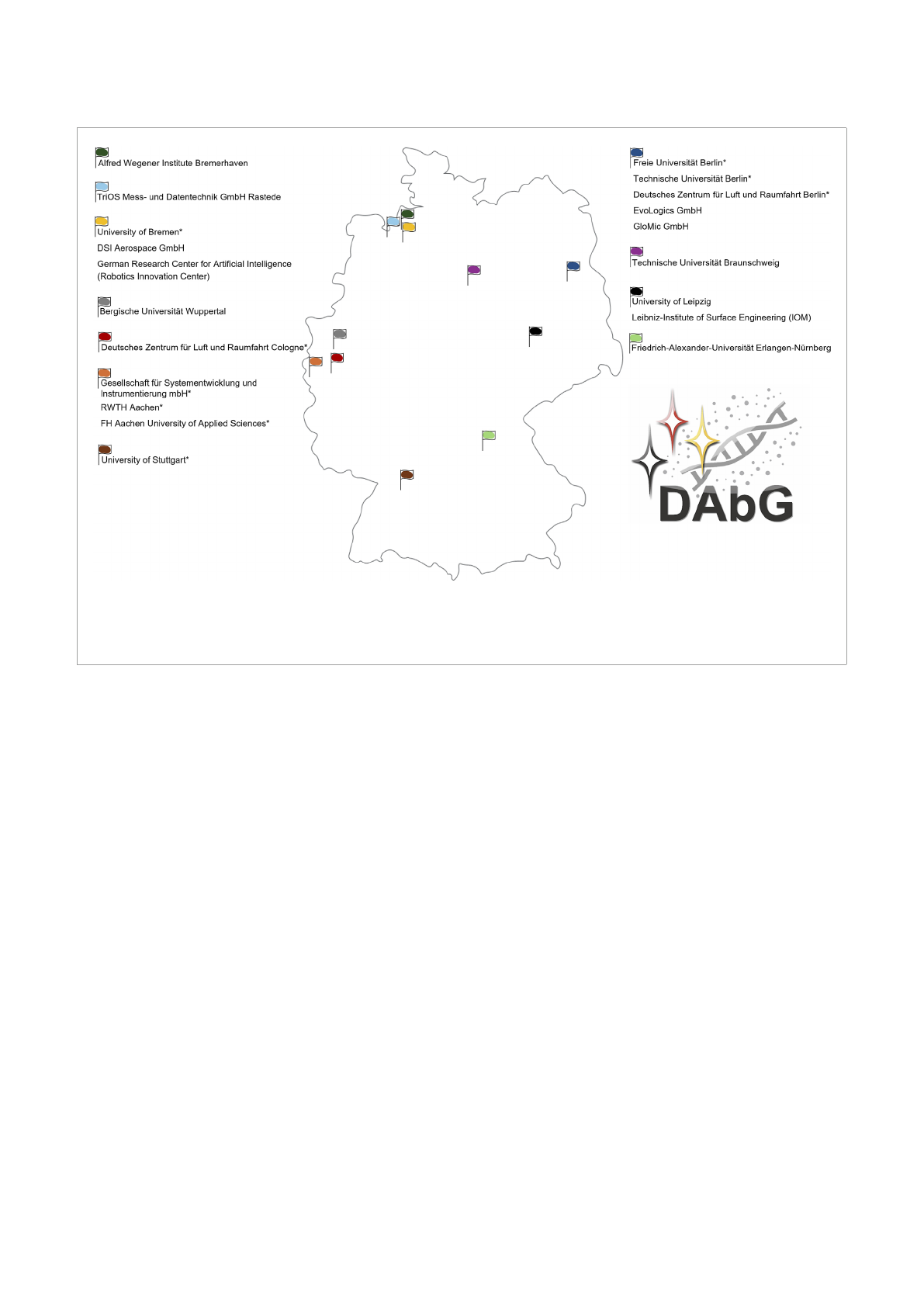
field at German research facilities (Figure1).
Europa Clipper is scheduled for launch in October 2024 and
has the overarching goal to constrain the habitability of Europa’s
subsurface ocean with about 50 close flybys within the 4 years of
its prime mission while in orbit around Jupiter (Vanceetal., 2023).
The locations of these flybys are all fixed in form of a flyby sequence,
but a potential extended mission could allow for targeted flybys over
regions that have turned out to be of specific interest for Europa’s
habitability.
JUICE (launched 14 April 2023) has a somewhat broader scope.
During the first part of the mission the spacecraft will stay in a Jovian
orbit with two flybys of Europa and tens of flybys of each Callisto and
Ganymede. In December 2034, ESA plans to go into Ganymede orbit
for a detailed investigation of the largest moon in the Solar System.
After up to 1year in Ganymede orbit a crash onto the moon’s surface
will then end the JUICE mission.
Titan will be visited by the spectacular Dragonfly mission in
the mid 2030s. Currently, the launch of this NASA New Frontier
class mission is foreseen in 2028 with an arrival in 2034. The
spacecraft is a rotorcraft lander weighing about 450kg, that - driven
by radioisotope thermoelectric generators (RTG) – will sample the
moon’s atmosphere and surface composition at different landing
sites to assess Titan’s potentially prebiotic organic chemistry. The
combination of low gravity and dense atmosphere allow the drone-
like lander to investigate various sites and altitudes during its
Frontiers in Astronomy and Space Sciences 02 frontiersin.org
Klenner etal. 10.3389/fspas.2024.1422898
FIGURE 1
Locations of research groups in Germany with ongoing astrobiology research and collaborations related to icy ocean worlds. Research themes are
summarized in Table1. The German Astrobiology Society (Deutsche Astrobiologische Gesellschaft; DAbG) logo is shown on the bottom right.
Institutions where DAbG members are currently located are marked with an asterisk.
3.5-year prime mission by flying distances of up to 100km while
climbing to altitudes of up to several kilometers (Barnes etal., 2023).
Beyond these approved missions, there are long term strategies
of space agencies, most notably NASA, ESA and the China National
Space Administration (CNSA), to investigate the giant planets
and their icy moons. On the U.S. side, this is outlined in the
Planetary Science and Astrobiology Decadal Survey 2023–2032
(NationalAcademiesofSciences,Engineering, and Medicine, 2023)
as well as in reports written by the Outer Planets Assessment
Group (OPAG), established in 2004 (Beauchampetal., 2009). The
NASA competitive programs, Discovery and New Frontiers (NF),
include the possibility to propose missions to icy ocean worlds. New
Horizons (NF1) performed a flyby of dwarf planet Pluto. JUNO
(NF2) is in orbit around Jupiter. The aforementioned Dragonfly has
been selected as the fourth New Frontiers mission (Barnesetal.,
2021). All those missions have relevance to icy ocean worlds
exploration.
The Planetary Science and Astrobiology Decadal Survey
2023–2032 foresees up to three major missions in the near future.
Firstly, the next New Frontiers mission (NF5) lists Enceladus
as a potential target. Moreover, the next two flagship missions
should be a Uranus orbiter and an Enceladus lander. Following
the Orbilander concept (MacKenzieetal., 2021), the latter would
be a mission that looks for life on Saturn’s active ocean moon
with a planned arrival in the early 2050s. Already sometime
earlier the Uranus orbiter would arrive and the exploration of the
Uranian moons, some of which are potential ocean worlds, will
certainly be part of the mission goals. ESA considers contributing
to this Uranus mission in a similar fashion as it has been
successfully implemented for the joint Cassini-Huygens mission
whereESA provided theHuygensprobe that landed onTitanin 2005
(Lebretonetal., 2005).
At ESA, the long-term priorities in space sciences are described
in the Voyage 2050 report (Tacconietal., 2021), which identifies
a mission to “moons of the giant planets” as the fourth large
mission (L4) in the science program (following JUICE, Athena
and LISA) as well as a so-called “Inspirator Mission”, aiming for
sample return from one of the icy moons (Rapleyetal., 2022).
With a launch date in the early 2040s, Enceladus is the most
likely target for this L4 mission, as recently announced by ESA
(Martinsetal., 2024).
China is also planning to investigate the Jovian system with the
Tianwen-4 mission (also referred to as Gan De, after a Chinese
astronomer of the 4th century). As a possible launch date, 2029 has
been announced (Leietal., 2021). It is worth noting that currently
there are no concrete plans to land on a Jovian satellite, and
even less so to physically penetrate the ice crust. Although many
ideas were addressed and the concept of a Europa lander mission
was studied (Handetal., 2022), this concept was not rated as a high-
priority mission. Nevertheless, some astrobiological questions will
only be answered by lander missions or melting/drilling probes. For
example, limiting elements of life, such as iron, may be remotely
Frontiers in Astronomy and Space Sciences 03 frontiersin.org

Klenner etal. 10.3389/fspas.2024.1422898
detectable on the surface in flybys, but in situ analyses with a lander
provides spatially better resolved and much more detailed and
sensitive measurements. Other space agencies, e.g., Russia, Japan, or
India, currently do not have plans for ocean moon exploration.
2 Activities in Germany - general
overview
In the last decades there has been increasing activities in
Germany to investigate icy ocean moons to realize future space
missions to these worlds. DAbG Members (Figure1;Table1)
are heavily involved in both missions to the Jovian system
JUICE and Europa Clipper. Involvements include participations
in various instrument teams, such as the Particle Environment
Package-Neutral Ion Mass Spectrometer (PEP-NIM; Barabashetal.,
2013), the JANUS multispectral camera (DellaCorteetal., 2014)
and the Ganymede Laser Altimeter GALA (Enyaetal., 2022)
for JUICE as well as the SUrface Dust Analyzer (SUDA) for
Europa Clipper (Kempfetal., 2024).
2.1 Explorer Initiatives at the German
Aerospace Center
Since 2012, the Explorer Initiatives at the German Aerospace
Center (DLR) have been supporting universities, research
institutions and commercial companies from all over Germany
in specially created project lines. The aim of these project lines
is to develop innovative technologies to enable future space
missions to astrobiologically interesting celestial bodies in our
Solar System (Funke and Horneck, 2018). Each project line is based
on a central, albeit currently fictitious, mission scenario:
In the EnEx initiative (“EnEx - Enceladus Explorer”; Kowalski
etal., 2016), technologies are being developed for taking a H2O
sample from a vent on Saturn’s moon Enceladus. The sample can
be taken without completely melting through the moon’s outer ice
shield, which is several kilometers thick.
Jupiter’s moon Europa is also receiving special attention, here
in the project lines “EurEx - Europa Explorer”, and “TRIPLE
- Technologies for Rapid Ice Penetration and subglacial Lake
Exploration”:
In EurEx, an autonomous underwater vehicle (AUV) is being
developed to explore the seabed of the deep global ocean on Europa
completely independently (Hildebrandtetal., 2022). The challenges
are enormous, particularly in terms of the AI required for this task,
and successful implementation is not expected before the middle of
this century.
While EurEx has a long-term focus, the TRIPLE project line
has a medium-term objective (Waldmann and Funke, 2020): The
plan is to develop an AUV that is even more miniaturized than the
EurEx AUV. This nanoAUV is designed as a payload for a melting
probe, which is designed to penetrate the ice sheet of Europa into
the global ocean below (see also Section 3). The melting probe will
be anchored in the ice at the point of entry into the ocean and will
serve as a base to ensure communication to the surface and from
there to Earth. The nanoAUV payload will then be deployed into
the ocean as a mobile unit and will be used for exploration within a
radius of approximately 100m around the base. The nanoAUV will
also be used to take samples from the bottom side of the ice and
bring these samples to the melting probe for further analysis within
the AstroBioLab, which is another payload of the probe. It is planned
to demonstrate the technological readiness of the complete TRIPLE
system consisting of three major parts: The melting probe TRIPLE-
IceCraft (Figure2), the mobile exploration unit TRIPLE-nanoAUV
and the TRIPLE-AstroBioLab.
These three main components are designed to work together
as consecutive stages of the TRIPLE comprehensive exploration
strategy. With its state-of-the-art instrumentation, the AstroBioLab
serves as the portable analytical field hub for analyzing samples
previously collected under the ice and transported to the surface.
2.2 The AstroBioLab
The AstroBioLab analytical pipeline consists of four modalities:
(a) fluorescence spectroscopy, (b) fluorescence microscopy, (c)
DNA sequencing and (d) mass spectrometry interconnected by a
sophisticated microfluidics system.
Fluorescence spectroscopy (a), especially when coupled with
Chromophoric Dissolved Organic Matter (CDOM) analysis
principles, emerges as a powerful tool in astrobiology, particularly
for scrutinizing extraterrestrial environments or seeking signs of
life (Barkeretal., 2009;Smithetal., 2018). Unique combinations of
fluorescence intensity, peak shapes and exact positions produce
characteristic spectral patterns that shed light on CDOM’s
composition, concentration and even its origin. Extensive testing
in Arctic ice, Antarctic lakes and deep-sea hydrothermal vents
has demonstrated the effectiveness of fluorescence spectroscopy
in studying complex aquatic ecosystems and in detecting organic
compounds under conditions analogous to those found on
other planets (Storrie-Lombardi and Sattler, 2009). For instance,
fluorescence analysis of water samples from Antarctic lakes
revealed significant photosynthetic and biodegradation activities,
(DeLaurentiisetal.,2013).Tomeetthefuture missionrequirements
regarding miniaturization, energy consumption, robustness and
easy handling, a semi-automatic fluorimeter module has been
designed and manufactured by the FH Aachen University of Applied
Sciences and GSI mbH (Figure3).
Fluorescence microscopy (b) will enable direct visualization
of particulate matter, ranging from submicron to submillimeter
size (e.g., Mulyukinetal., 2014). Studies in Earth’s polyextreme
environments like the Atacama Desert have shown the potential
of this technology in visualizing and identifying microbial life
forms in various microhabitats (Wierzchosetal., 2018). In future
field missions, miniaturized automated fluorescence microscopy
systems such as OpenFlexure (which can be 3D printed), can be
deployed for in situ exploration, thereby diminishing the necessity
for sample return. Furthermore, employing advanced fluorescence
techniques, such as lifetime imaging microscopy, may provide
additional insights into the microenvironment of (extra) terrestrial
water samples (Nadeauetal., 2016).
DNA sequencing (c) is yet another valuable tool for
exploring icy ocean habitats (e.g., Carréetal., 2024). Field tests
in locations like Antarctica’s subglacial lakes and Canadian high
arctic permafrost ice wedge have validated the feasibility of
Frontiers in Astronomy and Space Sciences 04 frontiersin.org

Klenner etal. 10.3389/fspas.2024.1422898
TABLE 1 Institutes in Germany (see Figure1) and their icy ocean world research themes.
Institute Research themes Web links (on 01 August 2024)
Alfred Wegener Institute Bremerhaven Arctic research, nanoAUV sample return system, Life
detection
https://www.awi.de/en/focus/mosaic-expedition.html
Bergische Universität Wuppertal TRIPLE Forefield Reconnaissance System (FRS) https://www.uni-wuppertal.de/en
DSI Aerospace GmbH nanoAUV avionics https://www.dsi.space/
Deutsches Zentrum für Luft und Raumfahrt (DLR),
Institute of Aerospace Medicine, Cologne
Laboratory experiments, Space simulation facilities,
Life detection efforts, Participation in ESA’s space
experiment IceCold (PI Elke Rabbow)
https://www.dlr.de/en/dlr/locations-and-
offices/cologne
https://www.dlr.de/me/en/desktopdefault.aspx/tabid-
7207/
Deutsches Zentrum für Luft und Raumfahrt (DLR),
Space Operations and Astronaut Training,
Microgravity User Support Center (MUSC), Cologne
Operations of experiments during field studies, in Low
Earth Orbit (ISS), on the Moon (LUNA connected
with the DLR Human Exploration Control Centre), in
the Solar System and on ground; hardware tests,
evaluation of operation procedures; integrated
astrobiology and planetary science topics, leading
ESA’s next space experiment on board the ISS: BioSigN
(PI Jean-Pierre de Vera)
https://www.dlr.de/en/rb/about-
us/departments/microgravity-user-support-center-
musc
Deutsches Zentrum für Luft und Raumfahrt (DLR,
Institute of Planetary Research, Berlin
Laboratory and numerical simulations of subsurface
processes, Environmental chambers and
measurements in the Planetary Spectroscopy
Laboratory (PSL) as well as the astrobiological
Planetary Analog Simulation Laboratories (PASLAB)
and Raman Mineral and Biosignature detection
(RMBD) laboratory, Instrument participation in ESA’s
JUICE mission (Laser Altimeter GALA: PI Hauke
Hussmann; Camera JANUS: Co-PI Ganna
Portyankina); BioSigN Co-PI Mickael Baqué
https://www.dlr.de/en/pf
EvoLogics GmbH TRIPLE nanoAUV development https://evologics.de/
FH Aachen University of Applied Sciences Exploration of icy vent systems, In-situ
decontamination procedures, Life detection systems,
Melting probe technology
https://www.fh-aachen.de/en/
Freie Universität Berlin Laboratory and numerical investigations of subsurface
oceans and plumes, Analysis of spacecraft data,
Research on natural analogues from polar locations
https://www.geo.fu-berlin.
de/en/geol/fachrichtungen/planet/index.html
https://www.elsaesserlab.space
Friedrich-Alexander-Universität Erlangen-Nürnberg TRIPLE FRS https://www.fau.eu
German Research Center for Artificial Intelligence Under ice navigation, TRIPLE Launch and Recovery
System (LRS)
https://www.dfki.de/en/web
Gesellschaft für Systementwicklung und
Instrumentierung mbH
TRIPLE IceCraft melting probe development https://www.gsi-systems.de/
GloMic GmbH TRIPLE FRS https://www.labo.de/firma/glomic-gmbh.htm
Leibniz-Institute of Surface Engineering (IOM) Development of chemical sensors for space
applications
https://www.iom-leipzig.de/en
RWTH Aachen University TRIPLE IceCraft melting probe development, TRIPLE
Guidance, Navigation and Control (GNC) of the
nanoAUV, TRIPLE scientific payload AstroBioLab, Ice
Data Hub
https://www.rwth-aachen.de/go/id/a/?lidx=1
TriOS Mess- und Datentechnik GmbH Rastede TRIPLE in situ sensor technology as nanoAUV
payload
https://www.trios.de/en/
Technische Universität Berlin Investigation of the habitability of subsurface
environments including oceans, Instrumentation to
detect life
https://www.tu.berlin/en
(Continued on the following page)
Frontiers in Astronomy and Space Sciences 05 frontiersin.org
Loading more pages...