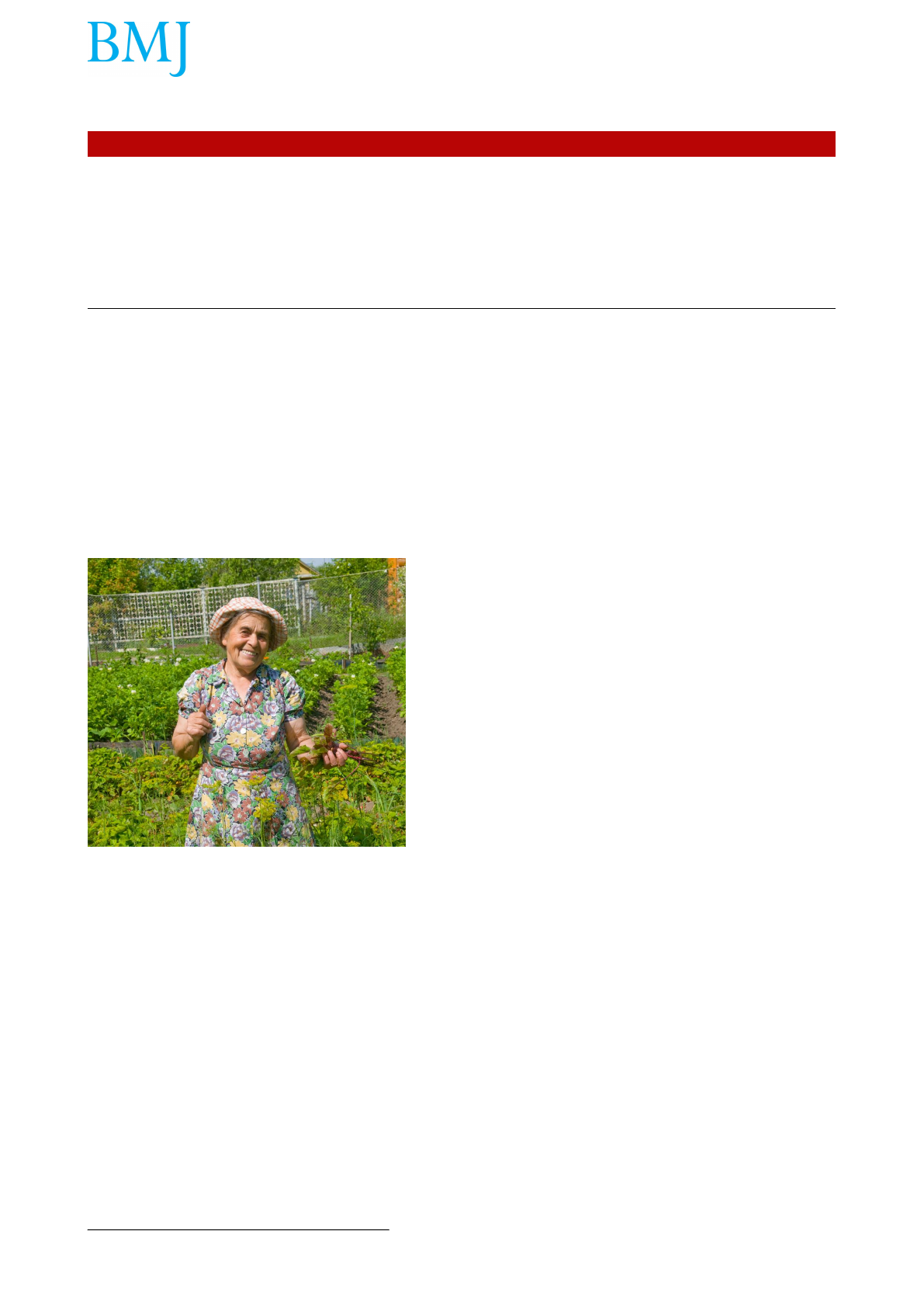
How to meet the challenge of ageing populations
EU countries need to work together with health professionals and other stakeholders
Nick Fahy consultant and researcher on European health issues 1, Martin McKee professor of
European public health 2, Reinhard Busse professor of healthcare management 3, Emily Grundy
professor of demographic gerontology 2
1Nick Fahy Consulting, Tunbridge Wells TN1 2HX, UK; 2London School of Hygiene and Tropical Medicine, London, UK; 3Technical University of
Berlin, Berlin, Germany
The EU partnership aims to add two years of healthy life
to the European average by 2020
One of the main arguments used to justify major reform of the
NHS is the potential cost of an ageing population. The United
Kingdom is not alone; the number of people aged over 65 in
the European Union will almost double over the next 50 years,1
and there will be only two people of “working age” for each
person over 65 compared with four today. It is estimated that
this could cost EU countries as much as 15-40% on top of
current expenditure to maintain existing health services. So how
is Europe collectively responding?
EU leaders (including those from the UK) are pinning much
hope on “innovation”—speeding up the process of bringing
new ideas from research to practical application.2As part of this
“innovation union” initiative, the European Commission has
proposed a “pilot partnership on active and healthy ageing.”3
By bringing together government officials, industry, health
professionals, and other stakeholders from across Europe, the
commission hopes to find ways of removing bottlenecks and
speeding up the application of science in practice. The first
meeting of the partnership’s steering group was held in May;
its concrete priorities for specific research, development, and
deployment, and the necessary support, are due later this year.
These could include better tools for early diagnosis of heart
disease, for example, or using remote monitoring to help people
with chronic conditions take care of themselves more
independently.
The proposed benchmark for this partnership is to add two years
of life in good health to the European average by 2020. Long
term trends of improving life expectancy suggested that this
was likely to be achieved with no additional intervention.4
However, the commission’s recent figures are not encouraging,
with the most recent data published in March 2011 showing a
fall in average European healthy life expectancy by 0.3 years
for women and 0.6 years for men between 2007 and 2008.4
The most important element of this benchmark, however, is not
the precise figures or even whether they are achieved. It is the
commitment by all EU countries to work together with health
professionals and other stakeholders to meet the challenge of
ageing. This does not change the primary responsibility of
countries for their own health systems. Nevertheless, the
partnership’s public consultation (which ran from November
2010 to January 2011) identified common problems, such as
fragmentation of funding (for example, between health and
social care), lack of clear and accessible evidence about which
new innovations work, complex regulatory requirements (such
as uncertainty over which legislation applies to new technologies
such as telemedicine), and failure to involve patients and
professionals in the development of the new solutions they will
be using.5Each country can then use the collective European
effort as a basis to tackle the local and specific challenges of
their ageing population.
What already exists can offer a great deal. Apart from any new
solutions that this EU partnership may help to generate, there
is already much scope for cross European learning to help health
systems respond to healthy ageing.6The European Observatory
nick@nickfahyconsulting.eu
Reprints: http://journals.bmj.com/cgi/reprintform Subscribe: http://resources.bmj.com/bmj/subscribers/how-to-subscribe
BMJ 2011;342:d3815 doi: 10.1136/bmj.d3815 Page 1 of 2
Editorials
EDITORIALS

on Health Systems and Policies (a collaboration of international
organisations, governments, and universities that supports
evidence based policy making7) has summarised evidence
showing where European systems should focus for maximum
improvement.8This includes better coordination of care across
health and social services, as well as within health systems; the
targeting of priority conditions that create the greatest burden
of ill health, such as hypertension, stroke, and dementia; better
management of hospital admissions; and encouragement of
better self care. It also highlights the scope for
prevention—again, tackling the burdens from heart disease and
stroke, flu immunisation, smoking and alcohol misuse, injuries
from falls, healthy diet and nutrition, and inappropriate
combinations of drugs for older people with multiple conditions.
It also emphasises the importance of linking policies in the
health sector to those in other sectors to create appropriate
housing and living environments, and keeping people in work
and involved in their communities.9At a practical level, the
observatory is sharing evidence through a summer school this
July on the response of the health systems to the ageing crisis
(www.observatorysummerschool.org).
Although efforts are being made to deal with the problems across
Europe and beyond, no single country has the answers, as the
recent reports of the Care Quality Commission on failures in
care for older people have highlighted clearly.10 While debates
continue in England about the future organisation of the NHS,
Europe is facing the same underlying challenge of ageing. Rather
than focusing on the structure of the health service, England
could benefit from applying good practices from other countries
to close the gap in funding for its ageing population.
Competing interests: All authors have completed the ICMJE uniform
disclosure form at www.icmje.org/coi_disclosure.pdf (available on
request from the corresponding author) and declare: NF, RB, and EG
are co-directors of the Observatory Summer School 2011; NF was
formerly head of unit for health information in the European Commission;
MM and RB are directors of the European Observatory; no other
relationships or activities that could appear to have influenced the
submitted work.
Provenance and peer review: Commissioned; not externally peer
reviewed.
1 European Commission. 2009 Ageing report. 2009 http://ec.europa.eu/economy_finance/
publications/publication14992_en.pdf.
2European Council. Conclusions. 2011. www.consilium.europa.eu/uedocs/cms_data/docs/
pressdata/en/ec/119175.pdf.
3 European Union. Europe 2020 flagship initiative Innovation Union. 2010. http://bookshop.
europa.eu/uri?target=EUB:NOTICE:KI3110890:EN:HTML.
4 European Commission. Heidi data tool. Health expectancy: healthy life years (HLY) from
2004 onwards. http://ec.europa.eu/health/indicators/echi/list/echi_40.html#main?
KeepThis=true&TB_iframe=true&height=450&width=920.
5 European Commission. Synthesis report on the public consultation on the European
innovation partnership on active and healthy ageing. 2011 http://ec.europa.eu/research/
innovation-union/index_en.cfm?section=active-healthy-ageing&pg=consultation.
6 Doyle YG, McKee M, Sherriff M. A model of successful ageing in British populations. Eur
J Public Health 2010: published 29 September; doi:10.1093/eurpub/ckq132.
7 European Observatory on Health Systems and Policies. www.euro.who.int/en/home/
projects/observatory.
8 Rechel B, Doyle Y, Grundy E, McKee M. How can health systems respond to population
ageing? WHO, 2009. www.euro.who.int/en/what-we-do/data-and-evidence/health-evidence-
network-hen/publications/2009/how-can-health-systems-respond-to-population-ageing.
9 Ståhl T, Wismar M, Ollila E, Lahtinen E, Leppo K. Health in all policies: prospects and
potentials. Ministry of Social Affairs and Health, 2006.
10 Care Quality Commission. Dignity and nutrition for older people. 2011. www.cqc.org.uk/
reviewsandstudies/inspectionprogramme-dignityandnutritionforolderpeople.cfm.
Cite this as: BMJ 2011;342:d3815
Related links
bmj.com/rapidresponse
•“It may be argued that high-income countries have reached
a plateau in life expectancy where further investment is
likely to bring little return...” Nikhil K Patel, Nikhil K
Patel, FY1 Doctor, Basildon Hospital. To submit a rapid
response, go to any article on bmj.com and select “Respond
to this article”
Reprints: http://journals.bmj.com/cgi/reprintform Subscribe: http://resources.bmj.com/bmj/subscribers/how-to-subscribe
BMJ 2011;342:d3815 doi: 10.1136/bmj.d3815 Page 2 of 2
EDITORIALS
Loading more pages...