
Special Section: Challenges of and Solutions to Human-Wildlife Conflicts in Agricultural
Landscapes
Human–wildlife coexistence in a changing world
Hannes J. König ,1Christian Kiffner ,2Stephanie Kramer-Schadt ,3,4 Christine Fürst ,5
Oliver Keuling ,6andAdamT.Ford 7
1Junior Research Group Human-Wildlife Conflict & Coexistence, Leibniz Centre for Agricultural Landscape Research (ZALF), Eber-
swalder Str. 84, Müncheberg, D-15374, Germany, email hkoenig@zalf.de
2Center for Wildlife Management Studies, The School for Field Studies (SFS), PO Box 304, Karatu, Tanzania
3Department of Biology, Technische Universität Berlin (TUB), Rothenburgstr. 12, Berlin, D-12165, Germany
4Department of Ecological Dynamics, Leibniz Institute for Zoo- and Wildlife Research (IZW), Alfred-Kowalke-Straße 17, Berlin, D-
10315, Germany
5Institute for Geosciences and Geography, Dept. Sustainable Landscape Development, Martin-Luther University Halle (MLU), Von-
Seckendorff-Platz 4, Halle (Saale), D-06120, Germany
6Institute for Terrestrial and Aquatic Wildlife Research (ITAW), University of Veterinary Medicine Hannover, Bischofsholer Damm 15,
Hannover, D-30173, Germany
7Department of Biology, The University of British Columbia (UBC), 1177 Research Road, Kelowna, BC, V1V 1V7, Canada
Abstract: Human–wildlife conflict (HWC) is a key topic in conservation and agricultural research. Decision
makers need evidence-based information to design sustainable management plans and policy instruments.
However, providing objective decision support can be challenging because realities and perceptions of human–
wildlife interactions vary widely between and within rural, urban, and peri-urban areas. Land users who incur
costs through wildlife argue that wildlife-related losses should be compensated and that prevention should be
subsidized. Supporters of human–wildlife coexistence policies, such as urban-dwelling people, may not face
threats to their livelihoods from wildlife. Such spatial heterogeneity in the cost and benefits of living with wildlife
is germane in most contemporary societies. This Special Section features contributions on wildlife-induced
damages that range from human perspectives (land use, psychology, governance, local attitudes and perceptions,
costs and benefits, and HWC and coexistence theory) to ecological perspectives (animal behavior). Building
on current literature and articles in this section, we developed a conceptual model to help frame HWC and
coexistence dimensions. The framework can be used to determine damage prevention implementation levels and
approaches to HWC resolution. Our synthesis revealed that inter- and transdisciplinary approaches and multilevel
governance approaches can help stakeholders and institutions implement sustainable management strategies that
promote human–wildlife coexistence.
Keywords: agricultural landscapes, conceptual framework, human–wildlife interaction, methods and tools for
human–wildlife research, protected areas, transboundary challenges
Coexistencia Humano – Vida Silvstre en un Mundo Cambiante
Resumen: El conflicto humano – vida silvestre (HWC) es un tema muy importante para la investigación agrícola
y de la conservación. Los tomadores de decisiones necesitan información basada en evidencias para diseñar planes
de manejo sustentable e instrumentos políticos. Sin embargo, proporcionar un apoyo objetivo para las decisiones
puede ser un reto ya que las realidades y percepciones de las interacciones humano – vida silvestre varían enorme-
mente entre y dentro de las áreas rurales, urbanas y peri-urbanas. Los usuarios de terrenos que incurren en costos
debido a la vida silvestre argumentan que las pérdidas relacionadas a la vida silvestre deberían ser compensadas
y que la prevención debería estar subsidiada. Es probable que quienes apoyan las políticas de coexistencia
entre humanos y vida silvestre, como los habitantes de zonas urbanas, no enfrenten una amenaza a su medio de
Article impact statement: Integrated and participatory research are needed to provide the evidence base to address human–wildlife conflict
and coexistence.
Paper submitted March 1, 2020; revised manuscript accepted April 3, 2020.
This is an open access article under the terms of the Creative Commons Attribution-NonCommercial License, which permits use, distribution
and reproduction in any medium, provided the original work is properly cited and is not used for commercial purposes.
786
Conservation Biology, Volume 34, No. 4, 786–794
© 2020 The Authors. Conservation Biology published by Wiley Periodicals, Inc. on behalf of Society for Conservation Biology
DOI: 10.1111/cobi.13513

König et al. 787
subsistencia debido a la vida silvestre. Dicha heterogeneidad espacial en el costo y beneficio de cohabitar con
la vida silvestre es relevante en la mayoría de las sociedades contemporáneas. Esta Sección Especial presenta
contribuciones sobre daños inducidos por vida silvestre que van desde las perspectivas humanas (uso de suelo,
psicología, gobierno, actitudes y percepciones locales, costo y beneficio y la teoría del conflicto y la coexistencia
humano-vida silvestre) hasta las perspectivas ecológicas (comportamiento animal). A partir de los artículos y la
literatura actuales en esta sección desarrollamos un modelo conceptual para ayudar a estructurar los alcances
del HWC y de la coexistencia. El marco de trabajo puede usarse para determinar los niveles y estrategias de
implementación de la prevención del daño a la solución del conflicto humano - fauna. Nuestra síntesis reveló
que las estrategias inter- y transdisciplinarias y las estrategias de gobierno multiniveles pueden ayudar a que los
actores y las instituciones implementen estrategias de manejo sustentable para promover la coexistencia entre
los humanos y la vida silvestre.
Palabras Clave: áreas protegidas, interacción humano, fauna, marco de trabajo conceptual, métodos y her-
ramientas para la investigación humano, fauna, paisaje agrícola, retos transfronterizos
:
,
,,
,,
,
, (
) ()
,
,
,:;
:
:,,,,,
Introduction
Human–wildlife conflicts (HWCs) are common near
agricultural and other production landscapes, such as
urban and peri-urban areas or near protected areas
(PAs). Human-wildlife conflicts is defined as interactions
between wildlife humans with a negative outcome
(Madden 2004). From an anthropocentric perspective,
such conflicts may occur when wildlife damage crops,
injure or kill domestic animals, or threaten or kill people.
Because this is a reciprocal process, humans and animals
are negatively affected by the conflict, and HWC is one
of the most complex and urgent issues facing wildlife
management and conservation (Frank et al. 2019),
especially outside PAs (Woodroffe et al. 2005). Scholars
are seeking ways to refocus policy-relevant conflict
research on finding pathways toward human–wildlife
coexistence (Marchini et al. 2019) and coadaptation
(Carter & Linnell 2016).
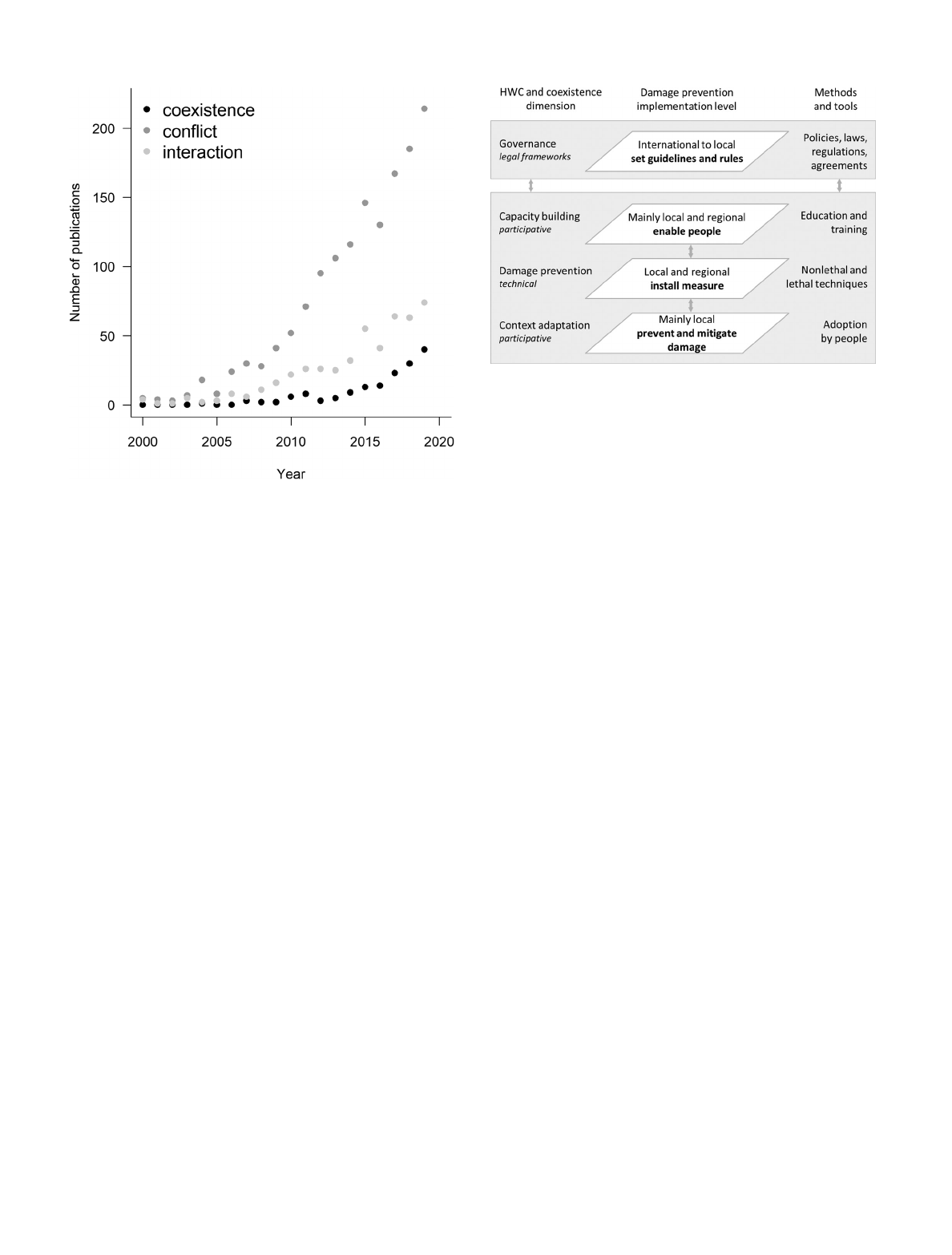
The literature on HWCs, interaction, and coexistence
has grown exponentially in the last 20 years (Fig. 1), and
work on conflict (based on a keyword search) outpaces
work on interactions and coexistence 3-fold. This may
be because scholarship on human–wildlife interactions
has focused mainly on conflict (i.e., negative outcomes
for people, wildlife, or both) (Chapron & López-Bao
2020 [this issue]) or because new ways of thinking
about these interactions now include a paradigm of
coexistence. Most published studies were conducted in
the biological sciences (approximately 45%), followed
by the agricultural sciences (approximately 35%). Work
in the social sciences and humanities (approximately
12%) warrants greater attention and integration (Bennett
& Roth 2019; Frank et al. 2019).
Coexistence is defined as a dynamic but sustainable
state in which humans and wildlife coadapt to living
in shared landscapes, where human interactions with
wildlife are governed by effective institutions that
ensure long-term wildlife population persistence, social
legitimacy, and tolerable levels of risk (Carter & Linnell
2016). Although this term has only recently been used
by researchers, scientific focus on human–wildlife coex-
istence emerged much earlier (Herrero 1970). In 2003 a
Special Section in Conservation Biology was published:
“Human-Carnivore Conflict: Local Solutions with Global
Applications” (Treves & Karanth 2003). The guest editors
of the section highlighted the need for multidisciplinary
research in HWC and for involving policy makers and
managers. The importance of stakeholder participation
in environmental decision making is increasingly being
recognized, and multiple attempts have been made to
implement participative processes (Reed 2008). With
this Special Section on HWC, we sought to broaden the
scope by considering multiuse agricultural landscapes
and species ranging from native carnivores (e.g., lions
[Panthera leo], spotted hyena [Crocuta crocuta], and
Conservation Biology
Volume 34, No. 4, 2020
788 Conflicts and Coexistence
Figure 1. Number of peer-reviewed articles on
human–wildlife conflict, interaction, and coexistence
published from 2000 to 2019 based on literature
search in the Scopus database. Search strings are
“human–wildlife coexistence,” “human-wildlife
conflict,” and “human–wildlife interaction.”
wolves [Canis lupus]) and herbivores (e.g., elephants,
wild boar [Sus scrofa], and Japanese macaque [Macaca
fuscata]) to invasive species (e.g., camels, feral pigs, and
rabbits).
Examples in the section showcase wildlife disturbed
and threatened by agricultural practices and, in contrast,
wildlife that thrive in agricultural lands (i.e., have net
growth rates >1 and able to exploit anthropogenic
resources). The 11 contributions to this section include
comprehensive reviews, essays, and innovative case
studies from Africa, Asia, Europe, and North America,
where HWC and coexistence challenges differ.
Contributors were asked to address 3 critical questions
related to HWC and coexistence: What are the key
challenges of social–ecological models used to promote
coexistence? Which methodological and biological
considerations determine the effectiveness of mitigation
measures that can facilitate coexistence? And, which
dimensions, instruments, and levels of governance de-
termine the outcome of HWC and coexistence (Fig. 2)?
We considered why integrated research, based on a
combination of socioeconomic, socioecological, and ba-
sic ecological research methods, is needed to understand
and overcome the challenges of HWC and to transform
them into coexistence. We also examined theories,
concepts, and challenges of HWC and coexistence and
devised a conceptual framework to structure HWC and
Figure 2. Conceptual framework of human–wildlife
conflict (HWC) and coexistence that can be used to
determine damage prevention implementation levels
and approaches to human–wildlife conflict resolution.
coexistence into different dimensions, damage preven-
tion implementation levels, and methods and tools. We
applied our framework to the case of gray wolves (Canis
lupus) returning to Germany, although the framework
is generic enough to be transferrable to other conflict
scenarios. We also explored HWC challenges posed by
the decoupling of policy jurisdictional boundaries and
transboundary movement of wildlife.
In our synthesis of the Special Section contributions,
we sought to present a clear path to conflict solving:
a holistic perspective that objectively considers and
weighs diverging arguments of stakeholder groups to
provide the evidence base required to cope with the
diverse and challenging facets of HWC and coexistence.
We considered the role of holistic and interdisciplinary
(joint research among different scientific disciplines)
science in generating new knowledge about HWC and
coexistence and in facilitating transdisciplinary work
with stakeholders that bridge the gaps between science,
policy making, and practice. By transdisciplinary,we
mean coproduction of knowledge as boundary work
by policy makers and managers in research activities
in support of identifying solutions to a problem (von
Wehrden et al. 2019).
Call for Governance Structures
The underlying reasons for HWCs are manifold. The
unprecedented magnitude of natural resource use by
humans (Turner Ii et al. 2007) is fueled by a population
approaching 8 billion people, many of them in systems
that depend on persistent economic growth. The need
to produce food (Godfray et al. 2010) is accompanied by
high rates of land-use changes, which typically transform
Conservation Biology
Volume 34, No. 4, 2020

König et al. 789
natural or seminatural areas to urbanized and agricultural
areas (Foley et al. 2005).
Current HWC and coexistence research focuses
primarily on large mammals (Nyhus 2016), perhaps
because such species can pose a risk to human safety
and livelihoods. This anthropocentric view of wildlife
leads to classifying species as good or bad, without con-
sidering their intrinsic value. Human activities (e.g., land
conversion, harvesting, and introduction of non-native
species), however, constantly affects species’ presence
(Sala et al. 2000), but species may respond differently
to those human activities (Brashares 2010). Hence, due
to the finite nature of natural resources, agricultural and
human-dominated landscapes are increasingly becoming
arenas for human–wildlife interactions. Source–sink
dynamics attracting wildlife to human food sources and
the magnitude of conflict may be context dependent,
yet conflicts frequently attract considerable attention
where wildlife is perceived to negatively affect people’s
well-being or livelihoods (Kansky et al. 2016).
Moreover, human–wildlife interactions often trans-
lated into conflicts between people or groups of people
with divergent interests (Redpath et al. 2015). For
example, conflicts arise between farmers, who focus on
economic production, and conservationists, who seek
to maintain natural areas.
The institutional structures that shape interactions
between humans and wildlife are diverse and vary by re-
gion. For example, European approaches to coexistence
are often formalized through international regulatory
processes, and these may differ from processes in rural
areas in the global South, where more informal and
community-driven approaches typically provide the
context for coexistence (e.g., Broekhuis et al. 2018). The
effectiveness of international conservation agreements
in shaping human–wildlife coexistence remains largely
untested. The consensus is principally that coexistence
can be achieved only through a holistic perspective in
which socioeconomic and ecological aspects are given
full consideration (Nyhus 2016; Hill et al. 2017).
A key challenge in managing human–wildlife interac-
tions is to design and implement sustainable governance
mechanisms (Morzillo et al. 2014; Soulsbury & White
2015). People and most wildlife species have extensive
learning abilities, complex social life histories, and
their own agendas and strategies on how to access
and use resources. Instruments for spatial planning and
development at multiple scales are needed to manage
human–wildlife interactions sustainably to avoid or
reduce conflicts (Seijger et al. 2017) and to ensure a
sustainable coexistence (Woodroffe et al. 2005).
To make progress toward human–wildlife coexis-
tence, a better understanding and objective testing
of assumptions about the causes of wildlife-induced
damages from various perspectives, including wildlife
ecology, human perceptions and behavior, and legal
frameworks (Chapron & López-Bao 2020; Treves &
Santiago-Ávila 2020 [this issue]; Wilkinson et al. 2020
[this issue]) is essential. This is particularly important in
landscapes where people have modified nature in such
a way that agriculture provides habitat to some (pro-
tected) species and where novel governance models are
needed to balance shared land use between people and
wildlife.
Agriculture and Conservation Interface
Confronted with returning carnivores, such as gray
wolves and brown bears [ursus arctos]inEurope
(Chapron et al. 2014), governance (i.e., how to manage
conflicts or turn them into sustainable coexistence) is
challenged when conflicts become political (Treves et al.
2017). Ideally, finding solutions includes participatory
and stakeholder-inclusive approaches in which all regu-
latory agencies and community members codevelop pro-
grams that can collectively evaluate possible trade-offs
related to wildlife management goals (Dorresteijn et al.
2016; Martin et al. 2020). However, scant quantitative re-
search addresses how best to derive such a participatory
process in the context of human–wildlife coexistence.
In this Special Section, 2 conflict areas appear of major
concern: agricultural landscapes that provide habitat for
wildlife (Carter et al. 2020 [this issue]; Denninger Snyder
& Rentsch 2020 [this issue]; Perry et al. 2020 [this issue];
Rees et al. 2020 [this issue]; Tsunoda & Enari 2020 [this
issue]; Wilkinson et al. 2020) and transboundary PAs and
areas surrounding PAs (Jordan et al. 2020 [this issue];
Martínez-Jauregui et al. 2020 [this issue]; Salerno et al.
2020 [this issue]), where wildlife species damage mainly
subsistence farms and where effective implementation
of conservation laws has resulted in increased wildlife
populations. For people lacking access to governance
over wildlife management, informal actions, such as retal-
iatory killing or poaching, may occur at high rates outside
PAs and can have negative consequences for wildlife
inside PAs (Kahler et al. 2013). Such uncoordinated
and often illegal lethal management can have cascading
effects on the species’ distribution, abundance, and
long-term population viability (Woodroffe et al. 2005).
In other cases, lethal control can unintendedly increase
damage occurrences (Eklund et al. 2018; van Eeden
et al. 2018). Due to the often illegal, and thus cryptic,
nature of these informal responses, the magnitude
and effects of poaching on wildlife species are rarely
monitored directly (Liberg et al. 2012). Although strong
governance may help shape coexistence, formalized
governance is not a panacea for coexistence. For
example, heavily subsidized predator control programs
in the United States are aimed explicitly at reducing
carnivore populations rather than at contributing to
human–carnivore coexistence (Bergstrom 2017).
Conservation Biology
Volume 34, No. 4, 2020

790 Conflicts and Coexistence
Perhaps a formal and objective accounting of farm-
ers’ perceptions about wildlife-related damages and
establishing effective means for quantifying economic
losses and costs (i.e., transaction and opportunity costs)
(Carter et al. 2020; Jordan et al. 2020; Rees et al.
2020; Salerno et al. 2020) can improve transparency in
this controversial topic. We conclude that conservation
needs to focus especially on multiuse landscapes, such as
agricultural areas, where the interface between humans
and wildlife occurs.
Conceptual Framework and an HWC Example with
Wolves
Transforming HWC to sustainable coexistence requires
holistic and integrative approaches. Building on existing
literature and contributions to this section, we devel-
oped a conceptual framework for structuring different
dimensions of HWC, damage prevention implementation
levels, and methods and tools (Fig. 2). We considered
the case of gray wolves (Canis lupus)inGermanyto
illustrate how the framework can be applied to a specific
context. The framework applies mostly to conflicts that
are damagerelated, and less to those that are political.
Gray wolves returned to Germany in 2000, and
by 2019 there were 105 packs and 25 pairs and
13 individuals (approximately 700 individuals total
[www.dbb-wolf.de]). Livestock owners perceived and
experienced diverse direct and indirect economic losses
due to the presence of wolves and the subsequent need
to adapt to the new situation.
Governance
In response to the increasing wolf numbers, a strictly
protected species under the EU directive, Germany’s
parliament approved in 2019 (Bundestag 2019) an
amendment to the Nature Conservation Act that relaxes
lethal control of wolves (Kiffner et al. 2019). Adjustments
were justified mainly to establish legal options (e.g.,
killing injured and “problematic” wolves [i.e., wolves
that have repeatedly breached wolf-proof fences and
killed livestock]). Federal states must implement the law.
For example, Brandenburg (where most of the wolves
live in Germany) developed a state-specific regulation
that provides guidelines on when, how, and under what
circumstances wolves can be killed (Brandenburg 2019).
Capacity Building
Multiple stakeholder groups are directly and indirectly
affected by wolves. This includes livestock farmers, state
agencies that implement wolf monitoring and formally
handle livestock losses due to predation, private hunters
who perceive loss of prey, and wildlife managers who
cull problematic wolves. Capacity building (e.g., how
to build fences and apply for funding for fences or
for compensation) is carried out by legal authorities
or nongovernmental organizations and mainly targets
farmers who keep livestock.
Damage Prevention
Implementation of damage prevention measures in-
cludes fences built to a minimum standard height and
voltage and livestock guarding (Reinhardt et al. 2012).
Preventive killing of wolves is illegal. However, in the
event of repeated predation events, private hunters and
wildlife managers are allowed to kill individual wolves
or entire packs until local predation has stopped.
Context Adaptation
Adoption of effective mitigation strategies (Denninger
Snyder & Rentsch 2020) is key to effective damage
prevention and HWC and coexistence. Because one-size-
fits-all strategies to reduce HWC are ineffective (Eklund
et al. 2018), adaptation to specific HWC situations
is required. By considering legal frameworks (laws),
knowledge, and technical equipment (capacities and
capabilities), stakeholders (e.g., livestock keepers) may
choose their own damage prevention measures (e.g.,
fencing and guard dogs) to cope with wolves.
Challenges
Although this governance approach appears relatively
straightforward, the seamless integration of local actors
affected by wolves remains a challenge. For example,
payment routines for carnivore damages are subject to
bureaucratic processes, delayed access to funds, and
unresolved claims (Morehouse et al. 2018). For some
stakeholders, whose dominant belief system focuses
on the existence and intrinsic value of wolves on the
landscape (Boman & Bostedt 1999), the expansion
of carnivore populations to new areas challenges the
utilitarian value of people’s livestock. The current model
lacks an explicit system to evaluate the effectiveness of
the implemented mitigation methods and even an assess-
ment of the benefits that the return of an apex predator
will yield, such as dilution of pathogens or reduction of
browsing damage (Ripple et al. 2014). We suggest such
an evidence basis is a necessary step in effective damage
prevention. In this case, wolf predation behavior, land-
scape and governance structures, and farm management
ideally inform a holistic and integrated assessment.
Management Options for Coexistence
It is a general management challenge when humans and
wildlife live in transboundary areas. Although we are
aware that people and wildlife have always had lethal
and nonlethal interactions, there are emerging frontiers
Conservation Biology
Volume 34, No. 4, 2020
Loading more pages...