
This version is available at https://doi.org/10.14279/depositonce-8629
Copyright applies. A non-exclusive, non-transferable and limited
right to use is granted. This document is intended solely for
personal, non-commercial use.
Terms of Use
Werner, L. C. (2019): Disruptive Material Intelligence of Physarum: Liquid Architecture of a Biological
Geometry Computer. In: Adamatzky, A. (ed.): Slime Mould in Art and Architecture. Gistrup : River
Publishers. pp. 227–247.
Liss C. Werner
Disruptive Material Intelligence of
Physarum: Liquid Architecture of a
Biolo
g
ical Geometry Computer
Published versionChapter in book |

14
Disruptive Material Intelligence of
Physarum: Liquid Architecture of a
Biological Geometry Computer
Liss C. Werner
Technical University of Berlin, Germany
E-mail: [email protected]
Physarum polycephalum, also called slime mold or myxamoeba, has started
attracting the attention of those architects, urban designers and scholars, who
work in experimental trans- and flexi-disciplines between architecture, com-
puter sciences, biology, art, cognitive sciences or soft matter; in short,
disciplines that build on cybernetic principles. Slime mold is regarded as
a bio-computer with intelligence embedded in its physical mechanisms
(Adamatzky, 2013; Jones, 2016). In its plasmodium stage, the single cell
organism shows geometric, morphological and cognitive principles poten-
tially relevant for future complexity in human–machine networks (HMN)
within architecture and urban design. The parametric bio-blob presents
itself as a geometrically beautiful1graph structure–morphologically adap-
tive, logistically smart. It indicates cognitive goal driven navigation and the
ability to externally memorize, similarly to ants (Johnson, 2001). Physarum
communicates with its environment. The chapter introduces the ‘creature’
in the context of ‘digital architecture’2: (a) in an overview of the current
state of architectural and urban projects based on slime mold, (b) in digital
1The emotional and subjective term ‘beautiful’ may generally be inappropriate for a
scientific publication; here it refers to the three qualities of architecture coined by the Roman
architect and engineer Vitruvius (80–70 BC–15 BC). The Vitruvian Triad, firmitas, utilitas,
venustas, describes the quality of architecture as scientific means of measure.
2‘Digital architecture’ here refers to the ‘first digital turn’ in the 1990s (Novak, 1991).
227

228 Disruptive Material Intelligence of Physarum: Liquid Architecture
theory with a glimpse into Physarum’s parallels to our digitally networked
multi(cyber)space, (c) I will consider Physarum as liquid geometry com-
puter – a cybernetic disruptive bio-architectural device. A discussion on its
algorithmic and parametric design strategies for architectural optimization
and computational urban planning for a lean networked (un)conscious city is
envisaged at a next stage.
14.1 Introduction
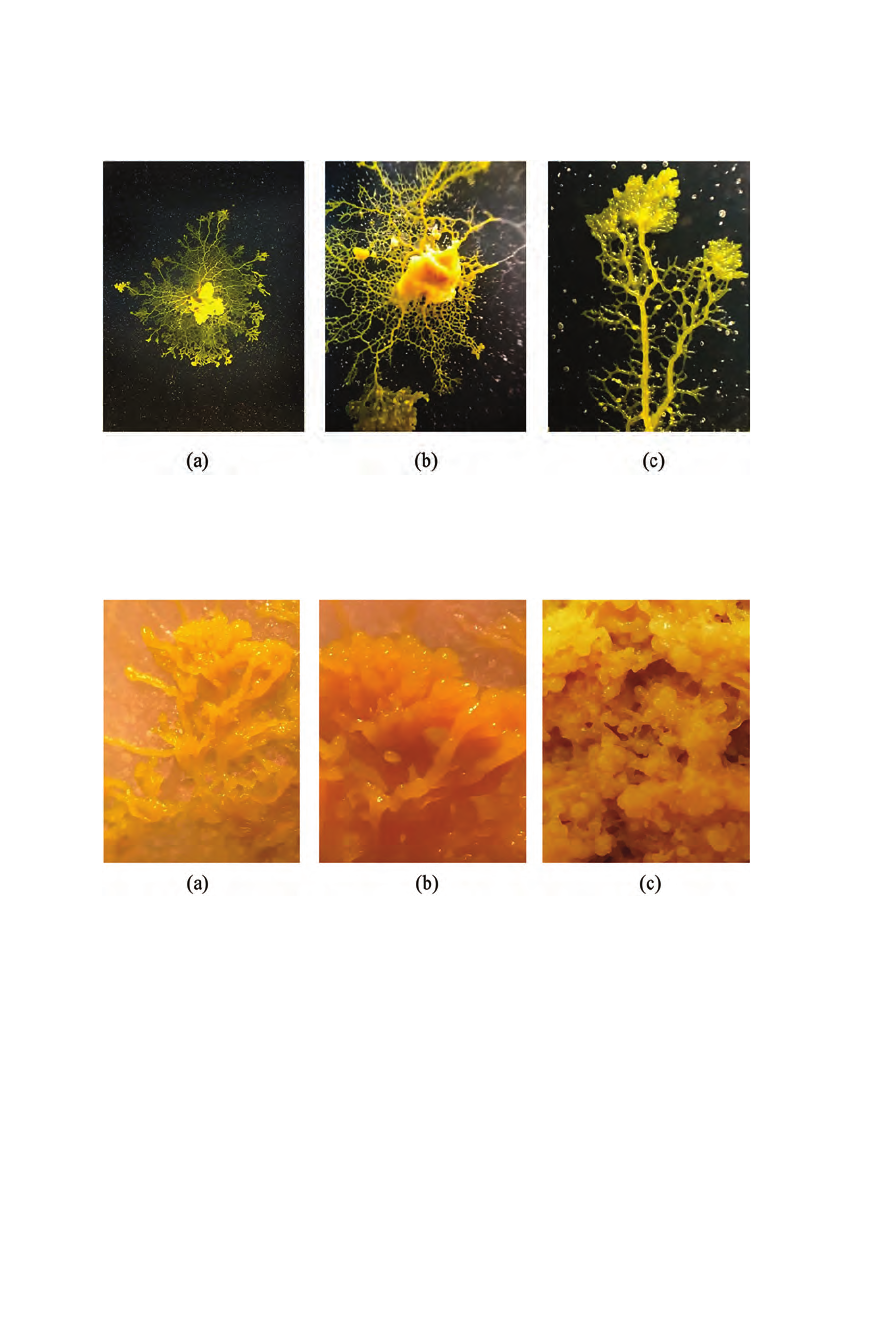
Physarum structure reveals two distinct geometric patterns: (a) on the edges
Physarum polycephalum develops thin branches, searching their environment
for food (Figure 14.1(a), (b)), (b) at a 1:10 enlargement the tips of the
branches reveal a double-curved surface geometry of bulging droplet-like
blobs3, which occasionally turn into elongated three-dimensional oval shapes.
Those clusters of blobs have an intricate topography at their edges demon-
strating a landscape of regularly shaped and rounded hills (Figure 14.2(a),
(b)). They can be seen as the edges where foraging growth is happening
through the actuation the protein actin enabling the construction process
of the contracting filament membrane, ectoplasm as outer layer and endo-
plasm, the liquid found within. Actin is partly responsible for the built up
of contractile filaments of muscle cells (D’Haese, 1978). Once the organ-
ism grows and the branches with the bulging blobs at their tips become
longer through foraging, they divide into further branches and link up like
veins. Self-organizing growth is triggered through cytoplasmic liquid pumped
back and forth in a rhythmically oscillating manner inside the membrane
(Kishimoto, 1958; Zonia, 2007). Eventually, the organism grows a regular –
slightly noisy – Voronoi pattern. The links (the edges surrounding the Voronoi
cells) connect corresponding nodes (vertices). Once the slime mould moves,
location and size of vertices and edges change, disappear or merge; new links
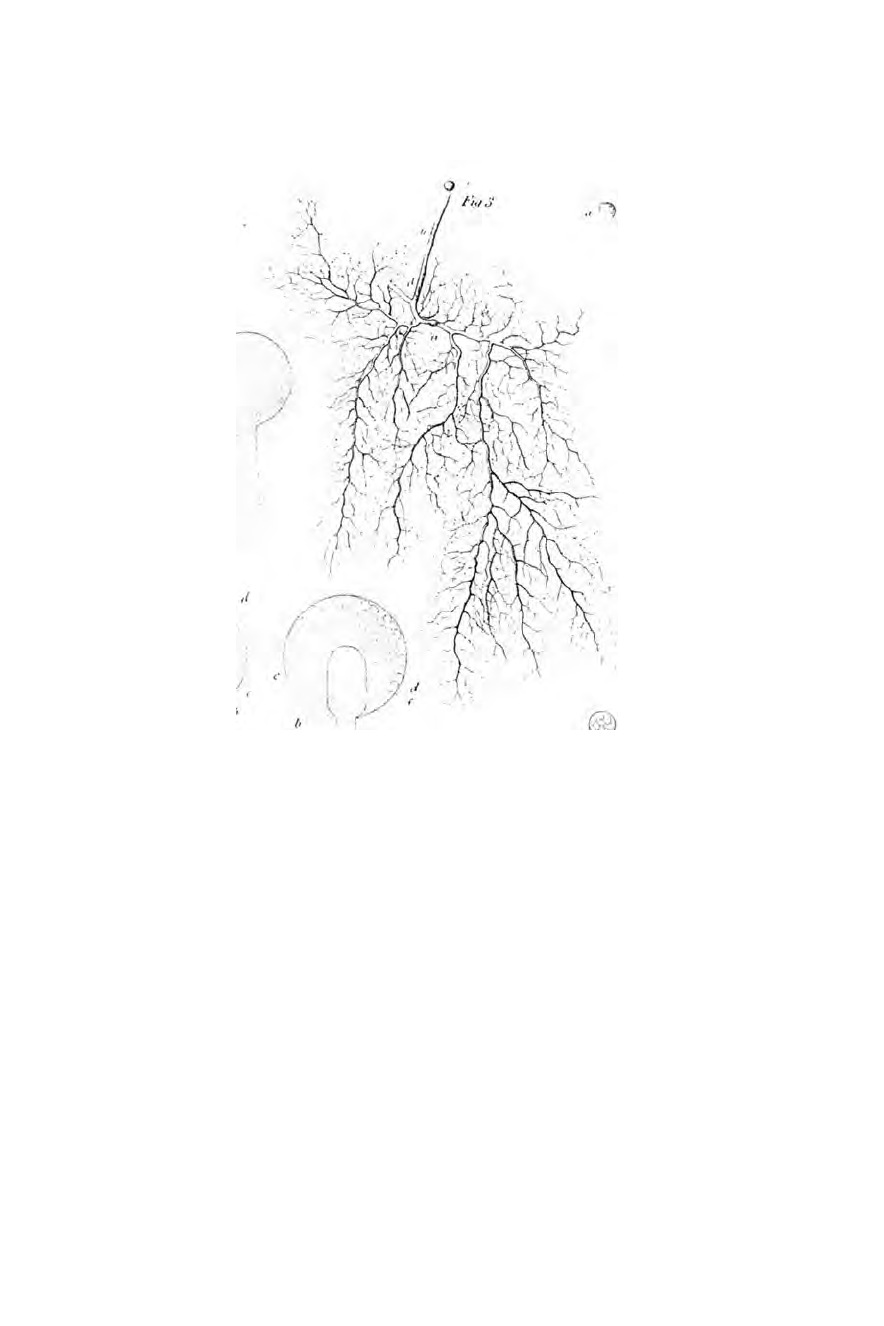
and vertices (nodes) develop (Figure 14.3(a)–(c)). They traverse according
to the geometrical and structural change of the blob, steered by external
and internal parameters. The large membrane acts as transport network for
3The term blob stands for binary large object. In architecture, the blob was introduced by
the architect Greg Lynn in the 1990s, the era of the first digital turn in architecture. It describes
an amoeba-like architectural forms. See ‘Folds, Bodies and Blobs’, (Lynn, 1995; Lynn, 1998).
Since then blob-itecture or blob-architecture has been established as a formal typology of
architectural round forms modelled or generated using digital tools and became part of digital
theory in architecture – especially in the discussion around bio-digital and genetic architecture
(Sykes, 2010; Werner, 2015).
First published in Werner, L. C.: Disruptive Material Intelligence of Physarum: Liquid Architecture of a
Biological Geometry Computer. In: Adamatzky, A. (ed.): Slime Mould in Art and Architecture. River
Publications, 2019. ISBN 978877022729, e-ISBN 9788770227
14.1 Introduction 229
Figure 14.1 1(a), 1(b) (left, centre). Branches departing from food source (oat), searching
for nutrition, Voronoi pattern partly formed. (c) (right). blob-like physa bubble at end of
searching branch.
Figure 14.2 (a), (b) (left, center). Blob landscape developing at the end of a searching
branch. Swelling blobs move forward through the oscillation of a liquid within the membrane–
specimen magnified. (c) (right). Blob landscape. Physarum polycephalum has created a
morphing liquid topography and continues growing–specimen magnified.
nutrients and sensor in constant exchange with its environment; its foraging
is governed by the organism sensing influences alien to its own. In the
case of our Physarum those are, e.g., noise (Meyer, 2017), light intensity,
temperature, amount or nutrition in the substrate. Jakob von Uexk¨
ull’s funda-
mental findings in the systematics of living systems being informed by their
First published in Werner, L. C.: Disruptive Material Intelligence of Physarum: Liquid Architecture of a
Biological Geometry Computer. In: Adamatzky, A. (ed.): Slime Mould in Art and Architecture. River
Publications, 2019. ISBN 978877022729, e-ISBN 9788770227
230 Disruptive Material Intelligence of Physarum: Liquid Architecture
Figure 14.3 (a) (left), (b) (centre), (c) (right). 2D-branching to Voronoi phase 01, 02 and 03.
Over the course of 3 days Physarum polycephalum has developed a network between the food
sources.
environment, its Umwelt (Uexk¨ull, 1909) come into effect. As a living organ-
ism, which is well described in Jakob von Uexk¨ull’s diagram on Merkwelt and
Wirkwelt (1920), Physarum is assumed to also be equipped with sensorial
capabilities, that receive information from ‘the world as sensed’(Uexk¨ull,
1909), an organ that can remember and an organ that can actuate reaction.
Speed and direction of growth can be trained through the moulds capacity
of memorizing externally (Reid, 2012). The cellular slime mould shows the
behavioral pattern of a biological computer adapting cybernetic principle of
learning through conversation with its environment. It “can be considered as
a reaction-diffusion, or excitable medium encapsulated in an elastic growing
membrane.” (Adamatzky, 2009)
The wonder of form-making performed by the slime mold occurs in the
stage of its life-cycle called plasmodium stage. The life cycle of the
First published in Werner, L. C.: Disruptive Material Intelligence of Physarum: Liquid Architecture of a
Biological Geometry Computer. In: Adamatzky, A. (ed.): Slime Mould in Art and Architecture. River
Publications, 2019. ISBN 978877022729, e-ISBN 9788770227
Loading more pages...