
sustainability
Article
Facilitating Low-Carbon Living? A Comparison of
Intervention Measures in Different
Community-Based Initiatives
Martina Schäfer 1,*, Sabine Hielscher 1, Willi Haas 2ID , Daniel Hausknost 3ID , Michaela Leitner 4,
Iris Kunze 5and Sylvia Mandl 4
1Center for Technology and Society, Technische Universität Berlin, Sekr. HBS 1, Hardenbergstraße 16-18,
2
Institute for Social Ecology, University of Natural Resources and Life Sciences (BOKU), Schottenfeldgasse 29,
3Institute for Social Change and Sustainability (IGN), Vienna University of Economics and Business,
4Austrian Institute for Sustainable Development, Lindengasse 2/12, A-1070 Wien, Austria;
5Center for Global Change and Sustainability (gW/N), University of Natural Resources and Life
*Correspondence: [email protected]; Tel.: +49-30-314-26854
Received: 25 December 2017; Accepted: 28 March 2018; Published: 2 April 2018
Abstract:
The challenge of facilitating a shift towards sustainable housing, food and mobility has
been taken up by diverse community-based initiatives ranging from “top-down” approaches in
low-carbon municipalities to “bottom-up” approaches in intentional communities. This paper
compares intervention measures in four case study areas belonging to these two types, focusing
on their potential of re-configuring daily housing, food, and mobility practices. Taking up critics
on dominant intervention framings of diffusing low-carbon technical innovations and changing
individual behavior, we draw on social practice theory for the empirical analysis of four case studies.
Framing interventions in relation to re-configuring daily practices, the paper reveals differences
and weaknesses of current low-carbon measures of community-based initiatives in Germany and
Austria. Low-carbon municipalities mainly focus on introducing technologies and offering additional
infrastructure and information to promote low-carbon practices. They avoid interfering into residents’
daily lives and do not restrict carbon-intensive practices. In contrast, intentional communities
base their interventions on the collective creation of shared visions, decisions, and rules and thus
provide social and material structures, which foster everyday low-carbon practices and discourage
carbon-intensive ones. The paper discusses the relevance of organizational and governance structures
for implementing different types of low-carbon measures and points to opportunities for broadening
current policy strategies.
Keywords:
low-carbon municipalities; intentional communities; ecovillages; social practice theories;
interventions in practices; low-carbon measures
1. Introduction
The combined pressure of global climate change, peak oil, and other environmental challenges
are driving agendas towards low-carbon consumption patterns. Despite an increased policy interest
in combatting climate change, significant changes in shifting to low-carbon consumption patterns
have not yet come about [
1
]. Spurling et al. [
2
] point out that the dominant framings of motivating
Sustainability 2018,10, 1047; doi:10.3390/su10041047 www.mdpi.com/journal/sustainability

Sustainability 2018,10, 1047 2 of 23
changes towards more sustainable ways of living are those of technological innovation and influencing
the behavior of individual agents, in particular, by supporting people to make better choices for
the environment [
3
]. The adaption of low-carbon technological innovations and infrastructures are
thought to be “capable of sustaining present ways of life but with much lower carbon emission than
at present” [
4
] (p. 32) but leaving daily practices largely unchanged and unquestioned. Individual
behavior change programmes are mainly grounded in considering people as rational actors that, for
instance, want to save money or addressing attitudes and values in order to develop more sustainable
lifestyles, frequently through providing information and/or social marketing campaigns [
2
]. So far,
such approaches have had limited impact [
5
,
6
]. As a response, they have been criticized for their lack
of attention to the fact that individual behavior is embedded in social and material structures that
make a change in daily routines very challenging [4].
In parallel to this literature, community-based grassroots organization initiatives with “novel
bottom-up solutions for sustainable development and sustainable consumption; solutions that respond
to the local situation and the interests and values of the communities involved” [
7
] (p. 585) have
emerged over the last two decades. These initiatives have gained increased interest from policy elites
and academics over the last several years, as they are said to play an important role in taking measures
that facilitate changes in daily practices and initiating real-world experiments in low-carbon living (see,
for instance, [
8
,
9
]). They are said to challenge existing values, norms [
7
], and institutional practices [
10
].
Further, Seyfang [
11
] has found that these initiatives have developed novel forms of organization
and systems of provision. Academic work on community-based sustainability initiatives has mainly
made use of frameworks derived from literature on socio-technical transitions such as strategic niche
management and multi-level perspective to conceptualize the activities of these initiatives [
12
]. This
literature has been potentially helpful in focusing attention on the processes through which grassroots
innovations play a part in the diffusion of low-carbon technologies. However, little attention has gone
into the examination of the dynamics of consumption [13].
In reaction to these critiques, emerging research within environmental sociology has begun to
challenge dominant approaches by drawing on the concept of social practices. Taking social practices as
the unit of analysis moves the emphasis away from concentrating on diffusing low-carbon technologies
and changing the behaviors of individuals to analyzing practices as processes of co-evolving technical,
economic, social, and cultural developments [
14
]. Within this literature, Strengers and Maller [
15
] have
recently stressed the need to examine how existing carbon-intensive practices can be changed and how
certain interventions can initiate such changes. In this context, Spurling et al. [
2
] have introduced three
types of “interventions-in-practice”: “recrafting practices,” “substituting practices,” and “changing the
ways practices interlock,” which, however, have thus far hardly been applied in empirical studies.
Drawing on social practice theory, in this paper, we investigate the low-carbon measures of
two types of community-based initiatives: “bottom-up” intentional communities and “top-down”
low-carbon municipalities. Their approaches to facilitating low-carbon living, and the challenges
they face in trying to implement them over time, can be extremely diverse. While some initiatives
tend to focus on sector-specific innovations within housing, food, and mobility, others offer an
integrative approach to initiating low-carbon living across the different sectors. Especially intentional
communities go beyond efforts to solely reduce CO
2
emissions and engage in broader issues than
environmental sustainability such as community building and participation (e.g., [
16
]). Drawing on
the intervention framings developed by Spurling et al. [
2
], we aim to provide a better understanding
of the potential to change daily practices associated with differing interventions implemented as a
result of community-based initiatives.
Summing up, the paper links literature on community-based initiatives with concepts from
social practice theory with the aim to address limitations of the dominant intervention framings of
technological innovation and influencing behavior of individual agents. Specifically, this paper
addresses the following research questions: How do intentional communities and low-carbon
municipalities differently design and implement low-carbon measures? What role do organizational

Sustainability 2018,10, 1047 3 of 23
structures play when developing low-carbon measures and attempting to reconfigure carbon-intensive
practices? The analysis is based on in-depth interviews and workshops with actors from four
intentional communities and low-carbon municipalities in Germany and Austria.
The paper is structured as follows: Section 2briefly provides a background on the two types
of community-based initiatives, before Section 3introduces the literature on social practice theory,
focusing particularly on possible ways of intervening in everyday practices. Section 4introduces the
four investigated case studies and outlines the methodological approach in the study. This is then built
upon in Section 5to empirically detail the low-carbon measures implemented in the community-based
initiatives, drawing on the three interventions-in-practice concepts. In the discussion, reflections on
the differing ways of designing and implementing of low-carbon measures are offered, in particular
considering the initiative’s organization and governance structures. Finally, we draw conclusions,
considering the potential of community-based initiatives to change carbon-intensive practices.
2. Background: Intentional Communities and Low-Carbon Municipalities
The term community-based initiative has been used to refer to several differing organizations,
groups, settlements, and projects, for example, solar settlements [
17
], eco-neighborhoods [
18
], and
low-carbon municipalities [
19
]. Walker and Devine-Wright [
20
] (p. 497) have argued that the term
“community” has been “a much used word that is readily attached to projects,” which vary greatly, for
instance, in how initiatives organize themselves, how they make decisions, which aims they attempt
to achieve, and how they make use of possible outcomes. In this paper, we investigate low-carbon
measures and activities of two types of community-based initiatives: intentional communities and
low-carbon municipalities. In the following section, we present some of the key characteristics of these
two community-based initiatives, including their organizational and governance structures.
The term “intentional community” encapsulates initiatives that are residence-led settlements
or neighborhoods with shared property and commons, such as ecovillages and cohousing projects.
These initiatives have spread globally over the last two to three decades. There are around “1000
local ecovillage projects and networks worldwide, among them approximately 130 in Europe” ([
21
]
(p. 6), referring to the Global Ecovillage Network (GEN) platform; the GEN has received consultative
status with the UN Economic and Social Council (ECOSOC), has been an active participant in the
World Social Forum meetings, and is regularly sending representatives to climate summits and/or
part of civil society exhibitions). Additionally, there are an estimated “1000 cohousing communities
in operation and around the same number in the process of being finished” [
22
] (p. 578), creating
several country-based networks (in this paper, we have particularly focused on ecological-orientated
intentional communities). In recent years, governments have started to acknowledge the role of
such initiatives within various sustainability agendas, considering them to be “best practice” cases
for sustainable living and encouraging them to exchange their experiences with a wider public [
23
].
In terms of the ecological footprint, some ecovillages have proven to be successful models for reducing
energy consumption while maintaining a high level of quality of life [24–29].
Regarding organizational and governance characteristics, intentional communities (ecovillages
and cohousing projects) are consciously designed through participatory processes with the aim to
live more communally, while frequently creating their own locally owned physical infrastructure and
developing novel social and cultural ways of life [
29
,
30
]. They have collectively bought the land and
property, which is in most cases owned by a cooperative. The cooperative follows ecological and
social values, for instance, in developing eco-guidelines for the buildings, forestry and agriculture, and
affordable housing. The village infrastructure frequently consists of private flats in communally owned
housing estates and a variety of shared areas and buildings such as shared kitchens, playgrounds,
workshops, gardens, and laundry rooms. In building these settlements, low-carbon technologies are
often adopted and climate change adaptation measures are being taken [
31
]. Although there are many
similarities between different types of intentional communities, eco-villages can in some respects also
be considered a special subset of co-housing communities as they have a greater focus on sustainable

Sustainability 2018,10, 1047 4 of 23
living compared with other co-housing communities [
32
,
33
]. Intentional communities are not an
administrative unit on their own but mostly are part of a municipality.
The organizational and governance structures of low-carbon municipalities are quite different to
intentional communities. They are coordinated and implemented by an administrative/political body.
Their governance is based on administrative structures that define a community, e.g., municipalities.
They draw from resources provided by the administrative structure itself and are typically connected to
top-down policy strategies and programmes. The relevance of low-carbon municipalities has already
been recognized internationally and globally (see [
8
,
34
]). The worldwide largest network of low-carbon
municipalities and districts that is dedicated to climate protection is the “Climate Alliance,” which was
founded in Frankfurt in 1990. By now, the network is comprised of more than 1700 municipalities from
26 European countries. With around 950 members, the network is of particular importance to Austria,
but there are also around 470 members in Germany. Each member of the Climate Alliance has agreed
to contribute to the reduction of greenhouse gas emissions and promotion of environmental justice.
Additionally, in Germany, municipalities can apply to be a recognized low-carbon community
through the “National Climate Initiative,” which is administrated by the Federal Ministry for the
Environment, Nature Conservation, Building and Nuclear Safety. Based on a road map of low-carbon
measures, which has to be approved by the municipal council, it is possible to receive funding for
a “climate manager” for two to three years. However, prolongation of the funding depends on the
successful reduction of greenhouse gases in the first two years, which puts the municipality under
pressure to implement effective measures within a rather short period of time. So far, climate protection
is no compulsory task for municipalities, as is, e.g., provision with water and energy or educational
facilities. This means that especially smaller municipalities normally do not have special financial
or personal resources for such a task. A more recent program, the Austrian “e5 program,” combines
funding possibilities with external audits to implement energy efficiency measures. The aim of the
program is to provide low-carbon municipalities with long-term monitoring opportunities connected
to climate change. If a municipality has implemented at least half of the agreed measures, it will
be awarded the European Energy Award, which has been developed in 2002 in cooperation with
partners from Germany, Switzerland, and Poland to form a joint European qualification program
for municipalities [
35
]. By now more than 1300 municipalities all over Europe participate at the
program European Energy Award, which is also supported by the European Union [
36
]. In Germany,
the program “Masterplan Kommunen” was initiated in the year 2015 to provide special support to
municipalities with very ambitious objectives of reducing energy use and emission of greenhouse
gases (95% reduction of greenhouse gases and 50% reduction of end energy consumption until 2050
compared to 1990) [37].
Intentional communities and low-carbon municipalities have attracted the attention of academics
for some time now. The work on intentional communities includes studies, for instance, that have
examined the potential transformative nature of these initiatives for wider societal changes [
29
,
38
–
40
],
have critically interrogated how these initiatives might provide solutions for sustainable living [
31
,
41
],
and have linked intentional communities to degrowth ideas [
22
,
42
]. Other studies have had a narrower
focus, looking at the development and potential of renewable energies in these initiatives, innovative
uses of time and space [
43
], or motivations to join them [
44
]. The work on low-carbon municipalities has
mainly concentrated on their responses to climate change mitigation and adaptation targets [
19
,
45
–
47
],
examining, for instance, governance issues [
48
], obstacles for implementing responses [
49
], and
networking activities between initiatives [45].
This paper attempts to address the limitations of dominant intervention framings by comparing
low-carbon measures designed by low-carbon municipalities and intentional communities, drawing
on social practice theory to frame interventions in practice. By doing so, we seek to provide a better
understanding of the potential to change daily practices associated with differing intervention framings.
The next section outlines the theoretical framework, drawing on social practices theory.
Sustainability 2018,10, 1047 5 of 23
3. Theoretical Framework
Introducing a practice perspective grounded in social practice theory, Spurling et al. [
2
] (p. 4)
have argued that “social practices are a better target of intervention [
. . .
] than ‘behavior’, ‘choice’ or
technological innovation alone.” According to Spurling et al. [
2
] (p. 4), through a practice perspective
the question of changing individual behaviors gets re-framed to “how do we shift everyday practice to
be more sustainable” such as heating and cooking. Transformations of daily practices are a result of a
co-evolution and/or re-configuring of several interdependent elements within complex socio-technical
systems [
14
]. Drawing on three interventions-in-practice framings outlined by Spurling et al. [
2
],
we compare low-carbon measures within two types of community-based initiatives in order to
examine the potential of different intervention framings to change carbon-intensive practices into
low-carbon ones.
3.1. Social Practice Theory
Social practice theory encourages a shift in analyzing current consumption patterns by focusing
on socially shared practices instead of individual behavior. People are viewed as “carriers of
practices” [
50
], who perform regular behavioral routines such as showering, heating, and preparing
lunch. Social practices are sustained not merely by norms or rational choices but by their regular
performance. Consumption patterns are therefore not necessarily a reflection of individual preferences
but rather are perceived to be a result of engaging in practices. The performance of practices relies
on co-evolution of the elements that make up a practice. These elements must come together and be
aligned to reproduce practices and keep them alive. Practices also exist beyond their performance,
as they are socially grounded in shared states of emotions, understandings, and a network of things,
norms, and embodied know-how [
51
,
52
]. Definitions of the elements of a practice vary [
53
]; one of the
most commonly used versions has been advocated by Shove et al. [54]:
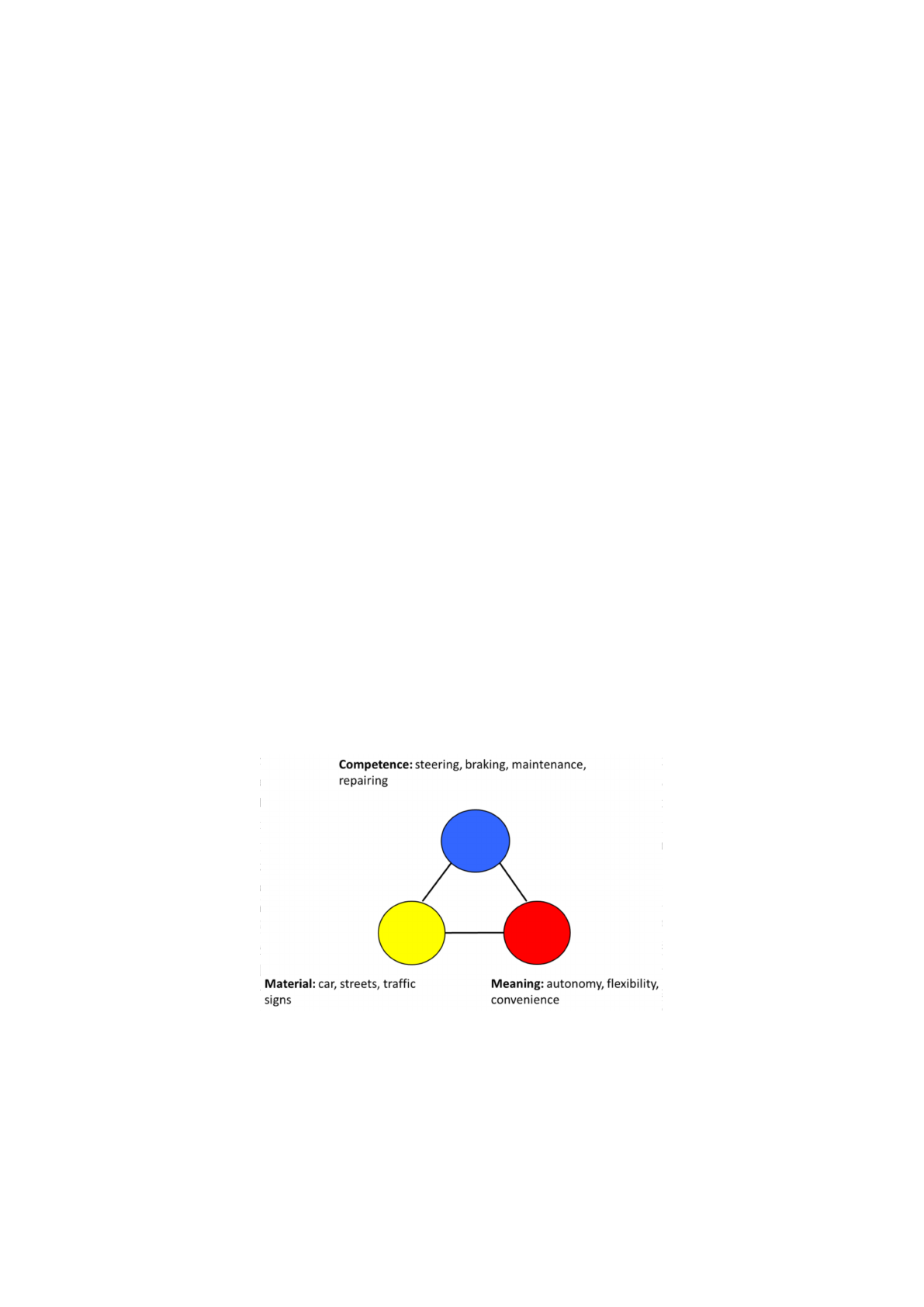
“Meanings refer to ideas, aspirations, values, and symbolic meanings; competences to shared
know-how and practical intelligibility; and materials are the physical stuff, such as technologies,
objects and infrastructures” ([
14
] (p. 4), drawing on [
54
]) (see Figure 1for an illustration of the linkages
between the elements).
Figure 1. Elements of a practice: driving a car (own design, after [54]).
A more recent development within the literature of social practice theories has been the conceptual
development of “bundles of practices” (see, for instance, [
54
]). Such developments have been based on
the recognition that practices do not exist in isolation and are linked together through time and space.
They co-evolve to either become incompatible or closely coupled, as such linkages are characterized
“as either in harmony or in conflict” ([
55
] (p. 2), drawing on [
56
]). For instance, a change to a
Loading more pages...