
Pohletal. Fungal Biology and Biotechnology (2022) 9:4
https://doi.org/10.1186/s40694-022-00133-y
RESEARCH
Establishment ofthebasidiomycete Fomes
fomentarius fortheproduction ofcomposite
materials
Carsten Pohl1† , Bertram Schmidt1† , Tamara Nunez Guitar1, Sophie Klemm2 , Hans‑Jörg Gusovius3 ,
Stefan Platzk4 , Harald Kruggel‑Emden4, Andre Klunker5 , Christina Völlmecke5 , Claudia Fleck2* and
Vera Meyer1*
Abstract
Background: Filamentous fungi of the phylum Basidiomycota are considered as an attractive source for the biotech‑
nological production of composite materials. The ability of many basidiomycetes to accept residual lignocellulosic
plant biomass from agriculture and forestry such as straw, shives and sawdust as substrates and to bind and glue
together these otherwise loose but reinforcing substrate particles into their mycelial network, makes them ideal can‑
didates to produce biological composites to replace petroleum‑based synthetic plastics and foams in the near future.
Results: Here, we describe for the first time the application potential of the tinder fungus Fomes fomentarius for lab‑
scale production of mycelium composites. We used fine, medium and coarse particle fractions of hemp shives and
rapeseed straw to produce a set of diverse composite materials and show that the mechanical materials properties
are dependent on the nature and particle size of the substrates. Compression tests and scanning electron microscopy
were used to characterize composite material properties and to model their compression behaviour by numerical
simulations. Their properties were compared amongst each other and with the benchmark expanded polystyrene
(EPS), a petroleum‑based foam used for thermal isolation in the construction industry. Our analyses uncovered that
EPS shows an elastic modulus of 2.37 ± 0.17 MPa which is 4‑times higher compared to the F. fomentarius composite
materials whereas the compressive strength of 0.09 ± 0.003 MPa is in the range of the fungal composite material.
However, when comparing the ability to take up compressive forces at higher strain values, the fungal composites
performed better than EPS. Hemp‑shive based composites were able to resist a compressive force of 0.2 MPa at 50%
compression, rapeseed composites 0.3 MPa but EPS only 0.15 MPa.
Conclusion: The data obtained in this study suggest that F. fomentarius constitutes a promising cell factory for the
future production of fungal composite materials with similar mechanical behaviour as synthetic foams such as EPS.
Future work will focus on designing materials characteristics through optimizing substrate properties, cultivation
conditions and by modulating growth and cell wall composition of F. fomentarius, i.e. factors that contribute on the
meso‑ and microscale level to the composite behaviour.
© The Author(s) 2022. Open Access This article is licensed under a Creative Commons Attribution 4.0 International License, which
permits use, sharing, adaptation, distribution and reproduction in any medium or format, as long as you give appropriate credit to the
original author(s) and the source, provide a link to the Creative Commons licence, and indicate if changes were made. The images or
other third party material in this article are included in the article’s Creative Commons licence, unless indicated otherwise in a credit line
to the material. If material is not included in the article’s Creative Commons licence and your intended use is not permitted by statutory
regulation or exceeds the permitted use, you will need to obtain permission directly from the copyright holder. To view a copy of this
licence, visit http:// creat iveco mmons. org/ licen ses/ by/4. 0/. The Creative Commons Public Domain Dedication waiver (http:// creat iveco
mmons. org/ publi cdoma in/ zero/1. 0/) applies to the data made available in this article, unless otherwise stated in a credit line to the data.
Open Access
Fungal Biology and
Biotechnology
*Correspondence: claudia.fleck@tu‑berlin.de; vera.meyer@tu‑berlin.de
†Carsten Pohl and Bertram Schmidt shared first co‑authorship
1 Chair of Applied and Molecular Microbiology, Technische Universität
Berlin, Str. des 17. Juni 135, 10623 Berlin, Germany
2 Chair of Materials Science and Engineering, Technische Universität
Berlin, Str. des 17. Juni 135, 10623 Berlin, Germany
Full list of author information is available at the end of the article

Page 2 of 13
Pohletal. Fungal Biology and Biotechnology (2022) 9:4
Introduction
Fungal biotechnology is an innovation driver for the bio-
economy with its principles of circular economy and sus-
tainability [1, 2]. Especially filamentous fungi have a rich
and very versatile metabolism that forms the basis for a
diverse palette of products, which become harnessed by
the food, beverage, pharmaceutical, biofuel, textile, feed,
automotive, packaging and chemical industries. How-
ever, filamentous fungi are not only masters of biosynthe-
sis, they are also masters of decomposition. Their ability
to degrade and transform lignocellulosic substrates into
composite materials is unique in nature and attracted a
lot of interest recently [1, 2]. In several interdisciplinary
endeavours, fungal bio(techno)logists, designers, process
engineers and material scientists have collaborated to
turn by-products from agriculture and forestry with the
help of basidiomycetes into composite materials as high-
lighted in recent reviews [3–5]. The vision is surprising
and fascinating, yet plausible and thus hopefully achiev-
able in the near future: Plastics, foams, textiles and other
materials derived from petroleum-based resources could
soon be functionally replaced by a new class of bioma-
terials produced by fungal biotechnology [2]. Given the
urgent need to reduce global carbon dioxide emission
and plastic pollution, the pressure to innovate is indeed
high. Within the last 5years, the ability of fungal myce-
lium not only to digest but also to bind and connect loose
plant-based particles into firmer composite materials
has thus led to a substantial increase in publications that
pioneered the manufacturing process and that described
some characteristics of mycelium-based materials [6–12].
Potential applications for fungal composite materials that
have been discussed so far are as diverse as disruptive—
soon packaging material, thermal insulation, acoustic
insulation, construction material as well as leather could
be produced by filamentous fungi of the phylum Basidi-
omycota [2–4, 13–15].
To contribute to these research efforts, we ran a bio-
prospecting program in 2018 in our Berlin-Brandenburg
area to explore the local biodiversity of mushroom-form-
ing fungi and to build up a strain collection of basidiomy-
cetes that reflects the predominant regional biodiversity
and that feeds well on regional renewable plant resources.
As recently described [16], we could isolate and identify
about 75 basidiomycetes, most of which were assigned
to the order Polyporales, including the tinder fungus
Fomes fomentarius, the fire sponge Phellinus robustus,
Ganoderma adspersum, the artist´s bracket Ganoderma
applanatum and the turkey tail Trametes versicolor. Also,
representatives of the order Agaricales became members
of the strain collection including the oyster mushroom
Pleurotus ostreatus, the stump mushroom Armillaria
ostoyae and the similar looking Pholiota limonella [16].
In growth experiments on different substrates from
regional agricultural residual streams, the white-rot fungi
F. fomentarius, P. ostreatus and T. versicolor excelled with
the best performance [16].
Various considerations let us to focus our further
research on the tinder fungus F. fomentarius. This basidi-
omycete, which is prevalent throughout the temperate
climate zone of the northern hemisphere, is well-known
to traditional medicine and thus has a rich ethnomyco-
logical tradition [17, 18]. Furthermore, the trama of its
fruiting bodies has been safely used by mankind for hun-
dreds of years as wound dressing and leather alternative
[19]. Remarkably, the fruiting bodies are water-repellent,
very stable and light-weighted. Interestingly, the hyme-
mium follows a hierarchically honeycomb structure and
was previously already subjected to mechanical test-
ing [20], showing compressive stress–strain curves of
foams, where an initially linear course is followed by an
extended plateau region [20]. Given that such charac-
teristics could be adjusted in the future for laboratory
cultivated F. fomentarius mycelia that were fed on renew-
able plant biomass, new materials for lightweight appli-
cations, specifically for anisotropic loading conditions
could be developed. Finally, the genome sequence of
one F. fomentarius isolate identified in France has been
recently published (strain CIRM-BRFM 1821) [21] and
uncovered many genes in its genome predicted to encode
lignin-active peroxidases and manganese peroxidases
which are key for the breakdown of lignin. As its genome
sequence contains less genes predicted to encode cellu-
lases, it grows less well on cellulose, which is typical for
white-rot fungi. F. fomentarius was thus recently ranked
with a moderate hyphal expansion rate on lignocellulosic
substrates but a high rate of decomposition of its sub-
strate when compared to another 20 basidiomycetes [22].
Another important premise for our decision was that F.
fomentarius grows well on local agricultural residues such
as hemp shives or rapeseed straw [16]. Hemp was once an
important source for fibres for the textile industry, but its
cultivation and use declined in the last century because
cotton and synthetic fibres became more popular. The
Keywords: Filamentous fungi, Fomes fomentarius, Circular economy, Bioeconomy, Hemp, Rapeseed, Composite
material, Mycelium, Neo‑Hooke model, Finite element method FEM, Mechanical properties, Compressive strength,
Stiffness
Page 3 of 13
Pohletal. Fungal Biology and Biotechnology (2022) 9:4
worldwide annual area of hemp harvested mainly for
seeds and fibres is reported with about 150,000ha for
2018 [23]. In Europe alone, the area under cultivation
has increased to over 40,000ha in recent years, which
represents a potential use for at least 60,000 t of shives
[23]. Hemp fibres currently experience a resurgence of
interest by the textile industry as an environmentally
friendly alternative to cotton, the cultivation of which is
high in water demand, pesticide use and soil salinization
[23]. In contrast, hemp is a frugal but high-yielding plant
that has no pesticide and low fertilizer demand but uses
water about six times more efficiently for biomass forma-
tion than cotton [24, 25]. Thus, hemp can grow well even
under hot and dry conditions and on poor-soil sites such
as prevalent in the Berlin-Brandenburg area and beyond
[26]. The second main product after hemp fibre separa-
tion, the shives, are currently very often under-valued in
applications like animal bedding. But with its content of
about 48% w/w cellulose, 21 to 25% w/w hemicellulose
and 17–19% w/w lignin [27], hemp shives are ideal sub-
strates for both white-rot and brown-rot basidiomycetes.
Rapeseed will remain an important source of oil pro-
duced for food and feed as well as technical use, although
it has a high water and fertilizer demand and the land use
efficiency can be regarded as critical in terms of biodiesel
production due to the low energy efficiency [28]. The
Food and Agriculture Organization of the United Nations
lists the harvested area of rapeseed as 36.96 Mio ha. In
Brandenburg, winter rapeseed is the most important oil-
seed crop with an acreage of about 77,000 ha [29], which
takes up about 10% of the arable land [30]. The composi-
tion of rapeseed straw is very similar to hemp shives with
about 37% w/w cellulose, 24% w/w hemicellulose and
about 17% w/w lignin [31] and thus well suited as a sub-
strate for both white-rot and brown-rot basidiomycetes.
In the current study, we describe the cultivation of F.
fomentarius on both hemp shives and rapeseed straw
for the production of composite materials. We applied
compression tests to determine the compressive Young’s
Modulus as recently described for composite materials
obtained with Schizophyllum, Ganoderma and Trametes
species, respectively [7, 32, 33] and used scanning elec-
tron microscopy to characterize the composite structure
and mechanical properties. We used the experimental
data for numerical simulations of the compression behav-
iour. We furthermore studied the impact of the substrate’s
particle sizes on the composite material properties and
used fine, medium and coarse fractions of hemp shives
and rapeseed straw to produce a set of diverse composite
materials. Their properties were compared amongst each
other and with the benchmark expanded polystyrene
(EPS), a petroleum-based foam used for thermal isolation
in the construction industry.
Results anddiscussion
Substrate preparation andclassification
The particle size of both hemp shives and rapeseed straw
substrates were reduced by means of a laboratory cutting
mill. To estimate the mass percentages of the subsequent
classification products, sieve analyses of the milling prod-
ucts were carried out using analytical sieves and shakers.
Rapeseed straw showed significantly larger amounts of
screening residue of mesh sizes above 8mm (Additional
file1). Furthermore, fine fractions below 0.63mm mesh
size were found at about 5% weight fraction. To achieve
a mass distribution of approximately one third each for
small, medium, and large fraction, the results suggested
classification cut sizes of 2mm and 3.15mm, given the
available screens. Consequently, these mesh sizes were
utilized during the following classification processes via
a Mogensen Sizer. Simultaneously, a 0.65mm screen was
used with the intention to reduce the finest particles such
as dust. Hence, three particle fractions were prepared for
each substrate: small (0.63–2mm), medium (2–3.15mm)
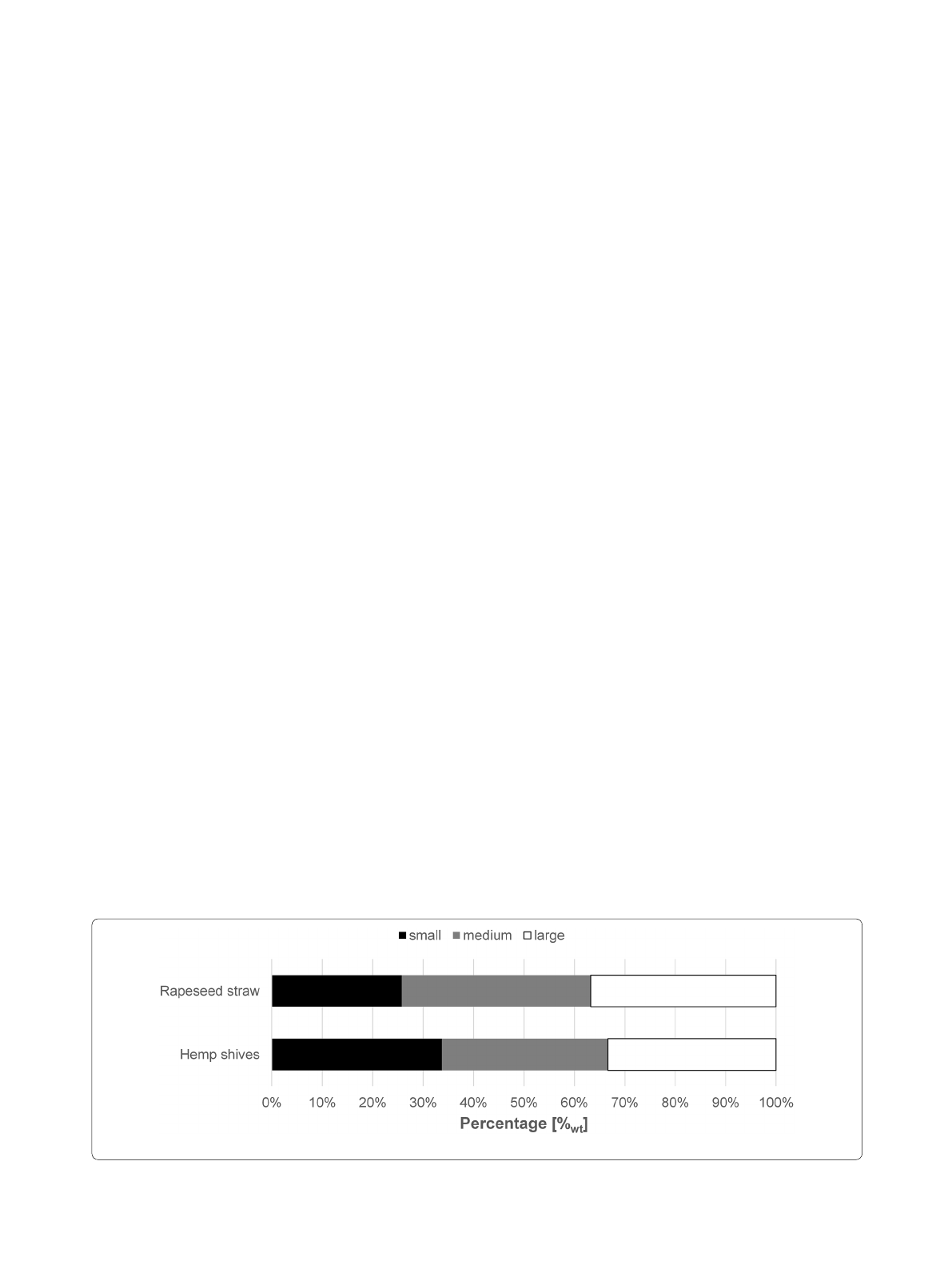
and large (> 3.15mm–6.3mm). The resulting mass per-
centages are shown in Fig.1.
Fig. 1 Mass distribution of plant substrate fractions after classification
Page 4 of 13
Pohletal. Fungal Biology and Biotechnology (2022) 9:4
Finally, bulk density was determined for all fractions
by measuring the total bulk volumes of the fractions
(Additional file2). Each fraction was subjected to further
analysis with respect to particle size and shape by means
of digital image analysis. A significantly larger number
of finest particles were found within all rapeseed straw
samples compared to hemp shives, possibly due to differ-
ences in abrasion resistance (note that results from image
analysis are based on the number of particles rather than
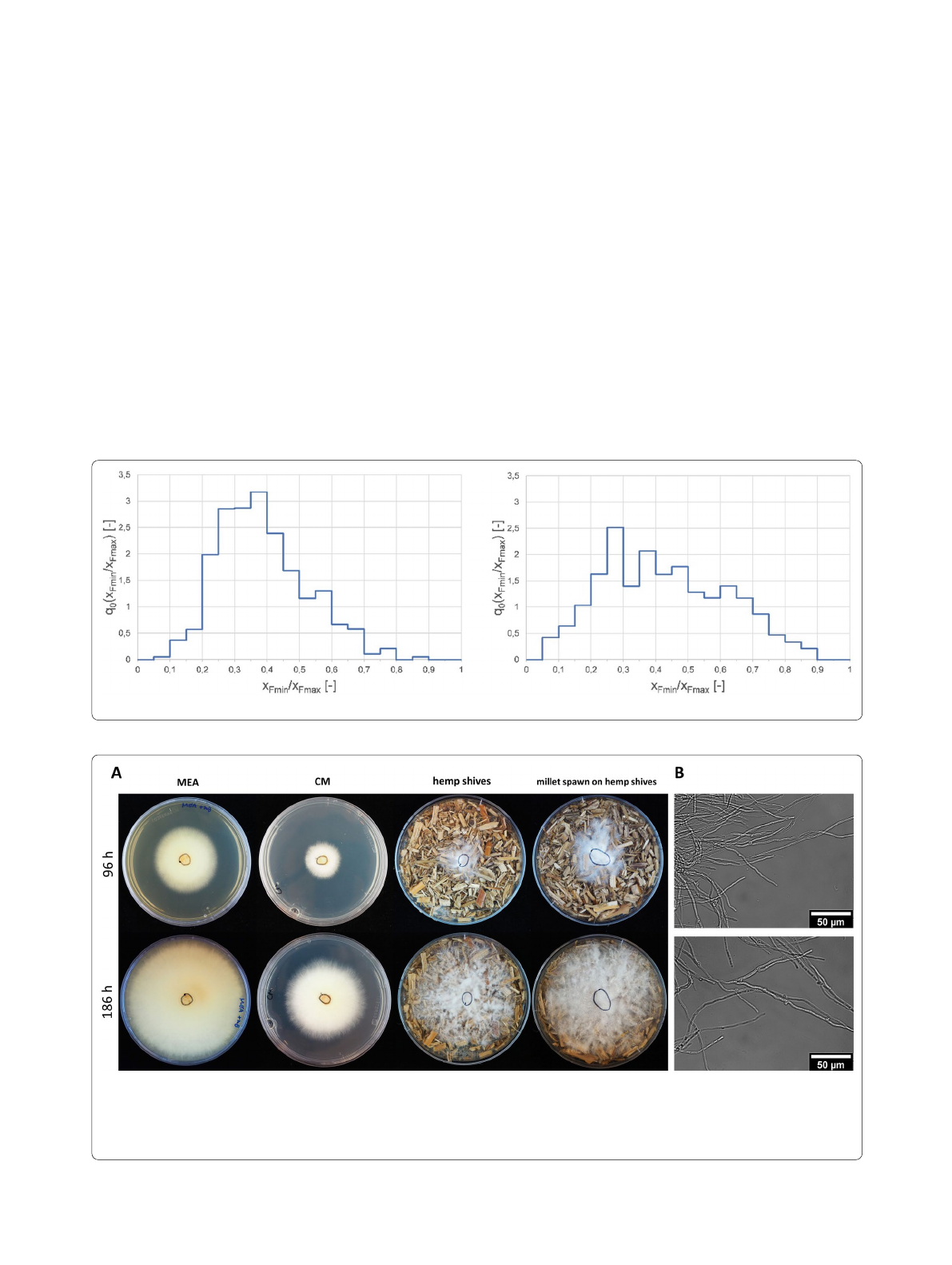
mass percentages). In Fig.2, histograms of the ratios of
minimum to maximum Feret diameters of hemp shives
and rapeseed straw middle fractions are depicted. While
the rapeseed straw’s modal value is smaller than the cor-
responding value for hemp shives, its distribution is
broader and leans towards larger Feret ratios. Within the
examined fraction, hemp shives display thinner and more
elongated shapes.
Cultivation ofF. fomentarius andmanufacturing
ofcomposite materials
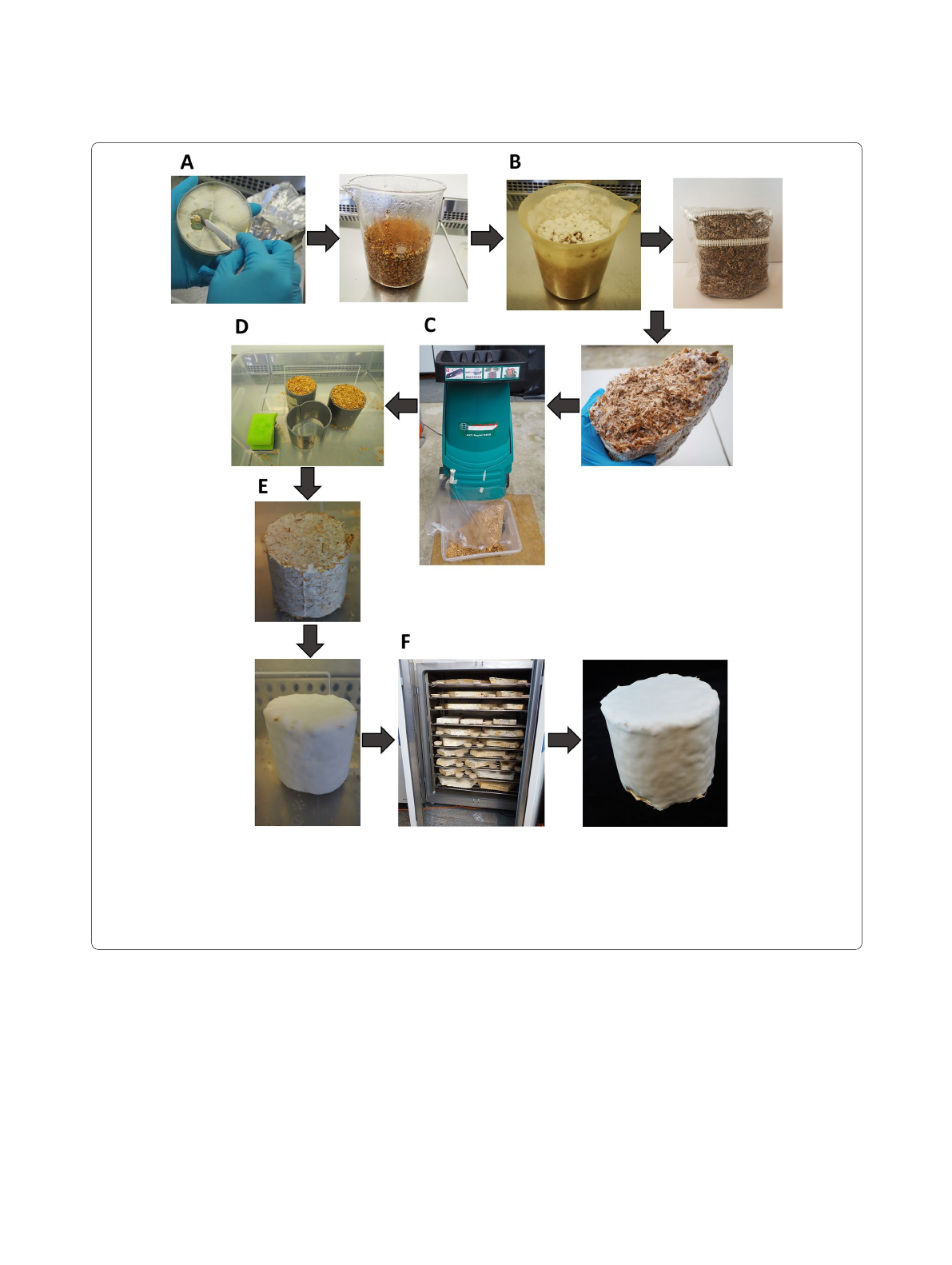
F. fomentarius grows well on malt extract agar (MEA),
glucose-based complete medium (CM) and on lignocel-
lulosic substrates such as hemp shives and forms hyphae
with a mean diameter of 2.8µm (n = 300, SD = 0.7, Fig.3).
A three-stage laboratory manufacturing process was
established for F. fomentarius (for details see “Methods”
section). In the first stage, mycelium harvested from malt
agar plates (Fig.4A) was used to inoculate millet grains
Fig. 2 Histograms of minimum to maximum Feret diameter ratios for hemp shives (left) and rapeseed straw (right)
Fig. 3 A F. fomentarius colonies after incubation at 25 °C in the dark for 96 h and 186 h. Doubling time of colony surface area on MEA and CM are
6 h (n = 8, SD = 1) and 14 h (n = 8, SD = 2) respectively. As the fungus also grows into the shives and towards the bottom of the agar plate, it is
impossible to estimate a doubling time based on radial growth measurement when cultivated on hemp shives inoculated with pure F. fomentarius
mycelium or with millet spawn. B Light microscopic images of F. fomentarius hyphae when cultivated in liquid CM for 96 h and 186 h, respectively at
400× magnification
Page 5 of 13
Pohletal. Fungal Biology and Biotechnology (2022) 9:4
to obtain precultures of F. fomentarius during a 2-week
cultivation (Fig.4B). This ‘millet spawn’ then served as
inoculum to inoculate 3-L bag cultures of hemp shives
and rapeseed straw for the second stage cultivation. For
future industrial upscaling efforts, however, we propose
that the millet preculture should be substituted by non-
food plant substrates that become mixed with non-inoc-
ulated plant substrates to avoid extensive use of cereal
grains. After the 2-week cultivation in substrate bags, the
overgrown substrates were shred and transferred into
sterile cylindrical moulds (Fig.4C and D), to allow for a
final cultivation with the duration of 2weeks, whereby
the moulds were removed after one week (Fig.4E). For
each condition tested (substrate, particle fraction), at
least six biological replicates were produced. The final
composite materials obtained with this manufacturing
process were optically inspected after cutting, revealing
a gradient of fungal growth within the test specimens
Fig. 4 Laboratory manufacturing process for F. fomentarius composite materials. A Inoculation of sterile millet with for F. fomentarius mycelium
followed by an incubation for 2 weeks at 25 °C in the dark. B Inoculation of hemp shives (or rapeseed straw) cultivation bags with the millet spawn
followed by an incubation for 1 week at 25 °C in the dark. Note that the use of millet spawn for inoculation has the advantage of good mixing
properties in the 3‑L cultivation bags used and thus generation of more homogeneous growth throughout the plant substrates. C Shredding of
preliminary hemp shives (or rapeseed straw) composites and transfer of the material into moulds. D Filled moulds before cultivation for 1 week at
25 °C in the dark. E Sample appearance after 1 week of cultivation. Moulds are removed to allow thorough overgrowth of the samples for another
week. F Drying in an oven at 60 °C for 2 days and final appearance of composites used for compression tests
Loading more pages...