
Effect of alkali ions on optical properties of
flavins: vibronic spectra of cryogenic
M
+
lumiflavin complexes (M ¼Li–Cs)†
David M¨
uller,
a
Pablo Nieto,
a
Mitsuhiko Miyazaki
ab
and Otto Dopfer *
ac
Received 23rd November 2018, Accepted 7th January 2019
DOI: 10.1039/c8fd00203g
Flavin compounds are frequently used by nature in photochemical processes because of
their unique optical properties which can be strongly modulated by the surrounding
environment such as solvation or coordination with metal ions. Herein, we employ
vibronic photodissociation spectroscopy of cryogenic M
+
LF complexes composed of
lumiflavin (LF, C
13
H
12
N
4
O
2
), the parent molecule of the flavin family, and alkali ions (M ¼
Li–Cs) to characterize the strong impact of metalation on the electronic properties of
the LF chromophore. With the aid of time-dependent density functional theory
calculations (PBE0/cc-pVDZ) coupled to multidimensional Franck–Condon simulations,
the visible photodissociation (VISPD) spectra of M
+
LF ions recorded in the 500–570 nm
range are assigned to the S
1
)S
0
(pp*) transitions into the first optically bright S
1
state
of the lowest-energy M
+
LF(O4+) isomers. In this O4+ structure, M
+
binds in a bent
chelate to the lone pairs of both the O4 and the N5 atom of LF. Charge reorganization
induced by S
1
excitation strongly enhances the interaction between M
+
and LF at this
binding site, leading to substantial red shifts in the S
1
absorption of the order of 10–20%
(e.g., from 465 nm in LF to 567 nm in Li
+
LF). This strong change in M
+
/LF interaction
strength in M
+
LF(O4+) upon pp*excitation can be rationalized by the orbitals involved
in the S
1
)S
0
transition and causes strong vibrational activity. In particular,
progressions in the intermolecular bending and stretching modes provide an accurate
measure of the strength of the M
+
/LF bond. In contrast to the experimentally identified
O4+ ions, the predicted S
1
origins of other low-energy M
+
LF isomers, O2+ and O2, are
slightly blue-shifted from the S
1
of LF, demonstrating that the electronic properties of
metalated LF not only drastically change with the size of the metal ion but also with its
binding site.
a
Institut f¨
ur Optik und Atomare Physik, Technische Universit¨
at Berlin, Hardenbergstr. 36, 10623 Berlin,
Germany. E-mail: dopfer@physik.tu-berlin.de; Fax: +49 30 314 23018
b
Laboratory for Chemistry and Life Science, Institute of Innovation Research, Tokyo Institute of Technology,
4259, Nagatsuta-cho, Midori-ku, Yokohama, Japan
c
Tokyo Tech World Research Hub Initiative (WRHI), Institute of Innovation Research, Tokyo Institute of
Technology, 4259, Nagatsuta-cho, Midori-ku, Yokohama, Japan
†Electronic supplementary information (ESI) available. See DOI: 10.1039/c8fd00203g
This journal is © The Royal Society of Chemistry 2019 Faraday Discuss.
Faraday Discussions
Cite this: DOI: 10.1039/c8fd00203g
PAPER
Open Access Article. Published on 07 January 2019. Downloaded on 6/17/2019 9:58:57 AM.
This article is licensed under a
Creative Commons Attribution-NonCommercial 3.0 Unported Licence.
View Article Online
View Journal
Introduction
In addition to amino acids, DNA bases, and carbohydrates, avins are an
important class of biomolecules. Flavins are yellow dye molecules (“avus”means
yellow in Latin) derived from the tricyclic heteroaromatic 7,8-dimethyl-10-alkyl-
isoalloxazine chromophore and differ by the alkyl substituent R at the N10
position (Fig. 1). The most important members of the avin family are lumiavin
(LF, R ¼CH
3
,C
13
H
12
N
4
O
2
, 7,8-dimethyl-10-methyl-isoalloxazine), riboavin (RF,
R¼ribityl) also known as vitamin B
2
, the cofactor avin mononucleotide (FMN,
R¼ribophosphate), and the co-enzyme avin adenine dinucleotide (FAD, R ¼
ribophosphate + adenine). The parent molecule, iso-lumichrome (iso-LC, R ¼H)
is a metastable tautomer and occurs in the most stable structure as lumichrome
(LC), in which the H atom of N10 is transferred to N1. For this reason, LF is oen
considered as the most simple stable avin.
The isoalloxazine chromophore absorbs in a wide optical range, and the
details of the optical spectrum and resulting photochemistry strongly depend on
many intrinsic and environmental factors, including (1) the oxidation, proton-
ation, and metalation states, (2) the substituent R, (3) solvation, and (4) coordi-
nation with counter ions. This strong modulation in the optical properties of
avins and avoproteins is used by nature in various fundamental photochemical
processes, in biocatalysis, and in redox reactions.
1–5
For instance, they are
involved in blue-light receptors (BLUF), in light-oxygen-voltage (LOV) sensing, in
processes of the respiratory chain, in the enzymatic oxidation of glucose, and in
the repair process of DNA. Two Nobel prizes in chemistry are strongly related to
avins. The rst one was awarded in 1937 to Karrer for the synthesis and struc-
tural analysis of avin compounds. The second one was awarded in 2015 to
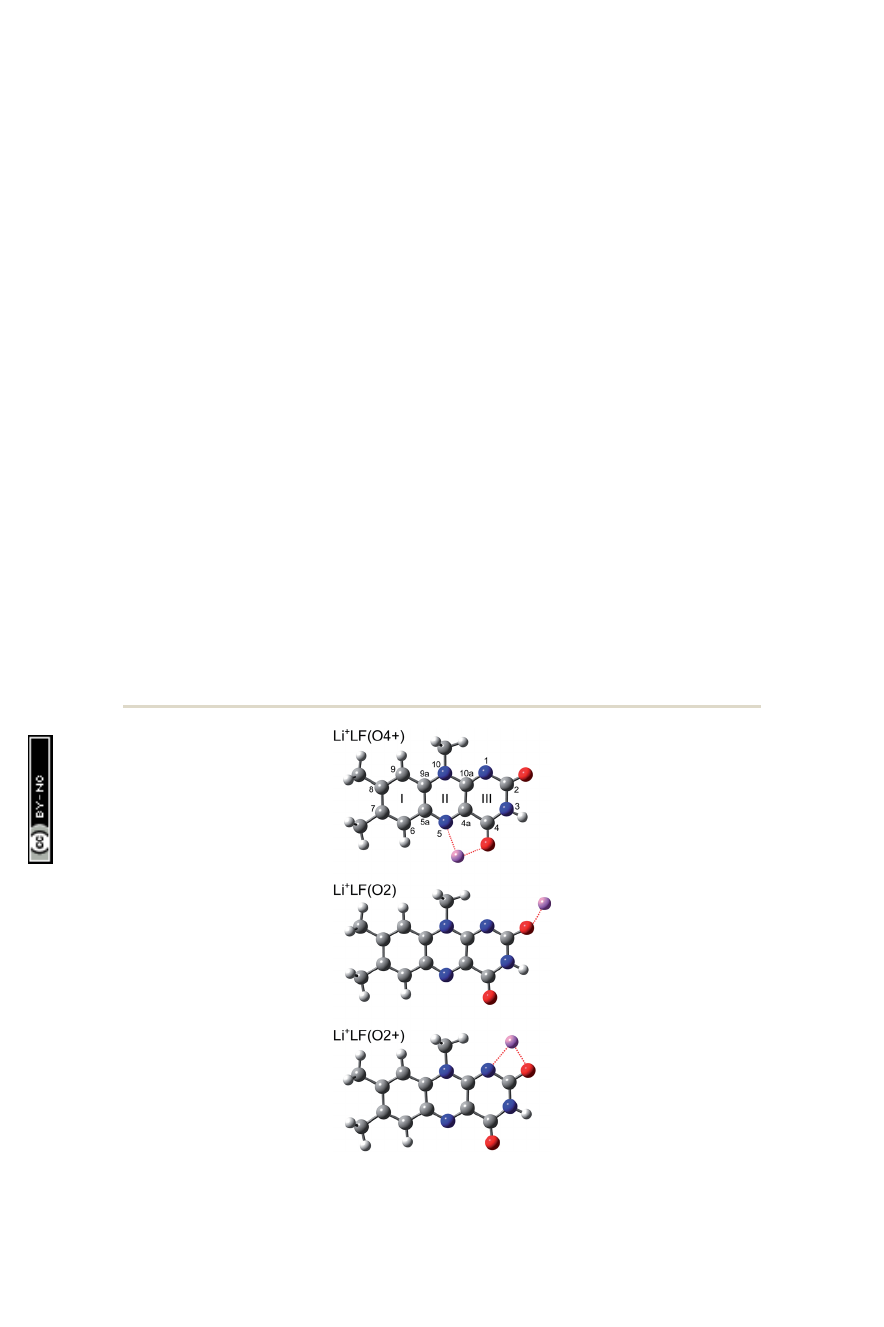
Fig. 1 Structures of relevant M
+
LF isomers calculated at the PBE0/cc-pVDZ level of theory
illustrated for M ¼Li, along with atom and ring numbering. N/O atoms are indicated in
blue/red colour.
Faraday Discussions Paper
Faraday Discuss. This journal is © The Royal Society of Chemistry 2019
Open Access Article. Published on 07 January 2019. Downloaded on 6/17/2019 9:58:57 AM.
This article is licensed under a
Creative Commons Attribution-NonCommercial 3.0 Unported Licence.
View Article Online

Lindahl, Modrich, and Sancar for unravelling the mechanism of DNA repair,
which involves the fully reduced avoprotein FADH
. A number of biochemical
processes of avins are based on their strong interactions with coordinating
metal ions.
6–15
Due to their importance, numerous studies have characterized the absorption
properties of avins by a variety of spectroscopies in the condensed phase
(absorption, emission, time-resolved spectroscopy)
16–19
and quantum chemical
calculations.
16,20–25
These studies reveal that the excited-state photochemistry and
absorption of avins from the ground electronic state (S
0
) are controlled by
optically bright pp*excitations of the aromatic pelectron system and essentially
dark np*states involving the excitation of electrons from in-plane lone pairs of
the various O and N heteroatoms. Some of these transitions are strongly affected
by solvation and protonation. Concerning LF, the S
1
state observed near 450 nm is
assigned to the rst allowed pp*state, and calculations predict a large geometry
change upon electronic excitation. As a result, there is a large difference between
the vertical and adiabatic transition energies (of around 50 nm or 0.3 eV),
implying that vibronic excitation and temperature have a substantial impact on
the position, shape, and width of the S
1
absorption band.
25
Indeed, the absorption
spectra observed in the condensed phase at room temperature are broad and
unresolved, and thus do not provide reliable and precise information and
understanding of the effects of the environment on the optical properties of
avins at the molecular level. Signicantly, optical spectra of LF derivatives
recorded at 4 K in an n-decane matrix (single crystals, Shpolskii method) show
that low temperatures are required to obtain vibrationally resolved optical spectra
with sharp rovibronic transitions.
26
Because of the strong dependence of the optical spectra on the environment,
the intrinsic properties of the active avin chromophore must be determined by
the spectroscopy of molecules isolated in the gas phase. However, such studies
are scarce, mainly because of the difficulties involved in generating cold avin
molecules and their ions and complexes in the gas phase. To this end, we recently
started a research program to systematically characterize the geometric and
electronic properties of avin ions in their protonated, metalated, and micro-
solvated states by infrared and optical photodissociation spectroscopy coupled to
electrospray ionization (ESI) techniques for ion generation in the gas phase.
27–32
Apart from our contributions to avin spectroscopy summarized below, a few
other studies on isolated avins have appeared recently. The pioneering uo-
rescence spectrum of LF embedded in He droplets (T¼0.4 K) exhibits vibrational
resolution and was assigned to the S
1
)S
0
(pp*) transition by comparison to
quantum chemical calculations coupled to multidimensional Franck–Condon
(FC) simulations.
33
The authors estimate that the S
1
origin observed at
21 511 cm
1
(464.88 nm) is shied by less than 1% upon the weak interaction
with the He droplet. Optical spectra of room temperature cations and anions have
recently been reported for FAD mono- and dianions,
34–36
alloxazine and LC
anions,
37
protonated alloxazine,
38
and a avin derivative with a protonated amino
side chain.
39
Signicantly, all these latter studies report only optical spectra with
very broad absorption bands because vibronic resolution cannot be obtained at
elevated temperature (T¼300 K).
32
As a consequence, the spectral information
about shis and (de-)protonation sites, etc. is quite limited, and the interpretation
Paper Faraday Discussions
This journal is © The Royal Society of Chemistry 2019 Faraday Discuss.
Open Access Article. Published on 07 January 2019. Downloaded on 6/17/2019 9:58:57 AM.
This article is licensed under a
Creative Commons Attribution-NonCommercial 3.0 Unported Licence.
View Article Online

relies heavily on quantum chemical calculations which may not always produce
reliable quantitative predictions.
In the past few years, our group has applied infrared and optical photodisso-
ciation spectroscopy to mass-selected avin ions, with the aim of characterizing
the geometric, vibrational, and electronic structure of a number of protonated and
metalated avins ranging from LC to FMN in the electronic ground and rst
excited singlet states (S
0
,S
1
).
27–32
The avin ions are generated by ESI in the gas
phase and subsequently studied by (1) infrared multiple-photon dissociation
(IRMPD) in an Fourier-transform ion cyclotron resonance mass spectrometer
27–29
and (2) by electronic photodissociation in the visible range (VISPD) in a cryogenic
ion trap coupled to a quadrupole/time-of-ight tandem mass spectrometer (Ber-
linTrap).
30–32
Signicantly, these studies report the rst (and to date only)
vibrationally-resolved spectra of avins isolated in the gas phase, and thus provide
for the rst time reliable experimental information about protonation and met-
alation sites as well as their impact on the electronic properties. The IRMPD
spectra recorded at room temperature display sufficient vibrational resolution to
determine the preferred protonation and metalation sites of the avins in the S
0
state by comparison to quantum chemical density functional theory (DFT) calcu-
lations.
27–29
In contrast, vibronic resolution in electronic VISPD spectra of such
ions can only be achieved at temperatures well below 100 K because only then can
extensive spectral congestion from hot bands be avoided.
30–32,40,41
In general, these
studies reveal that the preferred protonation and metalation sites strongly depend
on the substituent R of the avin as well as the size and type of the metal ion, as
illustrated for the alkali and coinage metal ions, M ¼Li–Cs and Cu–Au.
30–32
The
most thoroughly studied so far are cations derived from LC and LF. IRMPD spectra
demonstrate that protonation preferentially occurs at N5 in H
+
LC and at O2 in
H
+
LF, in line with computational predictions at the B3LYP/cc-pVDZ level.
27
The
two major metalation sites observed for M
+
LC and M
+
LF with alkali atoms M ¼Li–
Cs are the two CO groups, leading to the O4+ and O2(+) isomers shown in Fig. 1 for
the case of Li
+
LF.
27–29
Their relative energies and bonding characteristics depend
sensitively on the size of the alkali ion. The optical VISPD spectra of H
+
LC and
M
+
LC with M ¼Li–Cs observed in the 400–500 nm range are attributed to the
lowest pp*excitation (S
1
) of the N5 protomer of LC, H
+
LC(N5), and the O4+ isomer
of M
+
LC, M
+
LC(O4+).
30–32
Signicantly, massive red shis ranging from 2400
(Cs
+
) to around 6000 cm
1
(H
+
) observed for the adiabatic S
1
origins of the O4+
and N5 ions indicate the strong impact of metalation and protonation on the
electronic structure of this prototypical avin. On the other hand, calculations
demonstrate that metalation/protonation at the O2(+) binding site has only
a minor impact on the S
1
origin energies, illustrating that the binding site of M
+
/H
+
is also an important parameter in tuning the electronic properties. Time-
dependent DFT (TD-DFT) calculations at the PBE0/cc-pVDZ level provide accu-
rate predictions for both the S
1
origin positions (to within 0.1 eV) and the vibra-
tional analysis using FC simulations.
30–32
As a result, the changes in the proton
affinity of LC and the M
+
/LC interaction strength are accurately probed by the
corresponding electronic energy shis and vibrational frequencies, demonstrating
the high and reliable information content of the vibronic excitation spectra.
Herein, we continue our series of studies to VISPD spectroscopy of M
+
LF ions
to probe the impact of the alkali ions Li–Cs on the electronic structure of LF using
the same experimental and computational approach as used for H
+
/M
+
LC.
30–32
In
Faraday Discussions Paper
Faraday Discuss. This journal is © The Royal Society of Chemistry 2019
Open Access Article. Published on 07 January 2019. Downloaded on 6/17/2019 9:58:57 AM.
This article is licensed under a
Creative Commons Attribution-NonCommercial 3.0 Unported Licence.
View Article Online

contrast to the previous IRMPD data on M
+
LF,
29
their VISPD spectra are highly
isomer-selective, because the locations of the electronic transitions in the optical
spectrum strongly depend on the M
+
binding site. The analysis by TD-DFT
calculations reveals similarities and differences between M
+
LF and M
+
LC.
Experimental and computational details
Vibronic VISPD spectra of mass-selected M
+
LF ions are obtained in a cryogenic
ion trap tandem mass spectrometer (BerlinTrap) described in detail elsewhere.
30
The major components of this setup include (1) an ESI source for ion production,
(2) a mini-quadrupole for ion accumulation, (3) a quadrupole mass spectrometer
for ltering the M
+
LF ions under investigation, (4) a cryogenic 22-pole ion trap for
storing and cooling the ions employing He buffer gas, and (5) a reectron time-of-
ight mass spectrometer for the analysis of the fragment ions generated by
photodissociation of parent ions. M
+
LF ions (M ¼Li–Cs) are produced in the ESI
source by spraying a suitable mixture at a constant ow rate of 2 ml h
1
. The
solution is prepared by dissolving 1 mg LF (Sigma Aldrich, >99%) and 2–4mg
alkali metal chloride salt (MCl, Sigma Aldrich, >99%) in 20 ml methanol and 1 ml
water. The resulting ions are accumulated for 90 ms in a short mini-quadrupole
located aer the skimmer. Aer passing through a hexapole, the desired M
+
LF
ions are selected by a tuneable quadrupole mass spectrometer and guided
through an octupole into the cryogenic 22-pole trap mounted onto the coldhead
of a cryostat held at 6 K. Here, the M
+
LF ions are trapped for 90 ms and cooled
down to a (ro)vibrational temperature of around 20 K by He buffer gas introduced
into the trap by a pulsed piezo valve.
30
Aer extraction out of the 22-pole trap, the
cold M
+
LF ions are guided by a series of einzel lenses into the extraction region of
an orthogonal reectron time-of-light mass spectrometer, where they are irradi-
ated by visible photons emitted from a pulsed optical parametric oscillator (OPO)
laser. The OPO laser (GWU, Versa-Scan) is pumped by the third harmonic of
a nanosecond Q-switched Nd:YAG laser (Innolas, Spitlight 1000, 180 mJ per pulse
at 355 nm) and delivers visible light pulses (beam diameter of 5 mm) with
a bandwidth of around 4 cm
1
and an energy of up to 3 mJ in the spectral range
500–570 nm. The repetition rates of both the laser and BerlinTrap mass spec-
trometer are 10 Hz. Photodissociation occurs just before the extraction zone of the
reectron (ca. 10 ms before the ion extraction pulse). Hence, both parent and
fragment ions can be detected with high transmission using a microchannel plate
detector. The VISPD action signal is obtained by linearly normalizing the frag-
ment ion signal by the parent ion signal and the laser intensity monitored
simultaneously with the ion signals. Scans are taken in wavelength steps of
0.02 nm (corresponding to 0.8 cm
1
at 500 nm), and 50 mass spectra are averaged
at each wavelength which is calibrated by a wavemeter. For all M
+
LF ions, the only
fragmentation process observed upon VISPD is dissociation into M
+
+ LF (Fig. S1
in ESI†). The photodissociation efficiency is of the order of a few % for strong
transitions. The typical width of the transitions observed is in the range 5–
10 cm
1
, and arises from the bandwidth of the laser (4cm
1
), unresolved
rotational substructure, overlapping vibronic transitions, and possibly lifetime
broadening.
The experimental VISPD spectra of M
+
LF are interpreted with the aid of
quantum chemical calculations.
42
To this end, DFT calculations at the PBE0/cc-
Paper Faraday Discussions
This journal is © The Royal Society of Chemistry 2019 Faraday Discuss.
Open Access Article. Published on 07 January 2019. Downloaded on 6/17/2019 9:58:57 AM.
This article is licensed under a
Creative Commons Attribution-NonCommercial 3.0 Unported Licence.
View Article Online
Loading more pages...