
1
Parametric Investigations of Mechanical Properties of Nap-core Sandwich Composites
Giap X. Ha1, Dragan Marinkovic, Manfred W. Zehn
Department of Computational and Structural Mechanics, Technische Universitaet Berlin, Germany
Abstract
The focus of this paper lies on the sensitivity of the nap-core sandwich – a novel kind of
structural composite – to changes of its parameters. First, the fabrication, properties, and
applications of the nap-core sandwich are briefly presented. This is followed by consideration of
the sandwich composite’s mechanical behavior. Finite element based simulation is applied to
perform the parametric investigations. The height of the nap-core and the thickness of its knitted
fabric as well as the face sheet of the sandwich are changed in order to investigate the
dependence of the general mechanical properties of sandwich composites on those parameters.
Experiments are used to validate the simulation results. The conducted investigation provides
valuable information for the design of nap-core sandwich composites.
Keywords: A. Fabrics/textiles; A. Layered structures; B. Mechanical properties; C. Computational
modeling.
1. Introduction
Composite materials, although rendering a relatively young group of modern engineering
materials, have attracted a great deal of attention due to numerous benefits they offer. Modeling
and simulation, as fundamental engineering activities, allow cost-effective investigation of their
mechanical behavior and development of the structural design that fits some specific purpose.
Even if limited to the work related to modeling, the scope of research in the field of composite
materials is still rather broad. It ranges from providing basic modeling tools such as finite elements
based on equivalent single-layer theories [1], layerwise theories [2, 3, 4], or their mixture [5, 6], via
models that involve multi-functional [7, 8, 9] and functionally graded materials [10] and up to the
models that deal with delaminated composites [11], damage detection and localization [12].
Sandwich-structured composites represent a special class of composite materials also known
as core materials. They are created by laying a lightweight but thick core between two thin and
stiff outer layers (also called skins or face sheets). The components are then bonded to one
another using a strong adhesive to form a unique structure that possesses good out-of-plane
compressive strength and high bending stiffness with a rather low density. Normally, the core has
a hollow structure to reduce the weight [13]. Due to the notable performance-to-weight ratio and
variety of the attached walls, the application of sandwich-structured composite materials
continues to grow in automotive, aerospace, transportation and other industries. In particular,
most lining elements are fabricated with non-metal sandwich materials of which the outer layers
1 Corresponding author
E-mail address: xuan.g.ha@campus.tu-berlin.de
2
are usually laminated fabric composites and the core is honeycomb, foam, or nap-core. When the
parameters of the sandwich’s components change, the mechanical behavior changes as well.
Hence, a wide range of properties may be produced for numerous applications.
Nap-core sandwich composite is a novel kind of cell-core material beside well recognized ones
such as foam or honeycomb sandwich composites. Most sandwich structures with honeycomb or
foam cores have a drawback originating from their closed inner structure. It causes difficulties in
integration of supply lines (ducts and wires), and it may give rise to accumulation of condensation
water that increases weight and reduces the mechanical properties of the structure. The nap-core
has been developed not only to overcome the above problems but also to provide some important
advantages in all physical, chemical as well as mechanical aspects [14]. Besides, nap-core sandwich
is considered to be a type of textile composite as its nap-core and outer layers include fabric
reinforcements. In other words, the nap-core sandwich is a textile composite fabricated with a
sandwich structure [15].
The nap-core is made of 2D knitted fabric that is first pre-impregnated with a thermosetting
resin and formed periodic cups with a pin mold by deep-drawing method. Afterwards, it is cured at
high temperature for a few hours before cooled down at the room temperature to acquire a
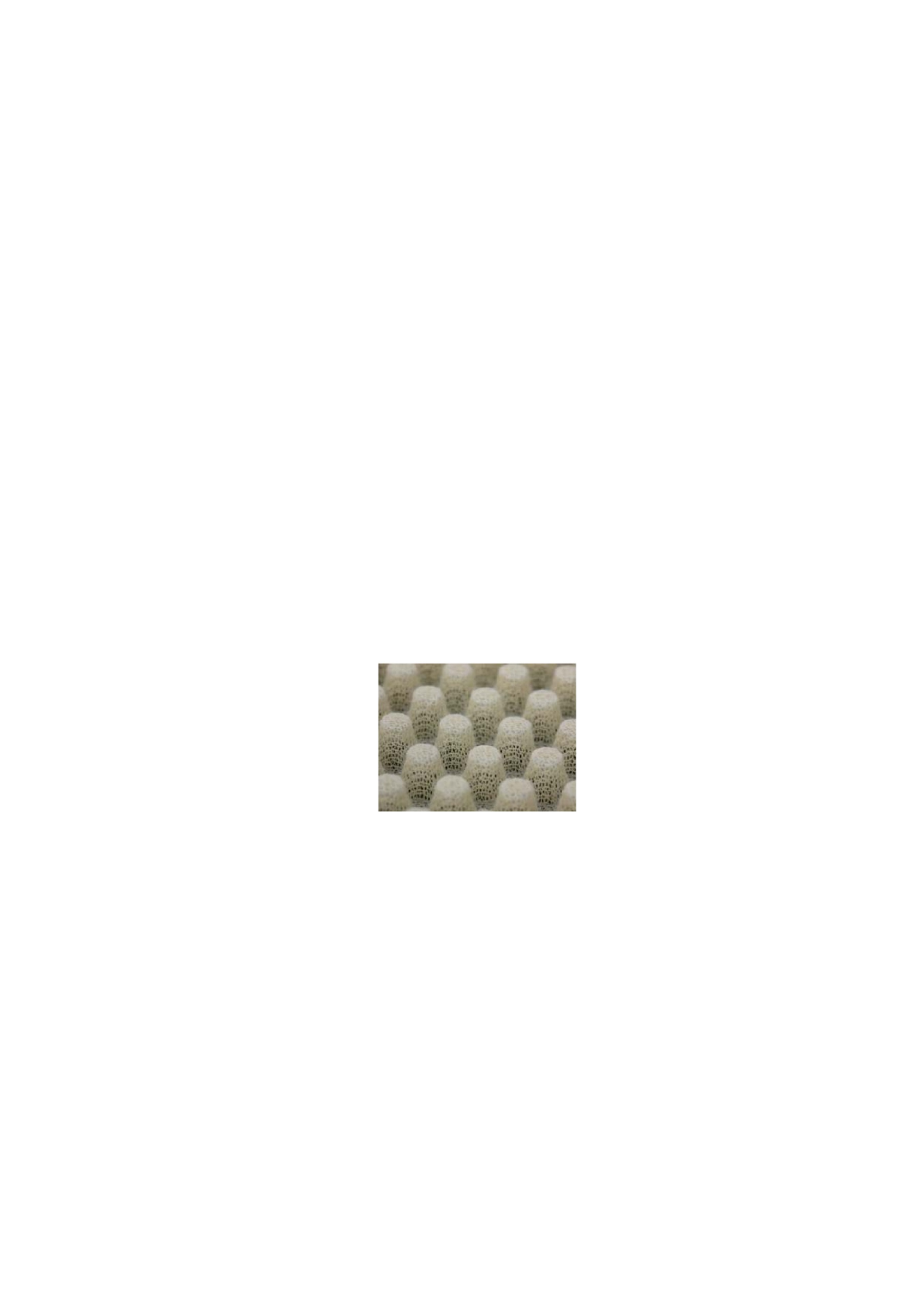
permanent 3-D form (see Fig. 1). The molding process gives the core crosswise periodic naps with
cup-shaped profile, hence the name. To ensure the nap-core’s desired properties (i.e., mechanical
strength, deformability, wettability, and heat insulation), the constituent elements need to be
properly selected, such as fiber material, resin material, knitting type of the fabric, etc.
Fig. 1. Photo of a nap-core
Since the nap-core resembles a fibrous structure, its resin plays the role of a coating layer
rather than a monolithic matrix. Here, the resin – a thermoset – has a large number of significant
functions, which is to
Protect the fabric from harmful factors, and diminish the negative influence of small
fractures in the fibers
Keep a stable shape of the core, and reduce wrinkles and disorders to the fabric
Keep the right position of the yarns, and minimize further fiber damage.
It is also worth mentioning that the resin possesses high reactivity and flexibility that are very
important in continuous production of the nap-core, so its content in the entire nap-core is a
matter of primary concern [16].
Beside numerous features shared with other sandwich-structured composites, nap-core and
its sandwich own some unique ones. Due to the open structure, nap-core sandwich composites

3
offer some rather important advantages for the design and installation including good drainage
and ventilation and easy integration of ducts and wires. The knitted structure of the nap-core is
already deformed non-uniformly after the forming process, so it is periodic at the macroscopic
scale but non-periodic at the mesoscopic scale. Moreover, the nap-core is a composite rather than
a single material, and its properties are changed significantly after the heating and curing stages.
The nap-core may bear pre-stress at some level having undergone the described manufacturing
procedure. Finally, the entire composite is anisotropic. Hence, it is difficult to forecast the
properties of the nap-core sandwich.
Obviously, the unique structure and properties of nap-core sandwiches set them apart from
other composite materials and render their testing and modeling a challenging task. Focusing on
them, it has been found that not too much work has been reported and most of the published
work so far is related to testing of nap-core sandwich structures. Gerber [17] tested and analyzed
symmetrical nap-cores in terms of mechanical properties and compared them to single sided nap-
cores and aviation-certified materials to evaluate their prospects for lightweight applications.
Bernaschek et al. [18] compared nap-cores and honeycombs with respect to a number of
mechanical properties such as flexural strength, modulus of elasticity, bonding of core material
and facing. Gerber et al. [13] experimentally investigated symmetrical nap-core and honeycomb
sandwich structures under impact load. Ha and Zehn [19] discussed the challenges of setting a
suitable finite element (FE) model for nap-core sandwiched structures and reported in a further
work [15] on approaches to FE modeling of nap-core composites, while the comparison with the
experimental study proved the suitability of the built FE models. The present work extends the last
mentioned one by using FE models to perform parametric investigations of geometric properties
of nap-core sandwich composites, i.e. their influence onto their mechanical behavior. Namely,
several geometric parameters, such as the overall height of the nap-core, the alignment pattern of
the naps (triangular or rectangular), the upper and lower diameters of the naps, the distance
between the nap centers, etc., determine predominantly the final properties of a nap-core
sandwich.
2. Experimental investigation of nap-core sandwich
2.1. Samples and experiments
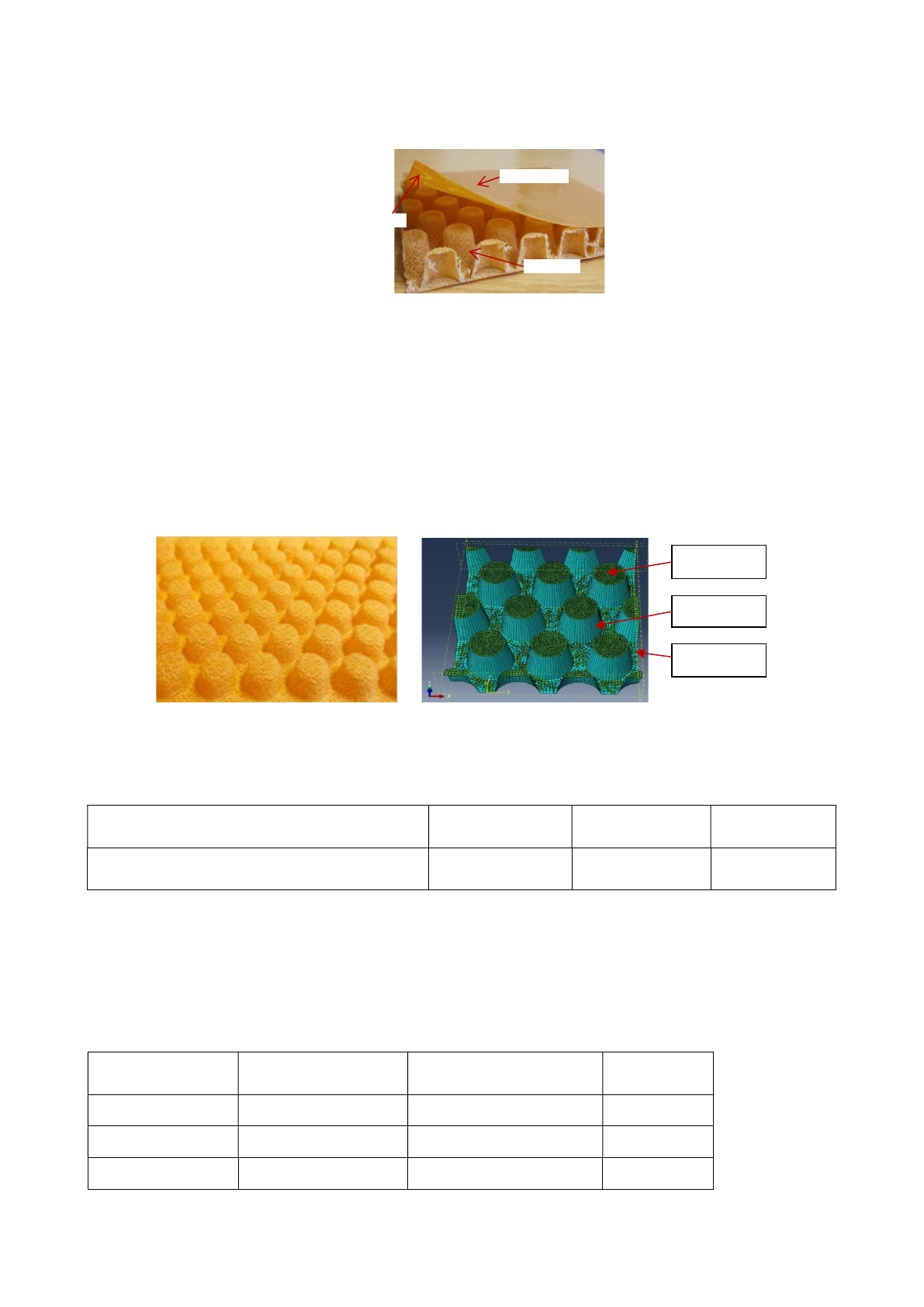
To obtain a nap-core sandwich, two thin face sheets of laminated composite are attached
firmly to the top face and bottom face of a nap-core with a strong adhesive (Fig. 2). The resulting
sandwich is open to both sides of its thickness, so it is classified as regional support composite - a
kind of non-homogeneously supported sandwich structure [20]. The selection of knitted fabrics
rather than other types of textile is crucial since knitting patterns permit larger elongation. There
are a number of possible material choices for the core’s fibers. Thermoplastic polymers (acrylic,
polyester or polyamide), aramid, glass, cellulose, basalt, and hybrid fibers are the most successful
ones (used alone or in combination) for they are non-toxic and strongly resistant against heat,
solvents, hydrolysis and oxidizing agents. The fibers made of them also prove to be highly durable
and tough. Nevertheless, many of those materials have low ultimate strain (around 4%) while
production of the nap-core necessitates the textile to stretch even up to 250%. Thus, fabrics
4
fabricated by knitting technique are used as they are very suitable for creating deep-drawn shapes
without local fractures or creases [16].
Fig. 2. Scheme of a typical nap-core sandwich
There are numerous types of nap-core available. However, it has been shown that their
mechanical behavior exhibits a high degree of similarity, so this paper exemplifies only one of
them, i.e. nap-core type P10-HN. Here, P means Phenolic resin, 10 denotes the height of the nap-
cores in centimeter, and HN stands for Hybrid Nomex fiber. The appearance of the nap-core is
shown in Fig. 3, while its parameters are given in Table 1. To ensure that the comparison between
the samples is appropriate, a big panel of P10-HN nap-core sandwich was fabricated. Afterwards,
all the samples were cut out from that panel.
Fig. 3. Nap-core type P10-HN: Actual sample (left) and simulation model (right)
Table 1
The parameters of P10-HN nap-core
Material
Boundary height
(mm)
Fabric thickness
(mm)
Volume weight
(kg/m3)
60%
fiber(5%Elasthane + 86%Nomex +
9%Polyamide) + 40% Phenolic resin 10 0.49 39
Three typical experiments were conducted on the samples of P0-HN nap-core sandwich:
compression, shear, and four-point bending. Table 2 gives the standards, sample sizes and test
speeds.
Table 2
Specifications for the mechanical tests on P10-NH nap-core sandwich
Test Standard
Sample size
length(mm) x width (mm)
Test speed
(mm/minute)
Compression D 3410/D 3410M – 03
50 x 50 10
Shear DIN 53 294 200 x 50 1
Four-point bending
DIN 53 293 400 x 50 10
The top
The wall
The bottom
Nap-core
Outer layer
Adhesive
5
2.2. Experimental results
As already mentioned, the performed experiments contain three types of tests: compression,
shear and bending. Whereas the experimental result of the four-point bending test was already
reported by Ha and Zehn [15], this paper includes the results of all the experimental tests. The
resulting relation between the force applied onto the sandwich and the displacements of the
sandwich’s top layer is presented and analyzed. The result of particular interest is the maximum
force when buckling occurs, which might also be accompanied by debonding of the top skin.
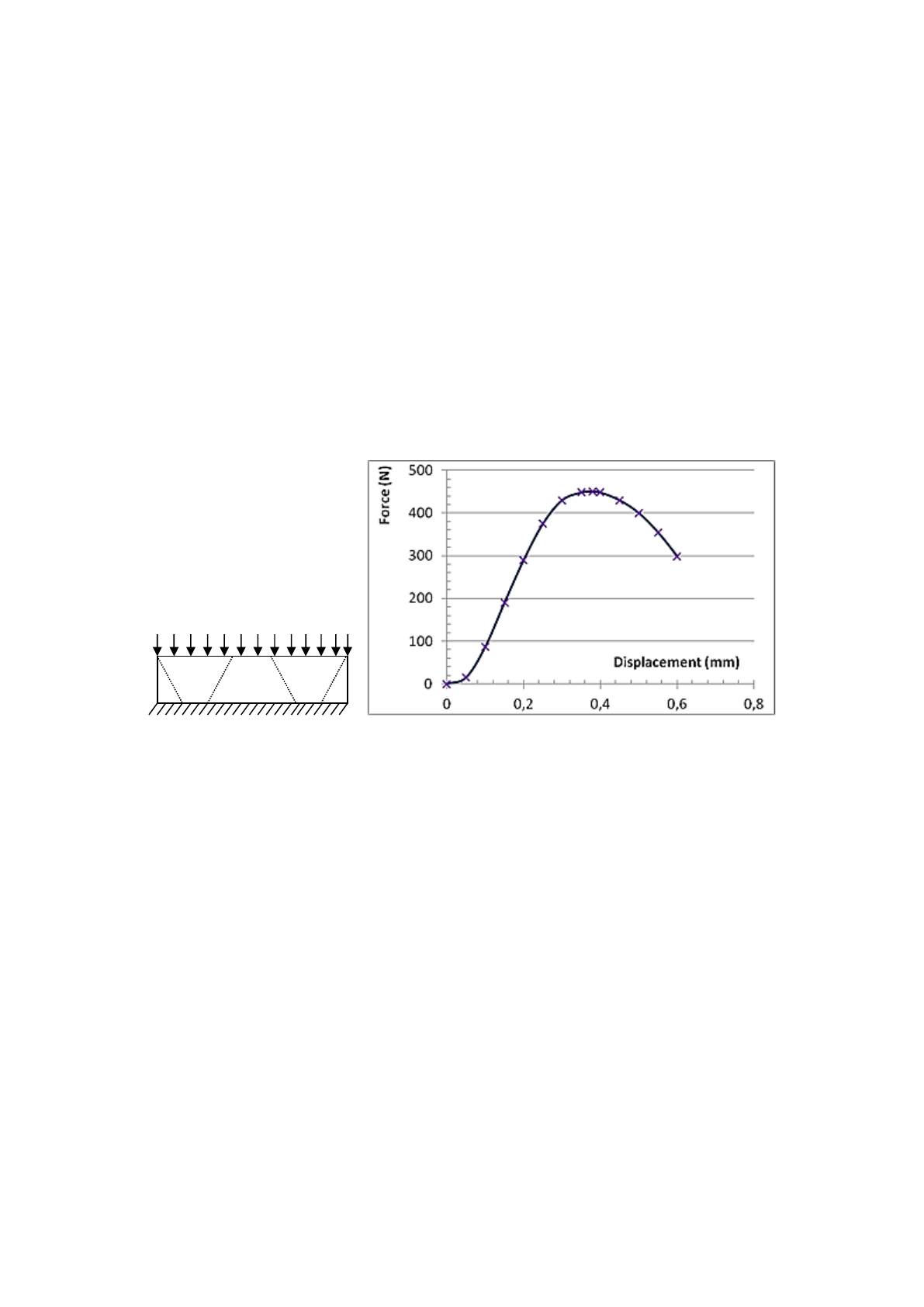
Due to the structure of the nap-core sandwich, in the compression test (Fig. 4, left) the sample
first undergoes a nonlinear interim period during which the nap-cores are gradually loaded until
each of them provides the full resistance. Subsequently, the sample deforms linearly almost till the
point at which the buckling occurs, followed by a fast decrease of the force (Fig. 4, right).
Fig. 4. Experimental scheme and data of the compression test on P10-HN nap-core sandwich
In the shear test (Fig. 5, left), a clear establishment period is not observed (Fig. 5, right). The
sandwich sample performs almost linearly from the very beginning of the test until the point of
shear buckling. Interestingly, the force does not descend but remains nearly unchanged beyond
the point of shear buckling. The same phenomenon was observed in the shear test of sandwiches
with aluminum honeycomb, reviewed by Francois Cote et al. in 2006 [21], but the reasons are
different. While hardening of the metal honeycomb core is what characterized the test by Francois
Cote et al., the yarn jamming within the knitted fabric nap-core is the cause of the effect in the
test reported here. Normally, yarn jamming happens when the fabric is extended in one direction
(either weft or warp). Thus, the spacing between the adjacent yarns in the other direction is
gradually narrowed. The yarns finally get in contact and hold each other better. In the shear test of
the nap-core sandwich, the extension of the nap-core’s knitted fabric is not uniform, so there is
also a local accruement of the yarns in the fabric, which keeps the nap-core from collapse. In the
end of the shear test, a further damage, namely the entire debonding of the top layer, might also
occur.
Sample
Loading more pages...