
Plasma-Assisted Immobilization of aPhosphonium Salt
and Its Use as aCatalyst in the Valorization of CO2
Yuya Hu,[a] Sandra Peglow,[b] Lars Longwitz,[a] Marcus Frank,[c, d] Jan Dirk Epping,[e]
VolkerBreser,[b] and Thomas Werner*[a]
Introduction
Acrucial point in the development of sustainable catalytic pro-
cesses is the separation and recycling of the catalysts.[1] In con-
trast to many other separation techniques,[2] immobilization of
catalysts allows facile separation from the product without te-
dious purification and isolationsteps as well as easy recovery
and reuse of the catalyst.[3] Numerous transformations can be
catalyzed by organocatalysts, which are typicallyreadily avail-
able and nontoxic.[4] Asignificant benefit of organocatalystsis
the carbon-basedscaffold, which allows facile structuralmodi-
fication,catalyst tuning,and catalystimmobilization.[5]
Amorphous hydrogenated carbon (a-C:H) thin films generat-
ed with plasma techniques are promising materials owing to
their chemical inertness and interesting physicalproperties,
such as high density,thermalstability,low friction, high wear
resistance, and hardness.[6] These films are appliedasprotec-
tive coatings for opticalwindows,[7] antireflective coatings for
crystalline silicon solar cells,[8] biomedical applications,[9] and
wear-resistant coatings for tools.[10] Owing to their unique
properties, a-C:H thin films are highlyattractive materials for
the immobilization of catalysts. An additional advantage in the
use of plasma-generated a-C:H films is the directattachment
of the polymericfilm to adesired surface without anypretreat-
ment.Compared to other coating procedures, it reduces prep-
arative steps and allows, in principle, the direct incorporation
of afunctionalized catalyst.
So far,there are only alimited number of reports regarding
the immobilization of catalysts by plasma techniques.For ex-
ample,Kruth et al. encapsulated Ru dyes[11] and Ir dyes[12] with
plasma polyallylamine (PPAAm) on TiO2.The prepared stable
TiO2/N3(Ru dye complex)/PPAAm catalystassemblies and en-
capsulated Ru sensitizer at the TiO2surfaceshowed improved
catalytic performance in visible-light-driven hydrogen evolu-
tion. Additionally,significant enhancement of photoefficiency
was observed with the PPAAm-encapsulatedIrdye/titania cata-
lyst assemblies. There are also some examples concerning
plasma immobilization techniques in biology,for instance, the
entrapmentofenzymes.Inthis respect, Belhacene et al.[13] and
Elagli et al.[14] reported the polymerization of tetramethyldisi-
loxane to immobilize b-galactosidasebyplasma-enhanced
chemicalvapor deposition. Furthermore, Heyse et al.[15] de-
The first plasma-assisted immobilization of an organocatalyst,
namely abifunctionalphosphonium salt in an amorphous hy-
drogenated carbon coating, is reported. This method makes
the requirementfor prefunctionalized supports redundant. The
immobilized catalyst was characterized by solid-state 13Cand
31PNMR spectroscopy,SEM,and energy-dispersive X-ray spec-
troscopy. The immobilized catalyst (1 mol%) was employed in
the synthesis of cyclic carbonates from epoxides and CO2.No-
tably,the efficiency of the plasma-treated catalystonSiO2was
higher than those of the SiO2support impregnatedwith the
catalystand even the homogeneous counterpart. After optimi-
zation of the reaction conditions, 13 terminal and four internal
epoxides were convertedwith CO2to the respective cyclic car-
bonates in yields of up to 99%. Furthermore, the possibility to
recycle the immobilizedcatalyst was evaluated. Even though
the catalystcould be reused, the yields gradually decreased
from the third run. However,this is the first example of the re-
cycling of aplasma-immobilized catalyst, which opens new
possibilities in the recovery and reuse of catalysts.
[a] Y. Hu, L. Longwitz, PD Dr.T.Werner
Leibniz-Institute for Catalysis at the University of Rostock
Albert-Einstein-Strasse 29a, 18059Rostock (Germany)
E-mail:T[email protected]
[b] Dr.S.Peglow,Dr. V. Breser
Leibniz-Institute for Plasma Scienceand Technology(INP)
Felix-Hausdorff-Strasse 2, 17489 Greifswald (Germany)
[c] PD Dr.M.Frank
Medical Biology and ElectronMicroscopy Center
University Medicine Rostock
Stremelstrasse 14, 18057 Rostock (Germany)
[d] PD Dr.M.Frank
Department Life, Light &Matter
University of Rostock
Albert-Einstein-Strasse 25,18059 Rostock (Germany)
[e] Dr.J.D.Epping
Institute of Chemistry
Technical University of Berlin
Strasse des 17 Juni 135, 10623 Berlin (Germany)
Supporting Information and the ORCID identification number(s) for the
author(s) of this article can be found under:
https://doi.org/10.1002/cssc.201903384.
T2020 The Authors. Published by Wiley-VCH Verlag GmbH &Co. KGaA.
This is an openaccessarticleunder the termsofthe Creative Commons
AttributionLicense, which permits use, distribution and reproduction in
any medium, provided the original work is properly cited.
ChemSusChem 2020,13,1825 –1833 T2020 The Authors. PublishedbyWiley-VCH Verlag GmbH &Co. KGaA, Weinheim1825
ChemSusChem
Full Papers
doi.org/10.1002/cssc.201903384
scribed the simultaneous injectionofanenzymesolutionand
acetylene or pyrrole into an atmospheric plasma to immobilize
enzymeswhile preserving their bioactivity.
The atom-economic addition of carbon dioxide to epoxides
yieldingcyclic carbonates is an interesting and frequently stud-
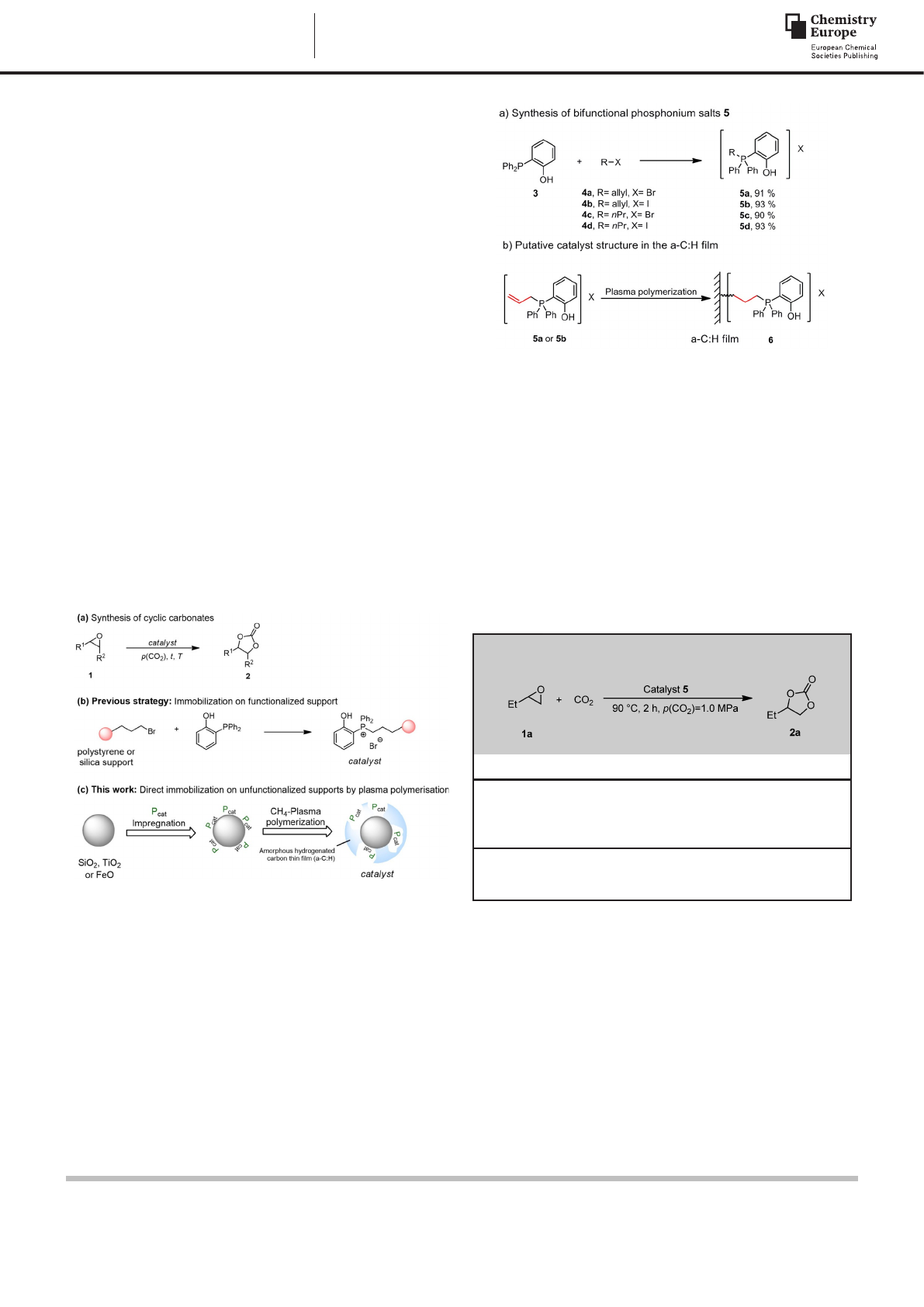
ied reaction (Figure 1a).[16] Lately,h
ighly active systemsb
ased
on OH-functionalized organocatalysts were reported for the
synthesis of cyclic carbonates.[17] Thesuperior activity of these
catalysts is attributed to epoxide activation andstabilization of
intermediates by hydrogen bonding.[18] We are interested in
the development of bifunctional onium salt catalysts for syn-
thesis of cyclic carbonates as well as their recovery and re-
use.[17a,b,19] In this respect, one strategy is the immobilization of
the onium salt catalyst on organic or inorganic supports. The
immobilization of monofunctional phosphonium salt catalysts
was studied previously.[20] Pioneering work on the immobiliza-
tion of bifunctional structural motifs hasbeen reported by Dai
et al.[21] and Liu et al.[22] Recently,wereported the immobiliza-
tion of abifunctional phosphonium bromidebearing aphenol
moiety utilizing functionalized polystyreneand silica supports
(Figure 1b).[19b] Herein, we report the use of plasma techniques
for the direct immobilization of P-based organocatalysts on un-
functionalized titaniumdioxide, iron oxide, and silica (Fig-
ure 1c). Furthermore, the efficiency and recyclability of the im-
mobilized catalysts were studied in the synthesis of cyclic car-
bonates.
Results and Discussion
Bifunctional phosphonium salts bearing ahydroxyl group in
the 2-position proved to be asuperior structuralmotif in the
cycloaddition of CO2andepoxides to form cyclic carbonates.[23]
We envisioned that an allyl substituent might allow subse-
quent immobilization in an a-C:H thin film generated by
plasma techniques. Thus, bifunctional phosphonium salts 5a
and 5b were synthesized by allylation of 2-(diphenylphospha-
nyl)phenol(3)with allyl bromide (4a)and allyl iodide (4b), as
shown in Scheme 1a.The incorporationof5a and 5b into the
a-C:H films most probably leads to asaturated linkageinthe
immobilized catalyst 6(Scheme 1b). Hence, we additionally
prepared salts 5c and 5d bearingasaturated side chain for
comparison of the activity.
Subsequently,wetested catalysts 5(1 mol%) in the model
reactionof1,2-butylene oxide (1a)with CO2to generate cyclic
carbonate 2a (Table 1). At 908Cand aCO
2pressure of 1.0 MPa,
bromide 5a and iodide 5b showed similar activity,giving the
desired carbonate 2a after 2hin 68 and 67%yield, respective-
ly (Table 1, entries 1and 2). Propyl-substituted phosphonium
bromide 5c gave 2a in only 40%yield (Table 1, entry 3). Nota-
bly,iodide 5d gave the best result under these reaction condi-
tions, and 1,2-butylene carbonate (2a)was obtained in 83%
yield (Table 1, entry 4). On the basis of these results, phospho-
nium salt 5b was chosen for immobilizationina-C:H films on
TiO2,FeO, and SiO2.
Initially,the supports were tested in the model reaction and
provednot to facilitate the reactionof1a with CO2(Table 2,
entries 1–3). Subsequently,these supports were treated with
Scheme1.a) Synthesisofphosphonium salts 5.b)Putative structure 6of
the immobilized phosphonium salts 5a and 5b.
Table 1. Comparison of phosphonium salts 5as catalysts in the synthesis
of carbonate 2a.
Entry Catalyst Loading [mol%] Yield of 2a[a] [%]
15a 168
25b 167
35c 140
45d 183
Reaction conditions:epoxide 1a (13.9 mmol, 1.0 equiv.), catalyst 5
(1 mol%), 908C, 2h,p(CO2)=1.0 MPa,solvent-free. [a] Yields determined
by 1HNMR spectroscopywith mesitylene as internalstandard.
Figure 1. a) Synthesis of cycliccarbonates 2from CO2and epoxides 1.
b) Previous strategy for the immobilizationofbifunctional phosphonium
salts using functionalizedsupports. c) Concept for the immobilization of
phosphonium salt catalysts in an a-C:H thin film by using plasmapolymeri-
zation techniques.
ChemSusChem 2020,13,1825 –1833 www.chemsuschem.org T2020 The Authors. PublishedbyWiley-VCH Verlag GmbH &Co. KGaA, Weinheim1826
ChemSusChem
Full Papers
doi.org/10.1002/cssc.201903384
low-pressure plasma to generate an a-C:H coating.[24] Also, in
the presence of the plasma-treated supports, the formation of
2a was not observed (Table 2, entries 4–6). The supports were
impregnated with catalyst 5b andtested in the model reaction
(Table 2, entries 7–9). The catalystretained its catalytic activity,
and all three catalysts 5b@TiO2,5b@FeO, and 5b@SiO2gave
1,2-butylene carbonate (2a)inhighyields of 87, 78, and 88%,
respectively (Table 2, entries 7–9). Subsequently,the impreg-
nated supports 5b@TiO2,5b@FeO, and 5b@SiO2weretreated
with alow-pressure plasma.The obtainedcatalysts 5bb3
PTiO2,
5bb3
PFeO, and 5bb3
PSiO2were tested in the model reaction
(Table 2, entries 10–12). Notably,with1mol%catalyst loading,
TiO2-and SiO2-supportedcatalysts converted 1,2-butylene
oxide (1a)to1,2-butylene carbonate (2a)in93and 99%yield
(Table 2, entries 10 and 12), whereas with the FeO-supported
catalystamoderate yield of 72%was obtained (Table 2,
entry 11). These yields are comparable to those obtained with
the impregnatedsupports (Table 2, entries 7–9 versus 10–12).
The nominallayer thickness of the a-C:H coating is related
to the plasma-treating time. Longer treatingtimes result in a
thicker film and better coverage of the particles. This may lead
to stronger catalystbinding to the surface, which reduces
leachingofthe catalystand enhances its recyclability.The
nominallayer thickness was determined by profilometry of an
a-C:H coating deposited on aplanar glass plate.[24] This is only
an approximationfor films on particles because the planar
glass plate is homogeneously coated, whereas the deposition
on particles is nonuniform and partial. Profilometric measure-
ments of the nominal layer thickness of a-C:H films obtained
after 6.5, 25, and 39 min of plasma treatment gave layer thick-
nesses of 53.3, 136.8, and 190 nm, respectively.Westudied the
impact of different plasma-treating times (6.5, 25, and 39 min)
on the catalytic activity of 5b on TiO2,FeO, and SiO2and the
effect of the catalystrecyclability in our model reaction. To
reveal the effect of the plasma treatment, the recycling of the
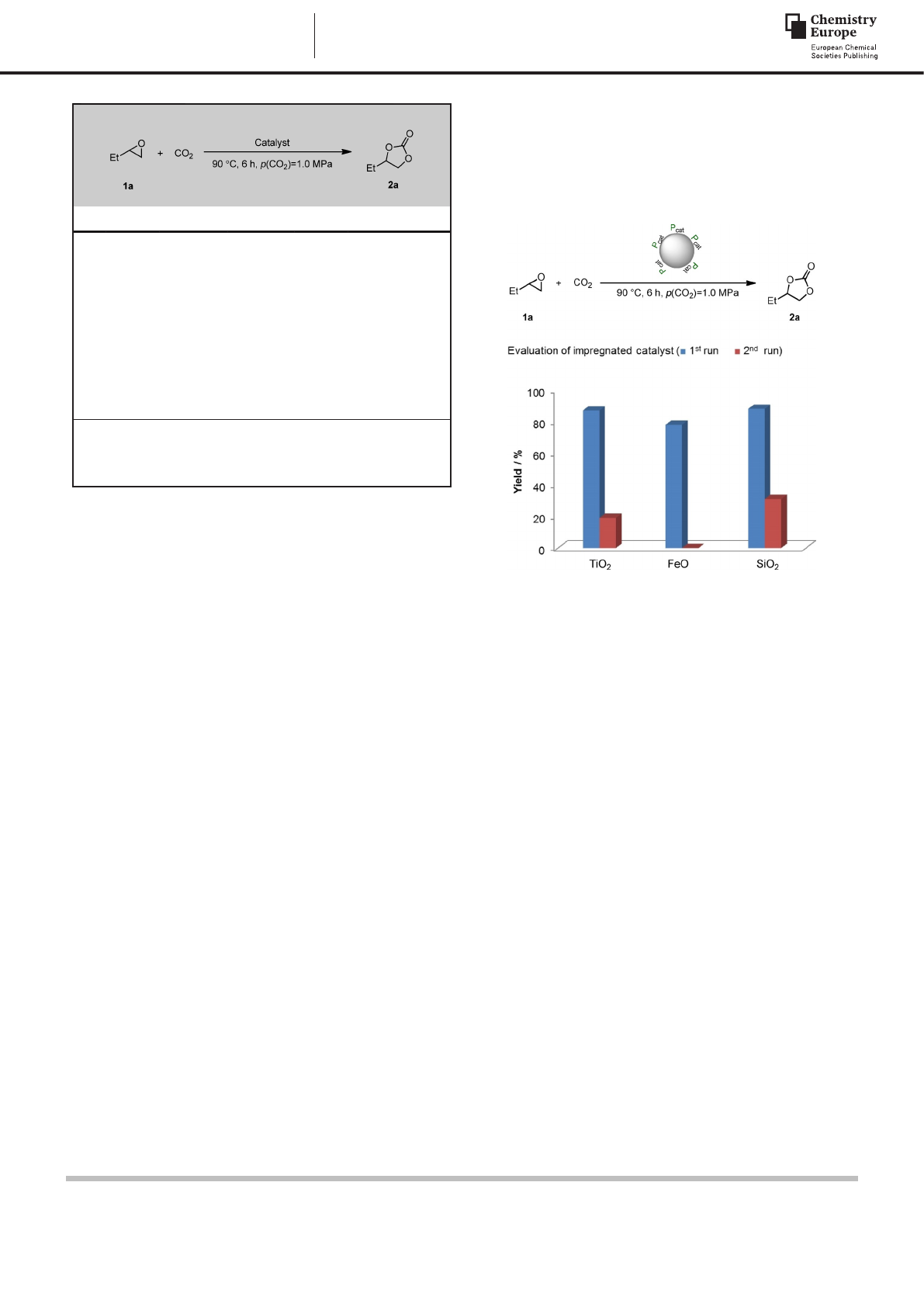
non-plasma-treated impregnatedcatalysts 5b@TiO2,5b@FeO,
and 5b@SiO2was initially investigated (Figure 2). In the model
reactionall three catalysts gave good yields of up to 88%after
6h at 908Cand 1.0 MPa CO2pressure in the first run. The
product wasobtainedafter simple filtration,and the recovered
catalystwas reused in asecond run under the same reaction
conditions. Notably,the yields dropped significantly.The best
yield achievedinthe second run was only 31%with 5b@SiO2.
We assumed that the low yields can be explainedbyleaching
of catalyst 5b into the liquid phase. This is easily possible be-
cause the catalyst is not covalently bonded to the supports.
The 31PNMR spectrum of the product mixture showedasignal
at d=20.2 ppm, which was assigned to homogeneous catalyst
5b.This consequentlyconfirms the proposed leaching.
We studied immobilized catalyst 5b on differentsupports
(TiO2,FeO, and SiO2)after 6.5 min plasma-treating time under
the same conditions. Catalysts 5ba3
PTiO2,5ba3
PFeO, and
5ba3
PSiO2gave the desired carbonate 2a in good to excellent
yields up to 98%(Figure 3a). Even though with catalysts
5ba3
PTiO2and 5ba3
PFeO the yields dropped significantlyin
the second run, in the presence of 5ba3
PSiO2carbonate 2a
was obtainedingreater than 80%yield. These results might
be explained by insufficient immobilization owing to the short
plasma-treating time. Nevertheless, compared with the impreg-
nated catalysts, the plasma treatment led to asignificant im-
provement of the yield (Figure 2vs. Figure 3a).
Hence, the same set of experiments was repeated with cata-
lysts 5bb3
PTiO2,5bb3
PFeO, and 5bb3
PSiO2obtained after
Table 2. Screening of supports and immobilized catalysts.
Entry Support 5b [mol%] Cat. t[a] [min] Yield of 2a[b] [%]
1TiO2––0
2FeO ––0
3SiO2––0
4TiO2–25 0
5FeO –25 0
6S
iO2–25 0
7TiO215b@TiO2–87
8FeO 1 5b@FeO –78
9SiO215b@SiO2–88 (65)[c]
10 TiO215bb3
PTiO225 93
11 FeO 1 5bb3
PFeO 25 72
12 SiO215bb3
PSiO225 99 (77)[c]
Reaction conditions: epoxide 1a (13.9 mmol, 1.0 equiv.), supportorcata-
lyst (500 mg), 908C, 6h,p(CO2)=1.0 MPa, solvent-free. [a] Plasma-treating
time. [b] Yielddetermined by 1HNMR spectroscopywith mesityleneasin-
ternal standard. [c] 2hreactiontime.
Figure 2. Recyclability evaluation of impregnated catalysts 5b@TiO2,
5b@FeO, and 5b@SiO2.Reactionconditions:epoxide 1a (13.9mmol,
1.0 equiv.), immobilized catalyst(500 mg, 1mol%catalystloading in respect
to 1a), 908C, 6h,p(CO2)=1.0 MPa, solvent-free. For the first runs yieldsof
isolatedproducts are given.For the second runsthe yield was determined
by 1HNMR spectroscopywith mesityleneasinternal standard.
ChemSusChem 2020,13,1825 –1833 www.chemsuschem.org T2020 The Authors. PublishedbyWiley-VCH Verlag GmbH &Co. KGaA, Weinheim1827
ChemSusChem
Full Papers
doi.org/10.1002/cssc.201903384
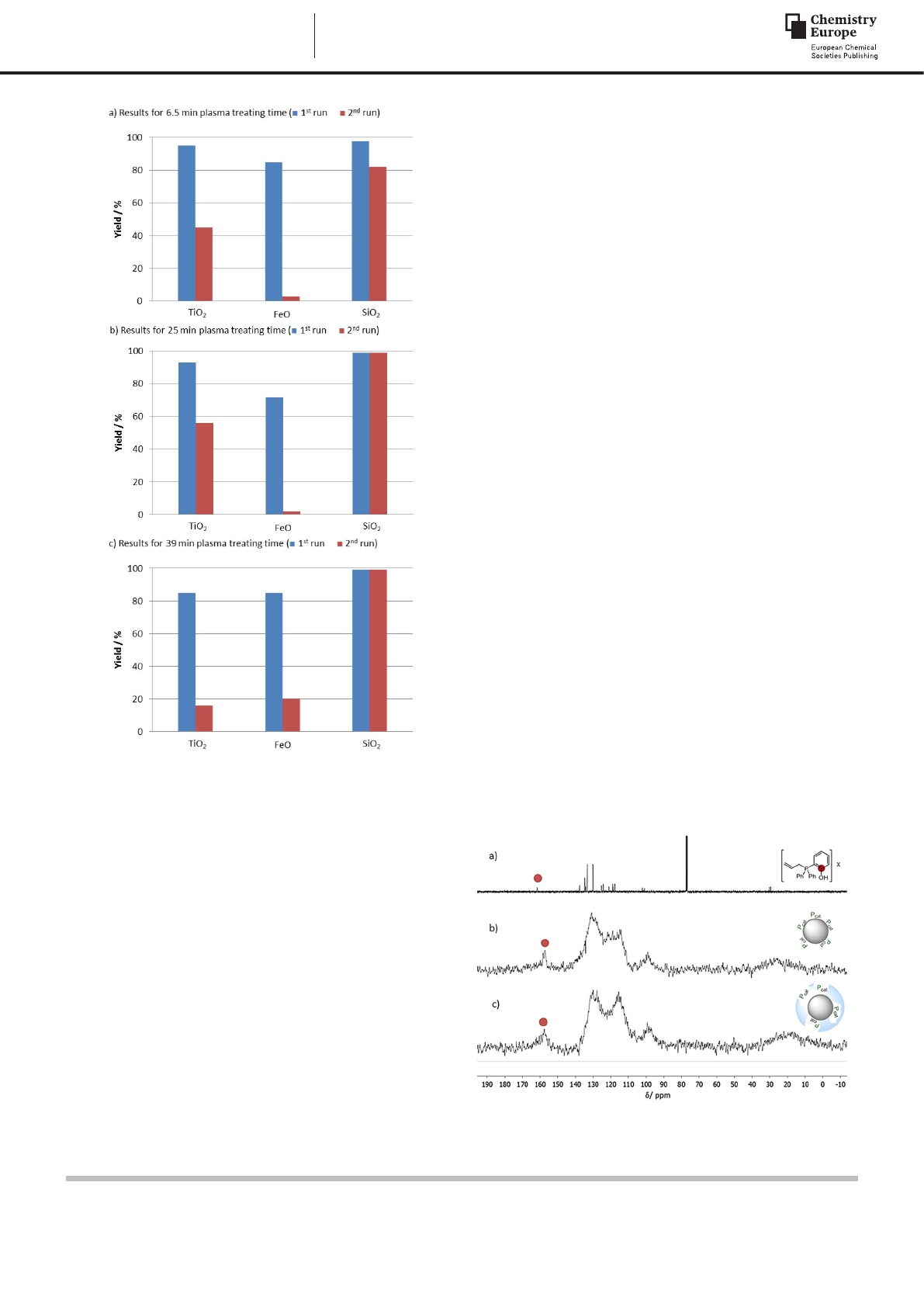
25 min plasma-treating time (Figure 3b). In the first run, all
three catalysts gave results comparable to those of 5ba3
PTiO2,
5ba3
PFeO, and 5ba3
PSiO2(Figure 3a vs. b, 1st run). The yields
for 2a were significantly increased in the case of the TiO2-and
SiO2-supported catalysts (5bb3
PTiO2and 5bb3
PSiO2)inthe
second run (Figure 3a vs. b, 2nd run). This indicates that pro-
longed plasma-treating time leads to improvedcatalystbind-
ing to the a-C:H coatings. Finally,the plasma-treating time was
extendedto39min, and the prepared catalysts were tested
under the standardconditions (Figure 3c). In the case of
5bc3
PTiO2the yields dropped in the first and second runs
compared to the results for shorter treating times (Figure 3a
and b). In contrast, 5bc3
PFeO showed increased yields com-
pared with the previous experiments.Again, the best result
was obtained with 5bc3
PSiO2,which gave a99% yield of 2a
in the first andsecond runs.
As observed for 5bc3
PTiO2,longerplasma-treating times
may lead to better recyclability,most probably owing to im-
provedimmobilization (Figure 3a and b). However,ifthe
plasma-treating time is too long, for example, 39 min for
5bc3
PTiO2,this may lead to partial coverage of the catalyst
and thus lower yields (Figure 3c vs.aand b). In the case of
5bb3
PFeO the enhanced yield and recyclability for aplasma-
treating time of 39 min indicated better immobilization of 5b
on the support. This suggeststhat not only the plasma-treat-
ing time but also the nature of the support materialisofcru-
cial importance for the efficiency andrecyclability of the cata-
lyst.
On the basis of these results, 5bb3
PSiO2was identified to
be the most promising catalyst. Thus, 5bb3
PSiO2was charac-
terized with various analytical methods and comparedwith ho-
mogeneous catalyst 5b and 5b-impregnated SiO2(5b@SiO2).
As expected, the elemental analysis of both impregnated cata-
lyst 5b@SiO2and plasma-treated catalyst 5bb3
PSiO2showed
the presence of phosphorus and iodine. The solid-state
31PNMR spectrum of plasma-treated catalyst 5bb3
PSiO2
showedabroad signal at d=16.9 ppm, which is in asimilar
range to that in the 31PNMR spectrum of homogeneous cata-
lyst 5b (d=20.2 ppm), indicating the presence of aphosphoni-
um motif. The solid-state 13CNMR spectra of impregnated
5b@SiO2and plasma-treated 5bb3
PSiO2showed the expected
signals compared with the 13CNMR spectrumofhomogeneous
catalyst 5b (Figure 4a–c). Notably,the characteristic signal for
the phenolic carbon atom at d=161 ppm for 5b can clearly
be identified in the solid-state spectrumof5b@SiO2and
5bb3
PSiO2.This is of particularimportance because it indicates
that the bifunctional nature of the immobilized catalyststays
intact,whichiscrucial for its superior catalytic activity.
Energy-dispersive X-ray (EDX) spectroscopy was performed
on impregnated 5b@SiO2,plasma-treated 5bb3
PSiO2,and the
SiO2support.[24] The EDX spectrum of the SiO2support showed
no signal in the range between 1.90 and 4.10 keV (Figure 5a).
Figure 3. Recyclability evaluation of catalyst 5b on TiO2,FeO, and SiO2with
different plasma-treating times:a)6.5 min, b) 25 min, c) 39 min plasma-treat-
ing time. Reactionconditions: epoxide 1a (13.9 mmol, 1.0 equiv.), immobi-
lized catalyst (500 mg, 1mol%catalyst loading with respect to 1a), 908C,
6h,p(CO2)=1.0 MPa, solvent-free. For the first runsyields of isolated prod-
ucts are given.For the second runs the yield was determinedby1HNMR
spectroscopy with mesityleneasinternal standard.
Figure 4. a) 13CNMR spectrum of homogeneous catalyst 5b in CDCl3.
b) Solid-state 13CNMR spectrum of impregnated catalyst 5b@SiO2.c)Solid-
state 13CNMR spectrum of plasma-immobilized catalyst 5bb3
PSiO2.
ChemSusChem 2020,13,1825 –1833 www.chemsuschem.org T2020 The Authors. PublishedbyWiley-VCH Verlag GmbH &Co. KGaA, Weinheim1828
ChemSusChem
Full Papers
doi.org/10.1002/cssc.201903384
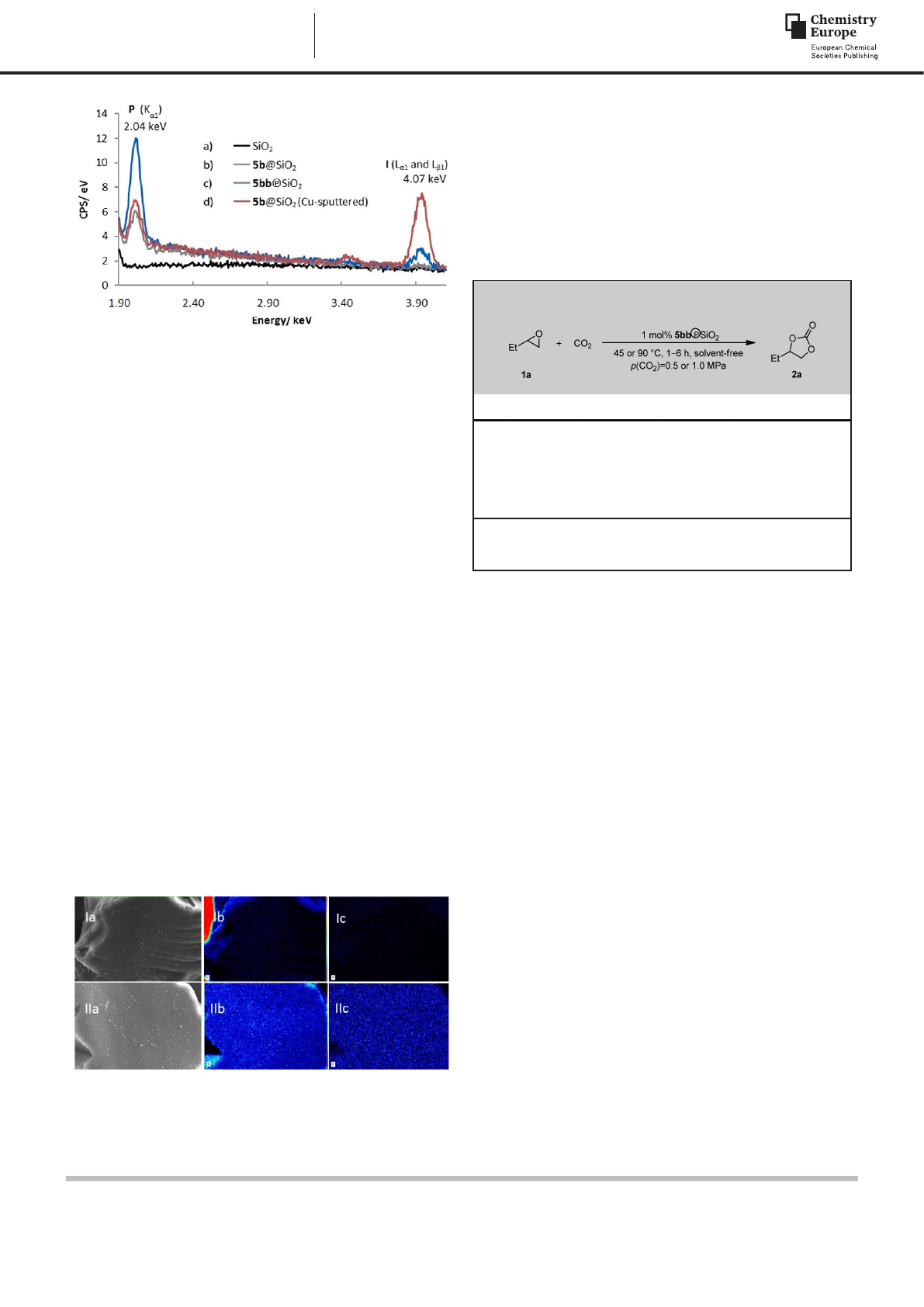
In contrast, the impregnated and plasma-treated materials
showedsignals at 2.04 keV (P Ka), which indicatethe presence
of phosphorus (Figure 5b and c). Notably, 5b@SiO2does not
show an iodine signal (Figure 5b), whereas 5bb3
PSiO2has a
low-intensity signal at 4.07 keV (I La1andL
b1), which is charac-
teristic for iodine (Figure 5c). The absence of the signal for I
La1and Lb1in Figure5band the low intensity of the signalin
Figure 5c can be explained by the difficulty of detecting sur-
face-associated iodine, which resultsfrom the high energy re-
quired for excitation of the iodine Ltransitions. This can be
overcomebychanging the sample pretreatment; for example,
the EDX spectrum of copper-sputtered 5b@SiO2clearly
showedthe presence of iodide (Figure 5d). The copperlayer
(z=29, 10 nm) alteredthe penetration and spreadofthe elec-
tron beam in the sample surfacecompared with the rather
electron-transparent carbon coating (z=6, 10–15 nm). Notably,
comparable peaks for phosphorus are obtainedunder both
pretreatment conditions (Figure 5b and d).
Moreover,westudied 5bb3
PSiO2by SEM and EDX mapping
in comparison to the neatsupport (Figure 6). The SEM images
of the silica support and 5bb3
PSiO2are shown in Figure 6Ia
and IIa. The carbon EDX mapping of theseparticles shows
clearly an increaseincarbon surface coating owing to plasma
treatment (Figure 6Ibvs. IIb). The mapping for phosphorusin-
dicatesthat the catalyst is evenly distributed over the support,
and the absence of phosphorous on the neatsupport (Fig-
ure 6Icand IIc).
Subsequently we studied the performance of catalyst
5bb3
PSiO2under different reaction conditions (Table 3). Under
the conditions of the catalystscreening, the desired product
2a was obtained in 99%yield (Table 3, entry 1). Decreasing
the reactiontime to 3hgave 2a in 99%yield of isolated prod-
uct (Table 3, entry 2), and even after 1hayield of 57%was ob-
tained (Table 3, entry 3). The influence of the CO2pressure was
also investigated. Decreasing the CO2pressure to 0.5 MPa led
to alower yield of 88%compared to the standard conditions
(Table 3, entry 1vs. 4). Next, the reaction temperature was de-
creasedto458C. Even at 458Cthe immobilized catalyst
5bb3
PSiO2led to full conversion and 99%yield after 6h
(Table 3, entry 5). Notably,a21%yield of 2a was still obtained
after 3hat this temperature (Table 3, entry 6).
On the basis of theseresultswedetermined reactioncondi-
tions suitable for the evaluation of the substrate scope
(1 mol%catalyst 5bb3
PSiO2,458C, 6h, p(CO2)=1.0 MPa,sol-
vent-free). As shown in Scheme 2, terminal aliphatic epoxides
1a–dwere converted to the respective carbonates 2a–din
yields of up to >99%under these conditions. In contrast, sty-
rene oxide (1e)showedonly moderate conversion,and 2e
was obtained in ayield of 61%. However,with aprolongedre-
action time of 24 h, full conversion was achieved, and the de-
sired product was isolated in 92%yield. In this reaction aceto-
phenone from aMeinwald rearrangementwas observed as a
byproduct.[25]
Glycerol has become widely available because it is the major
byproduct in the manufacturing of biodiesel.[26] “Biodiesel” is a
popularterm for the fatty acid methyl esters formed by trans-
esterification of vegetable oils with methanol.[27] It has been
shown that the use of glycerol as the feedstock for the synthe-
sis of carbonates can lead to asignificant reduction in the
carbon footprint of their productioncompared with the use of
fossil resources.[28] Glycidol (1f), epichlorohydrin (1g), and their
Figure 5. Sections of EDX spectra between 1.90 and 4.10 keV for a) the SiO2
support (black, carbon-coated),b)the impregnated catalyst 5b@SiO2(gray,
carbon-coated), c) the plasma-treated catalyst 5bb3
PSiO2(blue, carbon-
coated), and d) the impregnated catalyst 5b@SiO2(red, Cu-sputtered).[24]
Figure 6. SEM images of the silica support (Ia) and catalyst 5bb3
PSiO2(IIa).
EDX mapping with color-coded intensity range of carbon(Ib)and phospho-
rus (Ic) for the silica support.EDX mapping with color-coded intensity range
of carbon (IIb) and phosphorus (IIc) for the immobilized catalyst
5bb3
PSiO2.[24]
Table 3. Optimization of catalytic reaction conditionsfor the conversion
of 1,2-butylene oxide (1a).
Entry T[8C] p[MPa] t[h] Yield 2a[a] [%]
1901.0 699
2901.0 399
3901.0 157
4900.5 688
5451.0 699
6451.0 321
Reaction conditions:epoxide 1a (13.9 mmol, 1.0 equiv.), immobilized cat-
alyst 5bb3
PSiO2(500 mg, 1mol%catalystloading with respect to 1a), T,
t,p,solvent-free. [a] Yields of isolatedproductsare given.
ChemSusChem 2020,13,1825 –1833 www.chemsuschem.org T2020 The Authors. PublishedbyWiley-VCH Verlag GmbH &Co. KGaA, Weinheim1829
ChemSusChem
Full Papers
doi.org/10.1002/cssc.201903384
Loading more pages...