
applied
sciences
Article
Potential Study of Solar Thermal Cooling in
Sub-Mediterranean Climate
Mustafa Jaradat 1, Mohammad Al-Addous 1, Aiman Albatayneh 1, Zakariya Dalala 1and
Nesrine Barbana 2,*
1Department of Energy Engineering, German Jordanian University, Amman 11180, Jordan;
2Department of Environmental Technology, Technische Universität Berlin, 10623 Berlin, Germany
*Correspondence: [email protected]; Tel.: +49-030-314-28633
Received: 14 March 2020; Accepted: 30 March 2020; Published: 1 April 2020
Abstract:
Air conditioning is becoming increasingly important in the energy supply of buildings
worldwide. There has been a dramatic increase in energy requirements for cooling buildings in the
Middle East and North Africa (MENA) region. This is before taking the effects of climate change
into account, which will also entail a sharp increase in cooling requirements. This paper presents the
potential of using a solar thermal absorption cooling system in Sub-Mediterranean Climate. Four
sites in Jordan are now equipped with water-lithium bromide (H
2
O-LiBr) absorption chillers with
a total nominal capacity of 530 kW. The focus of the paper was on the pilot system at the German
Jordanian University (GJU) campus with a cooling capacity of 160 kW. The system was designed and
integrated in order to support two existing conventional compression chillers with a nominal cooling
capacity of 700 kW. The system was economically evaluated based on the observed cooling capacity
results with a Coefficient of Performance (COP) equals 0.32, and compared with the values observed
for a COP of 0.79 which is claimed by the manufacturer. Several techniques were implemented to
evaluate the overall economic viability in-depth such as present worth value, internal rate of return,
payback period, and levelized cost of electricity. The aforementioned economic studies showed that
the absorption cooling system is deemed not feasible for the observed COP of 0.32 over a lifespan
of 25 years. The net present value was equal to
−
137,684 JD and a payback period of 44 years
which exceeds the expected lifespan of the project. Even for an optimal operation of COP =0.79,
the discounted payback period was equal to 23 years and the Levelized Cost of Electricity (LCOE)
was equal to 0.65 JD/kWh. The survey shows that there are several weaknesses for applying solar
thermal cooling in developing countries such as the high cost of these systems and, more significantly,
the lack of experience for such systems.
Keywords:
thermally driven refrigeration; absorption chillers; solar collectors; solar air conditioning;
feasibility study; present worth value; payback period
1. Introduction
The increasing desire for air conditioning is mainly due to the demanding modern codes and
standards on ventilation and indoor air quality [
1
,
2
], according to modern glass buildings in hot dry
areas without considering of the climate and character of the country [3].
In countries with a generally high need for air conditioning, considerable load peaks (summer
peaks) occur in the public power grid, especially on hot summer days [
4
]. Complete blackouts in
network supply have already occurred [
4
]. The energy supply companies must respond to the growing
need for air conditioning and cooling by expanding investment-intensive peak load power plants.
Appl. Sci. 2020,10, 2418; doi:10.3390/app10072418 www.mdpi.com/journal/applsci

Appl. Sci. 2020,10, 2418 2 of 17
A relief strategy for the power grids is observed in the substitution of the conventional electrically
driven compression refrigeration system with thermally driven processes. In particular, the solar drive
heat is an attractive technology solution due to the coincidence between cooling requirements and
solar radiation. The extensive simultaneousness (seasonal and over the day) between solar supply and
occurring cooling load in buildings suggests the use of solar energy to provide the required drive heat.
The highest cooling loads occur at those hours when high radiation power is available (e.g., office
building), which could be attributed to either the user profile or the cooling loads which are strongly
linked to the radiation on the building envelope. [5,6].
The solar thermal air conditioning processes do not use environmentally harmful refrigerants [
7
].
Traditional refrigeration and air conditioning systems mainly use refrigerants that have a high potential
for global warming [
8
]. Developments in the direction of natural refrigerants (propane, CO
2
) offer
alternatives, but these are not yet very widespread in current refrigeration or air conditioning systems.
Therefore, by switching to thermal cooling processes, harmful substances are reduced.
The systems of »solar thermal cooling« primarily use solar energy as a thermal drive source for
cooling. In well-designed and working systems for solar thermal cooling, primary energy savings can
be achieved compared to conventional systems. This corresponds to a reduction in CO
2
emissions
in accordance with the annual Heating, Ventilation and Air Conditioning (HVAC) electricity energy
savings [
9
]. The use of electrical auxiliary energy is mainly consumed by driving pumps and fans of
the solar thermal cooling system.
There are a variety of ways to convert solar energy into useful cooling or conditioned air (cooling
and dehumidification). The combination of photovoltaics with compression cooling also offers these
advantages. If only looking at the cooling side, photovoltaics in combination with compression cooling
could be competitive in the future. However, the great ecological advantage of solar thermal cooling
systems does not lie in the cooling side, but in the multiple uses of the solar systems for water heating
and heating support, which could achieve the majority of the CO2savings [10].
Many studies have been accomplished related to thermal driven solar cooling and air conditioning.
Solar thermal cooling can be mainly classified as open and closed cycles. In open cycles, operated at
atmospheric pressure, the latent load (dehumidification) is handled using solid or liquid desiccants.
The water vapour in the air is considered as a sorbate while the solid or liquid desiccant is considered
as adsorbent or absorbent, respectively. Open processes consist of a combination of sorption
dehumidification and evaporative cooling, whereby a wide variety of interconnections are possible and
different sorbents are used. The most common method uses sorption rotors for dehumidification. Up to
now, the rotor materials used have only been either silica gel or lithium chloride, which is incorporated
into a cellulose matrix. Several studies were performed for desiccant evaporative cooling systems
(DEC) applying liquid desiccants such as [11,12] and applying desiccant wheels such as in [13,14].
Closed processes are represented by adsorption and absorption chillers. Adsorption refrigeration
systems use a solid to adsorb the refrigerant. Devices on the market use mainly silica gel as the
adsorbent and water as the refrigerant [
15
]. The COP values of the systems are in the range of
0.65 and heat from approximately 60
◦
C can be used to provide cooling at correspondingly low
re-cooling temperatures, [
16
]. The COP of adsorption chiller of 0.65 is obtainable only for high
desorption temperatures, high cooled water temperatures, and low cooling temperatures. For the
heating temperatures as low as 60
◦
C, it is drastically lower (down to 0.17–0.34) [
17
]. These systems
have some special features due to the periodic adsorption and desorption of the sorbents. As a rule,
two adsorbers are operated alternately, so that one adsorber is always available for the provision of
cold. This periodic operation leads to fluctuating temperatures at all temperature levels, a constraint
that must be taken into account when planning the system [18].
The main absorption chiller systems are the water-lithium bromide (H
2
O-LiBr) and the ammonia
water (NH
3
-H
2
O) systems. The H
2
O-LiBr systems are generally used for air conditioning in buildings.
The NH
3
-H
2
O systems are used for refrigeration applications with usable temperatures below the
freezing point of water. For H
2
O-LiBr, single-stage absorption chillers typically achieve a COP at
Appl. Sci. 2020,10, 2418 3 of 17
the nominal operating point of around 0.7–0.8 and require drive temperatures above 75
◦
C [
19
].
Double-stage absorption chillers have another generator–condenser pair to the components of a
single-stage absorption chiller, and a higher utilization of the heat supply can be achieved. Such
systems are mainly offered in the area of large cooling capacities and achieve COP values from 1.1 to
1.2. The drive temperatures required are typically above 140 ◦C [20].
The greatest market potential for solar thermal cooling lies in the international market, in countries
with a high solar radiation supply and therefore also a higher need for building and commercial
cooling. Large sales markets are located in China, the USA, Japan, and Southeast Asia [15].
Thermally operated chillers are currently available on the market for the output range from 5 kW
cooling to the megawatt range, as well as suppliers for DEC systems with an air volume flow of
4000 m
3
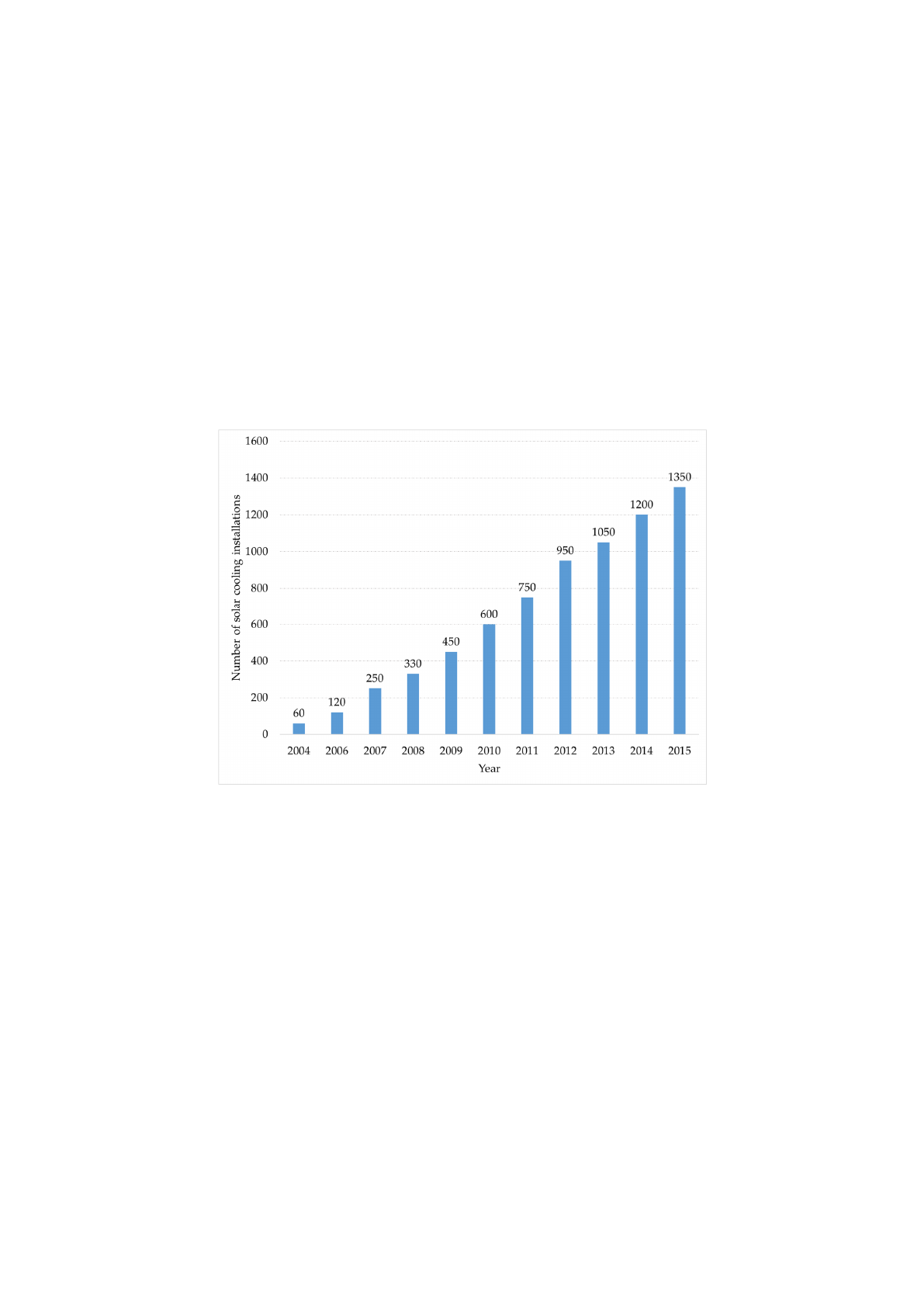
/h and above. However, only around 1350 solar cooling systems were installed worldwide
by the end of 2015 [
21
]. Figure 1shows the market development between 2004–2015 for small to
large-scale cooling and air conditioning systems [21].
Appl. Sci. 2020, 10, x FOR PEER REVIEW 3 of 17
nominal operating point of around 0.7–0.8 and require drive temperatures above 75 °C [19]. Double-
stage absorption chillers have another generator–condenser pair to the components of a single-stage
absorption chiller, and a higher utilization of the heat supply can be achieved. Such systems are
mainly offered in the area of large cooling capacities and achieve COP values from 1.1 to 1.2. The
drive temperatures required are typically above 140 °C [20].
The greatest market potential for solar thermal cooling lies in the international market, in
countries with a high solar radiation supply and therefore also a higher need for building and
commercial cooling. Large sales markets are located in China, the USA, Japan, and Southeast Asia
[15].
Thermally operated chillers are currently available on the market for the output range from 5
kW cooling to the megawatt range, as well as suppliers for DEC systems with an air volume flow of
4000 m³/h and above. However, only around 1350 solar cooling systems were installed worldwide by
the end of 2015 [21]. Figure 1 shows the market development between 2004–2015 for small to large-
scale cooling and air conditioning systems [21].
Figure 1. Number of solar cooling installations between 2004 and 2015. Reproduced with permission
from [21], Copyright AIP Publishing, 2016.
The aim of this paper is to investigate and assess four H₂O-LiBr absorption chiller pilot plants
located in different sites in Jordan. These pilot plants were funded by the German Corporation for
International Cooperation GmbH (GIZ) on behalf of Federal Ministry for the Environment, Nature
Conservation, Buildings and Nuclear safety of the Federal Republic of Germany. The current status
of the installed systems is to be discussed. The absorption chillers have a total nominal cooling
capacity of 530 kW (150 RT). The focus of the research was on the pilot system at the German
Jordanian University campus. The system has a capacity of 160 kW for cooling and a 50 kW for
heating. The system was designed and integrated in order to support the existing conventional
compression system with a cooling capacity of 700 kW. Furthermore, an economic study was also
carried out for the absorption system taking the environment effect of the reduction of CO₂ emissions
into account.
2. Sites Description
Four absorption chillers were installed in four sites in Jordan. The sites represent different
climate conditions that varied from a Mediterranean climate in Irbid (North-West) to a continental
Figure 1.
Number of solar cooling installations between 2004 and 2015. Reproduced with permission
from [21], Copyright AIP Publishing, 2016.
The aim of this paper is to investigate and assess four H
2
O-LiBr absorption chiller pilot plants
located in different sites in Jordan. These pilot plants were funded by the German Corporation for
International Cooperation GmbH (GIZ) on behalf of Federal Ministry for the Environment, Nature
Conservation, Buildings and Nuclear safety of the Federal Republic of Germany. The current status of
the installed systems is to be discussed. The absorption chillers have a total nominal cooling capacity of
530 kW (150 RT). The focus of the research was on the pilot system at the German Jordanian University
campus. The system has a capacity of 160 kW for cooling and a 50 kW for heating. The system was
designed and integrated in order to support the existing conventional compression system with a
cooling capacity of 700 kW. Furthermore, an economic study was also carried out for the absorption
system taking the environment effect of the reduction of CO2emissions into account.
2. Sites Description
Four absorption chillers were installed in four sites in Jordan. The sites represent different climate
conditions that varied from a Mediterranean climate in Irbid (North-West) to a continental climate in
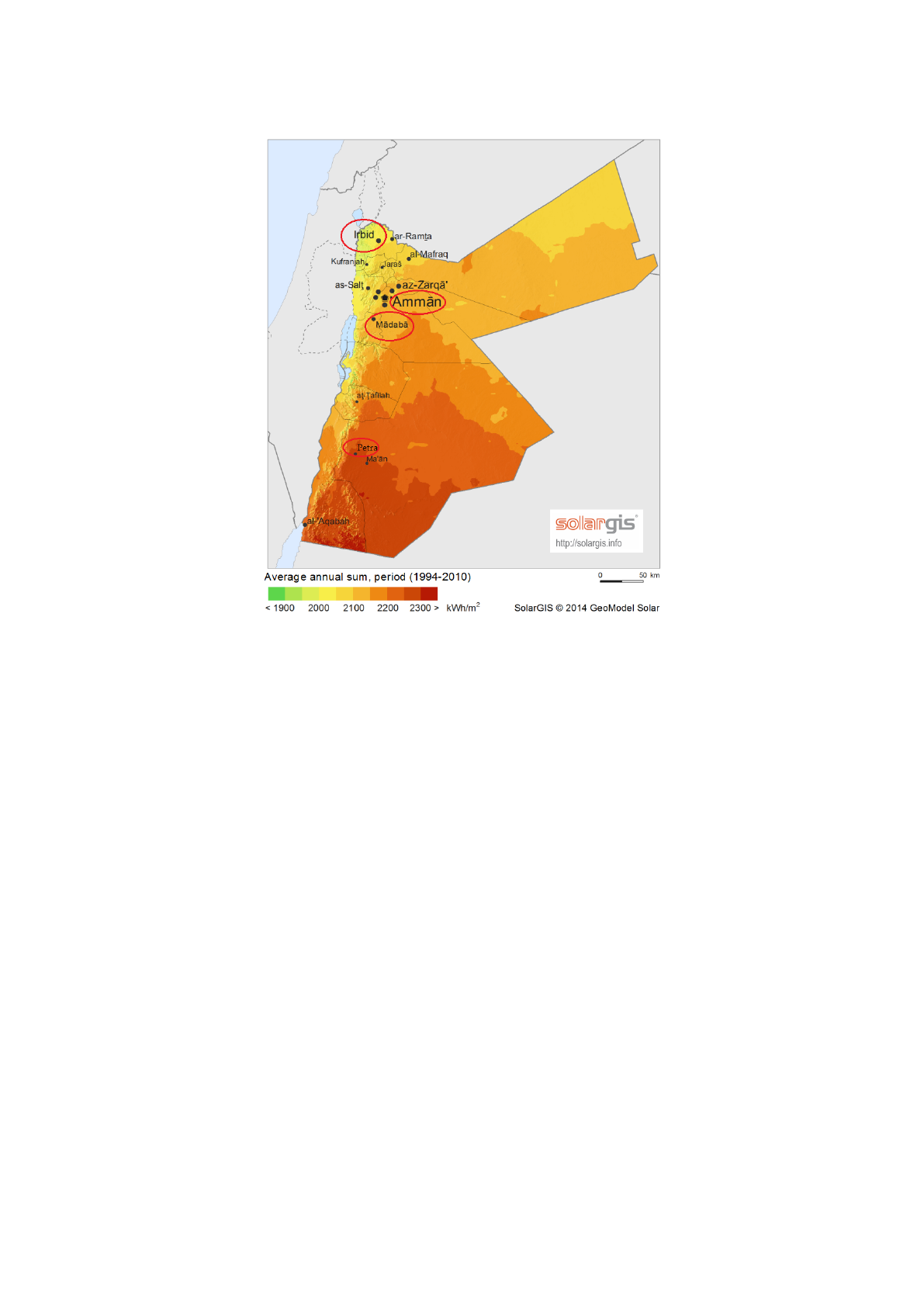
Madaba (inner regions), to an arid climate in Petra (south). Figure 2shows the four sites on a map of
Jordan together with the annual radiation on horizontal surfaces [22].
Appl. Sci. 2020,10, 2418 4 of 17
Appl. Sci. 2020, 10, x FOR PEER REVIEW 4 of 17
climate in Madaba (inner regions), to an arid climate in Petra (south). Figure 2 shows the four sites
on a map of Jordan together with the annual radiation on horizontal surfaces [22].
Figure 2. Map of Jordan with the four installed absorption chillers, encircled by red circles,
accompanied with the annual radiation on horizontal surfaces. Reproduced with permission from
[22], Copyright AIP Publishing, 2016.
2.1. Climate Conditions in Jordan
Jordan is located 80 km to the east of the Mediterranean Sea between latitudes 29°11′–32°42′ N
and longitudes 34°54′–38°15′ E, with an area of 89,329 km2 [23]. The climate of Jordan is
predominantly of the Mediterranean type. It is marked by sharp seasonal variations in both
temperature and precipitation. Summers are hot and dry while winters are cool and wet. Summer
starts around the middle of May and winter starts around the middle of November, with two short
transitional periods in between.
The temperature in Jordan varies by location and seasons. The temperature in the hilly regions
experience cold weather with temperatures below 0 °C. The summer temperature can reach
temperatures above 30 °C (as monthly average temperatures).
2.2. Climate Conditions of the Selected Sites
2.2.1. Irbid: Irbid Chamber of Commerce
The solar cooling unit has been installed at Irbid Chamber of Commerce since 2016. Irbid is
located in the North of Jordan. Irbid is characterized by a semi-arid climate with high annual solar
irradiation above 2000 kW/h, as shown in Figure 2. Heating is required during winter months in
which the ambient temperatures drop significantly.
2.2.2. Amman: Royal Culture Centre
Figure 2.
Map of Jordan with the four installed absorption chillers, encircled by red circles, accompanied
with the annual radiation on horizontal surfaces. Reproduced with permission from [
22
], Copyright
AIP Publishing, 2016.
2.1. Climate Conditions in Jordan
Jordan is located 80 km to the east of the Mediterranean Sea between latitudes 29
◦
11
0
–32
◦
42
0
N and
longitudes 34
◦
54
0
–38
◦
15
0
E, with an area of 89,329 km
2
[
23
]. The climate of Jordan is predominantly of
the Mediterranean type. It is marked by sharp seasonal variations in both temperature and precipitation.
Summers are hot and dry while winters are cool and wet. Summer starts around the middle of May
and winter starts around the middle of November, with two short transitional periods in between.
The temperature in Jordan varies by location and seasons. The temperature in the hilly
regions experience cold weather with temperatures below 0
◦
C. The summer temperature can
reach temperatures above 30 ◦C (as monthly average temperatures).
2.2. Climate Conditions of the Selected Sites
2.2.1. Irbid: Irbid Chamber of Commerce
The solar cooling unit has been installed at Irbid Chamber of Commerce since 2016. Irbid is
located in the North of Jordan. Irbid is characterized by a semi-arid climate with high annual solar
irradiation above 2000 kW/h, as shown in Figure 2. Heating is required during winter months in which
the ambient temperatures drop significantly.
2.2.2. Amman: Royal Culture Centre
Located at Jordan’s capital, Amman, which has an annual solar irradiation of above 2100 kW/h,
the absorption system has been in operation since 2016 and it has 8 to 16 operating hours a day,
the cooling demands are highest in the evening hours where most events take place. Thus, the system
is equipped with hot water storage to allow cooling and heating of non-solar hours.

Appl. Sci. 2020,10, 2418 5 of 17
2.2.3. Madaba: German Jordanian University
This absorption chiller has been in operation since 2015 and is located at the German Jordanian
University close to the ancient city of Madaba. Madaba has hot and dry summers with abundant
sunshine, more than 300 days per year. The cooling demand is for 6 to 10 h per day and is highest at
noon time with ambient temperatures that can reach 40 ◦C. This system is the focus of this study.
2.2.4. Petra: Petra Guest House
The absorption chiller is located at the gates of the UNESCO world heritage site of Petra and it
has been in operation since February 2015 at the Petra Guest House. Petra has a hot and dry climate
with an annual solar radiation above 2300 kW/h with ambient temperature up to 45
◦
C. the system
operates daily for 24 h (24/7). The system is equipped with a thermal energy storage of 12 m
3
as driving
heat after sunset is connected with a stand-by conventional compression for hours with peak load.
An overview of the installed absorption chillers is listed in Table 1[24].
Table 1. An overview of the installed absorption chillers.
Irbid Chamber
of Commerce
Royal Culture
Centre
German Jordanian
University
Petra Guest
House
Location Irbid Amman Madaba Petra
Nominal cooling capacity, kW 50 160 160 160
Gross solar collector area, m2140 449 480 388
Operating hours per day 6–12 8–16 6–10 24
Chilled water supply temperature, ◦C 8–10 8–10 6–8 9–11
3. GJU System Description
3.1. Description of the Installation Site
The existing solar heating and cooling system was installed on the rooftop of building C in the
campus of the German Jordanian University (GJU) in Jordan. GJU is a public university with around
5000 students, located near Madaba, Jordan. The absorption system under consideration is used to
support the already-existing conventional compression system for Building C. The cooling capacity of
Building C is equal to 700 kW and the share of H
2
O-LiBr was planned to be around 11% of the total
cooling capacity, i.e., 160 kW. Building C consists of four levels and a basement with a total floor area
of about 7500 m
2
. The ground and the third floors consist mainly of laboratories and offices. The first
and the second floors consist mainly of education rooms in addition to the academic staffoffices.
3.2. Meteorological Data
The Photovoltaic Geographical Information System (PVGIS) tool was used to generate Typical
Meteorological Year (TMY) data of solar radiation, temperature, and other meteorological data [
25
].
The data was provided by the typical meteorological year (TMY2) format containing hourly global and
beam radiation data in addition to ambient temperature and sunshine duration values. The considered
period for the data that was exported was from 1991–2010. Figures 3and 4show the metrological data
(daily ambient temperature and daily average global and diffuse radiation in June 2015) in the site over
a period of a year.
The air temperature data for year 2015 in Madaba is presented in Figure 3. Madaba has an
inland climate with large air temperature fluctuations across the seasons. In typical summer months
(May–September), the highest air temperature normally occurs in June and between 12:00 and 14:00
where the air dry bulb temperature could reach 40
◦
C. The solar radiation normally reaches its peak
value of around 1030 W/m2between 9:00 and 15:00, as shown in Figure 4.
Loading more pages...