Development and investigation
of II-VI semiconductor
microcavity structures
Alexander Pawlis
Amelgatzen, im Dezember 2003


Development and investigation
of II-VI semiconductor
microcavity structures
Von der Fakult¨at f¨ur Naturwissenschaften
der Universit¨at Paderborn
zur Erlangung des akademischen Grades eines
Doktor der Naturwissenschaften
genehmigte
Dissertation
von
Alexander Pawlis
Amelgatzen, im Dezember 2003


Abstract
Due to the strong coupling interaction between photon and exciton in semiconductor
microcavities, two new quantum mechanical eigenstates, the so-called polariton states are
manifested and show extraordinary optical properties. One of these properties is an ”anti-
crossing” behavior of the coupled polariton dispersion with a minimum energy difference,
the Rabi-splitting energy ΩRabi, which is observed in the resonance between photon and
exciton.
In this thesis I report on the observation and investigation of strong coupling between
photonic and excitonic modes in ZnSe/(Zn,Cd)Se multi quantum well microcavities. The
active layer, which is a ZnSe/(Zn,Cd)Se quantum structure, is grown by molecular beam
epitaxy. The results of the optimization of crystallographical and optical properties of
the ZnSe/(Zn,Cd)Se quantum structure as well as the implementation of a cavity length
gradient are discussed in detail. The active layer is covered with polycrystalline dielectric
Bragg-mirrors of ZnS/YF3or ZnSe/Y F3and a high reflectivity R >0.995 in the blue and
green spectral range is achieved.
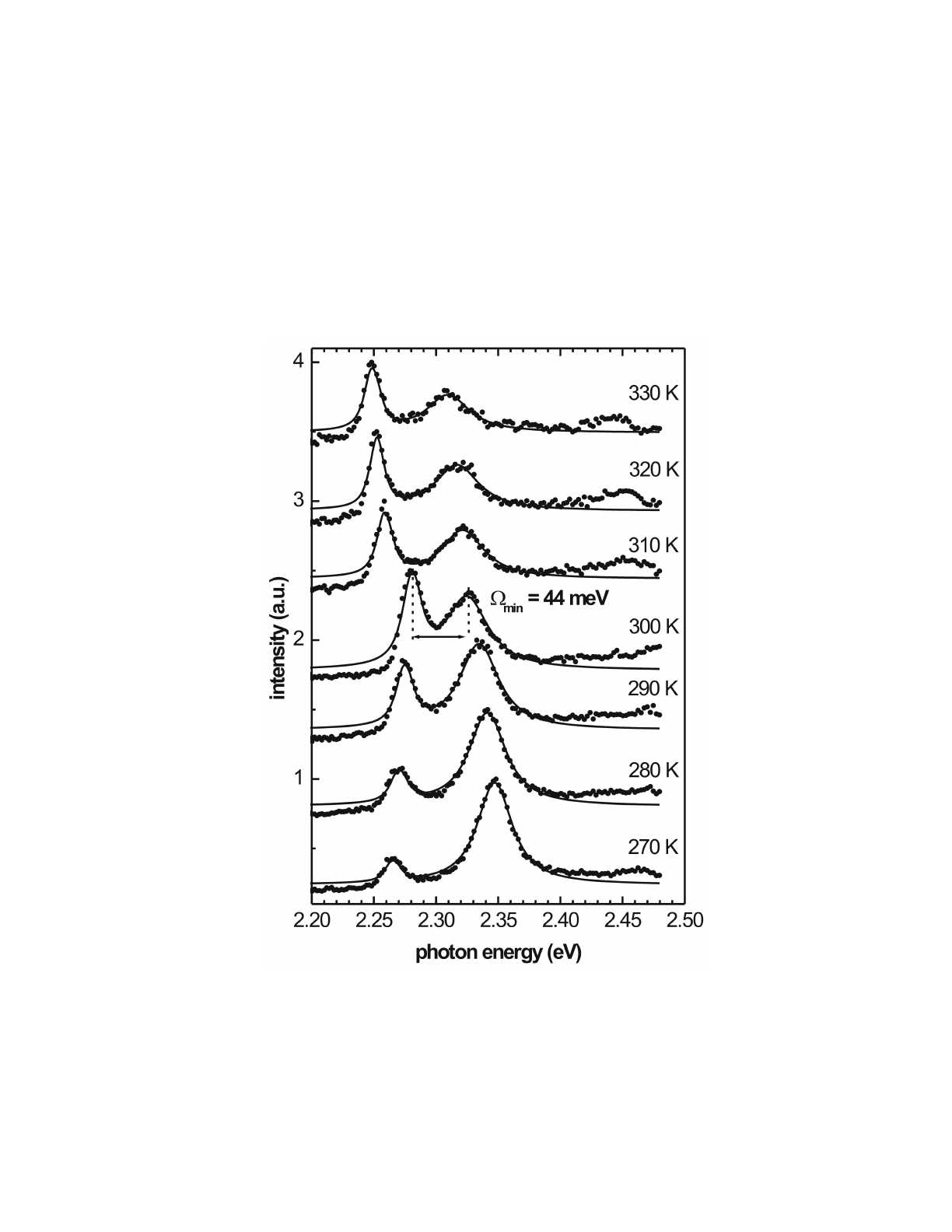
A large room temperature Rabi-splitting energy of Ω >35 meV has been measured
in microcavities containing four ZnSe/(Zn,Cd)Se quantum wells as active layers. The
”anti-crossing” behavior of the polariton modes has been demonstrated by reflectivity as
well as photoluminescence investigations.
Therefore two different methods of microcavity resonance tuning have been performed.
In reflectivity measurements the photonic mode has been tuned in resonance with the
excitonic mode by varying the spot position on the sample in direction of the micro-
cavity length gradient. In contrast to this, in temperature-dependent photoluminescence
measurements the polariton dispersion is obtained by modifying the resonance condi-
tion between excitonic and photonic mode via the temperature shift of the quantum well
transition energy.
All experimental results are in good agreement with the calculated polariton properties
based on the quantum electrodynamical model of a coupled photon-exciton oscillator.
Loading more pages...