
Imaging the Shapes and Dynamics of
Superfluid Helium Nanodroplets
vorgelegt von
M. Sc.
Bruno Langbehn
ORCID: 0000-0002-3245-8169
an der Fakultät II – Mathematik und Naturwissenschaften
der Technischen Universität Berlin
zur Erlangung des akademischen Grades
Doktor der Naturwissenschaften
Dr.rer.nat.
genehmigte Dissertation
Promotionsausschuss:
Vorsitzende: Prof. Dr. Kathy Lüdge
Gutachter: Prof. Dr. Thomas Möller
Gutachterin: Prof. Dr. Daniela Rupp
Gutachter: Prof. Dr. Karl-Heinz Meiwes-Broer
Tag der wissenschaftlichen Aussprache: 23. März 2021
Berlin 2021

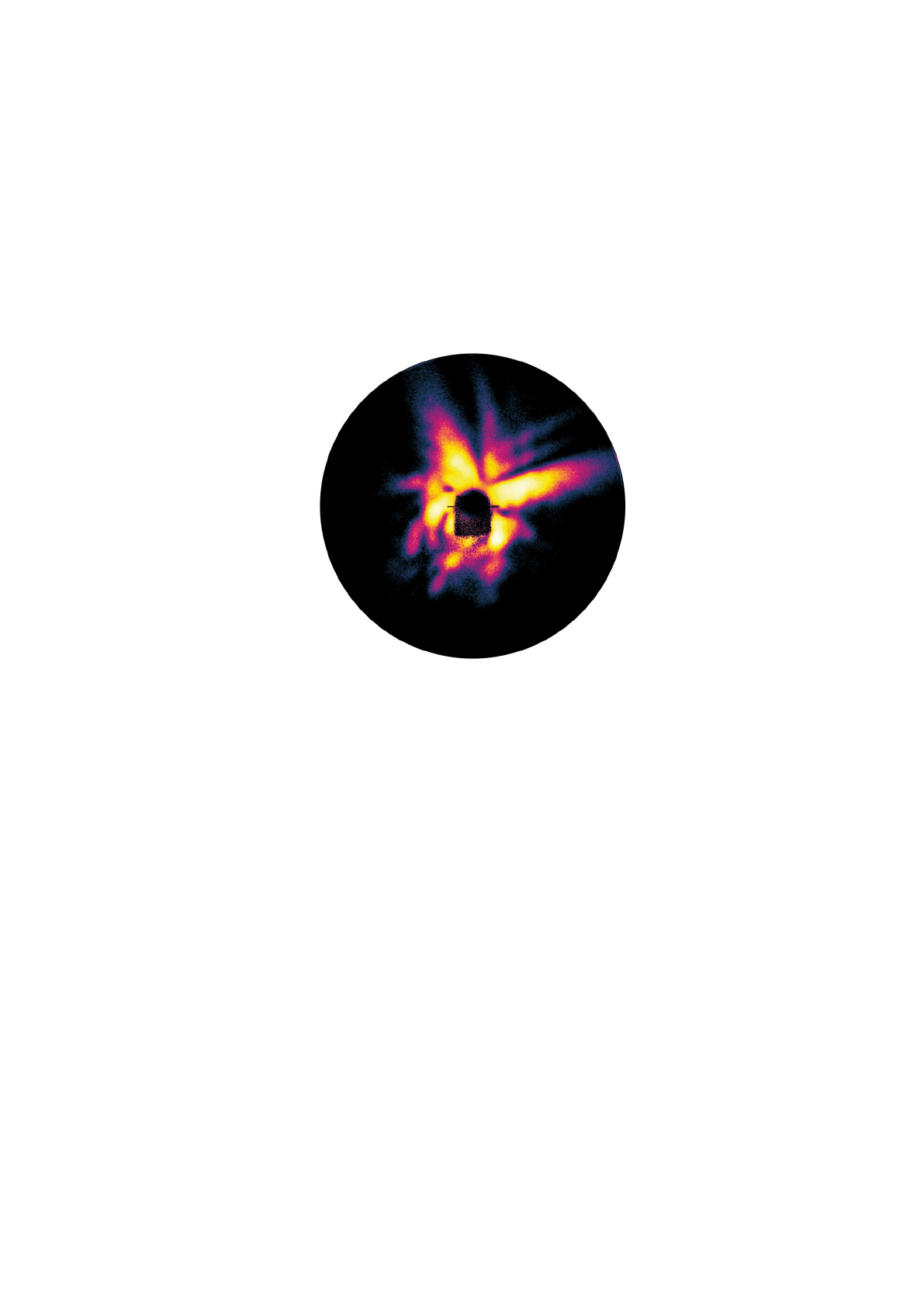
No chaos damn it.
– Jackson Pollock (1950)


Acknowledgments
I would like to thank the many people that contributed to this work – I would not have
been able to complete it without your support. Looking back, I am deeply grateful for
experiencing a vibrant scientific community based on teamwork and collaboration at
beam times, conferences, and in academia.
It was Thomas Möller enabling me to have that experience. I want to thank him for
giving me the opportunity to work in his group, for his reassuring advice, and for his
guidance throughout all stages of this endeavor. I learned so much from him in so many
different ways.
I am equally grateful to Daniela Rupp, who always helped me finding my way with her
ability to motivate and inspire people while creating confidence by seemingly knowing
what steps to be taken next. She, too, has truly become a role model for me.
Further, I want to thank Yevheniy Ovcharenko who played a key role in the experiment at
FERMI and thereby organized one of the smoothest beam times I have ever participated
in. Of course, this would not have been possible without the wonderful group of
people working at the experiment, the FERMI staff, and the team of the Low Density
Matter beamline. Therefore, I would like to especially thank Carlo Callegari, Oksana
Plekan, Michele DiFraia, Kevin C. Prince, Riccardo Cucini, Paola Finetti, Alexander
Demidovich, and Luca Giannessi. In addition, I want to thank Aaron C. LaForge and
Paolo Piseri for the always joyful time spent at the beamline – and at “Al Tiglio”.
I would like to thank Thomas Fennel and his group, especially Christian Peltz and
Katharina Sander, who contributed a lot to advance the analysis and the interpretation
of the data with their simulation and fitting routines.
For stimulating discussions on helium nanodroplets I would like to thank Andrey Vilesov,
Manuel Barranco, Francesco Ancilotto, Marius Lewerenz, and Frank Stienkemeier.
Finally, I would like to express my gratitude to the people in the group of Thomas Möller
for helping me – in one way or another – accomplish this thesis and for the congenial
working environment. I want to say a special thank you to Andrea Merli who largely
contributed to the enriching time I had teaching at the “Projektlabor”. I want to also
thank all the other group members I had the chance to work with in these past years:
Mario Sauppe, Anatoli Ulmer, Julian Zimmermann, Björn Senfftleben, Rico Mayro P.
Tanyag, Robert Richter, Tobias Bischoff, Andre Knecht, Maria Richter, Jan Philippe
Müller, Torbjörn Rander, Linos Hecht, Andrea Heilrath, Jakob Jordan, Katharina
Kolatzki, Frederic Ußling, Felix Zimmermann, Patrick Behrens, Theresa Höhne, Jonas
Hügle, Morten Kallevik Straume, Leonie Werner, Alexander Nelde, Thomas Menz, Tung
Cao Thanh, Pablo Nuñez von Voigt, Annabelle Spanier, Philipp Nelde, Fabian Seel,
Georg Noffz, Timo Dörries, Nils Bernhardt, Jannis Zimbalski, and Niklas Schneider.
v
Loading more pages...