J. Vac. Sci. Technol. A 34, 01A135 (2016); https://doi.org/10.1116/1.4936390 34, 01A135
© 2015 American Vacuum Society.
Enhancing of catalytic properties of vanadia
via surface doping with phosphorus using
atomic layer deposition
Cite as: J. Vac. Sci. Technol. A 34, 01A135 (2016); https://doi.org/10.1116/1.4936390
Submitted: 27 August 2015 . Accepted: 12 November 2015 . Published Online: 11 December 2015
Verena E. Strempel, Daniel Löffler, Jutta Kröhnert, Katarzyna Skorupska, Benjamin Johnson, Raoul
Naumann d'Alnoncourt, Matthias Driess, and Frank Rosowski
ARTICLES YOU MAY BE INTERESTED IN
Atomic layer deposition on porous powders with in situ gravimetric monitoring in a modular
fixed bed reactor setup
Review of Scientific Instruments 88, 074102 (2017); https://doi.org/10.1063/1.4992023
Surface chemistry of atomic layer deposition: A case study for the trimethylaluminum/water
process
Journal of Applied Physics 97, 121301 (2005); https://doi.org/10.1063/1.1940727
Review Article: Catalysts design and synthesis via selective atomic layer deposition
Journal of Vacuum Science & Technology A 36, 010801 (2018); https://
doi.org/10.1116/1.5000587

Enhancing of catalytic properties of vanadia via surface doping
with phosphorus using atomic layer deposition
Verena E. Strempel
BasCat - UniCat BASF JointLab, Technische Universit€
at Berlin, Sekr. EW K 01, Hardenbergstraße 36,
10623 Berlin, Germany
Daniel L€
offler
Process Research and Chemical Engineering, BASF SE, Carl-Bosch-Straße 38, 67056 Ludwigshafen,
Germany
Jutta Kr€
ohnert, Katarzyna Skorupska, and Benjamin Johnson
Department of Inorganic Chemistry, Fritz-Haber-Institut der Max-Planck-Gesellschaft, Faradayweg 4-6,
14195 Berlin, Germany
Raoul Naumann d’Alnoncourt
a)
BasCat - UniCat BASF JointLab, Technische Universit€
at Berlin, Sekr. EW K 01, Hardenbergstraße 36,
10623 Berlin, Germany
Matthias Driess
BasCat - UniCat BASF JointLab, Technische Universit€
at Berlin, Sekr. EW K 01, Hardenbergstraße 36,
10623 Berlin, Germany and Technische Universit€
at Berlin, Institut f€
ur Chemie, Sekr. C2,
Straße des 17. Juni 135, 10623 Berlin, Germany
Frank Rosowski
BasCat - UniCat BASF JointLab, Technische Universit€
at Berlin, Sekr. EW K 01, Hardenbergstraße 36,
10623 Berlin, Germany and Process Research and Chemical Engineering, BASF SE, Carl-Bosch-Straße 38,
67056 Ludwigshafen, Germany
(Received 27 August 2015; accepted 12 November 2015; published 11 December 2015)
Atomic layer deposition is mainly used to deposit thin films on flat substrates. Here, the authors
deposit a submonolayer of phosphorus on V
2
O
5
in the form of catalyst powder. The goal is to
prepare a model catalyst related to the vanadyl pyrophosphate catalyst (VO)
2
P
2
O
7
industrially used
for the oxidation of n-butane to maleic anhydride. The oxidation state of vanadium in vanadyl
pyrophosphate is 4þ. In literature, it was shown that the surface of vanadyl pyrophosphate contains
V
5þ
and is enriched in phosphorus under reaction conditions. On account of this, V
2
O
5
with the
oxidation state of 5þfor vanadium partially covered with phosphorus can be regarded as a suitable
model catalyst. The catalytic performance of the model catalyst prepared via atomic layer
deposition was measured and compared to the performance of catalysts prepared via incipient
wetness impregnation and the original V
2
O
5
substrate. It could be clearly shown that the dedicated
deposition of phosphorus by atomic layer deposition enhances the catalytic performance of V
2
O
5
by suppression of total oxidation reactions, thereby increasing the selectivity to maleic anhydride.
V
C2015 American Vacuum Society.[http://dx.doi.org/10.1116/1.4936390]
I. INTRODUCTION
Selective oxidation reactions are of great interest for the
(petro-)chemical industry, especially concerning the upcom-
ing raw material change. However, the direct oxidation of
alkanes, e.g., from natural gas, to produce bulk and platform
chemicals is not yet conventional. Industry lacks sufficient
active and selective catalysts. The only successfully estab-
lished reaction is the selective oxidation of n-butane to
maleic anhydride (MAN) with vanadyl pyrophosphate
(VO)
2
P
2
O
7
(VPP) catalyst.
1–7
MAN is produced in a mega-
ton per year range with a yield around 60%. The understand-
ing of the mode of operation of VPP is of general interest to
improve and reasonably design selective alkane oxidation
catalysts. However, the reaction mechanism has not been
identified until now.
8,11
VPP and its precursors are extremely
dynamic and can form several metastable phases under oxi-
dation conditions with n-butane.
10–14
Hence, the resulting
surface differs substantially from a theoretical VPP single
crystal surface. The specific functions of the different surface
species in the oxidation process remain mostly unknown.
Suggestions have been made, including particular roles for
vanadium(IV)vanadium(V) redox couples, isolated V
5þ
sites, or POH Brønsted acidic sites.
3,9–11
Near-ambient
pressure x-ray photoelectron spectroscopy (XPS) measure-
ments showed that the surface features a significant amount
of V
5þ
under reaction conditions.
12–14
The average surface
vanadium oxidation state under reaction conditions (400 C
in n-butane/O
2
/H
2
O/N
2
) is with þ4.3 significantly higher
than in the bulk (þ4.0) and that the surface V/P/O ratio is
with 1/1.5/6 different than the bulk ratio of 1/1/4.5.
a)
01A135-1 J. Vac. Sci. Technol. A 34(1), Jan/Feb 2016 0734-2101/2016/34(1)/01A135/8/$30.00 V
C2015 American Vacuum Society 01A135-1

Based on the literature results, we propose that V
2
O
5
doped at its surface with phosphorus can be a highly simpli-
fied model for the VPP catalyst. To test our hypothesis, we
prepared several catalysts consisting of V
2
O
5
partially cov-
ered with phosphorus at the surface. We used equipment and
techniques usually applied for atomic layer deposition for
the surface doping of the V
2
O
5
with phosphorus. Our aim is
not to create thin layers of phosphorus oxide on V
2
O
5
but
only to cover the surface of V
2
O
5
partially with phosphorus.
Thus, it can be debated whether our experiments can be
called atomic layer deposition (ALD) experiments in com-
mon. As we plan to do this partial coverage in a single ALD
cycle, the usually reported tests to prove the successful
application of ALD (growth per cycle diagrams, etc.) cannot
be shown in our case. However, the conditions used for the
deposition of phosphorus on V
2
O
5
were successfully applied
for deposition of AlPO
4
layers on silicon wafers.
ALD is traditionally a thin film deposition technique,
which uses usually two vapor phase precursors.
15,16
A sub-
strate is sequentially exposed to an overdose of the precur-
sors. The precursor molecules react with the surface OH
groups until saturation. ALD is always self-limiting, as the
reaction terminates once all the reactive sites on the surface
are consumed. ALD is mainly applied to deposit thin films
on flat substrates such as silicon wafers, e.g., for electronic
materials. In literature, it was shown that ALD can also be a
promising new technique for the synthesis of catalytic mate-
rials, including substrates in the form of powder.
17,18
The
self-limiting character of the reactions makes it possible to
achieve uniformly distributed deposits on porous high-sur-
face-area solids, which are of particular interest for catalysis.
Unlike other traditional catalyst synthesis routes (e.g.,
impregnation, grafting), ALD largely preserves the original
surface structure. The support is not moistened or brought in
contact with other solvents during ALD.
For comparison, phosphorus was also deposited on the
surface of V
2
O
5
via incipient wetness impregnation.
Incipient wetness impregnation (IWI) is a traditional synthe-
sis route for heterogeneous catalysts. Usually, an active
metal precursor is dissolved in an aqueous or organic solu-
tion. Then, a volume of the metal-containing solution equal-
ing the free pore volume of the substrate is added to the
substrate filling the pores completely. The impregnated sub-
strate is then dried and calcined to remove all volatile com-
ponents of the added solution, depositing the metal on the
catalyst surface. In our case, we use phosphorus instead of a
metal, water as solvent, and the V
2
O
5
as substrate.
Finally, all prepared catalysts and the original V
2
O
5
as
reference were catalytically tested for the oxidation of n-bu-
tane to maleic anhydride under standard conditions compara-
ble to the industrial process.
II. EXPERIMENT
A. Chemicals
Vanadium(V) oxide (V
2
O
5
, min. 99.9%, high-purity,
GfE) was pressed without binder at 185 MPa, crushed, and
sieved to a particle size fraction of 100–200 lm. The oxide
was preheated to 393 K in constant air flow (500 ml/min) to
remove the adsorbed water prior to ALD or impregnation
experiments. Trimethylaluminum ([CH
3
]
3
Al TMA, elec-
tronic grade, 99.9999%, Aldrich), oxalic acid (C
2
H
2
O
4
,
puriss. p.a., 99.0%, Sigma-Aldrich), water (H
2
O,
CHROMASOLV, for HPLC, Sigma-Aldrich), phosphoric
acid (H
3
PO
4
, 85 wt. % in H
2
O, 99.99%, trace metals basis,
Aldrich), and P-ICP standard (TraceCERT, Fluka) were used
without further purification. The ALD precursor tris(dime-
thylamino)phosphine ([Me
2
N]
3
P, HMPT, 97%, Aldrich) was
fractionally distilled under N
2
twice.
B. Catalyst synthesis
1. Atomic layer deposition
The ALD experiments were conducted in a Beneq TFS
200 cross-flow system (Beneq Oy, Espoo, Finland). Prior to
the experiments depositing P on V
2
O
5
, suitable process pa-
rameters for the HMPT precursor were established. HMPT
was deposited together with TMA as AlPO
4
on silicon
wafers (diameter of 200 mm). H
2
O served as the oxygen
source and pure N
2
gas (99.999%) served as carrier and
purge gas. The different precursors were alternately pulsed
into the reaction chamber. One ALD cycle consisted of eight
steps and followed a dose-purge sequence of (Me
2
N)
3
P (0.1
s)–N
2
(3 s)–H
2
O (0.1 s)–N
2
(3 s)–TMA(3.5 s)–N
2
(4 s)–H
2
O
(0.1 s)–N
2
(3 s). H
2
O and TMA were dosed via saturators at
25 C. The saturator for HMPT was heated to 30 C. During
deposition, the reaction chamber was maintained at 1.0 mbar
and 120 C with a steady flow of N
2
of 300 ml/min. The
thickness of the deposited film was analyzed with a
SENTECH multiple angle laser ellipsometer SE 400adv in
mapping mode.
The catalyst sample ALD-P/V
2
O
5
was prepared with a
silicon wafer as a sample holder for the V
2
O
5
powder.
Five grams of the oxide were uniformly spread over the wa-
fer to give a height of the powder layer below 2 mm. As
above, the saturator temperature was 30 C, the substrate
temperature was 120 C, and the pressure in the reaction
chamber was 1.0 mbar in a flow of 300 ml/min of N
2
. One
single ALD cycle was performed on 5 g V
2
O
5
with three
pulses of (Me
2
N)
3
P (each 3.5 s), N
2
purge (300 s), 500 O
3
pulses (each 2.5 s), and a final N
2
purge (300 s). O
3
was gen-
erated with the built-in ozone generator HyXo BMT 803N
(HyXo Oy, Kerava, Finland) using pure oxygen (99.999%)
as feed gas. O
3
production was 8 g/h (at 100 g/Nm
3
at 20 C).
2. Incipient wetness impregnation
A sample series of P/V
2
O
5
was prepared using IWI.
19,20
H
3
PO
4
or HMPT served as precursors and their desired
amounts were diluted in water. The total volume of solution
corresponded to the pore volume of V
2
O
5
(0.72 ml/g), which
was determined in advance. The oxide was impregnated
with the precursor solution and dried in constant flow of air
(500 ml/min) for 2 h at 110 C. The powders were subse-
quently calcined under continuous air flow (500 ml/min) at
450 C for 5 h.
01A135-2 Strempel et al.: Enhancing of catalytic properties of vanadia 01A135-2
J. Vac. Sci. Technol. A, Vol. 34, No. 1, Jan/Feb 2016

C. Characterization
N
2
physisorption measurements were performed at liquid
N
2
temperature on a Quantachrome Autosorb-6B analyzer.
Prior to the measurement, the samples were outgassed in
vacuum at 150 C for 2 h. The specific surface area S
BET
was
calculated according to the multipoint Brunauer–Emmett–
Teller method (BET).
Fourier transform infrared spectra (FTIR) were collected
on a Perkin-Elmer PE 100 spectrometer equipped with a
deuterated triglycine sulfate pyroelectric detector (64 accu-
mulated scans, 4 cm
1
resolution). The samples were pressed
(371 MPa) into infrared transparent, self-supporting wafers
(typically 10–16 mg/cm
2
), which were placed in an in situ
infrared transmission cell. The IR cell was directly con-
nected to a vacuum system equipped with a gas dosing line.
The catalysts were pretreated in vacuum (10
6
mbar) at
473 K for 1 h. Following this, ammonia was adsorbed at
293 K by increasing the equilibrium pressure to 7 mbar for
90 min. The gas phase was subsequently removed at 353 K
(10
6
mbar for 30 min). The spectra have been taken in am-
monia every 30 min and before and after gas desorption at
293 K.
The P content of the samples was determined with an
inductively coupled plasma-optical emission spectroscopy
(ICP-OES, Varian 720-ES). The powders were dissolved in
water using oxalic acid prior to ICP-OES measurements.
The spectroscope was five-point calibrated with a commer-
cially available, diluted standard for P.
XPS measurements were performed in a vacuum chamber
(10
8
mbar) using a Phoibos 150 MCD-9 hemispherical ana-
lyzer and an Al Kax-ray source (1486.6 eV). The resulting
peaks were normalized by number of sweeps, inelastic mean
free path, analyzer transmission function, and absorption
cross section. The energy scale was calibrated with sputter-
cleaned gold (Au 4f
7/2
¼84.0 eV) and copper (Cu 2p
3/2
¼932.7 eV).
Powder x-ray diffraction (XRD) measurements were per-
formed on a STOE STADI P transmission diffractometer
equipped with a primary focusing Ge monochromator (Cu
Ka
1
radiation) and DECTRIS MYTHEN 1K position sensi-
tive solid-state detector. The samples were mounted in the
form of small amounts of powder sandwiched between two
layers of polyacetate film and fixed with x-ray amorphous
grease.
D. Catalytic testing
Catalytic tests for the selective oxidation of butane to ma-
leic anhydride were carried out in a high-throughput setup
(hte GmbH, Heidelberg, Germany). The setup consisted of a
gas dosing unit, a reactor unit, and an analytics unit. The
setup was fully automated in terms of process control, data
processing, and management. The gas dosing unit allowed
mixing feeds containing N
2
,O
2
,n-butane, Ar (as internal
standard), and H
2
O. The reaction was conducted at atmos-
pheric pressure. The reactor unit consisted of eight parallel
reactors (outer diameter 18 mm and inner diameter 12 mm)
for catalyst samples with a maximum bed volume of 1 ml
and one blank reactor filled with inert material. The reactor
temperature was individually controlled for each reactor in
the range of 250–550 C. The temperature in the catalyst bed
was monitored by a multipoint thermocouple with three
measuring points along the fixed bed. The effluent gas of
each reactor was analyzed by two gas chromatographs
(7890A, Agilent) equipped with thermal conductivity and
flame ionization detectors. In addition, the effluent gas of the
blank reactor, which equals the inlet gas of all reactors, was
analyzed as well. A RTX wax column (Restek) separated
oxygenates. A HP-Plot Q column (Agilent) separated
alkanes and olefins. Permanent gases were separated using a
parallel combination of CP-Molsieve and PoraBOND Q
columns (Agilent).
The catalytic test was carried out in a gas mixture of 2%
butane, 3% steam, 3% argon, and 20% O
2
balanced with N
2
.
The gas hourly space velocity (GHSV) was fixed to
2000 h
1
. The catalyst beds consisted of 1 ml of a sieve frac-
tion of 100–200 lm, respectively. The catalyst performance
was tested in a temperature range starting from 300 to
450 C in steps of 25 K. Each temperature was held for 12 h.
During this time, the effluent gas of each reactor including
the blank reactor was analyzed five times. After reaching the
final temperature of 450 C, the temperature steps at 375,
350, and 325 C were repeated to check for activation or
deactivation of the catalyst samples with time on stream.
III. RESULTS AND DISCUSSION
A. V
2
O
5
reference characterization
The V
2
O
5
starting material was analyzed with FTIR spec-
troscopy of adsorbed ammonia to determine the concentra-
tion of acidic hydroxyl groups at the surface. The spectrum
of the preheated V
2
O
5
sample in vacuum was taken as a ref-
erence. Both, the spectrum obtained in the presence of gas-
phase NH
3
and the spectrum recorded after desorption of
physisorbed NH
3
are presented in Fig. 1. The adsorbed am-
monia on the surface gives mainly three bands.
21,22
The
peak at 1423 cm
1
is attributed to the asymmetric deforma-
tion vibration of ammonium ions formed by reaction of NH
3
with Brønsted acid sites. The band of the corresponding
symmetric deformation vibration is found as a weak feature
near 1670 cm
1
. Lewis acid sites on the surface of the oxide
are indicated by peaks corresponding to symmetric and
asymmetric deformation vibrations of coordinately bonded
ammonia molecules at 1300–1150 and 1611 cm
1
,
respectively.
The concentration of Brønsted acid sites is 9 lmol/g,
which has been calculated based on the integrated area of
the peak at 1423 cm
1
applying an extinction coefficient of
e¼2.1510
5
cm
2
/mol.
21,22
The extinction coefficient has
been determined in the literature for the asymmetric defor-
mation vibration of ammonium ions adsorbed on Al
2
O
3
-sup-
ported vanadia. A surface area of 3.87 m
2
/g was calculated
based on the adsorption isotherm of nitrogen measured at
77 K and the multipoint BET. Together with the OH site
concentration, the OH surface density can be calculated to
2.33 lmol/m
2
, which corresponds to 1.4 OH sites/nm
2
.
01A135-3 Strempel et al.: Enhancing of catalytic properties of vanadia 01A135-3
JVST A - Vacuum, Surfaces, and Films
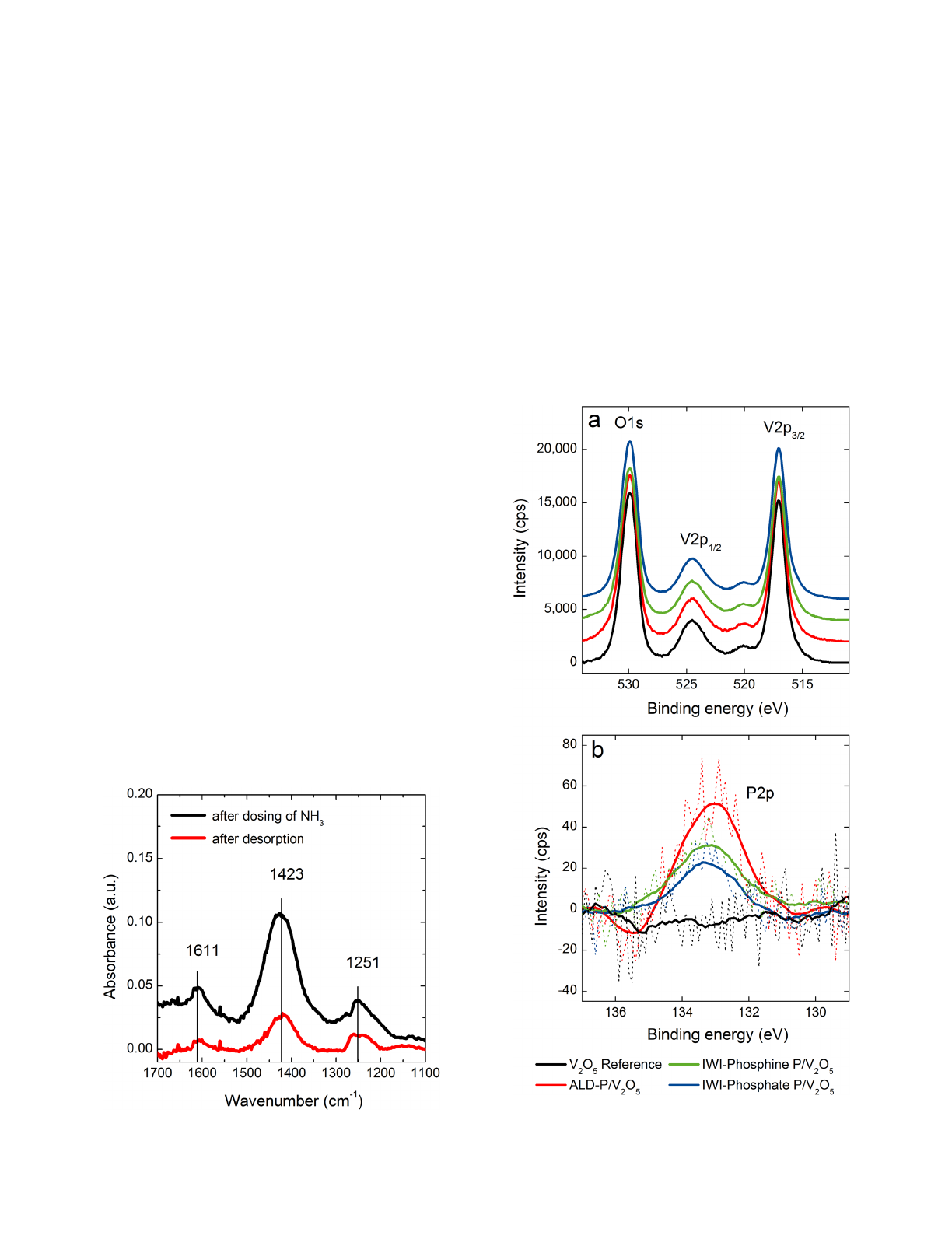
In addition to FTIR, XRD and XPS studies have been
conducted with the pure V
2
O
5
. The recorded XRD pattern
confirms the phase purity of the V
2
O
5
(Fig. 3). XPS studies
verify the oxidation state of þ5 for vanadium (Fig. 2).
B. Phosphorus atomic layer deposition
In preliminary experiments, the phosphorus precursor
was deposited on silicon wafers together with TMA and
water as an oxygen source yielding AlPO
4
. A dosing temper-
ature of 30 C for the P precursor and substrate temperature
of 120 C led to a uniform coating of the entire wafer. The
conformity of the wafer coating was confirmed with ellips-
ometry. An average thickness of 26.2 nm was reached after
200 ALD cycles. This corresponds to an average growth per
cycle of 1.31 A
˚/cycle. The ascertained average refractive
index of 1.550 is in good agreement with the literature value
of AlPO
4
n
D
¼1.546.
23
There are several literature reports
about different ALD processes for the formation of AlPO
4
.
H€
am€
al€
ainen et al. deposited AlPO
4
with aluminum chloride
AlCl
3
and trimethylphosphate (CH
3
O)
3
PO. They obtained a
growth rate of 1.4 A
˚/cycle and a refractive index of 1.5 at a
deposition temperature of 150 C.
24
At the same deposition
temperature Liu et. al. reached 1.7 A
˚/cycle with TMA and
trimethylphosphite.
25
The reported processes have been pro-
ven to be self-limiting due to the linear relationship between
film thickness and ALD cycle number. Our results for aver-
age growth rate and refractive index are in excellent agree-
ment with the reported ALD experiments. As our
experimentation time at the Beneq facility was limited, we
did not investigate the deposition of AlPO
4
in more detail,
e.g., measuring saturation curves or thickness-cycle number
plots. We were not primarily interested in the formation of
thick layers of AlPO
4
, but needed to determine suitable tem-
perature parameters for the P precursor. Based on our results,
we assume that our process for deposition of AlPO
4
is self-
limiting and thus an ALD process.
The temperatures for the formation of AlPO
4
were also
set for the deposition of P on V
2
O
5
using O
3
as oxygen
source. The conditions were chosen to ensure full saturation
of the V
2
O
5
surface with the P precursor in one single ALD
cycle. The deposition process was therefore not optimized in
time or precursor consumption. Both precursors were highly
overdosed. One ALD cycle led to a P/V
2
O
5
ratio of
121.9 lg(P)/g(V
2
O
5
), which was analyzed with ICP-OES
(see Table I). Assuming that one P precursor molecule reacts
with one OH site on the surface, we can calculate a surface
coverage of 43% based on the OH site density.
Although direct saturation curves for the ALD process
were not recorded, e.g., with online mass spectrometry or
FIG. 1. (Color online) FTIR spectra of ammonia adsorbed on the reference
V
2
O
5
. The spectra have been taken after NH
3
dosing at 293 K at 7 mbar and
desorption of NH
3
in vacuum 10
6
mbar at 473 K for 1 h.
FIG. 2. (Color online) XPS spectra of V
2
O
5
reference and P/V
2
O
5
samples:
(a) Spectra of the V 2p–O 1s region of vanadium oxide. No peak fitting is
shown (plotted with offset for clarity); (b) Spectra of the P 2p region (solid
lines are included to guide eye).
01A135-4 Strempel et al.: Enhancing of catalytic properties of vanadia 01A135-4
J. Vac. Sci. Technol. A, Vol. 34, No. 1, Jan/Feb 2016
Loading more pages...