
This version is available at https://doi.org/10.14279/depositonce-10426
Copyright applies. A non-exclusive, non-transferable and limited
right to use is granted. This document is intended solely for
personal, non-commercial use.
Terms of Use
Guevara-Carrion, G., Fingerhut, R., & Vrabec, J. (2020). Fick Diffusion Coefficient Matrix of a Quaternary
Liquid Mixture by Molecular Dynamics. The Journal of Physical Chemistry B, 124(22), 4527–4535.
https://doi.org/10.1021/acs.jpcb.0c01625
Gabriela Guevara-Carrion, Robin Fingerhut, Jadran Vrabec
Fick Diffusion Coefficient Matrix of a
Quaternary Liquid Mixture by Molecular
Dynamics
Accepted manuscript (Postprint)Journal article |

Fick Diffusion Coefficient Matrix of a
Quaternary Liquid Mixture by Molecular
Dynamics
Gabriela Guevara-Carrion, Robin Fingerhut, and Jadran Vrabec∗
Thermodynamics and Process Engineering, Technical University Berlin, 10587 Berlin, Germany
E-mail: vrabec@tu-berlin.de
Phone: +49 30 314 22755
1
Abstract
For the first time, the Fick diffusion coefficient matrix of a quaternary liquid mixture is
sampled consistently by means of molecular dynamics simulation. The required phenomeno-
logical diffusion coefficient and thermodynamic factor matrices of the mixture water + methanol
+ ethanol + 2-propanol are determined following the Green-Kubo formalism and Kirkwood-
Buff theory. Further, a system size correction methodology for the Fick diffusion coefficient of
multicomponent mixtures is proposed. Ten compositions are studied under ambient conditions
and validated by analyzing the ternary limits of the quaternary Fick diffusion matrix. Because
of complex intermolecular interactions due to the presence of hydrogen bonding, the elements
of the Fick diffusion coefficient matrix exhibit a significant composition dependence. The
magnitude of several cross coefficients indicate important coupling effects mainly affecting
the diffusive flux of water. These effects are explained in the light of the structural infor-
mation given by the radial distribution functions of the mixture. This work that solely rests
on molecular dynamics simulation techniques to predict the Fick diffusion coefficient matrix
of quaternary mixtures is expected to be a significant step forward for the understanding of
multicomponent diffusion.
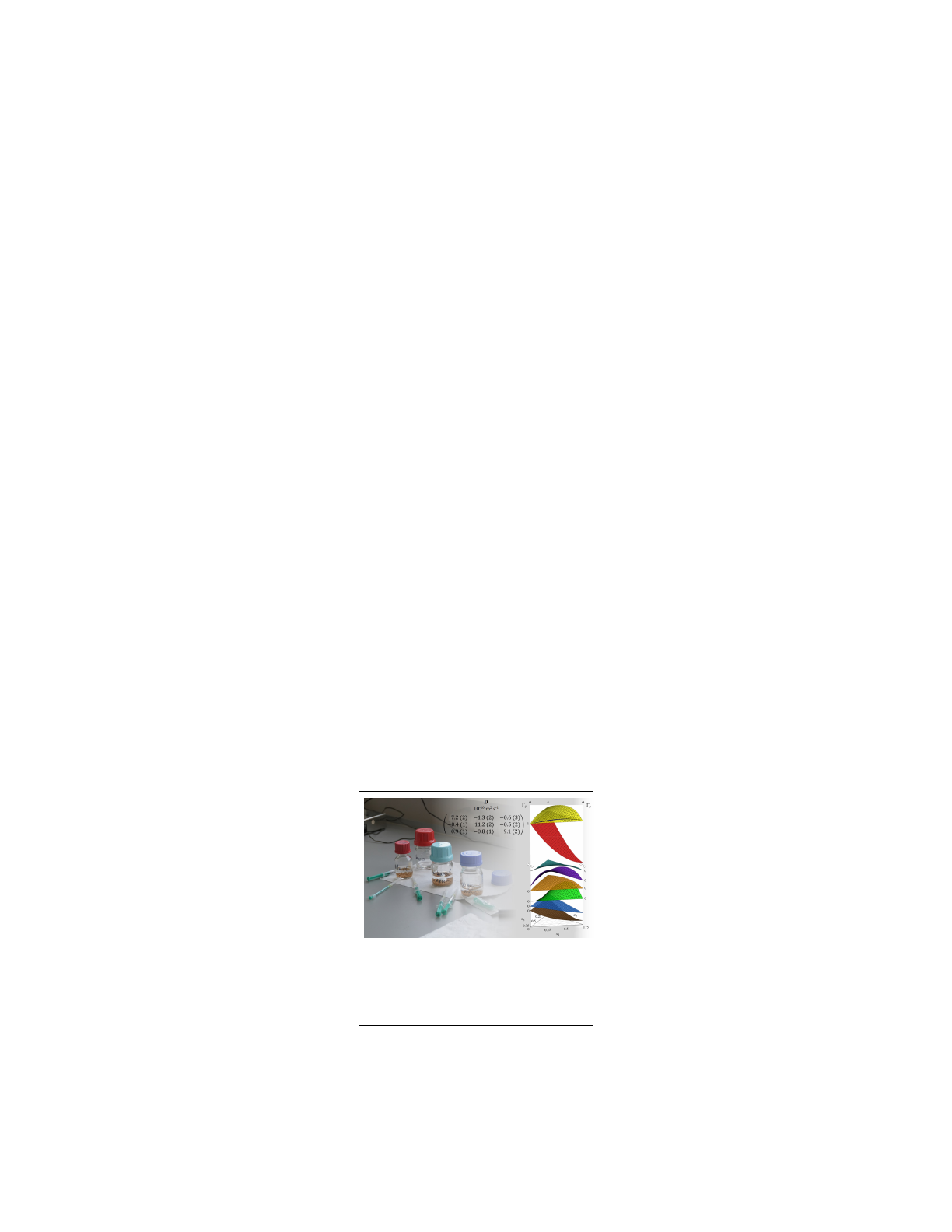
Graphical TOC Entry
2

Introduction
Multicomponent solutions are involved in the majority of mass transfer processes occurring in
nature and technical applications1. Almost all separation processes in chemical engineering, such
as distillation, absorption or extraction, are affected by multicomponent diffusion in liquids. Rate-
based methods employed for modeling, design and control of these unit operations involve mass
and energy transfer models, which require diffusion coefficient data for mixtures2.
Mass transport in multicomponent systems is complex. For instance, describing isothermal-
isobaric diffusion of a quaternary mixture by Fick’s law requires a matrix with nine different diffu-
sion coefficient elements that are composition dependent. Related experimental work is challeng-
ing not only because of the elaborate equipment that is required to distinguish between different
components, but also because of the presence of coupling effects that hinder data processing and
interpretation3. Consequently, the availability of experimental data on diffusion coefficients for
mixtures containing three or more components is very limited4. In fact, they have experimentally
been measured only for 17 quaternary mixtures5–17, but in some of these cases, only the main ele-
ments of the diffusion matrix are reported. With diffusion having entered the scientific arena in the
1850s through the contributions of Graham18 and Fick19, experimental measurements alone are
obviously not able to satisfy the growing need for accurate mass transport properties20, particularly
for liquids that are constituted of many components.
Most predictive equations for diffusion coefficients of multicomponent liquids are extensions
of the Darken relation21–23, which is not valid for mixtures with strong intermolecular interactions.
The underlying physical phenomena are not well understood and the lack of experimental data im-
pedes the development and verification of new predictive equations. On the other hand, molecular
dynamics simulation is a compelling alternative for such predictions. In fact, such simulations
have the capability to accurately predict Fick diffusion coefficients of binary24,25 and ternary mix-
tures26,27. Krishna and van Baten21 were the first to deduce the required mathematical framework
and sampled the Maxwell-Stefan diffusion coefficient matrix of quaternary n-alkane mixtures with
molecular dynamics. Later, Liu et al.22 determined the Maxwell-Stefan diffusion coefficients of
3

quaternary model mixtures interacting with the Weeks-Chandler-Andersen potential. However,
none of these works predicted the Fick diffusion coefficient, perhaps because of the lack of a
mathematical framework to sample the required thermodynamic factor matrix. In a recent work
of our group28, expressions for the thermodynamic factor matrix of quaternary mixtures based on
Kirkwood-Buff theory were derived to close this gap. To the best of our knowledge, this is the
first work on the prediction of quaternary Fick diffusion coefficients solely based on molecular
dynamics simulation techniques.
The quaternary mixture water + methanol + ethanol + 2-propanol was chosen in this context
since the Fick diffusion coefficient of most of the involved subsystems has been predicted in pre-
vious work. In fact, the binary subsystems water + methanol29, water + ethanol29, methanol +
ethanol30, water + 2-propanol25, and the ternary subsystem water + methanol + ethanol26,27 have
successfully been studied in this sense.
Theory
In the framework of the generalized form of Fick’s law, the molar flux of component iin a mixture
of four components is written as a linear combination of concentration gradients ∇cj31
Ji=−
3
∑
j=1
Di j∇cj,(i=1,2,3),(1)
where Dii are the main diffusion coefficients that relate the molar flux of component ito its own
concentration gradient and Di j are the cross diffusion coefficients that relate the molar flux of
component ito the concentration gradient of component j32. The Fick approach involves three
independent diffusion fluxes and a 3×3 diffusion coefficient matrix, which is generally not sym-
metric, i.e. Di j 6=Dji. Further, the numerical values of Di j depend both on the reference frame for
velocity (molar-, mass- or volume-averaged) and on the order of the components. In this work, the
molar-averaged reference frame is employed throughout.
The main shortcoming of Fick’s law is the fact that concentration gradients are not the true
4
Loading more pages...