1 © EURATOM 2019 Printed in the UK
Nuclear Fusion
Overview of first Wendelstein 7-X
high-performance operation
T.Klinger1,2, T.Andreeva1, S.Bozhenkov1, C.Brandt1, R.Burhenn1,
B.Buttenschön1, G.Fuchert1, B.Geiger1, O.Grulke1,3, H.P.Laqua1,
N.Pablant4, K.Rahbarnia1, T.Stange1, A.von Stechow1, N.Tamura5,
H.Thomsen1, Y.Turkin1, T.Wegner1, I.Abramovic1, S.Äkäslompolo1,
J.Alcuson1, P.Aleynikov1, K.Aleynikova1, A.Ali1, A.Alonso6, G.Anda7,
E.Ascasibar6, J.P.Bähner1, S.G.Baek9, M.Balden10, J.Baldzuhn1,
M.Banduch1, T.Barbui11, W.Behr8, C.Beidler1, A.Benndorf1,
C.Biedermann1, W.Biel8, B.Blackwell12, E.Blanco6, M.Blatzheim1,
S.Ballinger9, T.Bluhm1, D.Böckenhoff1, B.Böswirth10, L.-G.Böttger1,3,
M.Borchardt1, V.Borsuk8, J.Boscary10, H.-S.Bosch1, M.Beurskens1,
R.Brakel1, H.Brand13, T.Bräuer1, H.Braune1, S.Brezinsek8, K.-J.Brunner1,
R.Bussiahn1, V.Bykov1, J.Cai8, I.Calvo6, B.Cannas14, A.Cappa6,
A.Carls1, D.Carralero6, L.Carraro15, B.Carvalho16, F.Castejon6, A.Charl8,
N.Chaudhary1, D.Chauvin17, F.Chernyshev18, M.Cianciosa19,
R.Citarella20, G.Claps21, J.Coenen8, M.Cole1, M.J.Cole19, F.Cordella21,
G.Cseh7, A.Czarnecka22, K.Czerski23, M.Czerwinski1, G.Czymek8,
A.da Molin24, A.da Silva17, H.Damm1, A.de la Pena6, S.Degenkolbe1,
C.P.Dhard1, M.Dibon10, A.Dinklage1, T.Dittmar8, M.Drevlak1,
P.Drewelow1, P.Drews8, F.Durodie26, E.Edlund9, P.van Eeten1,
F.Effenberg11, G.Ehrke1, S.Elgeti10, M.Endler1, D.Ennis27, H.Esteban6,
T.Estrada6, J.Fellinger1, Y.Feng1, E.Flom11, H.Fernandes17, W.H.Fietz25,
W.Figacz22, J.Fontdecaba6, O.Ford1, T.Fornal22, H.Frerichs10, A.Freund8,
T.Funaba5, A.Galkowski22, G.Gantenbein25, Y.Gao8, J.García Regaña6,
D.Gates4, J.Geiger1, V.Giannella20, A.Gogoleva28, B.Goncalves17,
A.Goriaev26, D.Gradic1, M.Grahl1, J.Green11, H.Greuner10, A.Grosman17,
H.Grote1, M.Gruca22, C.Guerard6, P.Hacker1, X.Han8, J.H.Harris19,
D.Hartmann1, D.Hathiramani1, B.Hein1, B.Heinemann10, P.Helander1,2,
S.Henneberg1, M.Henkel8, J.Hernandez Sanchez6, C.Hidalgo6,
M.Hirsch1, K.P.Hollfeld8, U.Höfel1, A.Hölting1, D.Höschen8, M.Houry17,
J.Howard13, X.Huang5, Z.Huang1, M.Hubeny8, M.Huber25, H.Hunger25,
K.Ida5, T.Ilkei7, S.Illy25, B.Israeli4, S.Jablonski22, M.Jakubowski1,
J.Jelonnek25, H.Jenzsch1, T.Jesche29, M.Jia8, P.Junghanns10,
J.Kacmarczyk22, J.-P.Kallmeyer1, U.Kamionka1, H.Kasahara5,
W.Kasparek29, Y.O.Kazakov26, N.Kenmochi5, C.Killer1, A.Kirschner8,
R.Kleiber1, J.Knauer1, M.Knaup8, A.Knieps8, T.Kobarg25, G.Kocsis7,
F.Köchl30, Y.Kolesnichenko31, A.Könies1, R.König1, P.Kornejew1,
J.-P.Koschinsky1, F.Köster32, M.Krämer29, R.Krampitz1, A.Krämer-
Flecken8, N.Krawczyk22, T.Kremeyer11, J.Krom1, M.Krychowiak1,
I.Ksiazek33, M.Kubkowska22, G.Kühner1, T.Kurki-Suonio34, P.A.Kurz1,
S.Kwak1, M.Landreman35, P.Lang10, R.Lang25, A.Langenberg1,
T. Klinger etal
Overview of first Wendelstein 7-X high-performance operation
Printed in the UK
112004
NUFUAU
© EURATOM 2019
59
Nucl. Fusion
NF
10.1088/1741-4326/ab03a7
Paper
11
Nuclear Fusion
IOP
Original content from this work may be used under the terms
of the Creative Commons Attribution 3.0 licence. Any further
distribution of this work must maintain attribution to the author(s) and the title
of the work, journal citation and DOI.
International Atomic Energy Agency
2019
1741-4326
1741-4326/19/112004+11$33.00
https://doi.org/10.1088/1741-4326/ab03a7
Nucl. Fusion 59 (2019) 112004 (11pp)

T. Klinger etal
2
S.Langish4, H.Laqua1, R.Laube1, S.Lazerson4, C.Lechte29, M.Lennartz8,
W.Leonhardt25, C.Li1, C.Li8, Y.Li8, Y.Liang8, C.Linsmeier8, S.Liu8,
J.-F.Lobsien1, D.Loesser6, J.Loizu Cisquella1, J.Lore19, A.Lorenz1,
M.Losert25, A.Lücke, A.Lumsdaine19, V.Lutsenko31, H.Maaßberg1,
O.Marchuk8, J.H.Matthew12, S.Marsen1, M.Marushchenko1, S.Masuzaki5,
D.Maurer27, M.Mayer10, K.McCarthy6, P.McNeely1, A.Meier25, D.Mellein25,
B.Mendelevitch10, P.Mertens8, D.Mikkelsen4, A.Mishchenko1, B.Missal1,
J.Mittelstaedt4, T.Mizuuchi, A.Mollen1, V.Moncada17, T.Mönnich1,
T.Morisaki5, D.Moseev1, S.Murakami, G.Náfrádi7, M.Nagel1, D.Naujoks1,
H.Neilson4, R.Neu10, O.Neubauer8, U.Neuner1, T.Ngo17, D.Nicolai8,
S.K.Nielsen3, H.Niemann1, T.Nishizawa1, R.Nocentini10, C.Nührenberg1,
J.Nührenberg1, S.Obermayer10, G.Offermanns8, K.Ogawa5, J.Ölmanns8,
J.Ongena26, J.W.Oosterbeek1, G.Orozco10, M.Otte1, L.Pacios Rodriguez6,
N.Panadero1, N.Panadero Alvarez6, D.Papenfuß25, S.Paqay13, E.Pasch1,
A.Pavone1, E.Pawelec33, T.S.Pedersen1,2, G.Pelka22, V.Perseo1,
B.Peterson5, D.Pilopp1, S.Pingel1, F.Pisano14, B.Plaum29, G.Plunk1,
P.Pölöskei10, M.Porkolab9, J.Proll13, M.-E.Puiatti36, A.Puig Sitjes1,
F.Purps1, M.Rack8, S.Récsei7, A.Reiman4, F.Reimold1, D.Reiter8,
F.Remppel29, S.Renard17, R.Riedl10, J.Riemann1, K.Risse1, V.Rohde10,
H.Röhlinger29, M.Romé36, D.Rondeshagen1, P.Rong1, B.Roth29,
L.Rudischhauser1, K.Rummel1, T.Rummel1, A.Runov1, N.Rust1, L.Ryc22,
S.Ryosuke5, R.Sakamoto5, M.Salewski3, A.Samartsev25, E.Sanchez6,
F.Sano37, S.Satake5, J.Schacht1, G.Satheeswaran8, F.Schauer1,
T.Scherer25, J.Schilling1, A.Schlaich25, G.Schlisio1, F.Schluck8,
K.-H.Schlüter29, J.Schmitt27, H.Schmitz8, O.Schmitz10, S.Schmuck38,
M.Schneider1, W.Schneider1, P.Scholz1, R.Schrittwieser30, M.Schröder1,
T.Schröder1, R.Schroeder1, H.Schumacher39, B.Schweer26, E.Scott1,
S.Sereda8, B.Shanahan1, M.Sibilia4, P.Sinha1, S.Sipliä34, C.Slaby1,
M.Sleczka23, H.Smith1, W.Spiess25, D.A.Spong19, A.Spring1, R.Stadler10,
M.Stejner3, L.Stephey11, U.Stridde1, C.Suzuki5, J.Svensson1, V.Szabó7,
T.Szabolics7, T.Szepesi7, Z.Szökefalvi-Nagy7, A.Tancetti3, J.Terry9,
J.Thomas8, M.Thumm25, J.M.Travere17, P.Traverso27, J.Tretter10,
H.Trimino Mora1, H.Tsuchiya5, T.Tsujimura5, S.Tulipán7, B.Unterberg8,
I.Vakulchyk1, S.Valet1, L.Vano7, B.van Milligen6, A.J.van Vuuren10,
L.Vela28, J.-L.Velasco6, M.Vergote26, M.Vervier26, N.Vianello15,
H.Viebke1, R.Vilbrandt1, A.Vorköper1, S.Wadle25, F.Wagner1, E.Wang8,
N.Wang8, Z.Wang1, F.Warmer1, T.Wauters26, L.Wegener1, J.Weggen25,
Y.Wei8, G.Weir1, J.Wendorf1, U.Wenzel1, A.Werner1, A.White9,
B.Wiegel9, F.Wilde1, T.Windisch1, M.Winkler1, A.Winter1, V.Winters11,
S.Wolf29, R.C.Wolf1,32 A.Wright12, G.Wurden40, P.Xanthopoulos1,
H.Yamada5, I.Yamada5, R.Yasuhara5, M.Yokoyama5, M.Zanini1,
M.Zarnstorff4, A.Zeitler29, D.Zhang1, H.Zhang6, J.Zhu1, M.Zilker10,
A.Zocco1, S.Zoletnik7 and M.Zuin13
1 Max-Planck Institute for Plasma Physics, Wendelsteinstrasse 1, 17491 Greifswald, Germany
2 Greifswald University, Domstrasse 11, 17489 Greifswald, Germany
3 Technical University of Denmark, Anker Engelunds Vej 1, 2800 Kgs. Lyngby, Denmark
4 Princeton Plasma Physics Laboratory, 100 Stellarator Rd, Princeton, NJ 08540,
United States of America
5 National Institute for Fusion Science, 322-6 Oroshicho, Toki, Gifu Prefecture 509-5202, Japan
6 CIEMAT, Avenida Complutense, 40, 28040 Madrid, Spain
7 Wigner Research Centre for Physics, Konkoly Thege Miklos ut 29-33, 1121 Budapest, Hungary
8 Research Center Jülich GmbH, Institute for Energy and Climate Research Plasma Physics,
Wilhelm-Johnen-Strasse, 52428 Jülich, Germany
Nucl. Fusion 59 (2019) 112004

T. Klinger etal
3
9 Massachusetts Institute of Technology, 77 Massachusetts Ave, Cambridge, MA 02139,
United States of America
10 Max-Planck Institute for Plasma Physics, Boltzmannstrasse 2, 85748 Garching, Germany
11 University of Wisconsin Madison, Engineering Drive, Madison, WI 53706, United States of America
12 The Australian National University, Acton ACT 2601, Canberra, Australia
13 Eindhoven University of Technology, 5612 AZ Eindhoven, Netherlands
14 University of Cagliary, Via Universita, 40, 09124 Cagliari, Italy
15 Consorzio RFX, Corso Stati Uniti, 4-35127 Padova, Italy
16 Instituto de Plasmas e Fusao Nuclear, Av. Rovisco Pais, 1049-001 Lisboa, Portugal
17 CEA Cadarache, 13115 Saint-Paul-lez-Durance, France
18 Ioffe Physical-Technical Institute of the Russian Academy of Sciences, 26 Politekhnicheskaya,
StPetersburg 194021, Russian Federation
19 Oak Ridge National Laboratory, 1 Bethel Valley Rd, Oak Ridge, TN 37830, United States of America
20 University of Salerno, Via Giovanni Paolo II, 132, 84084 Fisciano SA, Italy
21 ENEA Centro Ricerche Frascati, Via Enrico Fermi, 45, 00044 Frascati RM, Italy
22 Institute of Plasma Physics and Laser Microfusion, 23 Hery Str., 01-497 Warsaw, Poland
23 University of Szczecin, 70-453, aleja Papiea Jana Pawa II 22A, Szczecin, Poland
24 University of Milano-Bicocca, Piazza dellAteneo Nuovo, 1-20126, Milano, Italy
25 Karlsruhe Institute of Technology, Hermann-von-Helmholtz-Platz 1, 76344 Eggenstein-Leopoldshafen,
Germany
26 Royal Military Academy, Avenue de la Renaissance 30, B-1000 Brussels, Belgium
27 Auburn University, Auburn, AL 36849, United States of America
28 Universidad Carlos III de Madrid, Av. de la Universidad, 30, Madrid, Spain
29 Institute for Surface Process Engineering and Plasma Technology, University of Stuttgart, Nobelstrasse
12, 70569 Stuttgart, Germany
30 Austrian Academy of Science, Doktor-Ignaz-Seipel-Platz 2, 1010 Wien, Austria
31 Institute for Nuclear Research, b.47, prospekt Nauky, Kiev 03680, Ukraine
32 Technical University of Berlin, Strasse des 17. Juni 135, 10623 Berlin, Germany
33 University of Opole, plac Kopernika 11a, 45-001 Opole, Poland
34 Aalto University, 02150 Espoo, Finnland
35 University of Maryland, Paint Branch Drive, College Park, MA 20742, United States of America
36 Istituto di Fisica del Plasma Piero Caldirola, Via Roberto Cozzi, 53, 20125 Milano, Italy
37 Kyoto University, Yoshidahonmachi, Sakyo Ward, Kyoto, Kyoto Prefecture 606-8501, Japan
38 Culham Centre for Fusion Energy, Abingdon OX14 3EB, United Kingdom
39 Physikalisch Technische Bundesanstalt (PTB), Bundesallee 100, 38116 Braunschweig, Germany
40 Los Alamos National Laboratory, Los Alamos, NM 87544, United States of America
E-mail: [email protected]
Received 23 November 2018, revised 15 January 2019
Accepted for publication 31 January 2019
Published 5 June 2019
Abstract
The optimized superconducting stellarator device Wendelstein 7-X (with major radius
R=5.5 m
, minor radius
a=0.5 m
, and
30 m3
plasma volume) restarted operation after
the assembly of a graphite heat shield and 10 inertially cooled island divertor modules. This
paper reports on the results from the first high-performance plasma operation. Glow discharge
conditioning and ECRH conditioning discharges in helium turned out to be important for
density and edge radiation control. Plasma densities of
1–4.5 ×10¹⁹ m−3
with central electron
temperatures
5–10 keV
were routinely achieved with hydrogen gas fueling, frequently
terminated by a radiative collapse. In a first stage, plasma densities up to
1.4 ×10²⁰ m−3
were
reached with hydrogen pellet injection and helium gas fueling. Here, the ions are indirectly
heated, and at a central density of
8·1019 m−3
a temperature of
3.4 keV
with
Te/Ti=1
was
transiently accomplished, which corresponds to
nTi
(
0
)τ
E
=
6.4 ×10¹⁹ keV s m−3
with a peak
diamagnetic energy of
1.1 MJ
and volume-averaged normalized plasma pressure
β=1.2%
.
The routine access to high plasma densities was opened with boronization of the first wall.
After boronization, the oxygen impurity content was reduced by a factor of 10, the carbon
impurity content by a factor of 5. The reduced (edge) plasma radiation level gives routinely
access to higher densities without radiation collapse, e.g. well above
1×10²⁰ m−2
line
integrated density and
Te=Ti=2 keV
central temperatures at moderate ECRH power. Both
Nucl. Fusion 59 (2019) 112004

T. Klinger etal
4
X2 and O2 mode ECRH schemes were successfully applied. Core turbulence was measured
with a phase contrast imaging diagnostic and suppression of turbulence during pellet injection
was observed.
Keywords: stellarator, divertor, ECR heating, NBI heating, plasma performance, turbulence,
impurities
(Some figuresmay appear in colour only in the online journal)
1. Introduction
Stellarators are free from current disruptions and are intrinsi-
cally capable to sustain a plasma steady-state without need
for current drive [1]. The stellarator magnetic field, however,
needs to be optimized to overcome major issues in neoclassical
transport, magnetohydrodynamic equilibrium and stability,
and fast particle confinement, in particular at high plasma
beta and low collisionality [2–4]. After successful first opera-
tion [5–7], the optimized stellarator device Wendelstein 7-X
[8, 9] is now operating with (yet uncooled) graphite heat shields
and a graphite island divertor [10, 11]. Wendelstein 7-X is a
high-iota, low shear stellarator with optimized magnetic field
geometry and
30 m3
plasma volume. It is the mission of the
device to demonstrate steady-state (pulse length
Tp⩽1800 s
)
generation and confinement of fusion-relevant hydrogen and
deuterium plasmas. The magnetic field with induction
2.5 T
on the magnetic axis is generated using a set of non-planar
and planar liquid-helium cooled superconducting NbTi coils.
All plasma facing components are designed for active water
cooling capability. Steady-state electron cyclotron reso-
nance plasma heating is provided by long-pulse gyrotrons.
Neutral beam injectors and ion cyclotron resonance heating
are foreseen for high beta plasmas and fast particle physics
investigations.
The device operation phase reported in the present paper is
performed without water cooling of the main in-vessel comp-
onents. This restricts the heating energy input to
200 MJ
.
High-performance plasma operation is nevertheless possible,
but at limited pulse lengths (typical
10–30 s
). Long discharges
(up to
100 s
) are restricted to lower heating power and conse-
quently lower plasma performance. Fully integrated divertor
operation must be demonstrated to develop a basis for high-
performance steady-state operation which follows after the
completion of the cooling water systems and the installation
of the water-cooled divertor and the cryo pumps.
The present paper is structured in a machine description
section2, long-pulse high density plasmas section3, and stel-
larator optimization section 4. The paper is summarized in
section5.
2. The Wendelstein 7-X stellarator device
As pointed out in section1, the magnetic field geometry of the
superconducting stellarator Wendelstein 7-X was optimized
to address major issues of the classical stellarator [3, 4]. A
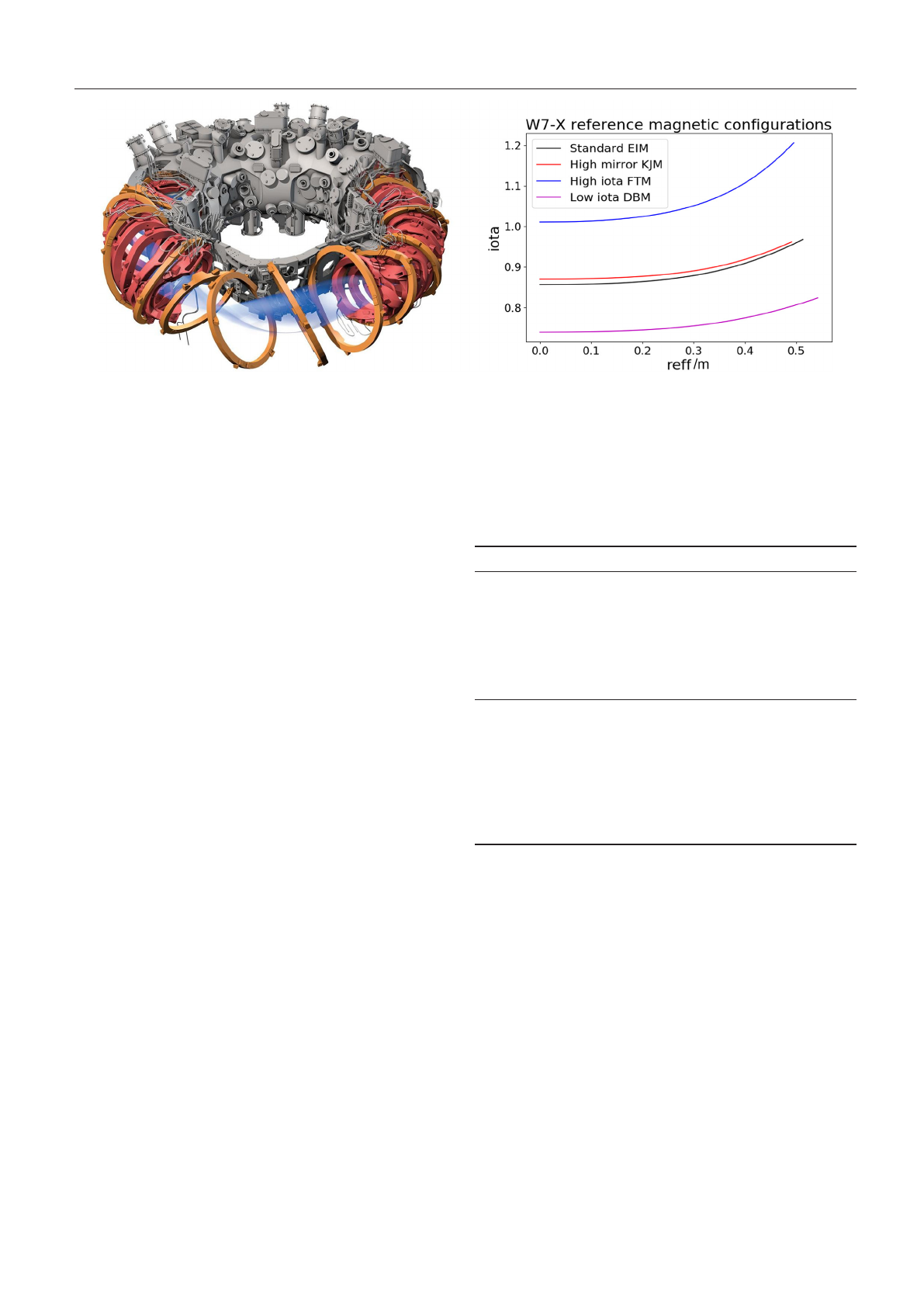
schematic drawing of the device and the rotational transform
of some of the magnetic field configurations are shown in
figure 1. The 50 non-planar coils (red) and 20 planar coils
(orange) are connected in series via superconducting bus bars.
All coils are bolted to a massive central support ring (gray)
and additionally fixed by mostly welded, partially bolted or
sliding local support elements. The complete magnet system
and the support structures are cooled down to
3.4 K
in the
cryostat vacuum between the outer vessel and the plasma
vessel. Both the plasma vessel, the outer vessel and the 253
ports are covered with a thermal insulation, based on multi-
layer foil and a thermal shield actively cooled to
70 K
[12].
The main device parameters are listed in table1. Stage 1
was the setup for the initial operation. After substantial exten-
sion of the in-vessel components and the heating systems, the
present stage 2 was reached. Stage 3 is planned for the sub-
sequent operation phase. Stage 4 is the projected full perfor-
mance configuration of the device. The most powerful heating
scheme of Wendelstein 7-X is the electron cyclotron reso-
nance heating (ECRH) with at present 10 long-pulse capable
140 GHz gyrotrons [13]. On average each gyrotron accounts
for
0.8 MW
power coupled into the plasma which provides a
highly flexible X2-mode and O2-mode heating scheme, both
on- and off-axis. The flexibility and the well-defined heat dep-
osition in the electron cyclotron resonance zone render ECRH
being the most advanced heating and current drive scheme
with the biggest potential for a future stellarator power reactor
[14]. The first of two neutral beam injector (NBI) boxes have
started operation with two positive ion sources and
55 kV
acceleration voltage and up to
3.5 MW
injection power [15].
The ion cyclotron resonance heating (ICRH) system requires
an antenna that is carefully shaped to the three-dimensional
plasma contour. This development is ongoing and commis-
sioning is foreseen for the next operation phase [16]. To
protect the (mostly uncooled) in-vessel components, the max-
imum heating energy during stage 2 is at present limited to
200 MJ
, which implies typical discharge times between 10
and
100 s
, depending on the input power. After completion
of the water cooling systems and the replacement of the iner-
tially cooled island divertor with an actively water-cooled one,
the maximum heating energy will be extended step-wise to
18 GJ
with at least one intermediate step at
1 GJ
(stage 3).
Wendelstein 7-X started first operation in the year 2015.
The heat and particle exhaust was controlled with five
poloidal graphite limiters, the remaining wall was either
steel or CuCrZr. Despite the unfavorable wall conditions, the
plasma performance was quite remarkable with peak electron
temperatures
8 keV
with simultaneous peak ion temperature
Nucl. Fusion 59 (2019) 112004
T. Klinger etal
5
2 keV
and line averaged density
3×10¹⁹ m−3
[5–7]. These
are typical conditions for the core electron root confinement
[5–7, 17] which is characterized by a reversal of the radial
electric field from edge to core [18]. First elements of stel-
larator optimization could be demonstrated by studying the
bootstrap current and neoclassical transport [19].
For the second operation phase (stage 2) the limiters were
replaced by an island divertor and major areas of the wall are
covered with graphite tiles. The island divertor consists of ten
separate modules formed by graphite target and baffle plates
that are matched to the magnetic field structure of Wendelstein
7-X [10, 11]. Depending on the magnetic configuration (given
by the rotational transform
ι/2π
, see figure1) natural magn-
etic islands form at the plasma boundary. They are intersected
with the divertor target plates and thus establish a multi-X-
point divertor for the exhaust of particle and heat flows across
the last closed flux surface. The aim of the second operation
phase is to demonstrate full divertor operation and exhaust
combined with improved plasma performance.
3. High density stationary discharges
The plasma performance of Wendelstein 7-X in terms of
plasma density, ion temperature, stored energy, and discharge
duration has dramatically improved after the installation
of the graphite heat shields and the graphite island divertor.
Another significant step forward was made with a suite of
wall conditioning measures [20]: The plasma vessel is baked
at 150 °C in order to remove water and hydrocarbons from
the vessel wall and in-vessel components. Without magnetic
field, glow discharge cleaning (GDC) is applied in hydrogen
(to reduce residual
CO
and
CH4
) and helium gas (to reduce
H2
). With the superconducting magnets ramped up, an addi-
tional wall conditioning inbetween discharges was made
with ECRH short pulse trains followed by pumping inter-
vals. The GDC in helium and hydrogen as well as the occa-
sional ECRH pulse train conditioning of the plasma facing
components (with total surface areas of
88 m2
graphite and
82 m2
steel) have greatly reduced the outgassing rates, rap-
idly dropping to values that were reached only at the end of
the initial (stage 1) operation phase with graphite limiters.
Plasma densities of
1–5×10¹⁹ m−3
with electron temper-
ature
5–10 keV
were achieved with hydrogen gas fueling;
higher densities where not accessible due to the radiative
limit. High plasma densities up to
1.4 ×10²⁰ m−3
could be
reached with repetitive hydrogen pellet injection and second
harmonic ECR heating in O-polarization (O2-scheme, see
figure 3(b) below). In a similar scenario with hydrogen
plasma, at a central density of
8×10¹⁹ m−3
, the ions are indi-
rectly heated and a temperature of
3.4 keV
with
Te/Ti≈1
was accomplished, still with second harmonic ECR heating
in X-polarization (X2-scheme). This discharge corresponds to
a (stellarator) record
nTi(0)τE=6.4 ×10¹⁹ keV s m−3
with
Figure 1. Schematic diagram of the superconducting stellarator device Wendelstein 7-X. The last closed magnetic flux surface is indicated
in light blue. The 50 non-planar (red) and the 20 planar (orange) superconducting coils are operated in a evacuated cryostat volume between
the plasma vessel and the outer vessel. Wendelstein 7-X is a high-iota low-shear device and the iota profiles (
β=0
) of some reference
magnetic configurations are shown on the right hand side. The reference configurations are standard (EIM), high mirror ratio (KJM), high
iota (FTM), and low iota (DBM).
Table 1. Major parameters of the stellarator Wendelstein 7-X. The
different stages of completion and extension mainly determine
the available heating power and the active cooling of the in-vessel
components.
Quantity Unit Stage 1 Stage 2 Stage 3 Stage 4
Plasma volume
m2
30
Major radius m 5.5
Minor radius m 0.5
Magnetic
induction on axis
T 2.5
Rotional
transform
2π
5
/
6
...
5
/
4
ECR heating
power
MW 4.3 8.5 10 10–15
ICR heating
power
MW 1.5 3.5
NBI heating
power H/D
MW 3.5 7/10 14/20
Heating energy MJ 4 200 1000 18 000
Pulse length typ. s 1–2 10–100 100–200 100–1800
Nucl. Fusion 59 (2019) 112004
Loading more pages...