
Kreinberg et al. Light: Science & Applications (2018) 7:41 Official journal of the CIOMP 2047-7538
DOI 10.1038/s41377-018-0045-6 www.nature.com/lsa
ARTICLE Open Access
Quantum-optical spectroscopy of a two-
level system using an electrically driven
micropillar laser as a resonant excitation
source
Sören Kreinberg
1
, Tomislav Grbešić
1
,MaxStrauß
1
, Alexander Carmele
2
, Monika Emmerling
3
, Christian Schneider
3
,
Sven Höfling
3,4
, Xavier Porte
1
and Stephan Reitzenstein
1
Abstract
Two-level emitters are the main building blocks of photonic quantum technologies and are model systems for the
exploration of quantum optics in the solid state. Most interesting is the strict resonant excitation of such emitters to
control their occupation coherently and to generate close to ideal quantum light, which is of utmost importance for
applications in photonic quantum technology. To date, the approaches and experiments in this field have been
performed exclusively using bulky lasers, which hinders the application of resonantly driven two-level emitters in
compact photonic quantum systems. Here we address this issue and present a concept for a compact resonantly
driven single-photon source by performing quantum-optical spectroscopy of a two-level system using a compact
high-βmicrolaser as the excitation source. The two-level system is based on a semiconductor quantum dot (QD),
which is excited resonantly by a fiber-coupled electrically driven micropillar laser. We dress the excitonic state of the
QD under continuous wave excitation, and trigger the emission of single photons with strong multi-photon
suppression ( gð2Þð0Þ¼0:02) and high photon indistinguishability (V=57±9%) via pulsed resonant excitation at 156
MHz. These results clearly demonstrate the high potential of our resonant excitation scheme, which can pave the way
for compact electrically driven quantum light sources with excellent quantum properties to enable the
implementation of advanced quantum communication protocols.
Introduction
The physics of two-level systems constitutes the basis
for quantum optics and quantum cavity electrodynamics.
It also has an important impact in the field of photonic
quantum technologies, where it enables the secure
exchange of information via single photons
1–4
as well as
efficient quantum computation with linear optics
5
.In
particular, single photons are key resources for quantum
key distribution using the BB84 protocol and for more
advanced schemes, such as the quantum repeater concept
for long-distance quantum communication. In such pro-
tocols and in quantum secure direct communication
6
,
information is usually encoded in the polarization of the
photon, and on-demand sources emitting single photons
with high indistinguishability are of major importance for
the implementation of these protocols. In this context,
semiconductor quantum dots (QDs) are nearly ideal two-
level systems and can act as triggered sources of single
photons
7
, where specific material properties can even be
used for the direct generation of linearly polarized pho-
tons
8
. To explore the physics of QDs and the quantum
nature of emission, different excitation schemes have been
© The Author(s) 2018
Open Access This article is licensed under a Creative Commons Attribution 4.0 International License, which permits use, sharing, adaptation, distribution and reproduction
in any medium or format, as long as you give appropriate credit to the original author(s) and the source, provide a linktotheCreativeCommons license, and indicate if
changes were made. The images or other third party material in this article are included in the article’s Creative Commons license, unless indicated otherwise in a credit line to the material. If
material is not included in the article’s Creative Commons license and your intended use is not permitted by statutory regulation or exceeds the permitted use, you will need to obtain
permission directly from the copyright holder. To view a copy of this license, visit http://creativecommons.org/licenses/by/4.0/.
de)
1
Institut für Festkörperphysik, Technische Universität Berlin, 10623 Berlin,
Germany
2
Institut für Theoretische Physik, Technische Universität Berlin, 10623 Berlin,
Germany
Full list of author information is available at the end of the article.
1234567890():,;
1234567890():,;
1234567890():,;
1234567890():,;
developed, which include simple non-resonant electrical
and optical excitation as well as more advanced schemes,
such as wetting-layer or p-shell resonant excitation
9–14
.
Most interesting is the strict resonant excitation of the
fundamental QD transition leading to resonance fluores-
cence (RF)
15–20
. From an experimental point of view,
strict resonant excitation is very demanding because it
requires laser stray-light suppression by typically more
than six orders of magnitude
16,21,22
. Nevertheless, the
development of efficient suppression schemes and the
availability of mode-hop-free tunable lasers have led to
huge progress in this field, and RF has become an
important experimental technique in quantum nano-
photonics. For instance, strict resonant excitation has
been used to study the subnatural linewidth from a single
QD
23
and to explore the non-resonant dot-cavity cou-
pling in microcavity systems
24
. It is interesting to note
that to date, the related experiments have only been
performed using bulky and expensive laser systems.
In view of applications in quantum communications,
strict resonant excitation of QDs is highly advantageous
because it leads to the emission of single photons with
excellent quantum properties in terms of multi-photon
suppression and photon indistinguishability
25
. Both
aspects are crucial for advanced quantum communication
protocols based on entanglement distribution via Bell-
state measurements
26,27
. In addition, to enable “real-
world”applications, it is highly interesting to develop
compact electrically driven quantum light sources.
Unfortunately, standard excitation schemes based on
carrier injection via a pin-diode design are intrinsically
non-resonant, limiting the achievable degree of indis-
tinguishability
28
. To overcome this issue, an advanced
excitation concept has been developed using an elec-
trically driven microlaser to excite a single QD in a nearby
microcavity system
29
. In this concept, quasi-resonant p-
shell excitation was demonstrated
30
, but strict resonant
excitation has not yet been achieved. In a similar scheme,
a light-emitting diode was used for the on-chip excitation
of a single QD
31
.
In this article, we demonstrate a fully nanophotonic
approach to resonantly drive a QD acting as a two-level
system and to generate single photons with excellent
multi-photon suppression and a high degree of photon
indistinguishability. Our concept is based on an elec-
trically driven QD micropillar laser that resonantly drives
a single QD located in a planar microcavity. To resonantly
excite a two-level system, we use a microlaser spectrally
matched to a QD, where the temperature of the micro-
laser is used as a fine-tuning knob in resonance scans. The
experiments are performed under continuous wave (CW)
and pulsed excitation of the electrically driven microlaser
to observe Mollow-triplet spectra and the triggered
emission of single photons with a Hong-Ou-Mandel
(HOM) visibility of 57%, respectively. Our results show
the potential of high-βmicrolasers to act as excitation
sources in quantum optics experiments and represent an
important step toward the development of integrated
quantum nanophotonic circuits relying on small-scale
coherent light sources for resonant excitation of quantum
emitters. This concept may lead to a significant cost
reduction in quantum optics experiments when using
microlasers instead of large laser systems as excitation
sources. Even more interesting will be the application of
low-threshold microlasers in integrated quantum circuits
and compact quantum light sources, where they can
Polarisation-maintaining
single-mode fibre
90:10
LinPol(H)
LinPol(V)
PBS
Attenuator
Variable
attenuator
Grating
spectro-
graph
Quantum dot
sample
in cryostat 2
670 nm
Diode
laser
μPillar
laser
in cryo 1
μScope
objective
LinPol
λ/2
λ/4
Scanning
Fabry-
Perot
Hong-Ou
-Mandel
Hanburry
Brown &
Twiss
Fig. 1 Schematic illustration of the experimental concept. Emission of the electrically driven microlaser in cryostat 1 is fiber-coupled to resonantly
excite a single QD in cryostat 2. Applying either CW or pulsed excitation, dressing of the two-level system or triggered emission of single photons can
be observed and verified by high-resolution spectroscopy and single-photon counting
Kreinberg et al. Light: Science & Applications (2018) 7:41 Page 2 of 9

resonantly trigger the emission of single photons and
photon pairs as key resources for photonic quantum
technology.
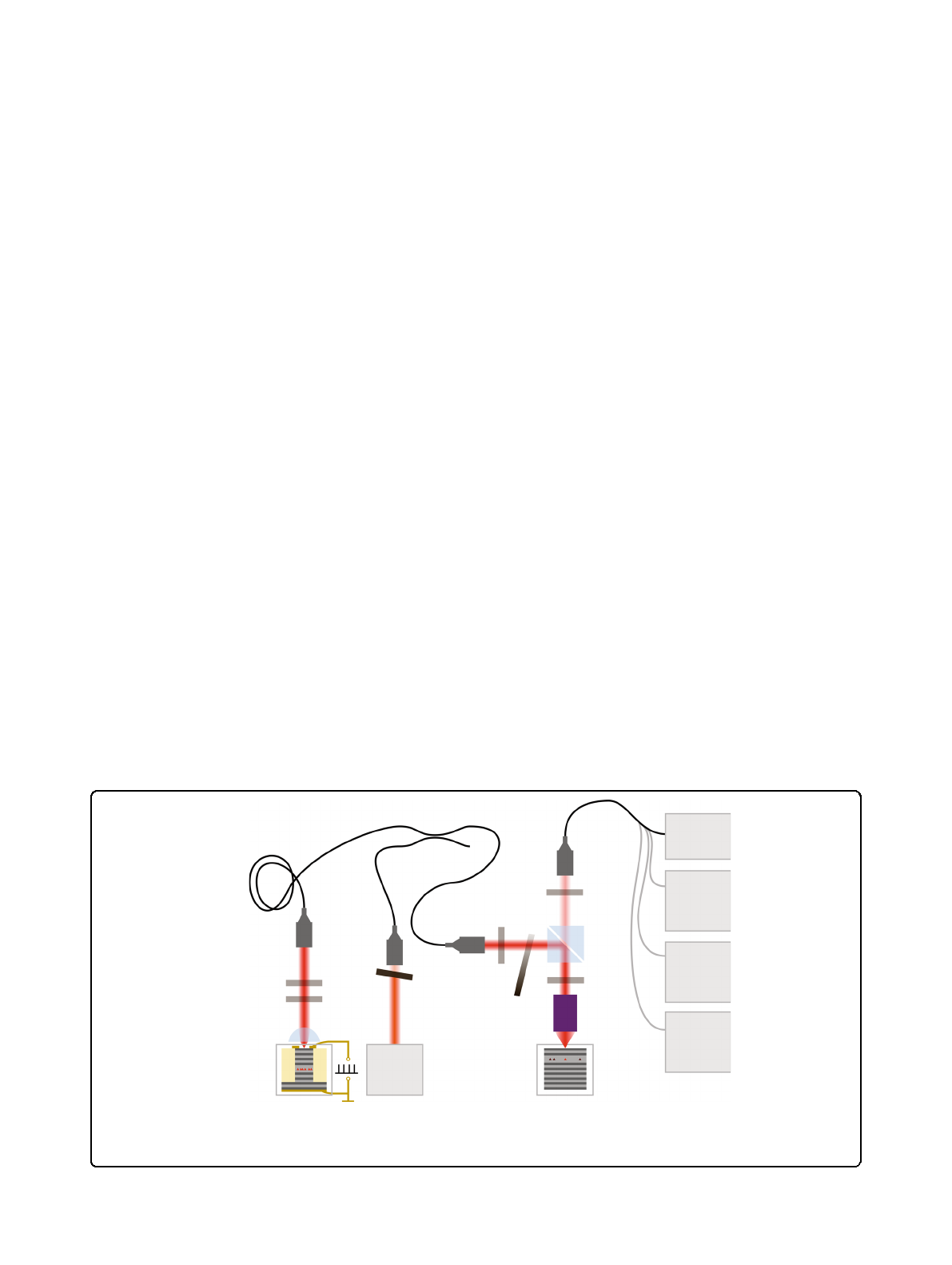
Our experimental concept is illustrated in Fig. 1.It
includes a QD micropillar laser located in cryostat 1 and a
spectrally matched QD located in cryostat 2. The light
emitted by the microlaser is coupled into a 10 m-long
polarization-maintaining single-mode fiber, which is
connected to the input port of the RF setup to excite the
selected QD in cryostat 2. The microlaser is driven by an
electrical voltage supply capable of delivering an adjus-
table DC bias and voltage pulses. The pulses have a width
of 520 ps, an amplitude up to 8 V, and a maximum
repetition rate of 312.5 MHz. Resonance tuning with the
tuning range of approximately 35 GHz is enabled by
changing the temperature of the microlaser in the 64–68
K range. The sample temperature of cryostat 2 is set to 7
K to minimize phonon-induced decoherence
32
and carrier
escape from the QDs in RF experiments. The need for
cryogenic operation is also present for other relevant
devices in quantum technology, such as superconducting
nanowire single-photon detectors, and is in general
required in advanced applications relying on quantum
coherence, such as long-distance quantum communica-
tions networks. See the Materials and methods section for
details on the sample technology and on the experimental
setup.
For the planned quantum-optical studies, it is crucial to
couple the emission of the high-βmicrolaser with sub-
microwatt output power very efficiently into a single-
mode fiber connecting the two cryostats. For this purpose,
we collimate the microlaser emission via a single low-loss
f=20 mm aspheric lens in front of the optical window of
cryostat 1. In this context, we would like to note that a
slight deviation of the circular cross section splits the
fundamental transverse micropillar mode into two gain-
coupled mode components with a spectral splitting of 11
GHz. One of the two modes wins the gain competition
and undergoes the lasing transition
33,34
. Emission of the
lasing mode is selectively coupled into the polarization-
maintaining single-mode fiber via a combination of a half-
wave plate plus linear polarizer and a collimating beam
coupler.
Materials and methods
Sample technology
The QD microlaser and the resonantly excited QD are
based on AlGaAs heterostructures grown by molecular
beam epitaxy. Both structures consist of high-quality
AlAs/GaAs-based distributed Bragg reflectors (DBRs)
forming a planar microcavity with a central one-λGaAs
cavity. A single layer of InGaAs QDs acts as the active
medium. For the microlaser, the planar microcavity is
composed of a rather high number (27 and 23) of mirror
pairs in the n-doped (lower) and p-doped (upper) DBRs to
ensure pronounced light–matter interaction and high-β
lasing. A dense array of micropillar lasers with a diameter
of 3 µm and a pitch of 60 µm are realized by high-
resolution electron-beam lithography and subsequent
reactive-ion etching. The sample is planarized with ben-
zocyclobutene to mechanically support the ring-shaped
upper Au contacts. This has the positive side effect of
protecting the AlAs layers from oxidization. The realized
array includes 62 electrically micropillar lasers emitting in
the spectral range of 912–919 nm. We refer to ref.
35
for
further details on the fabrication of electrically contacted
micropillars. The QD sample used in the RF experiments
has a more asymmetric microcavity design with 24 and 5
mirror pairs in the lower and upper DBRs, promoting
directional outcoupling of light with an extraction effi-
ciency of up to 42%
36
. Due to the low QD density of 2 ×
10
9
cm
−2
and the presence of random photonic defects,
this planar microcavity sample is highly suitable for single
QD experiments and does not require lateral device
processing. To address only a single QD with our laser
spot, we have selected a sample position with a very low
local QD density.
Experimental setup
The experimental configuration consists of two inde-
pendent helium-flow cryostats (cryostats 1 and 2,
respectively), each placed on a different optical table. The
electrically driven QD microlaser is installed in cryostat 1,
and a single-mode fiber guides the laser light to the RF
configuration in a cross-polarization configuration
18,19,21
at cryostat 2. The resonant laser light enters the RF setup
via a fiber beamsplitter, where it is superimposed with
light from a low-power non-resonant support laser. The
latter is a red diode laser (emission wavelength: 670 nm),
the emission of which fills the charge traps adjacent to the
QD to effectively gate the RF signal of the QD
37
. The
combined lasers are collimated again to free space and are
aligned with the RF detection beam path by a polarizing
beamsplitter cube (PBS). Excitation of the QD and
detection of RF is then performed confocally through a
numerical aperture =0.65, f=4 mm microscope objec-
tive. The main purpose of the PBS is to strongly suppress
the laser light reflected from the sample. To compensate
for possible polarization ellipticity and to maximize laser
stray-light suppression, a quarter-wave plate is placed in
the excitation/detection path between the PBS and the
microscope objective
19
. The detected light is fed into a
polarization-maintaining single-mode fiber, both for spa-
tial filtering and to facilitate quantum optics experiments.
For Hanbury Brown and Twiss and HOM-style single-
photon correlation experiments, superconducting single-
photon detectors with a time resolution full width at
half maximum (FWHM) of 55 ps are correlated.
Kreinberg et al. Light: Science & Applications (2018) 7:41 Page 3 of 9

High-resolution RF spectra are recorded using a scanning
Fabry-Perot interferometer with a spectral resolution of
100 MHz.
Results and discussion
In this work, we apply an electrically driven microlaser
to demonstrate for the first time the high potential of
micro- and nanolasers in quantum-optical spectroscopy.
Indeed, while the research interest in miniaturized lasers
has increased rapidly in recent years, their applicability
as resonant excitation sources in quantum nanopho-
tonics has been widely unexplored to date. To enable
related studies under strict resonant excitation, it is
crucial to obtain a microlaser that (a) can be operated
electrically under CW and pulsed operation with an
emission pulse width significantly shorter than the
spontaneous emission lifetime (here 510 ps) of the QD,
(b) shows single-mode emission with an emission line-
width significantly smaller than the homogeneous line-
width of approximately 1 GHz, (c) is spectrally matched
with a target QD within the available temperature-
tuning range on the order of 500 GHz, and (d) has
sufficiently high optical output power of approximately
100–500 nW at the single-mode fiberoutputtoatleast
saturate the QD transition.
To meet these stringent requirements, we first per-
formed reference measurements using a conventional
tunable laser as the excitation source to select a QD
showing pronounced and clean RF at 920 nm (see SI for
more details on the reference measurement), where 920
nm corresponds to the central wavelength reachable by
the micropillar lasers within the patterned array. All
measurements shown in this paper are performed on this
selected QD. In the second step, we chose a micropillar
laser with a slightly shorter emission wavelength of 919
nm at 10 K so that it can be spectrally matched with the
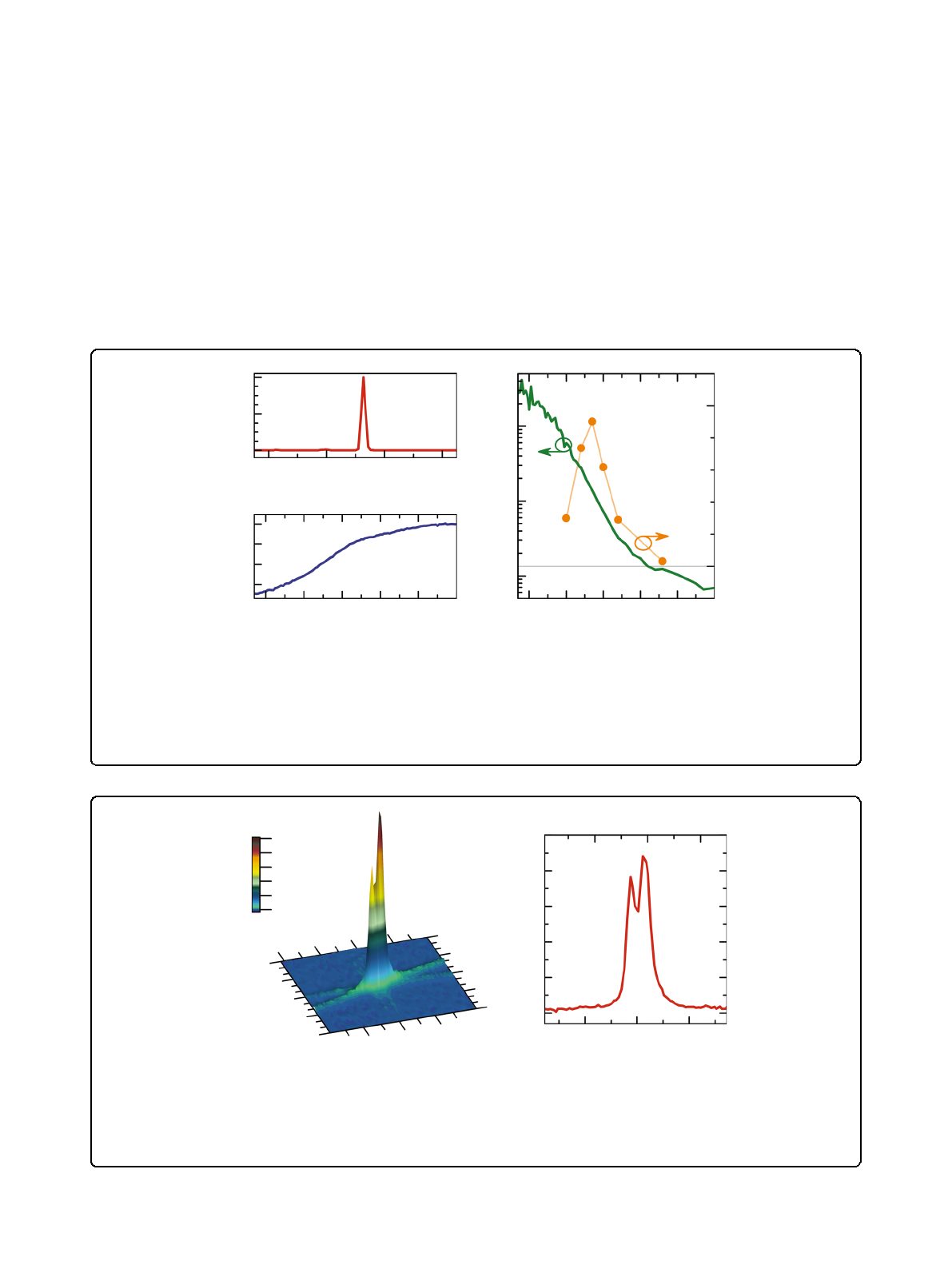
QD wavelength at 66 K. Figure 2a shows the 32 K elec-
troluminescence emission spectrum of the microlaser at
the output of the single-mode fiber. Without any spectral
filtering, we observe clear single-mode emission with a
side-mode suppression ratio of 19 dB and no significant
contribution from GaAs or wetting-layer emission (see
SI). Emission of the laser is coupled into a single-mode
fiber, leading to the output power of 350 nW (at V
bias
=
10.2 V) at the fiber output.
Figure 2b, c presents the corresponding voltage-
dependent output power and spectral linewidth of the
micropillar laser, respectively. The onset of laser action is
indicated by the nonlinear increase of the output intensity
between V
bias
=7 and 8 V accompanied by a strong
decrease of the emission linewidth to values well below
0.1 GHz. The associated transition from predominantly
spontaneous emission to stimulated emission is con-
firmed by measurements of the bias voltage-dependent
second-order photon autocorrelation function gð2ÞðτÞ,
which shows the typical bunching behavior in the
threshold region with gð2Þð0Þ>1 and a transition toward
coherent emission associated with gð2Þð0Þ¼1 at high
excitation
38,39
. It is worth noting that the equal-time
photon correlation only approaches gð2Þð0Þ¼1 when the
linewidth is already reduced by a factor of 100, in accor-
dance with ref.
40
. To avoid possible issues caused by
the response time of the detectors, we attenuated the
microlaser output in the gð2ÞðτÞmeasurements above the
threshold, keeping the count rate per detector always
below 1 MHz.
Having fulfilled the requirements (a)–(d) discussed
above, we are prepared for RF experiments using the
selected QD micropillar laser as a coherent excitation
source. For this purpose, the temperature of the fiber-
coupled microlaser in cryostat 1 is gradually varied
between 64 and 68 K, and emission of the QD in cryostat
2 is recorded via the attached RF setup. The corre-
sponding emission spectra (under CW excitation) are
presented in Fig. 3a as a color-scale intensity map. While
only weak emission of the QD and strongly suppressed
laser emission can be detected under resonant conditions
for QD-laser detuning >10 GHz, strong and very pro-
nounced RF emission occurs at resonance. In fact, when
scanning the microlaser emission over the QD s-shell
resonance, a double-peak response with a splitting of
5 GHz detuning can be resolved (cf. Fig. 3b). This splitting
is attributed to the fine-structure splitting of the excitonic
transition of the QD
41
. The measurements presented in
Fig. 3a, b also indicate that the reflected laser light and the
QD emission due to the above-band excitation by the red
laser make only marginal contributions to the RF signal.
In the present approach, both the microlasers and the
QDs are fabricated to emit at similar wavelengths.
Nevertheless, the fine tuning of the wavelengths required
for RF is still a very demanding prerequisite that we
overcome by selecting the appropriate microlaser and QD
among many candidates. A more deterministic approach
will require deterministic nanofabrication of suitable QD-
microcavity systems at the target wavelength
42
and either
electro-optical Stark tuning
43
or more advanced strain-
tuning
44
for spectral fine tuning of the QD.
Coherent excitation of the QD-based two-level system
is demonstrated in Fig. 4. Through the attenuation of the
micropillar laser emission, we cover a CW excitation
power range of 35–400 nW. Figure 4a shows the corre-
sponding emission spectra recorded with a high-
resolution Fabry-Perot scanning interferometer. With
increasing excitation power, we observe the characteristic
line broadening of the single emission line with a mea-
sured FWHM of 600 MHz at low drive toward the evo-
lution of the Mollow triplet at high excitation strengths
45
.
The splitting of the outer lines of the Mollow triplet with
Kreinberg et al. Light: Science & Applications (2018) 7:41 Page 4 of 9
respect to the center amounts to 640 MHz at 350 nW.
The occurrence of this important signature of coherent
excitation is confirmed for the studied QD by reference
measurements over a wider range of excitation powers
using a standard tunable laser (see SI).
The quantum nature of RF emission is investigated by
measuring the second-order photon autocorrelation
function gð2ÞðτÞ, again under CW excitation via the elec-
trically driven microlaser. As seen in Fig. 4b, the excita-
tion power-dependent photon correlation reveals
pronounced antibunching statistics with strong suppres-
sion of multi-photon emission events associated with
gð2Þð0Þ<0:4. Upon increasing the excitation power from 40
to 400 nW, the simple antibunching dip evolves into a
periodically modulated autocorrelation function. The
observed signatures are associated with Rabi oscillations
in agreement with the Mollow triplet observed in the
frequency domain (cf. Fig. 4a). Importantly, we observe
gð2ÞðτÞ>1 in the vicinity of zero time delay τ0. This
photon bunching increases slightly with increasing
10
1
0.1
67891011
6
916
Intensity (a.u.)
Linewidth (GHz)
g(2) (τ=0)
Intensity (nw)
918 920 922
1
10
0
5
10
a
b
c
102
103
789
Bias voltage (V)
Wavelength λ/nm
Bias voltage (V)
10 11
1.0
1.5
Fig. 2 Characterization of the electrically driven micropillar laser under CW excitation. a EL spectrum of the QD micropillar laser showing clean
emission of the fundamental mode. Higher-order lateral modes of the micropillar are well suppressed (see SI for details). bInput–output dependence
of the electrically driven QD micropillar laser with a threshold pump voltage of approximately 7–8V.cEqual-time second-order photon
autocorrelation function (as measured) and spectral linewidth of the QD microlaser (deconvoluted taking the spectral resolution of the Fabry-Perot
interferometer (0.1 GHz) into account). The nonlinear input–output characteristics in conjunction with the narrowing of the emission linewidth by
more than three orders of magnitude and the transition of gð2Þð0Þfrom values larger than one to unity are clear indications of predominantly
stimulated emission of the QD microlaser above the threshold
Microlaser detuning (GHz)
Detuning (GHz)
Frequency (GHz)
60
30
0
–30
–60
–10 010
Integrated intensity (counts/s)
Intensity (cts/s)
ab
2500
2000
1500
1500
500
0
67 K
66 K
X
L
68 K
5 k
4 k
3 k
2 k
1 k
0
66 K 65 K
–10 0 10
Fig. 3 Resonance fluorescence (RF) of a single QD under CW microlaser excitation (V
bias
=10.2 V). a 3D surface plot of the QD emission
intensity as a function of the frequency fand the microlaser detuning Δ. Using temperature tuning in the range of 64–68 K, the laser emission (L) is
tuned through the spectral resonance of the selected QD transition (X). A strong RF signal is observed in resonance at approximately 66 K. bEmission
intensity of the QD vs. laser detuning integrated over the spectral range of 60 GHz f60 GHz displayed in (a). The double-peak structure is
attributed to the fine-structure splitting of the excitonic transition
Kreinberg et al. Light: Science & Applications (2018) 7:41 Page 5 of 9
Loading more pages...