
Eileen Roesler, Dietrich Manzey, Linda Onnasch
A meta-analysis on the effectiveness of
anthropomorphism in human-robot interaction
Open Access via institutional repository of Technische Universität Berlin
Document type
Journal article | Accepted version
(i. e. final author-created version that incorporates referee comments and is the version accepted for
publication; also known as: Author’s Accepted Manuscript (AAM), Final Draft, Postprint)
This version is available at
https://doi.org/10.14279/depositonce-12447
Citation details
Roesler, E., Manzey, D., Onnasch, L. (2021). A meta-analysis on the effectiveness of anthropomorphism in
human-robot interaction. Science Robotics, 6(58). https://doi.org/10.1126/scirobotics.abj5425.
Terms of use
This work is protected by copyright and/or related rights. You are free to use this work in any way permitted by
the copyright and related rights legislation that applies to your usage. For other uses, you must obtain
permission from the rights-holder(s).

ANTROPOMORPHISM IN HRI
1
The Effects of Anthropomorphism on Human-Robot Interaction: A Quantitative Meta-
Analysis
E. Roesler1*, D. Manzey1, & L. Onnasch2
1Technische Universität Berlin, Germany, 2Humboldt-Universitätzu Berlin, Germany
* Corresponding author (eileen.roesler@tu-berlin.de)

ANTROPOMORPHISM IN HRI
2
Abstract
The application of anthropomorphic design features is widely assumed to facilitate human-
robot interaction (HRI). However, a considerable number of study results point in the
opposite direction. There is currently no comprehensive common ground on the
circumstances under which anthropomorphism promotes interaction with robots. This meta-
analysis aims to close this gap. A total of 4,856 abstracts were scanned. After an extensive
evaluation, 78 studies involving around 6,000 participants and 187 effect sizes were included
in this meta-analysis. The majority of the studies addressed effects on perceptual aspects of
robots. In addition, effects on attitudinal, affective, and behavioral aspects were also
investigated. Overall, a medium positive effect size was found, indicating a beneficial effect
of anthropomorphic design features on human-related outcomes. However, closer scrutiny of
the lowest variable level revealed no positive effect for perceived safety, empathy, and task
performance. Moreover, the analysis suggests that positive effects of anthropomorphism
depend heavily on various moderators. For example, anthropomorphism was in contrast to
other fields of application, constantly facilitating social HRI. In conclusion, the results of this
analysis provide insights into how design features can be used to improve the quality of HRI.
Moreover, they reveal areas in which more research is needed before any clear conclusions
about the effects of anthropomorphic robot design can be drawn.

ANTROPOMORPHISM IN HRI
3
Introduction
Robots are making inroads into our working life and everyday world (1,2). Whereas
early robot generations were mainly limited to industrial robots that worked in safety cages,
kept apart from human workers, current robotic agents are increasingly interactive. In this
process, interaction is changing from a segregated coexistence to direct collaboration with
humans in the same space and time. The ability to collaborate, in turn, enables the
implementation of robots in more diverse domains (3). In addition to being deployed in
industrial settings, robots are also becoming more common in service and social fields of
application such as school teaching and elderly care. This general shift of robots entering the
world of humans is increasingly accompanied by the application of human-like features in
robot design (4–7). The postulated effectiveness of this anthropomorphic design approach is
mainly based on two assumptions. First, robots are used in an environment that is designed
and optimized for humans. For this reason, the application of human-like design is assumed
to support a naturalistic and functional embodiment (4). Structural and functional similarities
e.g., limbs and joints provide the capabilities, which can support a successful movement
through an environment and an interaction with artefacts built for humans (8,9). Second,
from a human-centered point of view, anthropomorphism promotes more intuitive interaction
for people because it enables the transfer of scripts that are well known from human-human
interaction (10,11).
Anthropomorphism in HRI is thereby a reciprocal phenomenon. On the one hand, it
describes the general tendency of people to attribute human characteristics including human-
like mental capacities to non-living objects (12,13). On the other hand, anthropomorphism
describes a human-like design of robots that in turn facilitates the attribution of human-like
characteristics to the robot (3). This design element is used to evoke expectations, which, if
met, represent a knowledge base for interaction and a better anticipation of robots’ actions,
ANTROPOMORPHISM IN HRI
4
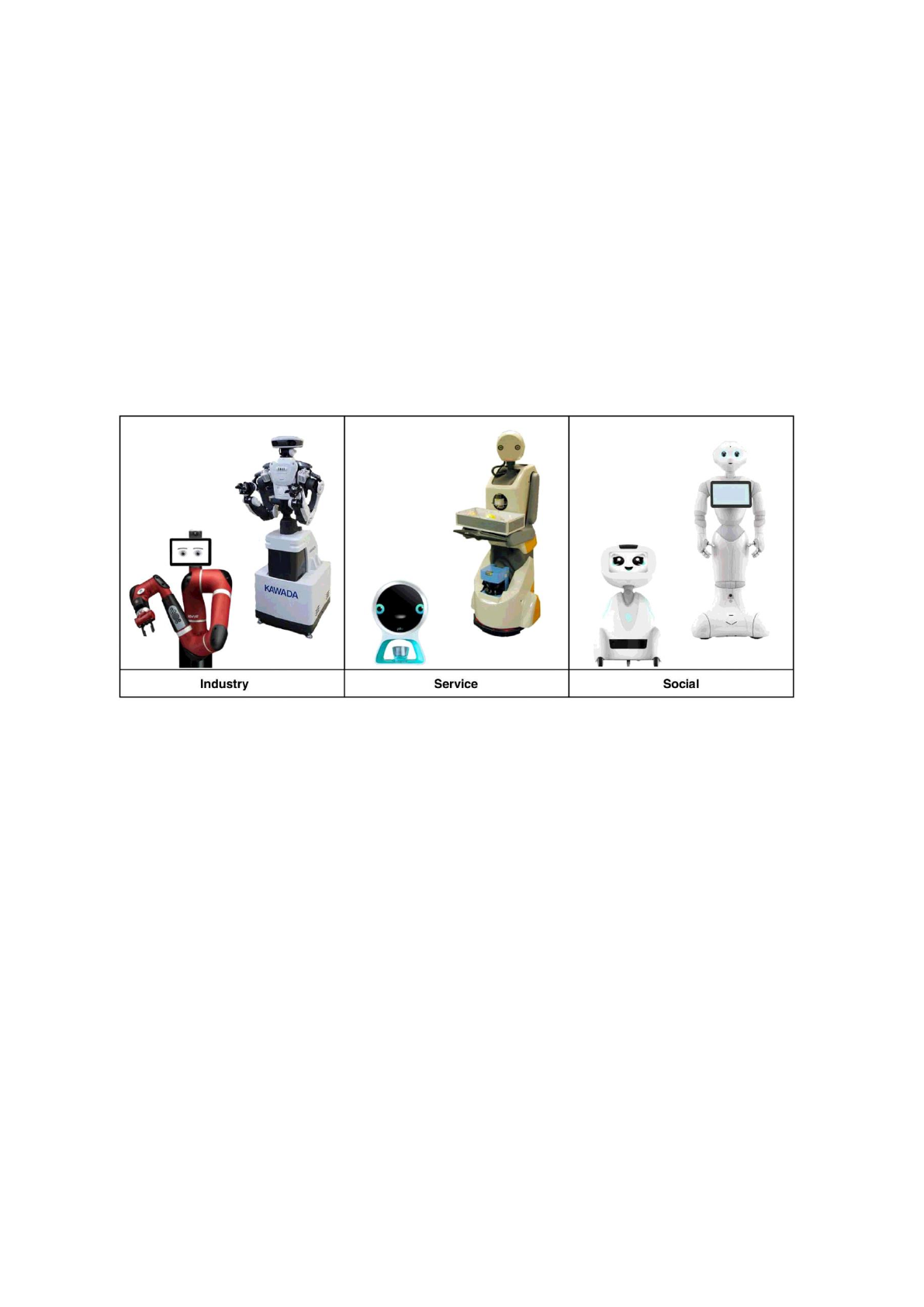
even for first encounters with this often completely new technology (5,11,14). Figure 1
shows a number of examples of anthropomorphic robot designs in different domains of
human-robot interaction (HRI). The examples also illustrate that most straightforward
approaches of anthropomorphic robot design address the overall appearance of robots (e.g.,
face-like characteristics or body shapes). However, other approaches include more subtle
aspects such as anthropomorphic trajectories, language-based communication, or simply
different types of framing (e.g., giving robots human names or human-like descriptions).
Fig. 1. Examples of anthropomorphic implementations. Anthropomorphic design by means of depicting human-
like facial features or body features for the industrial (left: Sawyer; right: Nextage), service (left: Pillo Health ;
right: SnackBot), and social domain (left: BUDDY; right: Pepper) received from the Anthropomorphic Robot
(ABOT) Database (15)
But is this design approach generally beneficial for HRI? While current research in
social application domains broadly supports this assumption (4,5,12), a different picture
emerges in other domains. For example, studies focusing on industrial HRI suggest that
anthropomorphic design features may not necessarily be beneficial, and can undermine the
perceived reliability of robots (16) and raise concerns with regard to their safety (17). These
results are unexpected, because the transfer of human-human interaction scrips should make
interaction more familiar and trustworthy, independent of the application domain in question.
Loading more pages...