
Decomposition-based Verification of Global
Compliance in Process Choreographies
Walid Fdhila
SBA-Research,
Vienna, Austria
Stefanie Rinderle-Ma
Faculty of Computer Science
University of Vienna
Vienna, Austria
stefanie.rinderle-ma@univie.ac.at
David Knuplesch
Institute of Databases and Information Systems
Ulm University
Ulm, Germany
Manfred Reichert
Institute of Databases and Information Systems
Ulm University
Ulm, Germany
Abstract—The verification of global compliance rules (GCR) in
process choreographies (e.g., partner-spanning quality assurance
in supply chains) is crucial and challenging due to the restricted
visibility of the private processes of the collaborating partners.
This paper provides a novel algorithm that decomposes global
compliance rules into assertions that can be verified by the
partners in a distributed way without revealing any private
process details. The decomposition is based on transitivity prop-
erties of the underlying GCR specification. This work uses GCR
based on antecedent and occurrence patterns and illustrates the
transitivity properties based on their specification in first order
predicate logic. It is formally shown that the original GCR can
be reconstructed from the assertions, which ensures the viability
of the approach. The algorithms are prototypically implemented
and applied to several scenarios. The ability of checking global
compliance constitutes a fundamental pillar of any approach
implementing process choreographies with multiple partners.
Index Terms—Distributed and cross-organizational business pro-
cesses, Business rules and compliance management, Business
process compliance, Global compliance rules, Rule decomposition
I. INTRODUCTION
The arrival of technologies such as blockchain and Industry
4.0 has pushed the process-oriented collaboration between
distributed business partners [25], realized by so called process
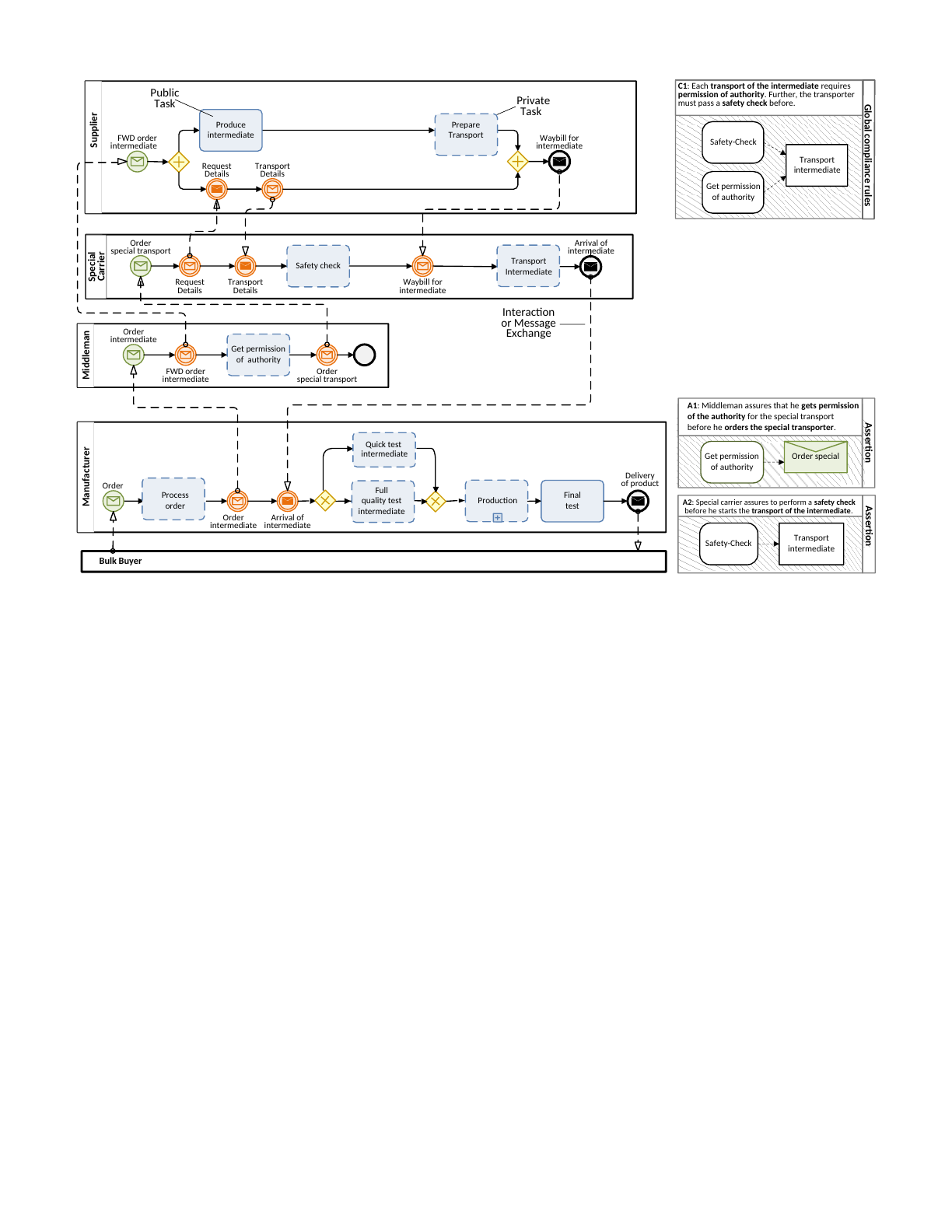
choreographies. Figure 1 depicts a collaboration diagram of a
supply chain scenario as a composition of the public models
[1] of the partners Manufacturer,Middleman,Special Carrier,
and Supplier. The private models of the partners, in turn,
implement and possibly extend the behavior of the public
models. Private tasks–depicted as dashed boxes in Fig. 1–
are not visible to the partners, whereas public tasks can
realize interaction (message exchange) between two partners.
Although private tasks are usually hidden to other partners,
restrictions over them might exist. In this case, no information
about how and when the task is executed, or how it is con-
nected to the other nodes of the corresponding private model
is visible to the other partners. Usually, this happens when a
collaborating partner imposes the execution of a specific task
which must exist in its private process and comply with a
given rule to another partner. The latter should then assure the
existence of such task, and that it follows the imposed rule.
Assume that the supply chain depicted in Fig. 1 is subject
to a Global Compliance Rule (GCR), which stems from legal
regulations and standards such as GDPR or Sarbanes Oxley.
A GCR constrains actions of multiple partners and/or the
interactions between them. Ensuring the compliance of process
choreographies with a GCR is crucial and challenging [16] as
a partner “only has the visibility of the portion of the process
under its direct control” [26]. In Fig. 1, GCR C1 asks for a
safety check, which is accomplished by a private task at the
Special Carrier. To cope with this issue, assertions can be used.
An assertion (A) is a commitment of a partner guaranteeing
that its private/public process complies with the constraint [8].
In the example, the Middleman agrees to get the permission
of the authority before ordering the sepcial transport (A1).
Special carrier commits to perform a safety check before
transporting the intermediate (A2). Combined, A1 and A2
enable checking GCR C1.
[26] tackles the problem of checking GCR on private tasks
based on IoT-enabled artifacts. The approach presented in this
paper aims to exploit assertions in order to stay independent of
a particular technology such as IoT. The fundamental research
question addressed in this work is as follows:
How to decompose a GCR into derived assertions that can be
checked in a distributed way without violating the privacy of
the involved process partners?
We tackle the question by providing a decomposition algo-
rithm that breaks down the initial GCR into derived assertions.
By combining the derived assertions, in turn, we can re-
construct the original GCR, i.e., the decomposition is lossless.
In turn, the assertions obtained from the decomposition can be
checked by the process partners in a distributed way without
revealing any private details. The decomposition relies on
Manufacturer Middleman
Bulk Buyer .
Special
Carrier
Supplier
Process
order
Order
intermediate
Arrival of
intermediate
Production Final
test
Delivery
of product
Order
Get permission
of authority
FWD order
intermediate
Order
special transport
Safety check
FWD order
intermediate
Order
intermediate
Produce
intermediate
Request
Details
Transport
Details
Prepare
Transport
Order
special transport
Request
Details
Transport
Details
Waybill for
intermediate
Arrival of
intermediate
Waybill for
intermediate
Transport
Intermediate
Transport
intermediate
Get permission
of authority
Safety-Check
Full
quality test
intermediate
Assertion A2 of Middleman
Order specialGet permission
of authority
Assertion A3 of Special carrier
Transport
intermediate
Safety-Check
Public
Task
Special
Carrier
C1: Each transport of the intermediate requires
permission of authority. Further, the transporter
must pass a safety check before.
A1: Middleman assures that he gets permission
of the authority for the special transport
before he orders the special transporter.
A2: Special carrier assures to perform a safety check
before he starts the transport of the intermediate.
Interaction
or Message
Exchange
Assertion
Assertion
Global compliance rules
Private
Task
Quick test
intermediate
Fig. 1. Running example with four process partners: Supply chain (adapted from [8])
transitivity properties of the underlying GCR specification.
In order to remain independent of a certain language and
technology, we rely on simple rules that consist of antecedent
and occurrence patterns. The transitivity properties are shown
by the example of a translation to first order predicate logic.
Similarly, for example, [29] presents declarative patterns based
on Linear Temporal Logic (LTL). As part of the evaluation,
the correctness of the decomposition algorithm is formally
proven. Moreover, the algorithm is prototypically implemented
and its application is demonstrated along basic choreography
scenarios.
The remainder of the paper is structured as follows: Section
II provides fundamentals. Section III-B deals with the de-
composition algorithm and Sect. IV with the correctness of
the algorithm. Sections V and III-A present details on the
implementation and application of the algorithm. Section VI
discusses related work and Section VII summarizes the paper.
II. FUNDAMENTALS AND TRANSITIVITY THEOREM
This section presents definitions and formal backgrounds for
global compliance rules (GCR) over a process choreography y.
A choreography includes three types of overlapping models:
(i) a private model representing the executable process and
including private activities as well as interactions with other
partners, (ii) a public model (also called the interface of the
process) that solely highlights the interactions of a given
partner, and (iii) a choreography model providing a global
view on the interactions between all partners [7].
The interactions of a single partner are described in a public
model. The public model thus serves as public (restricted)
view on the private model of the partner which “describes
the internal logic of a partner including its private activities and
interactions” [4]. In this paper, we assume that the choreog-
raphy yis sound, i.e., structural and behavioral compatibility
between public models and consistency between public and
private models are given [7]. For a formal definition of process
choreography, we refer the reader to Def. 3 in Appendix A.
We opt for expressing a GCR based on antecedence and
consequence patterns. An antecedence pattern specifies when
a GCR over yshall be triggered. In this situation, the desired
behavior of yis described by related consequence patterns.
Based on execution traces capturing all events related to the
enactment of y, antecedence and consequence patterns are
interpreted as follows: for each match of the antecedence
pattern there must be at least one match of a consequence
pattern. This simple representation of GCR abstracts from a
certain language and technology, i.e., any language can be cho-
sen that supports antecedence and consequence patterns, and
the transitivity properties defined in this paper. Antecedence
and consequence patterns are specified using occurrence and
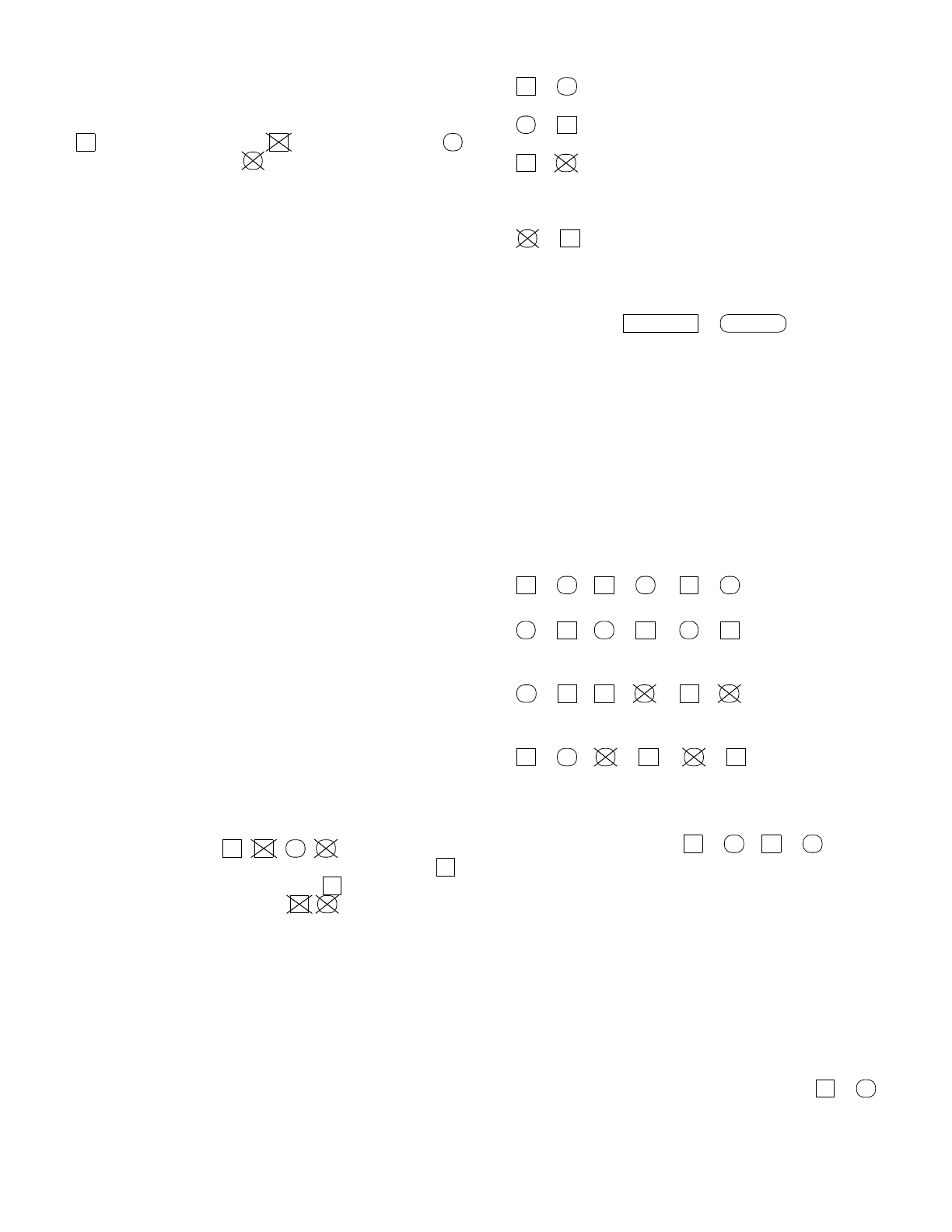
absence nodes, which either express the occurrence or ab-
sence of events related to the execution of activities or the
exchange of messages in y. We use the following notation:
A: Antecedence occurrence; A: Antecedence absence; A:
Consequence occurrence; A: Consequence absence
In a previous work [6], multiple formal languages employed
for business process compliance modelling and checking (e.g.,
linear temporal logic LTL, event calculus EC, extended com-
pliance rule graph eCRG) were compared. It was proven that
most of these languages can deal with most qualitative time
patterns, and can therefore be used to model the compliance
constructs addressed in this paper. Similar results were proven
in [14]. In order to specify these constructs as well as
transitivity properties required for the GCR decomposition,
this work uses the eCRG formalism [21]. The latter offers
a visual rule notation for expressing compliance rule graphs
over choreographies and is based on first order predicate logic.
Definition 1 specifies those parts of the eCRG formalism that
are necessary for defining GCRs and their decompositions.
In detail, Def. 1 (i) refers to activities and interactions in y,
(ii) allows for exactly one antecedence occurrence pattern per
rule, and (iii) assumes the rules to be structured as trees. As the
decomposition focuses on the interactions between the partners
and their control flows, (i) does not impose any restriction.
Moreover, (iii) contributes to simplify the algorithm. For the
sake of space and simplicity, we restrict the definition of GCR
to one antecedence occurrence pattern (ii), but will extend this
in future work.
Definition 1 (GCR structure): Given a process choreography
y(cf. Def. 3 in Appendix A), let Abe the set of public
and private activities and Ibe the set of interactions in
choreography model G. Then: a GCR ris defined as tree
r= (N, ρ, ϕ, type, pattern, root)with
•Nbeing the set of nodes,
•ρ:N→ {p1...pn}returning the partner responsible for
a node.
•ϕ:N×N→ { 99K,−→} returning the sequence flow
connector of two nodes, i.e., consequence sequence and
antecedence sequence connectors respectively.
•type :N→ A ∪ I mapping each node to an activity or
an interaction, i.e., message exchange.
•pattern :N→ { A,A,C,C}
•root ∈Nbeing the root node with pattern(root) = A
•∀n∈N\ {root}:pattern(n)6=A
•∀n∈Nwith pattern(n) ∈ { A,C}: n is leaf node
We illustrate the translation of a GCR into a First Order
Logic (FOL) expression using basic equivalences as in Def. 2
following below. As shown in the following, equivalences are
also required for ensuring correctness of the decomposition.
Additionally, throughout the paper we consider the conse-
quence sequence connector. This can be easily extended to
antecedence sequence connectors.
Definition 2 (Basic Equivalences): Based on [22] the
following equivalences hold by definition. Predicate x(t, ty)
describes that at the point in time tan activity (message) of
type ty was executed (i.e., sent or received).
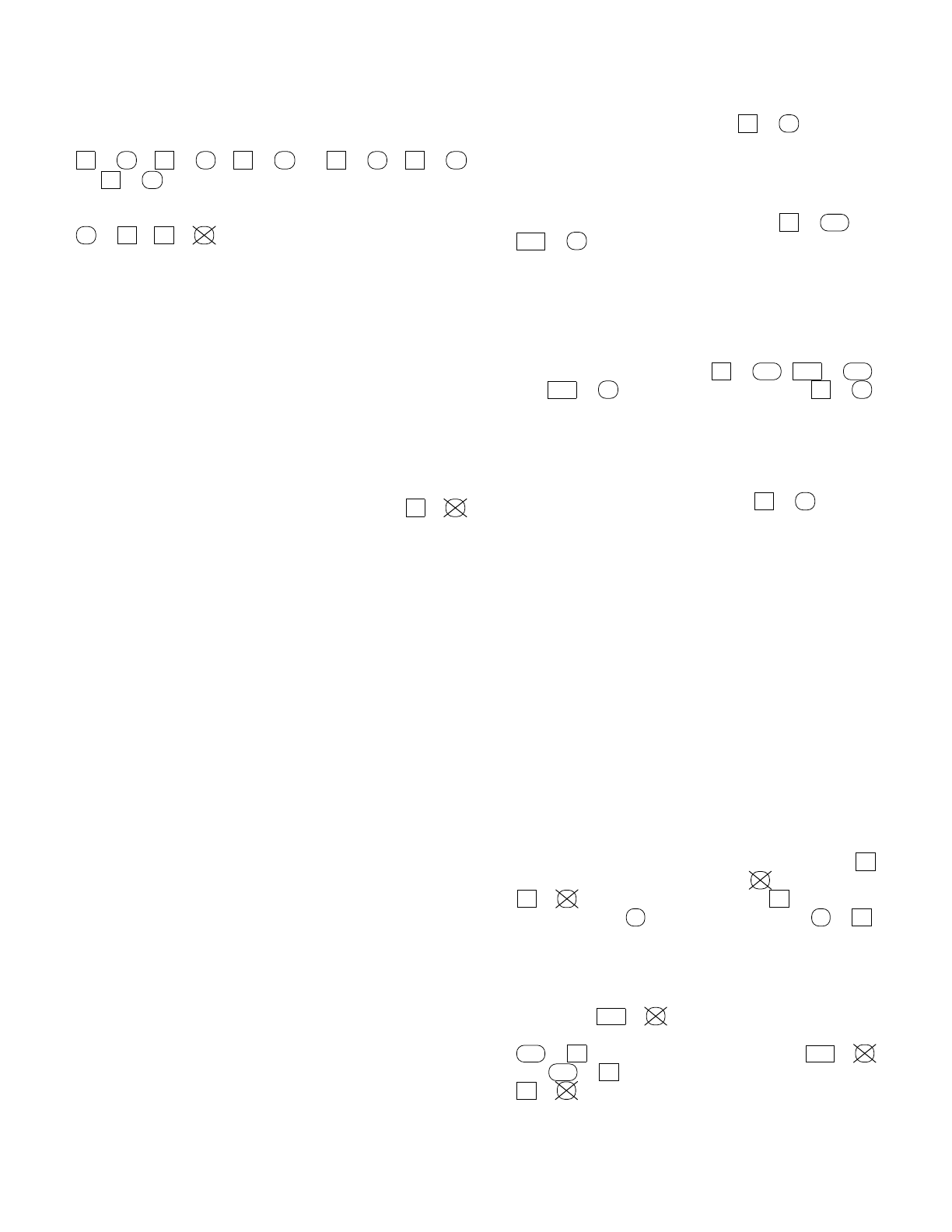
•A99K B:⇔ ∀a:x(a, A)→∃b: (x(b, B)∧a<b)
⇔ ∀a∃b:x(a, A)→(x(b, B)∧a<b)
•A99K B:⇔ ∀b:x(b, B)→∃a: (x(a, A)∧a<b)
⇔ ∀b∃a:x(b, B)→(x(a, A)∧a<b)
•A99K B:⇔ ∀a:
x(a, A)→@b: (x(b, B)∧a<b)
⇔ ∀a, b :x(a, A)→ ¬(x(b, B)∧a < b)
⇔ ∀a, b :x(a, A)→(¬x(b, B)∨b≤a)
•A99K B:⇔ ∀b:
x(b, B)→@a: (x(a, A)∧a < b)
⇔ ∀b, a :x(b, B)→ ¬(x(a, A)∧ ¬a < b)
⇔ ∀a, b :x(a, A)→(¬x(b, B)∨b≤a)
For example, GCR Production 99K Final test is translated
into: ∀a:x(a, Production)→ ∃b:x(b, Final test)∧a < b.
Relation <expresses a temporal precedence between aand b.
The decomposition algorithm presented in Sect. III-B exploits
the transitivities for GRC as in Theorem 1. Specifically, by
combining transitive relations, where each relation can be
checked locally by a single partner, it becomes possible to
reconstruct the original GCR behavior. Theorem 1 ensures that
the behavior of the derived assertions reproduces the behavior
of the GCR, but not vice versa.
Theorem 1 (Transitivities):
Let A, B, and Cbe three activity or message types. Then:
a. The rightwards transitivity holds:
A99K B∧B99K C⇒A99K C
b. The leftwards transitivity holds:
A99K B∧B99K C⇒A99K C
c. The rightwards zig zag transitivity holds for the conse-
quence absence:
B99K A∧B99K C⇒A99K C
d. The leftwards transitivity holds for the consequence ab-
sence:
A99K B∧C99K B⇒C99K A
In the following, the correctness of Theorem 1 is proven
applying Def. 2.
Proof 1 (Rightwards Transitivity): Let A, B, C be three
activities or interactions. Then A99K B∧B99K C
:⇔ ∀a∃b:x(a, A)→(x(b, B)∧a < b)∧∀b∃c:
x(b, B)→(x(c, C)∧b<c)
⇔ ∀a∃b:x(a, A)→(x(b, B)∧a<b)∧∀b:∃c:
x(b, B)→(x(c, C)∧b < c)
⇒ ∀a∃b, c :x(a, A)→(x(b, B)∧a<b)∧x(b, B)→
(x(c, C)∧b < c)
⇒ ∀a∃b, c :x(a, A)→x(b, B)→(x(c, C)∧a < b <
c)
⇒ ∀a∃c:x(a, A)→(x(c, C)∧a < c)⇒A99K C
q.e.d.
Leftwards transitivity can be proven similarly by replacing ’<’
with ’>’.
Corollary 1: Let A, B, C, and Dbe activities or interactions.
Then
A99K B∧B99K C∧C99K D⇒A99K C∧C99K D
⇒A99K D
Proof 2 (Rightwards Zig Zag Transitivity of Absence): Let
A, B, C be activities or interactions. Then:
B99K A∧B99K C
:⇔ ∀a∃b:x(a, A)→(x(b, B)∧b < a)∧ ∀b, c :
x(b, B)→(¬x(c, C)∨c≤b)
⇔ ∀a∃b:x(a, A)→(x(b, B)∧b < a)∧ ∀b, c :
x(b, B)→(¬x(c, C)∨c≤b)
⇒ ∀a∃b∀c:x(a, A)→(x(b, B)∧b<a)∧x(b, B)→
(x(c, C)→c≤b)
⇒ ∀a∃b∀c:x(a, A)→x(b, B)→(x(c, C)→c≤b <
a)
⇒ ∀a∀c:x(a, A)→(x(c, C)→c≤a)
⇒ ∀a, c :x(a, A)→(¬x(c, C)∨c≤a)⇒A99K C
q.e.d.
Leftwards zig zag transitivity of absence can be proven sim-
ilarly by replacing ’<’ with ’>’ and ’≤’ with ’≥’. The
transitivity of other constructs such as “chaining” or “requires
transitivity” can be found in Appendix B.
III. DECOMPOSING GLOBAL COMPLIANCE RULES
At design time, checking a GCR that solely refers to inter-
actions and/or public activities can be achieved by applying
contemporary compliance checking techniques (cf. [13]) either
on the choreography model or the public models of the
involved partners. By contrast, if a GCR refers to private
activities of different partners, it becomes impossible to check
its correctness as partners cannot view the private process
parts of the other partners and, therefore, cannot identify
the dependencies between the private activities involved in
the GCR. To cope with this, we suggest decomposing the
GCR into a set of assertions of which each can be checked
locally by the corresponding partner. The decomposed rules
then reproduce the behavior of the original GCR.
Decomposition in compliance checking has been exploited
by [32], but only at the process model level in order to
achieve performance gains for the compliance checks. The
paper at hand, first of all, proposes to decompose the global
compliance rule to distribute the compliance checks to the
partners for maintaining the confidentiality of their private
tasks. We start with illustrating the idea and the challenges
of GCR decomposition based on different scenarios. Then the
decomposition algorithm is introduced and explained.
A. GCR Decomposition Scenarios and Discussion
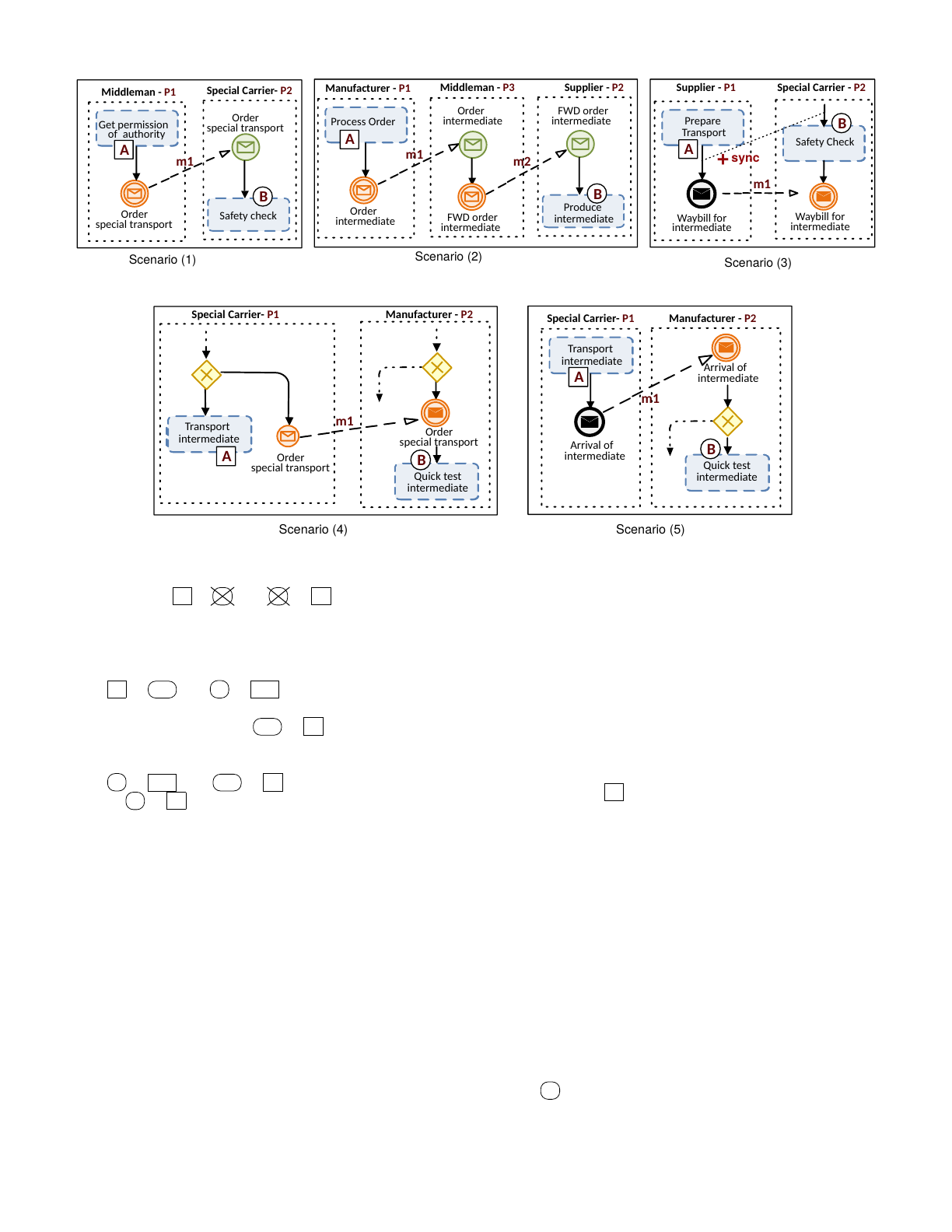
In the following, we use a set of scenarios (cf. Figs. 2 and 3)
to illustrate the GCR decomposition process. For the sake of
readability, in these scenarios we assume a simple compliance
rule involving two tasks of two different partners p1and p2.
In Scenarios 1 – 3, we assume rule A99K B, where the
execution of task Ashall be followed by the one of task B.
For simplicity, we use labels A,B,m1,m2,p1and p2instead
of the actual labels taken from the example of Fig. 1.
•In Scenario 1 there exists a message exchange m1
between p1and p2that fulfills conditions A99K m1and
m199K B. The behavioral and structural compatibility
(cf. Sect. II) between the partner processes ensures that
message m1sent by p1shall be correctly received by p2.
•In Scenario 2 we assume that there is no direct interaction
between p1and p2, but there exists a transitive interaction
through partner p3. Partner p1interacts with p3through
m1and p3interacts with p2through m2. In this sce-
nario, the transitive relations A99K m1,m199K m2,
and m299K Breproduce the behavior of A99K B.
Consequently, partner p3, which is initially not involved
in the GCR becomes involved in the derived assertions.
We call p3an intermediary partner.
•In Scenario 3 we assume that, even though there are
interactions between p1and p2, no direct or transitive
interactions reproduce the behavior of A99K B. As such,
additional message exchanges become necessary to in-
form about the execution state of activities involved in the
GCR. Message exchanges can be either synchronous or
asynchronous. Asynchronous message exchange only al-
lows for reactive GCR checking and, hence, for detecting
violations after their occurrence. Synchronous message
exchange is proactive as it enforces the GCR with new
restrictions to the process models, e.g., the execution of
Bis enabled only after receiving the synchronization
message (i.e. whether Ais or is not executed). Partner
p1shall also inform p2in case Ais not executed, as this
does not prevent Bfrom being executed according to the
GCR.
Rightwards transitivity (cf. Theorem 1.a) directly ensures the
correctness of Scenarios 1 and 3 from Figure 4. It should be
clear that the correctness of Scenario 2 can be directly derived
from Corollary 1 (cf. Sect. II).
For the scenarios depicted in Figure 3, we assume differ-
ent compliance rules, where the antecedent presence B
implies the later consequence absence Ain Scenario 4;
i.e., B99K A, and antecedence presence Brequires the
consequence presence Abefore, in Scenario 5, i.e., A99K B.
•In Scenario 4 (includes an adaptation of the example
of Fig. 1), for partner p1, the execution of Aauto-
matically implies non-execution of m1before and vice
versa (due to the used XOR pattern). Consequently, it
ensures rule m199K A. For partner p2, the execution of
Bis always preceded by the one of m1, which implies
m199K B. The composition of the two rules m199K A
and m199K B, in turn, reproduces the behavior of
B99K A. Similarly to Scenario 2, this dependency can
become more complex and transitive. This example also
Order
special transport
Safety check
Get permission
of authority
Get permission
of authority
Order
special transport
Produce
intermediate
Get permission
of authority
Process Order
Order
intermediate FWD order
intermediate
Order
intermediate
FWD order
intermediate Get permission
of authority
Prepare
Transport
Waybill for
intermediate
Get permission
of authority
Safety Check
Waybill for
intermediate
Middleman - P1 Manufacturer - P1
Special Carrier- P2 Supplier - P2Middleman - P3 Special Carrier - P2Supplier - P1
sync
+
A
B
m1 m1 m2
m1
AA
B
B
Scenario (3)
Scenario (1) Scenario (2)
Fig. 2. Scenarios 1–3
m1
Get permission
of authority
Transport
intermediate
Get permission
of authority
Order
special transport
Get permission
of authority
Order
special transport
Get permission
of authority
Quick test
intermediate
Arrival of
intermediate
Arrival of
intermediate
Transport
intermediate
Quick test
intermediate
Scenario (4) Scenario (5)
B
A
A
B
Special Carrier- P1 Manufacturer - P2 Manufacturer - P2Special Carrier- P1
m1
Fig. 3. Scenarios 4–5
illustrates A99K Band A99K Bin a similar way.
•In Scenario 5, if Bis executed, Ashould have been
executed before. However, the execution of Adoes not
imply that Bis always executed. Regarding p1, the
execution of Aimplies the one of m1and vice versa; i.e.,
A99K m1and A99K m1. Regarding p2, the execution
of Balways implies the one of m1before, but not the
other way around; i.e. m199K B. Since both assertions
refer to the same message exchange m1between p1and
p2, in combination with each other, the two assertions
A99K m1and m199K Bcan reproduce the behavior
of A99K B
The correctness of Scenario 5 concludes from the rightwards
transitivity (cf. Theorem 1.b), whereas Scenario 4 relies on
the zig zag transitivity of the absence (cf. Theorem 1.c).
Figure 4 summarizes the decomposition results of the sketched
scenarios. The latter are used to illustrate selected use cases.
The decomposition process is not limited to these scenarios
and, as aforementioned, the decomposition cannot always be
automated, but might require manual interaction and process-
ing. Altogether, the decomposition eases global compliance
rule checking, where each partner checks its corresponding
derived assertions locally. A GCR is rechecked only if at least
one of the derived assertions is not evaluated to true. Note that
this does not necessarily imply that the GCR is violated.
B. GCR Decomposition Algorithm
This section focuses on the decomposition algorithm and
explains the steps to derive assertions using transitivities.
Algorithm 1 realizes GCR decomposition as set out in Def.
1. It assumes that each node of the GCR is assigned to one
partner being responsible for it. Further on, we assume the
input GCR to be consistent and satisfiable (for dealing with
unsatisfiable and inconsistent rules we refer to [5]). In the
following, we first explain Algorithm 1 step by step and then
illustrate the entire algorithm along Example 1 (see below).
Starting from the Anode (cf. Def. 1), Algorithm 1 walks
outwards through all other nodes of the GCR. Thereby, the
visited parts are copied and become assertions. Wherever
the algorithm walks over a connector between two nodes
nand s, which are assigned to different partners ρ(n)and
ρ(s), the GCR is split at this position as this dependency
cannot be evaluated by a single partner. Next, the algorithm
tries to replicate the connector where the GCR was split
through (transitive) message exchanges between both affected
partners by applying the transitive relationships from Section
II. Therefore, sets n•,•s, and Θare calculated. Depending on
the pattern of s(cf. Def. 1), n•and •scontain the messages
succeeding or preceding nand s. Note that these calculations
have to be accomplished in a decentralized manner by ρ(n)
and ρ(s)themselves as nand smay be private tasks. Next, Θ
combines those messages of n•and •sthat can be combined.
If sis a Cnode (i.e., smust follow n), Θcontains message
tuples (m1, m2)that ensure that nis always followed by
Loading more pages...