
Adhesion of surfaces mediated by adsorbed particles: Monte Carlo
simulations and a general relationship between adsorption isotherms and
effective adhesion energies
Tillmann Stieger,
a
Martin Schoen
ab
and Thomas R. Weikl*
c
Received 3rd July 2012, Accepted 10th September 2012
DOI: 10.1039/c2sm26544c
In colloidal and biological systems, interactions between surfaces are often mediated by adsorbed
particles or molecules that interconnect the surfaces. In this article, we present a general relationship
between the adsorption isotherms of the particles and the effective, particle-mediated adhesion energies
of the surfaces. Our relationship is based on the analysis and modeling of detailed data from Monte
Carlo simulations. As general properties that should hold for a wide class of adsorption scenarios, we
find (i) that the particle-mediated adhesion energies of surfaces are maximal at intermediate bulk
concentrations of the particles, and (ii) that the particle coverage in the bound state of the surfaces is
twice the coverage in the unbound state at these bulk concentrations.
1. Introduction
Adhesion and adsorption are important phenomena in both
colloidal and biological systems. Characteristic aspects of these
systems are that the constituent molecules or particles typically
differ in size, and that the interactions between these constituents
are often dominated by surface interactions. Adsorption refers to
the binding of molecules or particles to the surfaces of larger
constituents and is typically characterized by adsorption
isotherms, i.e. by the surface concentrations of adsorbed mole-
cules or particles as a function of their bulk concentration or
chemical potential. Adhesion refers to the binding of two
surfaces that are typically large compared to molecular dimen-
sions and is characterized by adhesion energies per area.
Adsorption can lead to adhesion if molecules or particles bind
to two apposing surfaces, e.g. to the surfaces of two larger
particles or objects. The adhesion and aggregation of nano-
particles or microparticles, for example, can be mediated by
adsorbed proteins
1–5
or polymers.
6–10
Nanoparticles can affect
the adhesion of microparticles.
11
The adhesion of lipid
membranes can be caused by adsorbed proteins
12,13
or multiva-
lent ions
14
that crosslink the membranes. Membrane adhesion
may also be mediated by soluble proteins that interconnect
receptor and ligand proteins anchored in apposing
membranes.
15,16
In this article, we consider an ensemble of particles between
two parallel surfaces in Monte Carlo simulations. The two
surfaces can be seen as surface segments in the contact zone of
two constituents in colloidal or biological systems that are
significantly larger than the particles. The particles adsorb on the
surfaces and mediate adhesion if the separation of the surfaces is
close to the diameter of the particles. In our Monte Carlo
simulations, we determine the pressure that the particles exert on
the surfaces and the area concentrations of the adsorbed particles
at different surface separations. The effective particle-mediated
adhesion energy of the surfaces is then obtained by integrating
the pressure. Interestingly, the effective adhesion energy is
maximal at intermediate bulk concentrations of the particles.
Our analysis of the Monte Carlo results indicates that the
surface concentrations of the adsorbed particles depend in good
approximation on a single parameter, the sum of the chemical
potential and the binding energy of the particles, at least for
binding energies that are significantly larger than the thermal
energy kT where kis Boltzmann’s constant and Tdenotes the
temperature. Integration of these surface concentrations, or
adsorption isotherms, leads to free energies of adsorption in the
bound and unbound state of the surfaces. These free energies of
adsorption provide the basis for a simple model to calculate
effective, particle-mediated adhesion energies of surfaces that can
be generalized to a wide class of adsorption isotherms. The
simple model is in good agreement with the effective adhesion
energies obtained directly from the pressure measured in our
Monte Carlo simulations. In addition, the model explains why
the particle-mediated adhesion energies of surfaces are maximal
at intermediate bulk concentrations of the particles, and why the
particle coverage in the bound state of the surfaces is twice the
coverage in the unbound state at these bulk concentrations. Our
a
Technische Universit€
at Berlin, Stranski-Laboratorium f€
ur Physikalische
und Theoretische Chemie, Straße des 17. Juni 115, 10623 Berlin, Germany
b
North Carolina State University, Department of Chemical and
Biomolecular Engineering, 911 Partners Way, Raleigh, NC 27695, USA
c
Max Planck Institute of Colloids and Interfaces, Department of Theory
and Bio-Systems, Science Park Golm, 14424 Potsdam, Germany
This journal is ªThe Royal Society of Chemistry 2012 Soft Matter, 2012, 8, 11737–11745 | 11737
Dynamic Article LinksC
<
Soft Matter
Cite this: Soft Matter, 2012, 8, 11737
www.rsc.org/softmatter PAPER
Published on 01 October 2012. Downloaded by TU Berlin - Universitaetsbibl on 30/03/2016 13:32:14.
View Article Online
/ Journal Homepage
/ Table of Contents for this issue
model generalizes and helps to understand previous results
obtained in the special case of Langmuir adsorption.
17,18
2. The simulation model
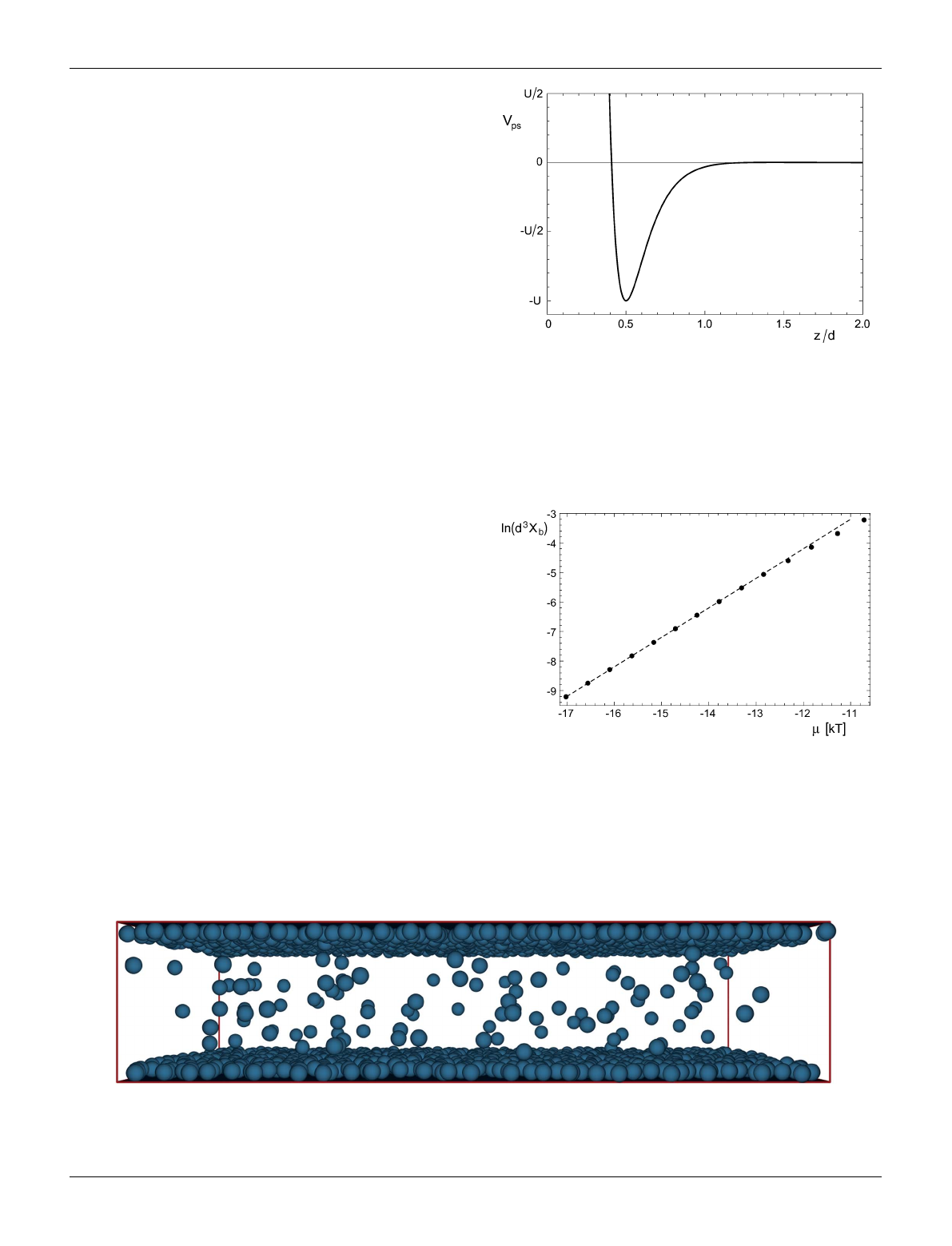
We consider spherical particles between two parallel surfaces (see
Fig. 1). The particles repel each other, but are attracted by the
surfaces. In our model, the interaction potential V
ps
between the
particles and the surfaces is short-ranged and decays to zero at
separations zof the particles from the surfaces close to the
particle diameter d(see Fig. 2). The interaction potential V
ps
attains its minimum value Uat the separation of z¼d/2 at
which the particles are in close contact with the surfaces. The
depth Uof the potential minimum corresponds to the binding
energy of the particles at the surfaces. The soft, pairwise repul-
sion of the particles has the form V
pp
¼4kT(d/r)
12
where ris the
distance between two particle centers.
We assume that the two parallel surfaces are segments of
colloidal objects that are large compared to the particles and
surrounded by the particle solution. The number of particles
between the parallel surfaces then varies because these particles
can exchange with the surrounding bulk of particles. We further
assume that the bulk particles constitute a large particle reser-
voir, with a bulk concentration X
b
of particles that is determined
by the chemical potential mof the particles (see Fig. 3). The
ensemble of particles between the two parallel surfaces consid-
ered here then corresponds to a grand-canonical ensemble with
chemical potential m.
3. Excess pressure and effective adhesion potential
In this section, we determine the effective, particle-mediated
adhesion potential of the surfaces from the pressure that the
particles exert on the surfaces. This pressure depends on the
separation Lof the surfaces and can be obtained from Monte
Carlo simulations (see Appendix for details). We consider here
the excess pressure to be
Dp(L)¼p(L)p(L¼N) (1)
since we assume that the two surfaces are surface segments of
larger objects that are fully surrounded by the particles. There-
fore at large separations, the overall forces exerted by the
particles are zero.
The effective, particle-mediated adhesion potential V
ef
of the
surfaces is obtained by integration over the excess pressure
Dp(L):
Fig. 1 Monte Carlo snapshot for the surface separation L¼10dwhere dis the diameter of the particles. The particles repel each other, but are attracted
by the surfaces. In this snapshot, the chemical potential of the particles is m¼12.32kT, which corresponds to a bulk concentration of X
b
¼0.01/d
3
of
the particles away from the surfaces. The binding energy U¼10kT of the particles at the surfaces leads to an area concentration of X
s
¼0.42/d
2
of the
particles in the adsorption layers.
Fig. 2 The particle–surface interaction potential V
ps
depends on the
distance zof the particle center from the surface. The interaction
potential attains its minimum value Uat the separation z¼0.5dat
which the spherical particle is in contact with the surface. The depth U>
0 of the minimum is the binding energy of the particle with the surface.
The potential is composed of a soft repulsive and a Yukawa-like
attractive term (see eqn (12) and (13) in the Appendix section for details).
Fig. 3 Bulk concentration X
b
versus chemical potential mof the particles
in our model (data points). At small values of X
b
and m, the two quantities
are related via ln(d
3
X
b
)x7.8kT +m(dashed line).
11738 | Soft Matter, 2012, 8, 11737–11745 This journal is ªThe Royal Society of Chemistry 2012
Published on 01 October 2012. Downloaded by TU Berlin - Universitaetsbibl on 30/03/2016 13:32:14.
View Article Online
Vef ðLÞ¼ð
N
L
DpL0dL0(2)
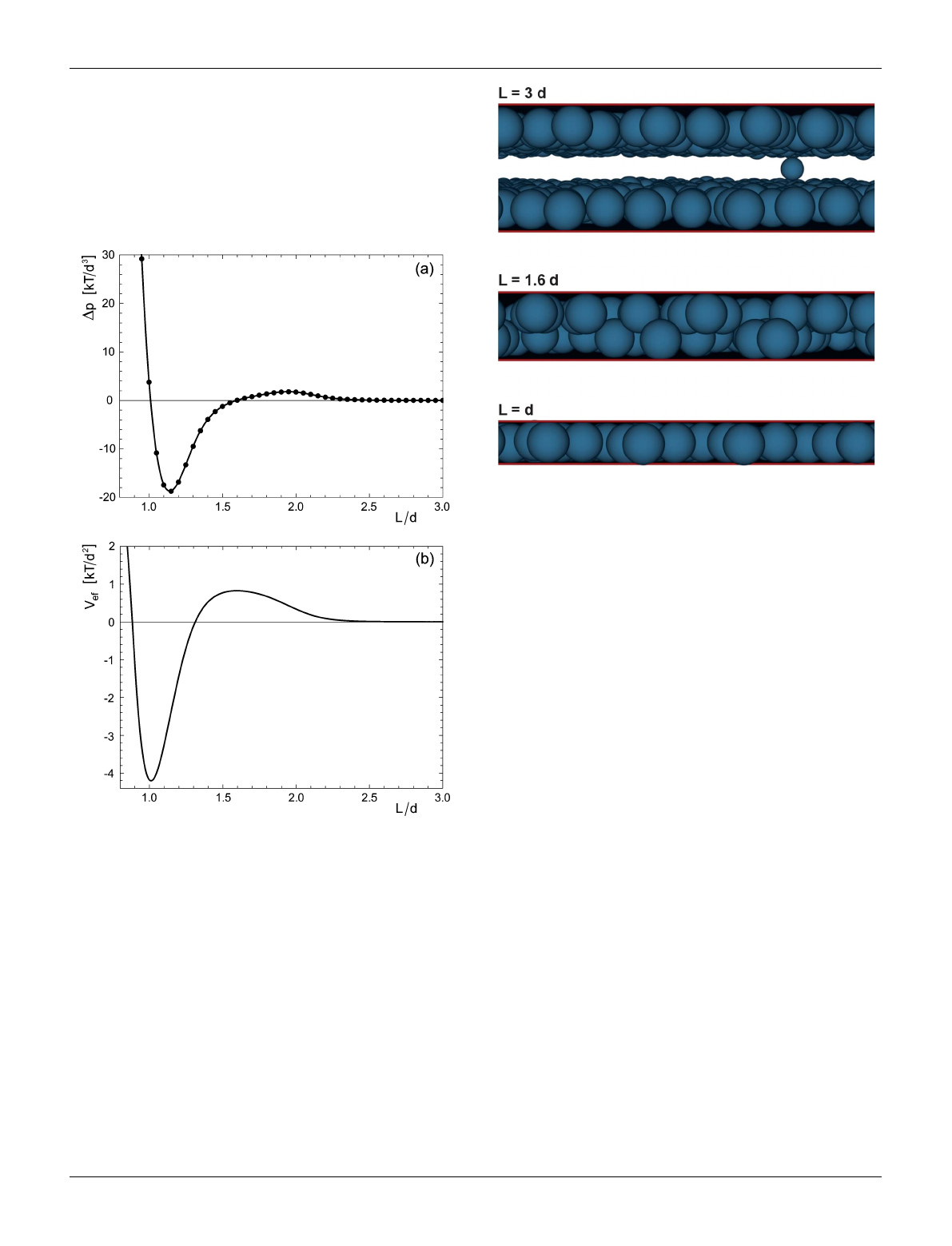
In Fig. 4, the excess pressure Dp(L) and the effective adhesion
potential V
ef
(L) are shown for the binding energy U¼10kT and
chemical potential m¼12.32kT, which corresponds to a bulk
concentration X
b
¼0.01/d
3
of the particles. The effective adhe-
sion potential exhibits a minimum value U
ef
at surface sepa-
rations Lclose to the diameter dof the particles since the particles
can bind to both surfaces at this separation. The depth U
ef
of this
minimum corresponds to the effective, particle-mediated adhe-
sion energy of the surfaces. At surface separations Laround 1.6d,
the effective adhesion potential V
ef
has a local maximum because
particles can no longer bind to both surfaces, and because
particles that bind to one of the surfaces sterically obstruct the
binding of particles to the other surface (see Fig. 5 and 6). This
maximum of height U
ba
constitutes a barrier for adhesion. At
larger surface separations LT3d, the effective potential V
ef
decays to zero because the particles adsorb independently on the
two surfaces.
A characteristic feature of the effective, particle-mediated
adhesion energy U
ef
is that it exhibits a maximum at an inter-
mediate value m¼m* of the chemical potential (see Fig. 7). With
increasing binding energy Uof the particles, the location of this
maximum is shifted to smaller values of the chemical potential
(see Fig. 8) and, thus, to smaller bulk concentrations X
b
of the
particles. In the following, we will show that the maximum of the
function U
ef
(m) can be understood from the adsorption isotherms
and adsorption free energies of the particles. Our starting point is
the surface concentration of adsorbed particles considered in the
next section.
4. Surface concentrations of particles
The surface concentrations of the particles in the adsorption
layers can be calculated from the concentration profiles X(z)of
the particles between the surfaces (see Fig. 6). Here, zis the
Cartesian coordinate perpendicular to the two surfaces, which
are located at z¼0 and z¼L. For large surface separations LT
3d, the particle concentration X(z) has two pronounced peaks
Fig. 4 (a) Excess pressure Dpexerted by the particles and (b) effective,
particle-mediated adhesion potential V
ef
of the surfaces as functions of
the surface separation Lin units of the particle diameter d. In this
example, the binding energy of the particles is U¼10kT and the chemical
potential is m¼12.32kT, which corresponds to a bulk particle
concentration of X
b
¼0.01/d
3
. The dots in subfigure (a) represent the
Monte Carlo data, and the line results from interpolation. The effective
potential V
ef
in subfigure (b) is obtained from the excess pressure Dp via
integration. The effective potential exhibits a minimum at a surface
separation close to the particle diameter at which the particles are firmly
bound to both surfaces. The depth U
ef
of the potential minimum is the
effective binding of the surfaces. Because of the entropy of the confined
particles, the minimum is located at a surface separation slightly larger
than the separation L¼dwhere the total binding energy to both surfaces
is minimal for a particle. In this example, the minimum is located at Lx
1.01d, and the effective binding energy is U
ef
x4.20kT/d
2
. The effective
potential exhibits a barrier of height U
ba
at intermediate separations at
which particles that bind to one of the surfaces obstruct the binding of
particles to the other surface. In this example, the barrier is located at
Lx1.60dand has the height U
ba
x0.83kT/d
2
.
Fig. 5 Monte Carlo snapshots at the surface separations L¼3d, 1.6d,
and dfor the same parameters as in Fig. 4.
This journal is ªThe Royal Society of Chemistry 2012 Soft Matter, 2012, 8, 11737–11745 | 11739
Published on 01 October 2012. Downloaded by TU Berlin - Universitaetsbibl on 30/03/2016 13:32:14.
View Article Online
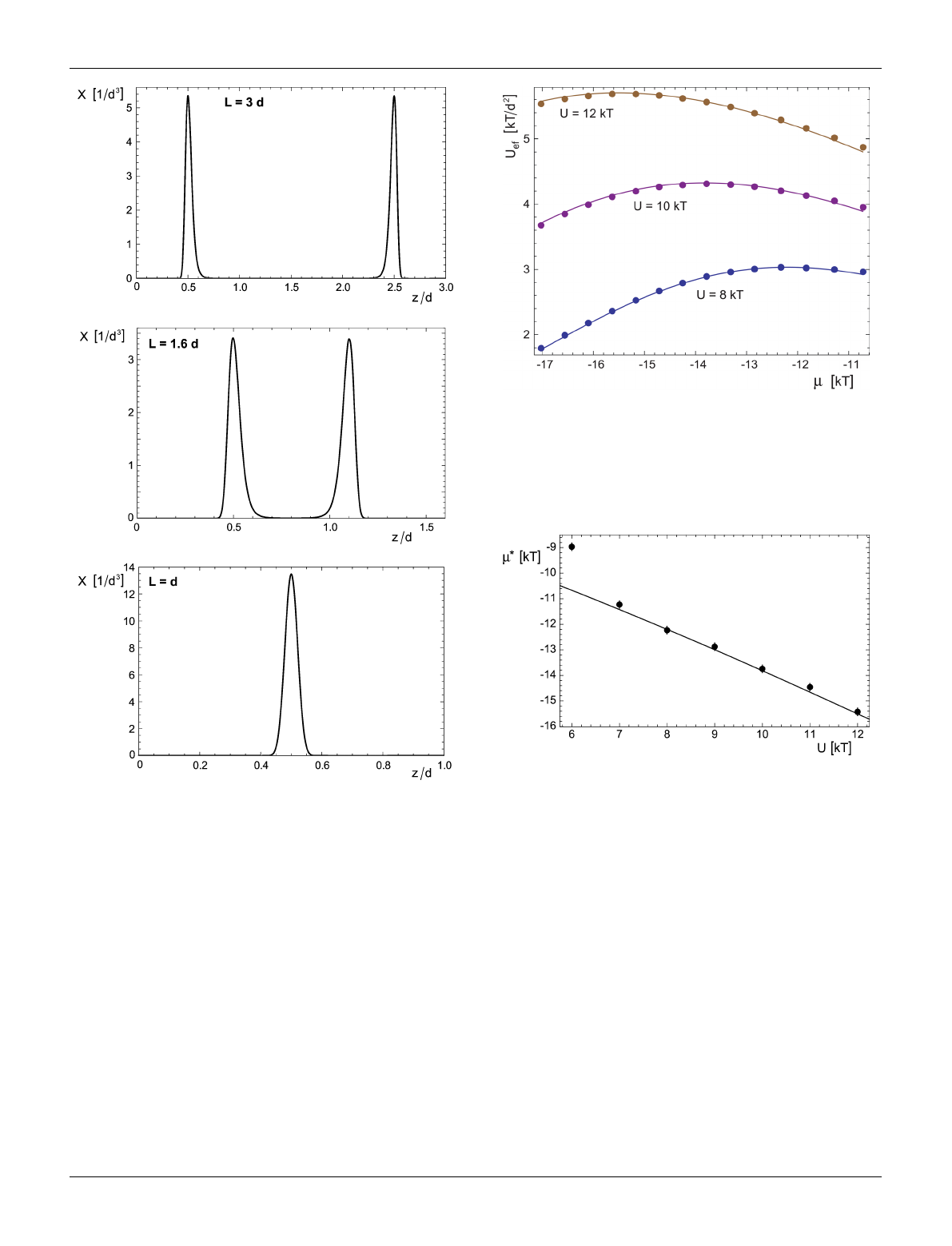
with maxima at z-values close to 0.5dand L0.5dwhere the
particle–surface interaction potential V
ps
is minimal. These two
peaks correspond to the single layers of adsorbed particles at the
two surfaces (see Fig. 5 and 6). At intermediate z-values in the
range d<z<Ldbetween the two peaks, the particle
concentration Xtends towards the bulk concentration X
b
because the particle–surface potential V
ps
is practically 0 for
these z-values, and because packing effects of the particles
between the surfaces are negligible for the bulk concentrations X
b
< 0.1d
3
considered here. For surface separations Lclose to the
binding separation d, the concentration profile X
z
has a single
peak that corresponds to a single layer of particles bound to both
surfaces. The surface concentration X
s
of particles in the
adsorption layers is obtained by integration over the peaks in the
concentration profiles X(z):
Xs¼ð
d
0
XðzÞdz(3)
For large surface separations, the surface concentration X
s
defined in eqn (3) is the area concentration of the single layer of
particles adsorbed to one of the surfaces. For the surface
Fig. 6 Concentration profiles X(z) of the particles between the surfaces
for the same surface separations Land parameters as in Fig. 5. The two
peaks in the profiles for L¼3dand L¼1.6dcorrespond to the single
layers of particles adsorbed at the two surfaces. The peaks at the sepa-
ration L¼1.6dare lower in height than the peaks at L¼3dbecause
particles that bind to one of the surfaces sterically obstruct the binding of
particles to the other surface at this separation (see the snapshot in Fig. 5
for L¼1.6d). The single peak in the concentration profile at the sepa-
ration L¼dcorresponds to a layer of particles bound to both surfaces.
Fig. 7 Effective, particle-mediated binding energy U
ef
of the surfaces as
a function of the chemical potential mfor the binding energies U¼8, 10,
and 12kT of the particles. The effective binding energy U
ef
exhibits a
maximum at intermediate values of the chemical potential. The points
represent the Monte Carlo data, and the lines the simple model based on
eqn (5).
Fig. 8 Values m* of the chemical potential at which the effective binding
energy U
ef
of the surfaces is maximal versus binding energy Uof the
particles. The data points result from an interpolation of Monte Carlo
data for U
ef
as a function of m(see e.g. data points in Fig. 7). The line
results from eqn (7) of the simple model with the fit function for the
adsorption isotherm X
s
(m+U
L
) indicated as a dashed line in Fig. 9(b).
The simple model is in good agreement with the Monte Carlo results for
particle binding energies U$7kT, but deviates at smaller binding
energies.
11740 | Soft Matter, 2012, 8, 11737–11745 This journal is ªThe Royal Society of Chemistry 2012
Published on 01 October 2012. Downloaded by TU Berlin - Universitaetsbibl on 30/03/2016 13:32:14.
View Article Online
separation L¼d, the surface concentration X
s
is the area
concentration of the particles that are bound to both surfaces.
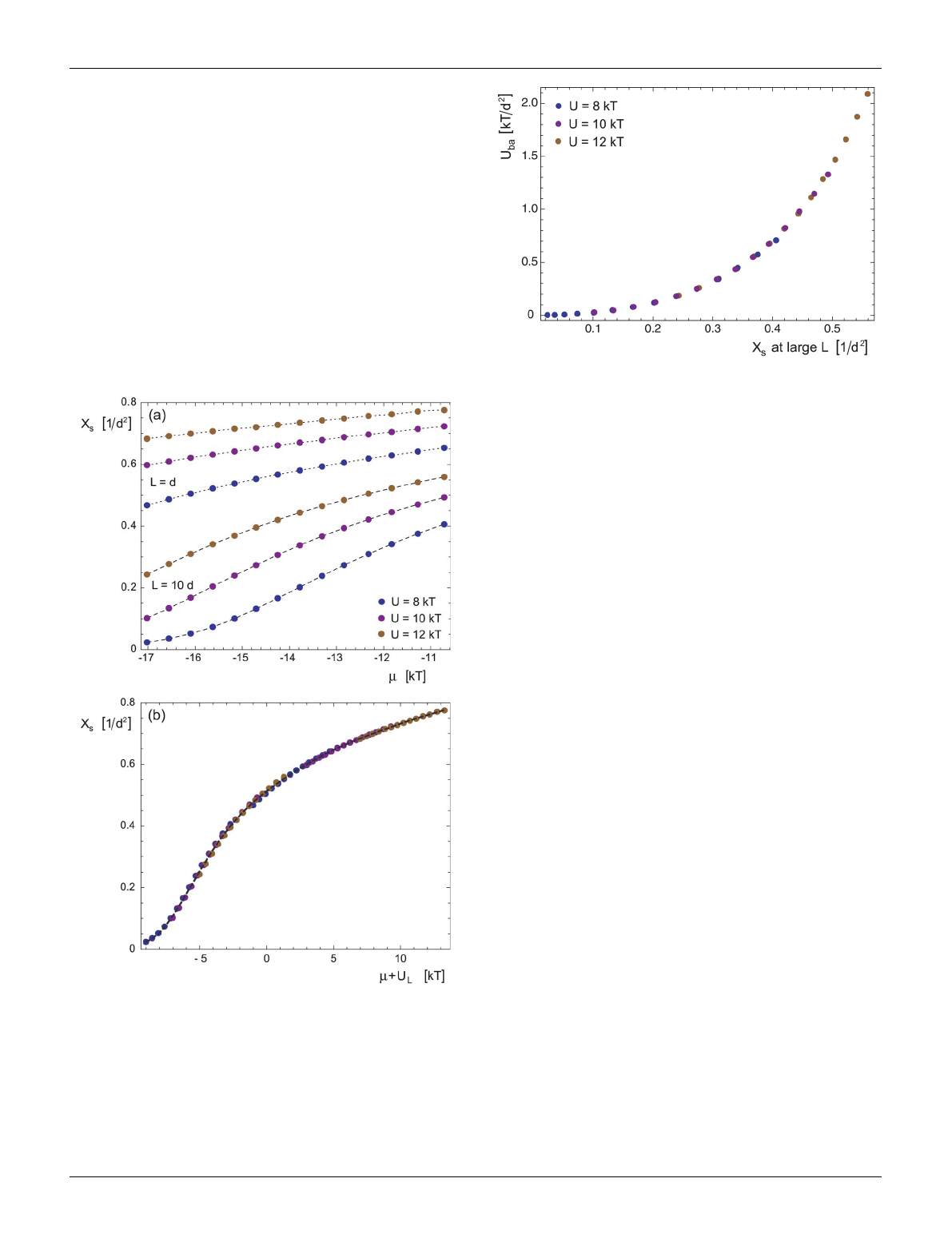
In Fig. 9(a), the surface concentration X
s
is shown as a func-
tion of the chemical potential mat the binding separation L¼dof
the surfaces and at the large surface separation L¼10d, for the
three binding energies U¼8, 10, and 12kT of the particles. The
area concentration X
s
increases with mand with the binding
energy Uof the particles, and is significantly larger at the surface
separation L¼dbecause the particles bind to both surfaces.
When plotted as a function of m+U
L
with U
L
¼Ufor large L
and U
L
¼2Ufor L¼d, the six curves of Fig. 9(a) fall onto a
single curve (see Fig. 9(b)), which indicates (i) that the surface
concentration X
s
depends on the sum of the chemical potential
and binding energy of the particles, and (ii) that the binding
energy at the surface separation L¼dis approximately twice the
binding energy at large separations, which is plausible since the
particles bind to both surfaces at this separation. The small
deviations between the curves in Fig. 9(b) presumably result from
small differences in the entropies of bound particles at L¼dand
at large L, which appear to be negligible compared to the binding
energies, at least for the binding energies Umuch larger than the
thermal energy kT considered here. Because of the soft repulsive
interactions of the particles, the surface concentration X
s
does
not saturate at large values of m+U
L
. A scaling argument
indicates that X
s
increases proportional to (m+U
L
)
1/6
for large
values of m+U
L
at which the adsorbed particles are arranged in a
hexagonal lattice (see Appendix).
The surface concentration X
s
of the particles at large surface
separation determines the height U
ba
of the barrier in the effec-
tive potential V
ef
. In Fig. 10, the barrier height U
ba
of the
effective potential is shown as a function of this surface
concentration for the three binding energies U¼8, 10, and 12kT
of the particles. The values of X
s
here correspond to the values in
Fig. 9(a) at the large surface separation L¼10d. For a given
binding energy U, different values of X
s
in Fig. 10 result from
different values of the chemical potential mof the particles. The
three curves shown in Fig. 10 fall onto a single curve since the
steric interactions between the two adsorbed layers of particles
that lead to the potential barrier only depend on the concentra-
tions of the particles in these layers.
5. Adsorption free energies
In the grand-canonical ensemble, particle concentrations can be
expressed as derivatives of the grand-canonical potential, or ‘‘free
energy’’ with respect to the chemical potential m. The concen-
tration profile X(z) thus can be related to a z-dependent grand-
canonical potential f(z)via X(z)¼vf(z)/vm, and the surface
concentrations X
s
defined in eqn (3) can be associated with a
surface potential, or ‘‘free energy’’ of adsorption f
s
. In the
previous section, we have shown that the surface concentrations
X
s
at the surface separation L¼dand at large separations
depend in good approximation on a single parameter, the
rescaled chemical potential m+U
L
with U
L
¼2Ufor L¼dand
Fig. 9 (a) Surface concentration X
s
of particles in the adsorption layers
as a function of the chemical potential mat the large surface separation
L¼10d(three bottom lines) and at the binding separation L¼dat which
the particles strongly bind to both surfaces. At both separations, the
surface concentration X
s
increases with the chemical potential mand with
the binding energy Uof the particles. (b) Same surface concentrations X
s
as a function of the rescaled chemical potential m+U
L
with U
L
¼Ufor
L¼10dand U
L
¼2Ufor L¼d. In this rescaled plot, the six curves of
subfigure (a) fall onto a single curve. The dashed line represents a 9
th
-
order polynomial fit to the Monte Carlo data (see Appendix).
Fig. 10 Height U
ba
of the barrier in the effective potential V
ef
as a
function of the surface concentration X
s
of adsorbed particles at the large
surface separation L¼10dfor the binding energies U¼8, 10, and 12kT
of the particles.
This journal is ªThe Royal Society of Chemistry 2012 Soft Matter, 2012, 8, 11737–11745 | 11741
Published on 01 October 2012. Downloaded by TU Berlin - Universitaetsbibl on 30/03/2016 13:32:14.
View Article Online
Loading more pages...