
International Journal of Data Science and Analytics (2019) 8:327–338
https://doi.org/10.1007/s41060-018-0111-4
REGULAR PAPER
Prospective crowdsensing versus retrospective ratings of tinnitus
variability and tinnitus–stress associations based on the
TrackYourTinnitus mobile platform
Rüdiger Pryss1·Thomas Probst2·Winfried Schlee3·Johannes Schobel1·Berthold Langguth3·
Patrick Neff4·Myra Spiliopoulou5·Manfred Reichert1
Received: 28 September 2017 / Accepted: 24 February 2018 / Published online: 12 March 2018
© Springer International Publishing AG, part of Springer Nature 2018
Abstract
Many symptoms of neuropsychiatric disorders, such as tinnitus, are subjective and vary over time. Usually, in interviews
or self-report questionnaires, patients are asked to retrospectively report symptoms as well as their severity, duration and
influencing factors. However, only little is known to what degree such retrospective reports reflect the actual experiences
made in daily life. Mobile technologies can remedy this deficiency. In particular, mobile self-help services allow patients
to prospectively record symptoms and their severity at the time (or shortly after) they occur in daily life. In this study, we
present results we obtained with the mobile crowdsensing platform TrackYourTinnitus. In particular, we show that there is a
discrepancy between prospective and retrospective assessments. To be more precise, we show that the prospective variation of
tinnitus loudness does not differ between the users who retrospectively rate tinnitus loudness as “varying” and the ones who
retrospectively rate it as “non-varying.” As another result, the subjectively reported stress-level was positively correlated with
tinnitus (loudness and distress) in the prospective assessments, even for users who retrospectively rated that stress reduces
their tinnitus or has no effect on it. The results indicate that mobile technologies, like the TrackYourTinnitus crowdsensing
platform, go beyond the role of an assistive service for patients by contributing to more detailed information about symptom
variability over time and, hence, to more elaborated diagnostics and treatments.
Keywords Prospective assessment of neuropsychiatric symptoms ·Retrospective assessment of neuropsychiatric symptoms ·
Self-help mobile applications ·Tinnitus ·Mobile data collection ·Mobile crowdsensing
BRüdiger Pryss
ruediger[email protected]
Thomas Probst
Winfried Schlee
Johannes Schobel
Berthold Langguth
Patrick Neff
patrick.nef[email protected]
Myra Spiliopoulou
[email protected]urg.de
Manfred Reichert
1 Introduction
The assessment of neuropsychiatric symptoms is essential in
psychology, medicine and neuroscience. For many neuropsy-
1Ulm University, James-Franck-Ring, 89081 Ulm, Germany
2Department for Psychotherapy and Biopsychosocial Health,
Danube University Krems, Dr.-Karl-Dorrek-Straße 30, 3500
Krems, Austria
3Clinic and Policlinic for Psychiatry and Psychotherapy,
University of Regensburg, Universitätsstraße 84, 93053
Regensburg, Germany
4Neuroplasticity and Learning in the Healthy Aging Brain,
University of Zurich, Andreasstrasse 15, 8050 Zurich,
Switzerland
5Department of Technical and Business Information Systems,
Otto-von-Guericke-University Magdeburg, Universitätsplatz
2, 39106 Magdeburg, Germany
123

328 International Journal of Data Science and Analytics (2019) 8:327–338
chiatric disorders, the severity and duration of symptoms
constitute essential criteria for diagnosis. For example, a
major depressive episode can only be diagnosed if the
patients have suffered from depressive symptoms for at least
2 weeks. Moreover, factors making the symptoms more or
less strong (i.e., correlates of the symptoms) need to be
identified for case conceptualization and treatment planning.
Hence, psychologists, physicians and researchers need to
reliably assess not only symptoms and their severity, but also
their fluctuations over time. However, most indicators of the
symptoms as well as their severity, duration and correlates
are subjective. In current practice, usually, their assessment
is based on retrospective reports of the patients. In turn, this
raises the question to what degree patients are able to remem-
ber the severity, duration and correlates of the symptoms they
have actually experienced.
Mobile technologies can effectively contribute to shed
light on this question. In particular, they allow complement-
ing the retrospective reports of the patients with prospective
assessments of symptom variation over time. In this arti-
cle, we describe how the mobile crowdsensing platform
TrackYourTinnitus [31,32,36–38,42], which we developed
during the last years, contributes to prospectively monitor
symptom variability over time for individuals with tinni-
tus. Tinnitus can be described as the phantom perception
of sound. Depending on its definition and duration as well
as on the patient age and birth cohort, between 5.1 and
42.7% of the population worldwide experience tinnitus at
least once during their lifetime [26]. On the one hand, tinni-
tus varies among patients (i.e., inter-individual variability);
on the other hand, it may vary for a particular patient (i.e.,
intra-individual variability) as well. Moreover, the diagnosis
and treatment of tinnitus and potential comorbidities require
assessments of several symptoms like loudness and varia-
tion of the perceived sound(s), stress-level, depressive and
anxiety symptoms as well as concentration. In this work,
we aim to compare findings from prospective and retrospec-
tive assessments of tinnitus symptoms (loudness and distress)
as well as the potential influencing factor/correlate “stress-
level,” which is often reported in the context of tinnitus
[24].
The limited (ecological) validity of retrospective self-
reports has been shown in several studies on other neu-
ropsychiatric disorders. For example, [1] assessed physical
activities of patients with eating disorders by retrospec-
tive self-reports as well as prospective assessments with an
accelerometer. Patients reported significantly less physical
activity retrospectively compared to the prospective mea-
surements with the accelerometer. In turn, [23] investigated
retrospectively as well as prospectively assessed anxiety and
related cognition in patients with agoraphobia. While anx-
iety did not differ between retrospective and prospective
assessments, cognition did.
Suchresultshighlighttheimportanceofecological momen-
tary assessment (EMA; also known as ambulatory assess-
ment & experience sampling) to support clinicians in assess-
ing neuropsychiatric symptoms as well as their correlates
accurately in real time. In EMA, the variable in question
(e.g., symptoms) is assessed repeatedly in daily life [46].
Instead of retrospectively asking the individuals, through an
interview or questionnaire, how strongly they experienced a
symptom in a given past time interval, the individuals are
asked how they currently experience it as well as its sever-
ity and potential correlates. In turn, this is accomplished at
several time points within the given time interval.
In the aforementioned studies, prospective and retrospec-
tive assessments were juxtaposed manually. To effectively
exploit the prospective assessments in a clinical setting, how-
ever, an integrated solution is needed, i.e., the EMA of a
patient should be transferred automatically to a database and
be made available to the responsible clinician(s) [34,43],
given the consent of the patient. Note that it has been already
reported for a long time that electronic systems are appreci-
ated by study participants [17], increase data accuracy [29],
lead to more complete datasets [22] and reduce costs [30]
compared to traditional paper-based methods. However, the
exploitation of the prospective assessments next to the ret-
rospective reports has not been investigated in the area of
tinnitus yet.
This paper presents the TrackYourTinnitus (TYT) mobile
crowdsensing platform [37,38] for the juxtaposition of retro-
spective and prospective assessments, with a focus on tinnitus
loudness, tinnitus distress and psychological stress. We elab-
orate how the prospective data are collected and how they
should be maintained for further usage. The paper provides
a significant extension of the work we presented in [35]. In
particular, [35] did not include the analysis of tinnitus dis-
tress and psychological stress. As the latter is associated with
several disorders (in general [3]; for tinnitus [24]), this anal-
ysis constitutes another fundamental comparison between
real-time assessments and retrospective reports. We provide
detailed backgrounds on the gathered and evaluated data as
well as the results for psychological stress. This additional
analysis reconfirms that mobile crowdsensing services will
become increasingly important for collecting large and eco-
logically valid longitudinal datasets in the context of clinical
research.
The remainder of the paper is organized as follows.
Related work is discussed in Sect. 2. In Sect. 3, we describe
the TYT mobile crowdsensing platform and explain the
workflow we implemented for collecting and maintaining
prospective assessments. Section 4presents the data as well
as the statistics used for juxtaposing the prospective with
the retrospective assessments. In Sect. 5, we present the
results of the statistical analyses, which suggest that integrat-
ing prospective assessments into the diagnostic–therapeutic
123

International Journal of Data Science and Analytics (2019) 8:327–338 329
processis crucial for optimizing diagnostics and, hence, treat-
ments. The paper concludes with a summary and outlook in
Sect. 6.
2 Related work
Mobile crowdsensing is an emerging research topic in various
application domains [19,20,39,45]. In the medical domain,
however, this research direction has been neglected so far.
The fact that the medical domain is less considered by con-
temporary crowdsensing approaches might be explainable
by legal and data privacy issues [2]. Nevertheless, mobile
crowdsensing offers promising perspectives for the medical
domain [8], as it exhibits unique features for gathering valu-
able patient data in the large scale [5]. In particular, mobile
crowdsensing allows for the effective, context-aware gather-
ing [21] of daily life patient data [33], which, in turn, will
shift clinical research to a new level.
Besides TrackYourTinnitus (TYT), other studies have
applied EMA approaches to track tinnitus in daily life
[9,11,27,48]. Yet, their focus was not to compare retrospec-
tive ratings and prospectively crowdsensed data. [48] and
[11] were pilot studies that showed for example that tinni-
tus tracking is feasible without negative consequences for
the participants and that tinnitus varies within and between
participants. [9] investigated fluctuations of tinnitus as well
as associations between tinnitus and stress. [27] tracked tin-
nitus and other symptoms (e.g., dizziness) in patients with
Meniere’s syndrome. Contrary to these approaches, TYT is
an open-source application, available for download in the
iOS app store or Google play store, so that there is a larger
and more representative sample compared to the participants
of the cited studies.
Beyond tinnitus, EMA approaches capturing many other
aspects such as pain [14] or feelings [15] in daily life were
scientifically evaluated. In addition, EMA approaches were
studied in the areas of mood disorders and mood dysregula-
tion [40,47] as well as in the context of substance use [44]
and eating disorders [7]. In psychotherapy research, EMA
has been used to predict patient progress [13]. Although most
neuropsychiatric symptoms are subjective experiences and,
thus, most EMA approaches use self-reports to capture these
symptoms, some neuropsychiatric symptoms are behavioral
(e.g., avoidance in anxiety disorders) or physiological (e.g.,
increase of heart rate in anxiety disorders). Note that mobile
systems offer opportunities to measure behavioral or physi-
ological data in daily life [6].
Altogether, EMA approaches provide unprecedented
opportunities to study neuropsychiatric symptoms under eco-
logically valid conditions [28], even though the utilization of
its possibilities is still in its infancy, especially in the medical
domain.
3 The TrackYourTinnitus platform
TrackYourTinnitus (TYT) is a mobile crowdsensing platform
that comprises a Web site for user registration, two mobile
applications (for iOS and Android) and a relational database
(MySQL) as the central repository storing the collected data
[37]. In particular, the anonymized or pseudonymized TYT
data from the repository are made available to clinicians as
well as researchers. The Web site further provides two funda-
mental features: First, users can visualize recorded tinnitus
data; second, they can report on their current tinnitus treat-
ment. In general, TYT was developed to track the individual
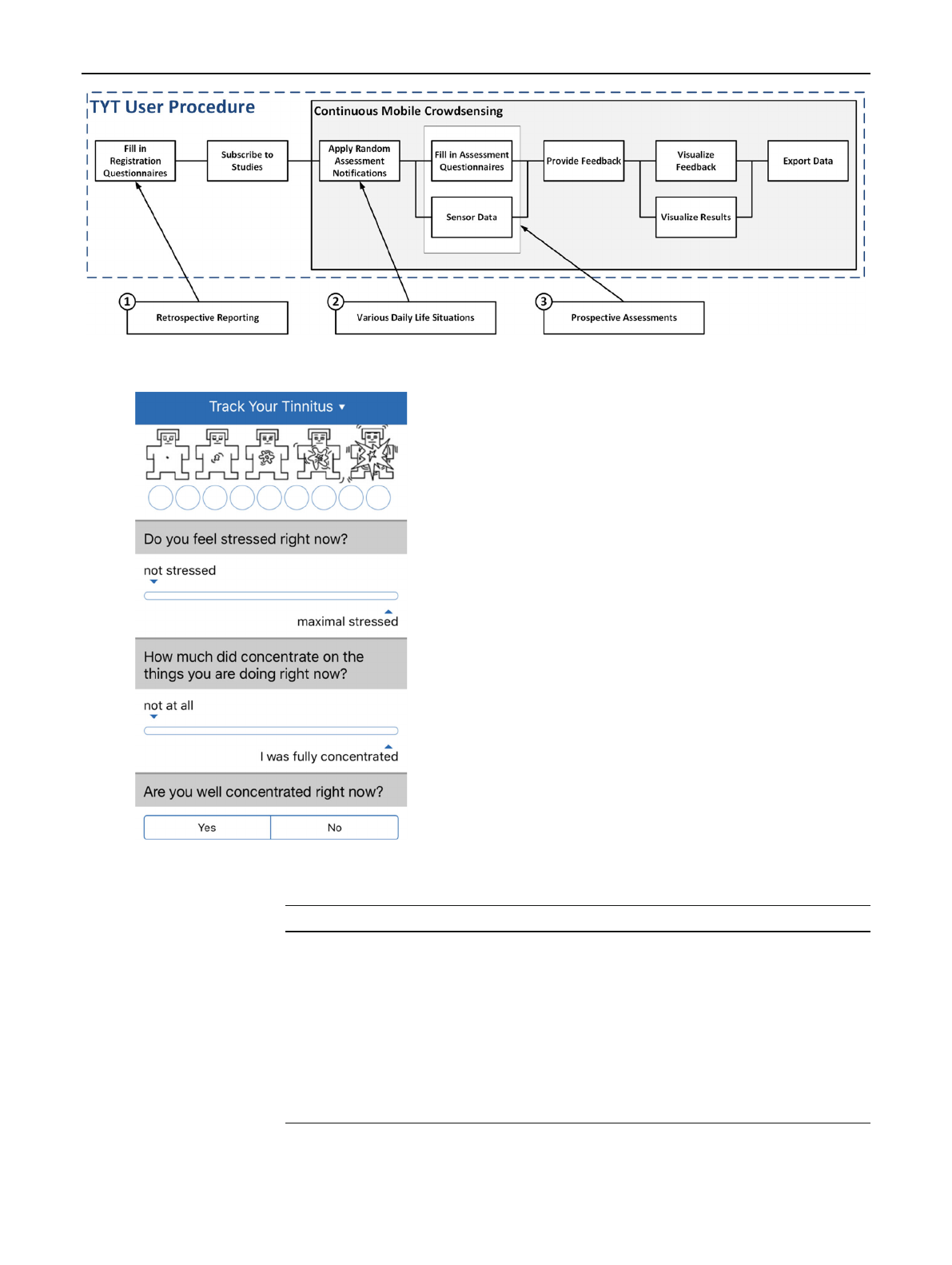
tinnitus perception of users. In this context, the procedure
depicted in Fig. 1is applied to the TYT users.1
Following this procedure, TYT pursues three goals. First,
data shall be collected on a daily basis (cf. Fig. 1,3
). How-
ever, a crowd user shall not foresee the times he or she is
asked to sense data (cf. Fig. 1,2
). This is ensured by asking
the crowd users in various daily life situations. Second, the
collected data shall enable new kinds of data analytics like
juxtaposing real-time assessments and retrospective reports
(cf. Fig. 1,1
). Third, gathered data shall be used to provide
feedback to the mobile crowd users.
To enable the use of TYT as well as to provide data being
appropriate for the data analysis applied in the context of this
paper, the following procedure has to be accomplished by the
users (cf. Fig. 1).
First, users have to create a TYT account, by using either the
TYT Web site or the TYT mobile applications.
Second, users have to fill in three registration questionnaires
(cf. Fig. 5). First of all, they have to fill in the “Mini-TQ-12”
questionnaire (cf. Fig. 5, Mini-TQ-12 [12]), which measures
tinnitus-related psychological problems. Second, they have
to fill in the “Tinnitus Sample Case History Questionnaire”
(TSCHQ) (cf. Fig. 5,TSCHQ[18]), in which details about
the current tinnitus status, relevant co-morbidities and the
tinnitus history are assessed. Note that TSCHQ comprises
two questions being crucial for the results of this paper. To
be more precise, the 11th item of TSCHQ asks the user
retrospectively whether or not the tinnitus loudness varies
from day to day. The 26th item of TSCHQ, in turn, requests
from users to rate retrospectively whether stress is associ-
ated with their tinnitus. Third, users have to fill in the “Worst
Symptom” questionnaire (cf. Fig. 5, Worst Symptom ques-
tionnaire), which asks the users about the worst symptom
currently caused by their tinnitus. While the first two ques-
tionnaires constitute already used instruments, the third one
was newly developed in the context of the presented research.
Altogether, the completion of the three questionnaires with
1More detailed information about the procedure can be found at https://
www.trackyourtinnitus.org/process.pdf
123
330 International Journal of Data Science and Analytics (2019) 8:327–338
Fig. 1 Mobile crowdsensing collection procedure
Fig. 2 Impression of assessment questionnaire in iOS
their 58 questions in total is a fundamental prerequisite for
users who want to access the TYT Web site features as well
as the TYT mobile applications (Fig. 2).
Third, after registering and completing the required ques-
tionnaires, users may exploit the mobile applications to
track their tinnitus and potential correlates during daily life.
For this purpose, a user needs to log in to the Android
or iOS mobile application. Then, he/she is asked to fill
in the assessment questionnaire developed for TYT (cf.
Fig. 5, assessment questionnaire). This repeatedly admin-
istered assessment questionnaire comprises 8 items (cf.
Table 1) including questions on the current tinnitus loudness,
tinnitus distress and subjective stress-level. Figure 3gives an
impression of how the questionnaire looks like in iOS.
Fourth, the assessment questionnaire is provided in two
ways. Either the mobile application automatically displays
the questionnaire to the user or the user himself makes the
conscious decision to fill out the questionnaire (cf. Fig. 5,
conscious decision). The first procedure is the preferred one
and is realized as follows: The assessment questionnaire is
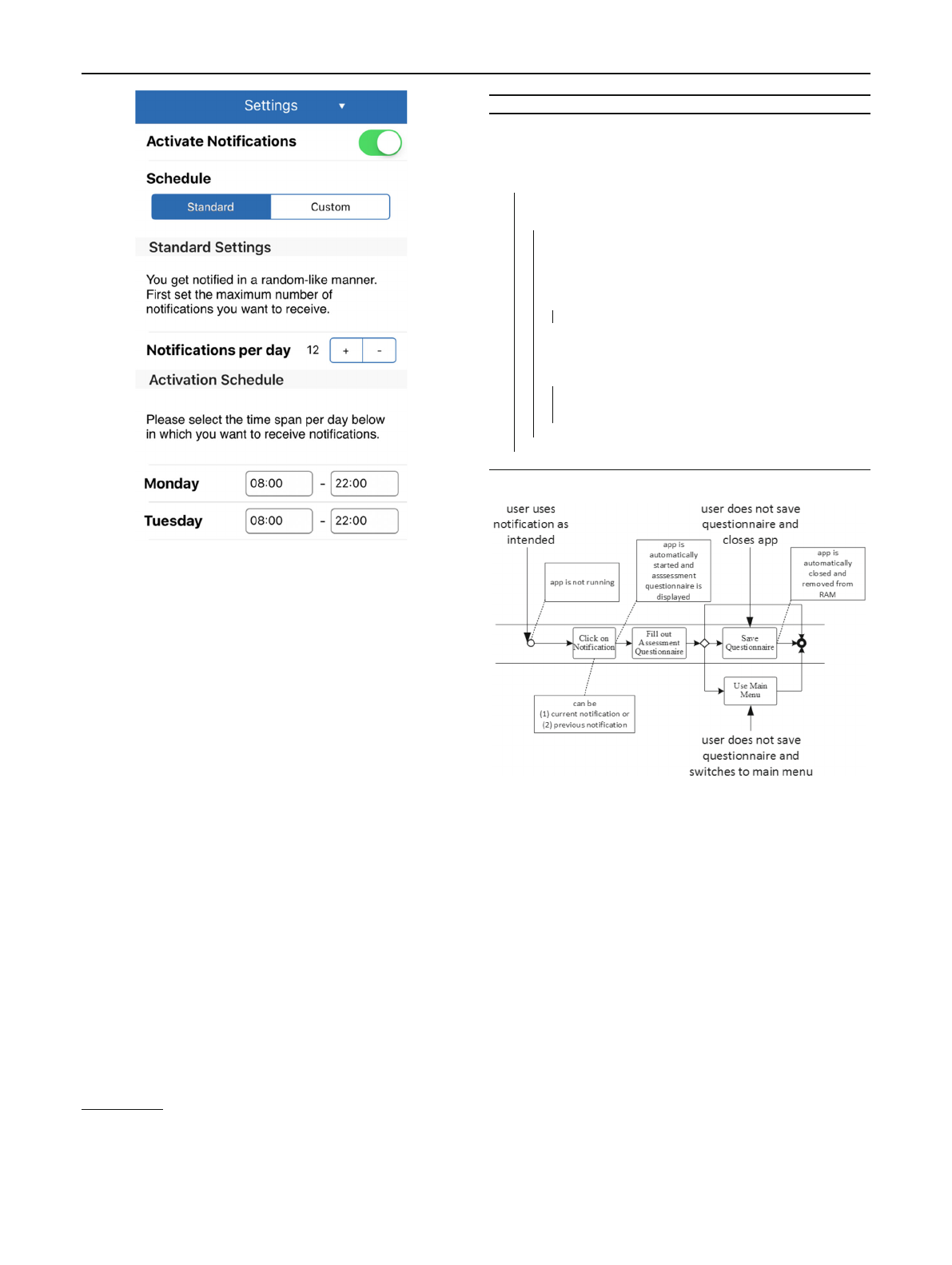
randomly presented to the user up to 12 times per day. Fig-
ure 3gives an impression of the notification settings in iOS.
Table 1 TrackYourTinnitus
assessment questions Question Scale M
1
Did you perceive the tinnitus right now? BS Perception
2
How loud is the tinnitus right now? VAS Loudness
3
How stressful is the tinnitus right now? VAS Strain
4
How is your mood right now? VAS Mood
5
How is your arousal right now? VAS Arousal
6
Do you feel stressed right now? VAS Stress
7
How much did you concentrate on the
things you are doing right now?
VAS Con.
8
Do you feel irritable right now? BS Irritability
BS binary scale, VAS visual analogue scale, Mmeasurement of, Con. concentration
123
International Journal of Data Science and Analytics (2019) 8:327–338 331
Fig. 3 Impression of notification settings in iOS
For the application of the assessment questionnaire, noti-
fication features for both Android and iOS as well as a
notification algorithm were realized [37]. We only present
the algorithm running on iOS (cf. Algorithm 1) and the cal-
culated notifications for a single day. In practice, notifications
are calculated in advance. The algorithm, in turn, works as
follows:
1. It partitions the time window a user has specified with
respect to a particular day into ntime intervals of equal
length. ncorresponds to the number of notifications the
user has chosen.
2. The algorithm then calculates exactly one notification for
each interval. Thereby, it ensures that for each notification
the points in time are randomly calculated.
3. Finally, it is ensured that there is an interval of at least
15 min between two notifications.
On the one hand, the procedure ensures that users cannot
foresee the time when being asked; on the other hand, it
ensures that they are sensed in various daily situations. Note
that this randomized approach was realized to improve the
ecological validity of the applied method. The approach to
randomly apply the assessment questionnaire is illustrated in
2arc4random_uniform(upper_bound): iOS internal function to return
a uniformly distributed random number less than upper_bound.
Algorithm 1: iOS algorithm for daily notifications of a user
Data:
timeInterval: time interval a user has specified for a day
numberOf NotificationsPerDay: notifications specified for a day
Result:
scheduleLocalNotification: calculated random notifications for a day
1begin
2lengthOfIntervall = timeInterval/numberOfNotificationsPerDay;
3lastNotification = 900; /* the 15 minutes */
4foreach n∈numberOf Notif icationsPerDay do
5secondsSinceStartOfInterval =
arc4random_uniform2(lengthOfIntervall);
6absoluteInterval=
7secondsSinceStartOfInterval+(n*lengthOfIntervall);
/* check the 15 minutes */
8if absoluteInterval −lastNoti f ication <900 then
9absoluteInterval = 2*absoluteInterval - lastNotification;
10 end
11 lastNotification = absoluteInterval;
/* check if notification is in
absoluteInterval */
12 if absoluteInterval <timeInterval then
/* notification found */
13 scheduleLocalNotification =
scheduleLocalNotification ∪absoluteInterval;
14 end
15 end
16 end
Fig. 4 Possible user action after a notification
Fig. 4. It works on both mobile operating systems in exactly
the same ways.
After a notification appears, the user may click on it. In the
latter case, the TYT mobile app is started (if not already run-
ning) and the assessment questionnaire is directly displayed
to the user. Then, he or she can fill out the questionnaire and
finally save the entered data. After saving the questionnaire
data, the mobile app is terminated 3 s later. Within these 3 s
the result is transferred to the TYT backend (if the mobile
app is online; otherwise, the result is locally stored until the
device gets an online connection).
The procedure to automatically terminate the app shall
speed up the process to fill out questionnaires after being
notified. Note that the user feedback we have received so far
supports this technical procedure. If the user does not save
123
Loading more pages...