
Utilizing the Capabilities Offered by Eye-
Tracking to Foster Novices’ Comprehension of
Business Process Models
Michael Zimoch1, R¨udiger Pryss1, Georg Layher2, Heiko Neumann2, Thomas
Probst3, Winfried Schlee4, and Manfred Reichert1
1Institute of Databases and Information Systems, Ulm University, Germany
2Institute of Neural Information Processing, Ulm University, Germany
3Dep for Psychotherapy and Biopsycho Health, Danube University Krems, Austria
4Department of Psychiatry and Psychotherapy, Regensburg University, Germany
{michael.zimoch, ruediger.pryss, georg.layher, heiko.neumann,
manfred.reichert}@uni-ulm.de, [email protected],
winfried.schlee@googlemail.com
Abstract. Business process models constitute fundamental artifacts for
enterprise architectures as well as for the engineering of processes and
information systems. However, less experienced stakeholders (i.e., no-
vices) face a wide range of issues when trying to read and comprehend
these models. In particular, process model comprehension not only requi-
res knowledge on process modeling notations, but also skills to visually
and correctly interpret the models. In this context, many unresolved is-
sues concerning the factors hindering process model comprehension exist
and, hence, the identification of these factors becomes crucial. Using eye-
tracking as an instrument, this paper presents the results obtained of a
study, in which we analyzed eye-movements of novices and experts, while
comprehending process models expressed in terms of the Business Pro-
cess Model and Notation (BPMN) 2.0. Further, recorded eye-movements
are visualized as scan paths to analyze the applied comprehension stra-
tegies. We learned that experts comprehend process models more ef-
fectively than novices. In addition, we observed particular patterns for
eye-movements (e.g., back-and-forth saccade jumps) as well as different
strategies of novices and experts in comprehending process models.
Keywords: Business Process Model Comprehension, Eye-Tracking, Cog-
nition, Eye-Movement Modeling Examples, (Hidden) Markov Model
1 Introduction
Business Process Management (BPM) aims at the creation, improvement, as
well as automation of business processes and has become vital for the success of
any enterprise [1]. In this context, a process model acts as a blueprint comprising
tasks, decisions, and actors dedicated to a specific process. Usually, these pro-
cess models are expressed in terms of textual or graphical artifacts. The latter,

2 Zimoch et al.
in turn, are utilized to advance the understanding of business processes (i.e.,
process model comprehension) for all involved stakeholders [2].
Generally, process models should be created in a way such that process stake-
holders do not face any problems in comprehending them. Still, stakeholders are
encountering challenges in the comprehension of process models [3], especially
the less experienced ones (i.e., novices) [4]. In this context, the use of eye-tracking
might provide valuable insights into the cognitive processes of comprehending
process models [5]. Amongst others, assertions about the cognitive load can be
made and the process model comprehension strategies applied can be identified,
e.g., by visualizing the corresponding scan path. In detail, the scan path reflects
the chronological order of fixations (i.e., gaze over informative areas of interest)
and saccades (i.e., quick eye-movements between fixations) [6].
This paper presents the results we obtained from a process model comprehension
study relying on eye-tracking. In detail, novices and experts in the domain of
process modeling had to study three different process models expressed in terms
of the Business Process Model and Notation (BPMN) 2.0 [7], whilst their fixa-
tion and saccade patterns were recorded by an eye-tracker. The objective of the
study is to deliberately disclose the approaches applied by novices and experts
to comprehend process models. Further, we want to investigate whether or not
there are differences in comprehending process models, e.g., in which way the
applied comprehension strategies between the participants differ. The study in-
sights can be used to derive comprehension guidance, especially for novices, and
be used to augment tools with features fostering process model comprehension.
The remainder of the paper is structured as follows: Section 2 describes the con-
text and setting of the study. Study results, in turn, are analyzed and discussed
in Section 3. Related work is discussed in Section 4. Finally, a summary and an
outlook on future work are given in Section 5.
2 Study Context
In general, comprehension constitutes a cognitive process that establishes re-
lations between available information on objects and events in the long-term
memory, together with information perceived at the moment from the sensory,
working, or short term-memory [8]. In this context, process model comprehension
can be termed as the process for decoding and capturing the information docu-
mented in process models [9]. To be more precise, individuals must cope with the
complexities involved of parsing the relevant syntactic,semantic, and pragmatic
information in a process model. As a consequence, novices are frequently con-
fronted with the challenge to properly read and comprehend process models [10].
To systematically study this challenge, we conducted an eye-tracking study on
how to foster the comprehension of process models. For this purpose, we identify
the scan paths (i.e., chronological order of fixations and saccades) of both novices
and process modeling experts while comprehending process models documented
in terms of BPMN 2.0. Moreover, it is found in eye-tracking studies that experts
comprehending a stimulus (e.g., picture) are more likely to reflect a smaller num-

Eye-Tracking to Foster Novices’ Comprehension of Business Process Models 3
ber of fixations,saccades, and consequently a shorter scan path length compared
to novices [11]. Therefore, amongst others, the use of eye-tracking enables us
to measure the cognitive load as well as to reveal visual stumbling blocks in a
process model, which, in turn, might hinder overall comprehension.
2.1 Study Setting
First of all, we want to identify the strategies for reading and comprehending
process models and analyze whether or not there are differences between novices
and experts. Therefore, we invite novices (n= 17) and experts (n= 19) from
the field of process modeling to participate in the study. This categorization into
two samples (i.e., novices and experts) is accomplished by a median split, i.e.,
based on the time spent on process modeling so far, as provided through a self-
reporting. In the study, participants are asked to read and comprehend three
different BPMN 2.0 process models. These process models cover three different
scenarios, i.e., fitness training, the purchase of an item in an auction, and the
ordering of a pizza. Further, the process models reflect three different levels of
complexity, i.e., easy,medium, and hard. In detail, the easy process model only
comprises a sequence of basic modeling elements of BPMN 2.0. With increasing
level of complexity, new BPMN elements are introduced, previously not con-
tained in the process models, and the total number of elements is increased.
After comprehending a process model, participants need to answer four true-or-
false comprehension questions, solely referring on the semantics of the process
scenario. The questions are used in order to ensure that participants actually
study the process models. Moreover, relative fixations and saccade patterns are
recorded with the SMI iView X Hi-Speed system at a sampling rate of 240 Hz.
Demographic data and qualitative feedback, in turn, are gathered based on que-
stionnaires. In addition, participants are given the instruction to complete the
study as fast as possible but, on the other, as meticulous as possible.
3 Analysis of Eye-Movements
Table 1 presents mean and standard deviation (SD) for all values obtained from
the two samples, i.e., novices and experts. For each level of complexity (i.e.,
easy,medium, and hard), the process model comprehension duration (in s), the
fixation and saccade counts as well as the length of the scan path (in px) are
shown. As expected, a clear difference between the single levels of complexity is
discernible, i.e., an apparent increase in respective factors. Further, juxtaposing
the results obtained for novices and experts, novices need more time for process
model comprehension. Fixation and saccade counts reflect a higher number and
this results in a longer scan path for the comprehension of process models.
Data collected with eye-tracking during the study is analyzed and visualized
with SMI BeGaze software, which allows for an extensive analysis of recorded
eye-movements. After analyzing of the obtained data, different scan paths for
comprehending a process model (i.e., process model comprehension strategies) are
4 Zimoch et al.
Both Novices Experts
Factor Mean (SD) Mean (SD) Mean (SD)
Easy
Duration 35.37 (14.52) 38.53 (16.26) 31.78 (12.29)
Fixation 121.42 (41.57) 138.76 (39.41) 104.84 (43.39)
Saccade 120.81 (39.81) 130.47 (36.12) 111.11 (43.84)
Scan Path 24398.44 (9349.76) 26342.18 (7192.88) 22454.89 (11107.53)
Medium
Duration 54.11 (22.05) 63.11 (23.28) 46.05 (16.30)
Fixation 187.08 (57.98) 209.12 (56.37) 167.47 (57.54)
Saccade 204.36 (68.50) 220.41 (69.54) 188.32 (68.94)
Scan Path 42181.03 (29357.56) 47364.35 (38368.67) 37543.32 (17865.93)
Hard
Duration 67.14 (29.02) 73.07 (33.04) 62.16 (24.01)
Fixation 240.94 (79.16) 264.94 (99.88) 216.00 (56.04)
Saccade 233.69 (83.85) 260.06 (88.90) 207.47 (81.50)
Scan Path 45217.22 (16077.79) 49534.24 (18576.74) 40900.32 (13962.37)
Table 1: Descriptive Results (i.e., Both, Novices, and Experts)
derived for novices and experts respectively. However, both samples show alike
comprehension strategies in the first iteration, i.e., after having a first glance on
the process models. More precisely, beginning from the start element of a process
model, both samples visually consider all elements in a process model through
an element-to-element procedure. After completing the first iteration, strategies
of novices and experts respectively differ during the second iteration. Thereby,
particular eye-movement patterns become apparent, e.g., back-and-forth saccade
jumps and targeted search. Many novices reconsider the process model once more
from the start element, but with a stronger emphasis on single elements and mo-
deling constructs (e.g., parallelism, decision points before splitting control flows
into alternative paths), indicating strong variabilities in saccade patterns as well
as fixation times. Experts, in turn, focus on decisive modeling constructs (e.g.,
decision points) in the process models and, hence, their attention shifts between
these elements. As opposed to experts, the scan paths of novices reflect higher
fixation and saccade counts. Further, they require a greater duration for com-
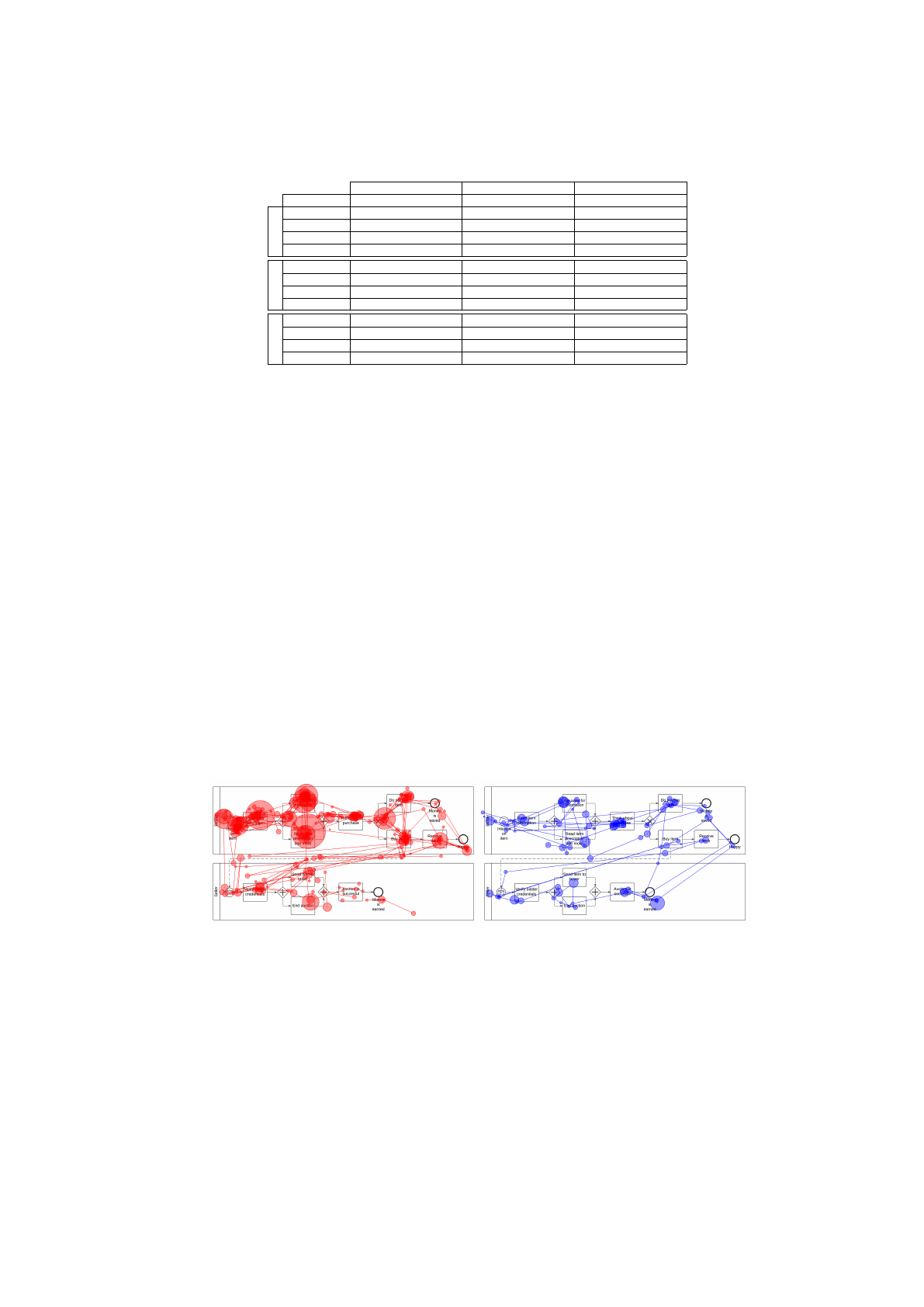
prehending a process model (cf. Table 1). Figs. 1 and 2 illustrate two identified
scan paths, one from a novice and one from an expert.
Fig. 1: Scan Path of a Novice Fig. 2: Scan Path of an Expert
In Fig. 1, the scan path of a novice is shown. It consists of 301 fixations,254
saccades, and an overall comprehension duration of 98.17 seconds. On the con-
Eye-Tracking to Foster Novices’ Comprehension of Business Process Models 5
trary, the experts’ scan path (cf. Fig 2) comprises 100 fixations and 99 saccades.
In addition, the comprehension duration is 27.47 seconds. Comparing both scan
paths, it becomes apparent that the novice spent more time studying the elements
in the process models, whereas the expert moved quickly over the elements.
3.1 Discussion
An explanation for our study findings might be that process models reflect com-
plex business processes with high information density. Thus, the process of com-
prehending such models leads to a high cognitive load, especially regarding no-
vices [12]. Process model comprehension not only requires knowledge on process
modeling notations, but also the capability to visually interpret these models.
Usually, these capabilities evolve over time due to increasing practical experien-
ces [13]. However, existing research revealed that the visual observation capabi-
lities of experts can be efficiently conveyed to novices [14]. To evaluate this, we
are currently conducting another exploratory study, in which we explicitly show
the novices how experts visually comprehend process models. For this purpose,
we are analyzing the scan paths of modeling experts more deeply with the goal
to derive an average scan path. Furthermore, decisive modeling constructs (e.g.,
parallelism) are identified, which are essential regarding the correct comprehen-
sion of process models. Consequently, novices can be directed through a process
model by selective reading, ensuring a correct process model comprehension.
The material used in the current study is provided in terms of Eye-Movement
Modeling Examples (EMMEs), which shall serve as a basis for guiding novices
in comprehending process models [15]. EMMEs either reflect the scan paths of
experts or highlight specific modeling constructs superimposed onto a process
model. In general, the use of EMMEs allows us to focus on the various dimensi-
ons in a process model. More specifically, any process model contains information
related to different dimensions, e.g., syntactics or semantics [16]. Amongst ot-
hers, the syntactic dimension refers to compliance with modeling rules, whereas
semantics refer to proper and complete documentation of a scenario in a process
model. Therefore, based on the dimension set, the EMMEs can reflect different
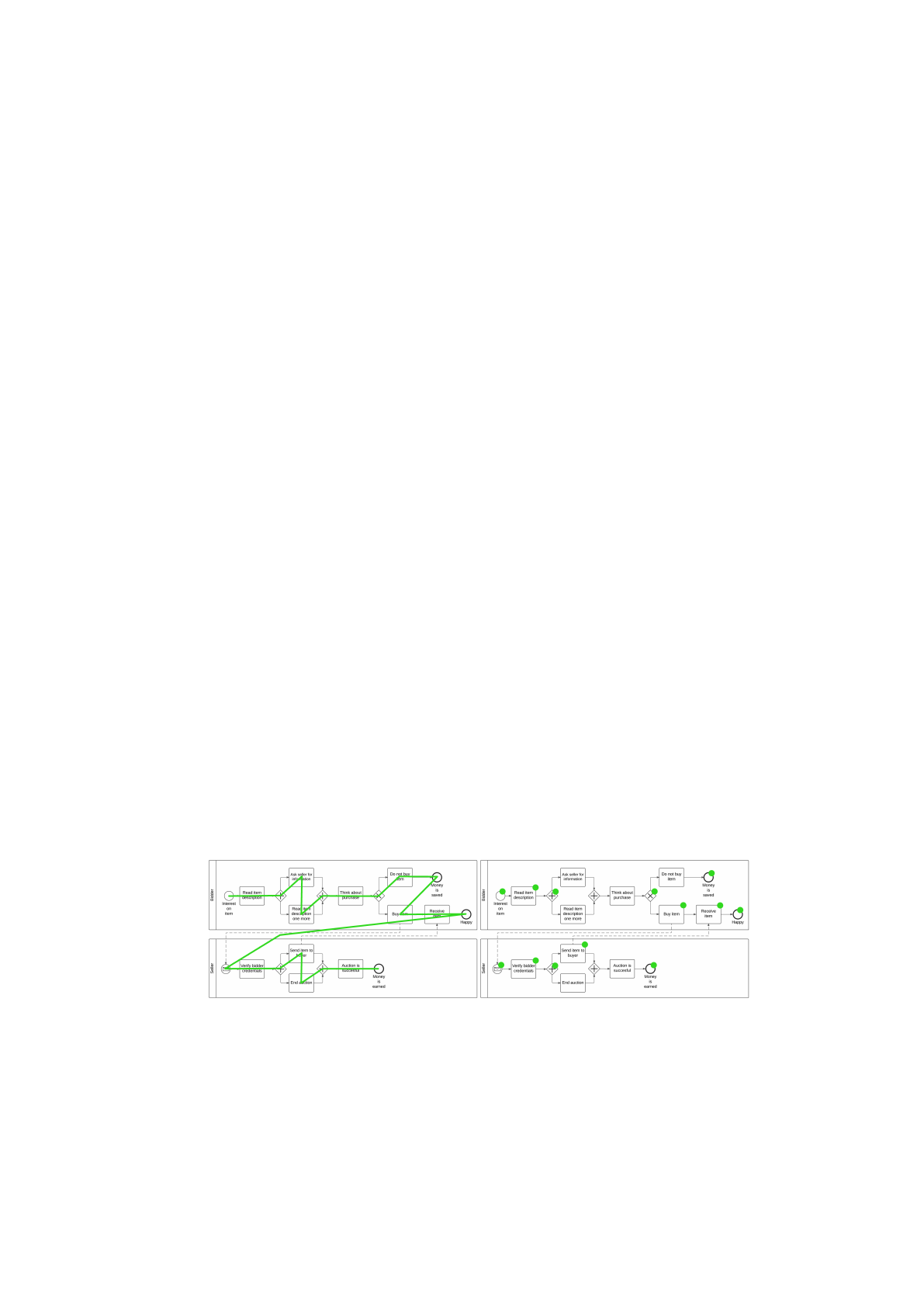
conditions (cf. Figs. 3 and 4). Fig. 3 shows the Path Display Condition, which
visualizes the derived experts average scan path in a process model. The Path
Fig. 3: Path Display Condition Fig. 4: Dot Display Condition
Loading more pages...