
1
Hermann-Rietschel-Institut | Fachgebiet Gebäude-Energie-Systeme | Marchstr. 4 D-10587 Berlin
Risk assessment of rehearsal rooms for choir singing regarding aerosols loaded
with virus
Authors: Anne Hartmann1, Dirk Mürbe2, Martin Kriegel1, Julia Lange1, Mario Fleischer2
1 Technical University of Berlin, Hermann-Rietschel-Institut
2 Charité Universitätsmedizin Berlin, Department of Audiology and Phoniatrics
DOI: http://dx.doi.org/10.14279/depositonce-10388
Introduction:
Regarding the current knowledge aerosols are one of the transmission ways of SARS-CoV-2-
viruses [RKI2020]. During speaking and singing aerosols are generated too, because the
airways, besides ventilation, are also the place of origin of voice source and spoken
language. Reports of high infection rates during choir rehearsal in closed spaces
[Hamner2020] indicate an increased aerosol production during singing, which could be
originated by characteristic mechanisms of voice physiology and the higher continuity of
vowel production over the time. Current investigations regarding the emission of particles
during speaking [Hartmann2020] and singing [Mürbe2020] showed an increase in the
aerosol production in both situations. Compared to breathing through the nose an average
increase of about factor 10 was described for speaking and for singing an average increase of
about factor 30 was described compared to speaking. A noticeable difference between the
different persons was found, whereas the role of “high-emitting persons” has to be kept in
mind for the transmission of the virus.
For the assessment of the risk of an infection with SARS-CoV-2-viruses during singing and for
an improved risk management in case of a restart of rehearsals and performances of choirs
besides the evaluation of the current prevalence of the disease and besides the general
hygiene and distance rules, other factors play an important role as well. These factors
include the number of Singers, the duration of rehearsal or performance, but particularly the
room situation and the air condition systems. Especially, the last two factors have been
addressed in an unsatisfactory manor in the current risk management and should therefore
be investigated in this paper through an analytical risk management based on the measured
particle concentration and typical room situations.
Background and methods
The longer a person stays inside a room, the further the aerosol concentration is raising.
Most important for the progression of this increase is the emitted concentration of the
contamination (number of infected persons and their particle emission rate), the air change
rate (supplied fresh air in relation to the room volume) as well as the effectiveness of the
ventilation system (ventilation effectiveness). Based on well-known equations to calculate
the concentration of contamination in internal spaces under the influence of different air
change rates, a risk assessment for different scenarios has been performed. The details of
the procedure can e.g. be found in [Kriegel2020].

2
Hermann-Rietschel-Institut | Fachgebiet Gebäude-Energie-Systeme | Marchstr. 4 D-10587 Berlin
Investigated scenarios
To assess the risks three typical application scenarios for choir rehearsals and performances
as well as a reference case have been selected:
choir rehearsal room
concert hall I
concert hall II
reference case: office
The calculations has been performed for the rehearsal room of the Berlin Philharmonic Choir
(assembly hall Clara-Grunwald-Schule Berlin), the Main hall of the concert house Berlin
(concert hall I – format “Schuhkarton” (“shoebox”)) as well as the concert hall of the
Dresden Philharmonic(concert hall II – format “Weinberg” (“vineyard”)). The number of
singers has been assumed basing on a radial distance of 2 m and the size of the stage area.
One infected singer in the room has been assumed and only the aerosols emitted by this
person have been classified as potentially critical, because they could carry viruses. An
average emission rate for singing of 2000 P/s has been used [Mürbe2020]. The number of
visitors applied to the current hygiene concepts of the two investigated concert halls. The
boundary conditions for the different scenario can be found in table 1.
Table 1: boundary conditions of the investigated scenarios
room
volume
in m³
number of
persons
choir
Number of
persons
visitors/
office
activity
emission
rate
in P/s
air change
in 1/h
ventilation
system
re-
hearsal
room
2,250
20
-
singing
2.000
rehearsal:
0.05
break:
2
window
concert
hall I
18,000
40
350
singing
2.000
2.2
mechanical
concert
hall II
22,500
50
498
singing
2.000
2.9
mechanical
office
60
-
2
speaking
130
2.4
mechanical
office
60
-
2
speaking
130
work:
0.05
break:
2
window
Results of the risk assessment
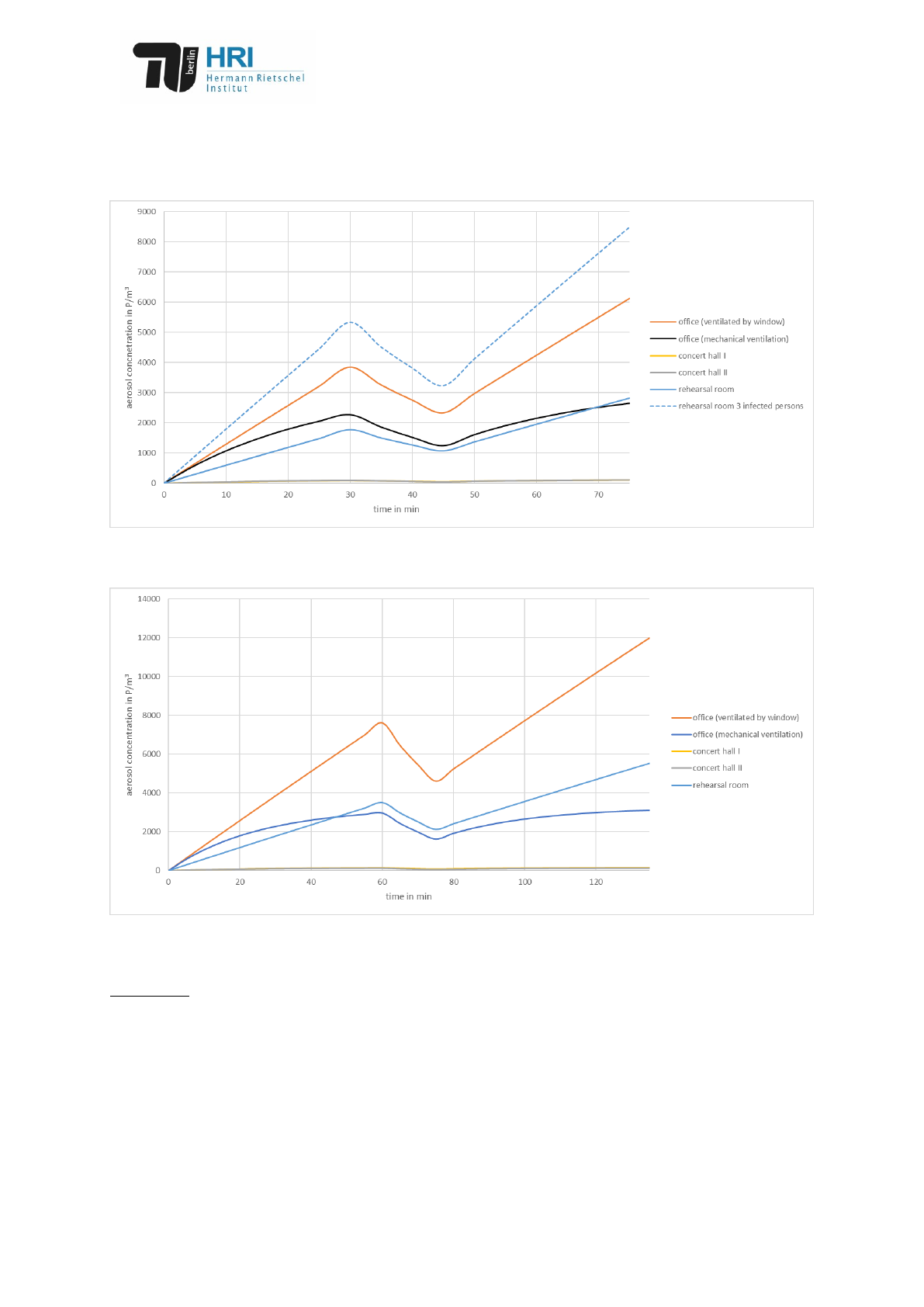
The progression of the aerosol concentration, of the potentially infectious aerosols (emitted
by the infected person), during 30 min of singing with a constant number of persons and a
constant air change rate in both concert halls as well as with missing ventilation in the
rehearsal room can be found in figure 1. For all three cases as well as the reference case a
break for ventilation of 15 min after the 30 min in which all persons have left the room has
been assumed. Finally, the concentration after another rehearsal of 30 min is listed. The air
change rate has been calculated as constant for both concert halls over the whole time,
3
Hermann-Rietschel-Institut | Fachgebiet Gebäude-Energie-Systeme | Marchstr. 4 D-10587 Berlin
whereas the ventilation through windows just has been performed during the breaks in the
rehearsal room as well as the office.
In addition, another case with a rehearsal of 60 min, followed by a 15 min break and another
rehearsal of 60 min has been investigated the result can be seen in figure 2.
Figure 1: progression of the aerosol concentration during a rehearsal of 30 min with a break of 15 min in the
middle for the three investigated rooms as well as the reference scenario office
Figure 2: progression of the aerosol concentration during a rehearsal of 60 min with a break of 15 min in the
middle for the three investigated rooms as well as the reference scenario office
Discussion
With simple analytical equations and simplified boundary conditions the increase of the
concentration of potentially infectious aerosols has been investigated. Nevertheless, in real
environments the results can be significantly different. A reason therefore is the real
ventilation effectiveness. There will be positions in the room with a higher concentration of
virus and other positions with a lower concentration. Typical positions with different
concentrations are near persons as well as above persons, because of thermal buoyancy
effects (the person is warmer than the surrounding air). Because of the fact that aerosols are
ideally airborne, they will be dispersed with the room air flow.

4
Hermann-Rietschel-Institut | Fachgebiet Gebäude-Energie-Systeme | Marchstr. 4 D-10587 Berlin
It becomes clear, that window ventilation may not be enough in some circumstances to
reduce the risk of infection through aerosols significantly and therefore a deceptive security
may occur. In general, a user does not know how much fresh air is introduced into the room
through an opened window. This volume flow mainly depends on the temperature
difference between inside and outside as well as the velocity of the wind. Solely mechanical
ventilation systems will be able to reduce the risks of infection with a high predictability.
Furthermore, large rooms have a positive effect on the increase in the aerosol
concentration. Whereas in the office (60m³room volume/infected person) with window
ventilation the concentration of potentially infectious aerosols has started to increase
immediately, in the rehearsal room without mechanical ventilation system
(2270m³room volume/infected person) it can be assumed that the increase will be a lot slower,
because the potentially infectious aerosols will be dispersed in the whole room in a lower
concentration at first.
With an increasing number of infected persons in the room the increase will be significantly
steeper. Even with three infected persons of the choir (dashed, blue line) in the rehearsal
room (without ventilation, 757m³room volume/infected person) this curve has exceeded the
curve of the office with mechanical ventilation fast. On the other hand, if for the concert hall
it has been calculated with further infected persons in the audience the concentration in the
room after 30 min just has been increased by 10 % and is therefore still significantly below
the concentration in the office room.
In addition, it has been found that in the rehearsal room even if the windows have been
opened, just a little decrease in the aerosol concentration can be found, which will raise
above the level before the break pretty soon after the singer has entered the room again.
Summary and recommendations for the risk management
The transmission of SARS-CoV-2-virus mainly occurs via the airways in the shape of droplets
and aerosols. During singing droplets as well as aerosols are generated in a higher number,
whereas a higher risk during choir singing can justified.
The previous measures to reduce the risk have focused on the protection against droplets,
which is also used efficiently for singing with a distance of 2 meters. This distance is also
reducing the risk of transmission through aerosols in the local area, but no assessment of the
further dispersion of particles in the room is possible. For the evaluation of the aerosol
concentration in the room important factors have been included in the present calculations
of the increase of the concentration of potentially infectious aerosols, which compares
typical situations for choir singing with an office as reference scenario.
A possibility to reduce the risk lies in a shortening of the duration of rehearsal, whereas in
the current example two parts of rehearsal of 30 min each and a compulsory ventilation in
the middle should be a feasible compromise from an artistic view, which has been applied in
the calculations. To increase the air volume per person large rooms should be selected for
choir rehearsals. The number of singers has to be reduced, whereas already because of the
distance necessary to protect against droplets the number of persons in the room is limited.
An important factor for the risk reduction lies in the existing ventilation options, whereas
window ventilation and mechanical ventilation have been compared. Especially an adequate
mechanical ventilation has a significant potential to reduce the risk and therefore this
possibility should be used. Window ventilation may help to reduce the risk as well, but it
mainly depends on the weather conditions und is therefore difficult to assess. If there are
just short breaks, it has to be kept in mind, that window ventilation may not be enough to
reduce the aerosol concentration.

5
Hermann-Rietschel-Institut | Fachgebiet Gebäude-Energie-Systeme | Marchstr. 4 D-10587 Berlin
The investigations have shown, that under given circumstances and with an optimal use of
different possibilities choir as well as ensemble singing may be possible, even when a certain
remaining risk of infection has to be addressed. The number of singers as well as their
positions, the room size and the ventilation system have been found to be effective
measures to the reduce the risk of infection in addition to the basic hygiene and distance
rules. Based on the importance of singing for culture and education a best possible risk
management is of special importance, to make, in cooperation with private and public
decision makers, individualized choir rehearsals and performances possible.
Literature:
[Hamner2020] Hamner, L., Dubbel, P., Capron, I., Ross, A., Jordan, A., Lee, J., Lynn, J., Ball, A.,
Narwal, S., Russell, S., Patrick, D., Leibrand, H. (2020): High SARS-CoV-2 Attack Rate
Following Exposure at a Choir Practice – Skagit County Washington, March 2020, in: MMWR
Morbidity and Mortality Weeky Report, Early Release 69, p. 606-610
https://dx.doi.org/10.15585/mmwr.mm6919e6
[Hartmann2020] Hartmann, A., Lange, J. , Rotheudt, H. , Kriegel, M. (2020): Emission rate
and particle size of bioaerosols during breathing, speaking and coughing, in: Preprint,
http://dx.doi.org/10.14279/depositonce-10331
[Kriegel2020] Kriegel, M., Hartmann, A. (2020): Risk assessment for internal spaces regarding
aerosols loaded with virus, in: Preprint, http://dx.doi.org/10.14279/depositonce-10344.2
[Mürbe2020] Mürbe, D., Fleischer, M., Lange, J., Rotheudt, H., Kriegel, M. (2020): Aerosol
emission is increased in professional singing, in: Preprint,
http://dx.doi.org/10.14279/depositonce-10375
[RKI2020] Robert-Koch-Institut (2020): SARS-CoV-2 Steckbrief zur Coronavirus-Krankheit-
2019 (COVID-19),
https://www.rki.de/DE/Content/InfAZ/N/Neuartiges_Coronavirus/Steckbrief.html#doc1377
6792bodyText1, letzter Zugriff: 22.06.2020, 12:00Uhr
Loading more pages...