
Faculty for
Engineering,
Computer Science
and Psychology
Institute for Databases
and Information Systems
Ulm University
Implementation and evaluation
of a mobile iOS application for
auditory stimulation of chronic
tinnitus patients
Bachelor thesis
Submitted by:
Stefan Mayer
stefan.may[email protected]
Verifier:
Prof. Dr. Manfred Reichert
Supervisor:
Marc Schickler
2015

Version 9th November 2015
Abstract
Mobile devices take in more and more space in our lifes and as tinnitus
becomes a much more widespread disease, science started to develop treatment
strategies. One of those treatment strategies is ’auditory training’ and with
this strategy in mind a game concept with spatial audio was developed to
provide an easily available ambulant help for chronic tinnitus patients. In the
course of this thesis a seperate game only using spatial audio is developed on
mobile iOS devices and in a study it is evaluated how good spatial audio can
work on different mobile platforms. At the end of thesis the work is
summarized and improvements in the game are displayed for further use in the
above mentioned game scenario.
c
2015 Stefan Mayer
This work is licensed under the Creative Commons Attribution-NonCommercial-ShareAlike 3.0
License. To view a copy of this license, visit
http://creativecommons.org/licenses/by-nc-sa/3.0/de/ or send a letter to Creative Commons,
543 Howard Street, 5th Floor, San Francisco, California, 94105, USA.
Satz: PDF-L
A
T
EX 2ε
Contents
1 Introduction 1
1.1 Goalsofthisthesis ......................... 2
1.2 Structure .............................. 3
2 Fundamentals 4
2.1 Gamebasics............................. 4
2.2 Coordinatesystems......................... 4
2.3 Anglemeasurement......................... 6
2.4 Head-related transfer function . . . . . . . . . . . . . . . . . . . 8
3 Requirements Analysis 9
3.1 Functional Requirements . . . . . . . . . . . . . . . . . . . . . . 9
3.2 Non-functional Requirements . . . . . . . . . . . . . . . . . . . 10
4 Implementation 12
4.1 Game ................................ 12
4.1.1 Architecture......................... 12
4.1.2 Game Structure . . . . . . . . . . . . . . . . . . . . . . . 13
Entities ........................... 14
Action............................ 15
Levels ............................ 15
GameSession ........................ 16
4.2 Inputhandling ........................... 16
4.2.1 Sensor ............................ 16
4.3 Details................................ 17
4.3.1 Class Variables . . . . . . . . . . . . . . . . . . . . . . . 18
4.3.2 Singleton Pattern . . . . . . . . . . . . . . . . . . . . . . 18
4.3.3 ImageCreation ....................... 18
4.3.4 Factory method pattern . . . . . . . . . . . . . . . . . . 19
4.4 UI .................................. 19
4.5 Concurrency............................. 21
4.5.1 Concurrent objects in the game . . . . . . . . . . . . . . 21
iii
Contents
4.6 OpenALwrapper.......................... 22
4.6.1 Structure .......................... 23
4.6.2 Buffer ............................ 24
4.6.3 Source............................ 25
4.7 Component interaction . . . . . . . . . . . . . . . . . . . . . . . 26
4.7.1 Tickaction ......................... 26
4.7.2 User interaction . . . . . . . . . . . . . . . . . . . . . . . 27
Pausing/Stopping . . . . . . . . . . . . . . . . . . . . . . 27
Starting ........................... 28
5 Requirements Comparison 30
5.1 Functional Requirements . . . . . . . . . . . . . . . . . . . . . . 30
5.2 Non-functional Requirements . . . . . . . . . . . . . . . . . . . 32
6 Study 34
6.1 Studydesign............................. 34
6.2 Results................................ 34
6.3 Discussion.............................. 37
6.3.1 Platformonly........................ 37
6.3.2 Platform including participant data . . . . . . . . . . . . 38
7 Recapitulation 39
7.1 Improvements............................ 39
7.1.1 Automated Testing . . . . . . . . . . . . . . . . . . . . . 39
7.1.2 OpenAL Wrapper . . . . . . . . . . . . . . . . . . . . . . 40
7.1.3 Gamelogic ......................... 40
7.2 ClosingStatement ......................... 41
8 Acknowledgement 42
Bibliography 43
iv
1 Introduction
Health is one of the most important aspects in our society and therefore a lot
of effort is made to keep people healthy. One of these efforts is to overcome
deseases and make people live longer. Non lethal deseases tend to be less
researched, because they have a smaller impact on our lifes. Nethertheless,
these non lethal deseases can be life affecting. One of these life affecting
deases is tinnitus. There are two types of tinnitus, one which is subjective and
another one which is objective [14]. An objective Tinnitus is caused by the
body tissue, but is a lot more uncommon than the subjective tinnitus which
occurs completely without any physical reason [14]. Such a tinnitus produces a
subjective sound on patients with the abscene of a physical source and is one
of the most common symptoms of hearing disorders. For 1-3% of the affected
people, their tinnitus is loud enough to affect their life [16]. For a long time
there has been no treatment to overcome tinnitus, but today there are a lot of
strategies to relieve subjective tinnitus:
•Psychoeducational treatment
. Because a lot of patients have a neg-
ative attitude towards their tinnitus, this strategy is recommended as
a basement of all treatment strategies. It is based on a psychological
explanation of the patient’s tinnitus [13].
•Cognitive behavioral therapy
is the best studied and evaluated treat-
ment for tinnitus. The patients are made aware of their tinnitus and are
helped by improving the modification of maladaptive patterns, causing
the tinnitus [13].
•Individualized auditory stimulation
. These strategies focus on the
tinnitus of the individual patient as each tinnitus is subjective and has
a different frequency range and loudness. One of these strategies is the
auditory training. With this technique the patient actively works on the
tinnitus. Studies have shown, that auditory training, including object
identification and localication, reduces tinnitus [13].
•Tinnitus retraining therapy is a combination of counseling and aud-
itory stimulation but is not evaluated very well [13].
1
1 Introduction
•Neuromodulatory treatment
. Because chronic tinnitus always results
in a change of nervous activity, this treatment focuses on reverting these
changes. One technique is to modify audio’s frequency and then let the
patients hear that audio in order to compensate the tinnitus [13].
•Pharmacotherapy is a strategy involving medication [13].
For application developers, the most interesting treatment strategy is probably
the auditory training, which is part of the individualized auditory stimulation,
because of the adaption capabilities an application and especially a mobile
application can have and therefore can be used for a lot of patients.
Additionally, as the amount of smartphone users increased rapidly in the last
years, a lot of game developers started developing games for smartphones [2].
The game industry also started to experiment with games depending solely
on spatial audio [26]. One of this game’s is ‘Audio Defense‘ for the platform
iOS [5]. The games target is to kill zombie enemies with weapons only through
hearing the zombies with headphones.
As there is a need to overcome tinnitus and there are a lot of people owning
mobile devices, it was only a matter of time to develop an application for mobile
devices especially fitted for tinnitus patients. For keeping the patients on their
training a game application works best, because the patients have a very high
motivation level. Such a game is not only cost efficient but the game industry
also has shown that such audio games are possible and very enjoyable.
1.1 Goals of this thesis
One goal of this bachelor thesis is to create a game, in which the main goals
are to identify and locate objects. This should make it possible to evaluate
how good object localization works on mobile devices. Therefore, three other
implemenations on the platforms Android, Windows Phone and a Web applica-
tion, of the game were made as part of other bachelor/master thesises. In the
game implemented by the four platforms it is the goal to take the best possible
pictures of animals, where the challenge is to find these animals only through
spatial audio. The creation of the game has some pitfalls.
•Embedding the OpenAL library
. One of the biggest pitfall is em-
bedding the OpenAL library into the game. As the API is written in
the non object-oriented C there is a need to build an object orientated
wrapper around it, which needs to be written in Objective-C.
2

1 Introduction
•Implementing the game
. Another pitfall is the implementation of the
game and its logic, which consits in finding a matching architecture as
well as structuring the logic.
•Designing a UI suitable for a study
. Because the game needs to be
used for a study there is a need for a UI especially adjusted for this study.
•Finding possibilities to use sensors
. For the in-game movement it
was decided to use the movement sensors of the device. The challenge
and goal is to interpret the motion data provided by the iOS SDK for
the use in the game.
Because frameworks like OpenAL and the iOS SDK are going to be used,
mathematical problems are solved differently. That is why there is a need to
make the different results usable in the game. This is mainly covered in the
fundamentals chapter 2. A study was done as well as part of this bachelor thesis.
This is covered in chapter 6 and compares the four implementations with each
other in terms of how good object localisation works on mobile devices.
1.2 Structure
Chapter 2 covers the fundamentals, like the game basics, angle conversion, as
well as coordinate systems and the head-related transfer function. In chapter 3
the functional, as well as the non-functional requirements for the application
are covered. The next chapter’s topic is about the implementation of the
game, making an OpenAL wrapper and the structure of the code. After the
implementation chapter 4 a comparison in the requirements of chapter 3 are
made in chapter 5. After that a chapter covering the results of the study follows
in chapter 6. And at the end a recapitulation chapter 7 summarizes this thesis.
3
2 Fundamentals
This chapter covers the fundamentals needed for the following chapters, espe-
cially for the implementation and study parts. In the beginning of the chapter
the game mechanic is explained, followed by an explanation of the conversions
needed to be made for using vectors and angles in the different subsystems.
Last but not least the head-related transfer function is covered, as it is a
fundamental part of the OpenAL implementation.
2.1 Game basics
The game which was implemented in this bachelor thesis, is mainly focused on
spatial audio. The target of the game is to locate sounds in a three dimensional
environment. Several sound targets are placed randomly around the player in
a circle. The aim is to take a photo of the targets one after another. To aim
on these targets the gyroscope of the iOS device is used, so the player has to
rotate in the target’s direction by himself. Whenever the target is in front of
the player, they have to take a photo of the target by tapping on the screen.
The objective is to get deviation from the sound targets position that is as
small as possible (see Figure 2.1, where target and player positions are shown).
The current implementation that was use in the study uses a maximum of two
targets, which are a frog and a bluejay bird.
2.2 Coordinate systems
For placing sounds and a player into the game a coordinate system is needed.
Because the sounds are also placed in OpenAL and sounds need to be displayed
on screen. Therefore, coordinates need to be converted between the systems.
Because the player has a static position, it is most intuitive to use a standard
cartesian coordinate system, with the player in the origin of the system (see
Figure 2.1 showing player and sounds). The UIKit of the iOS SDK used
4

2 Fundamentals
x
y
-3
-3
-2
-2
-1
-1
1
1
2
2
3
3
Player
Sound1
Sound 2
Figure 2.1: Two dimensional cartesian coordinate system.
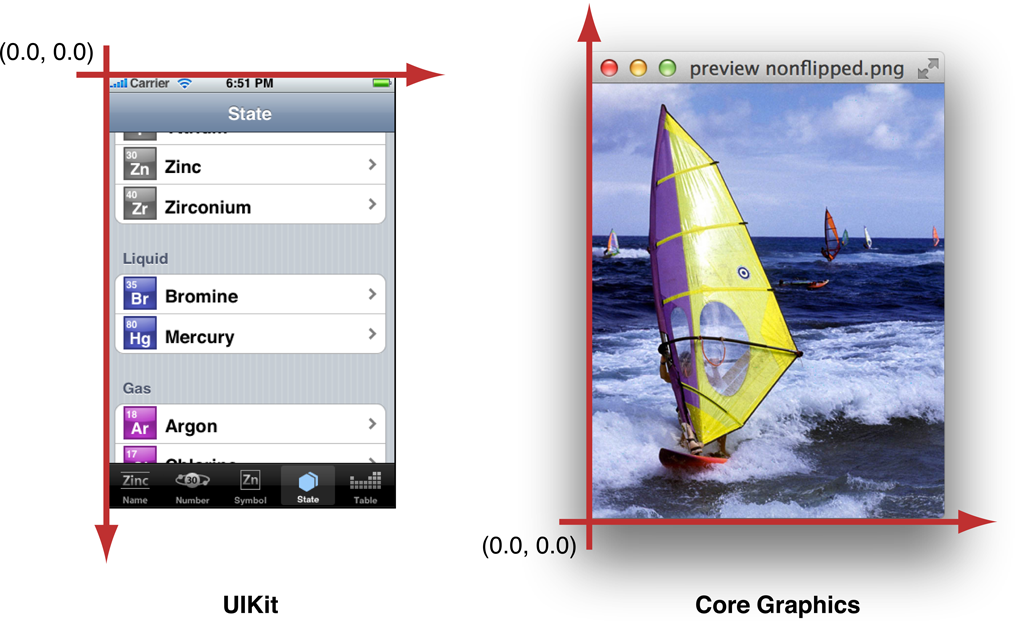
for image creation and UI desgin uses a two dimensional cartesian coordinate
system with the origin in the devices top left corner but also has the modification
that the y-axis goes in the other direction, which is common not only in iOS
systems but also in Android (see Figure 2.2). In contrast, the OpenAL library
Figure 2.2: UIKIt Coordinate system sample view [1].
uses the cartesian coordinate system in 2D but in its three dimensional version,
as it also can be used for three dimensional applications. Therefore, some
5

2 Fundamentals
small adjustments must be made when taking over coordinates from to game
to OpenAL. Which in our case is only changing the sign of the y coordinate.
Because of the choices made for the game the plane used by the game sits on
top of the XY plane of the OpenAL system (see Figure 2.3).
Game plane
x
z
y
-10
-10
-10
-5
-5
-5
5
5
5
10
10
10
Player
Sound1 Sound 2
Figure 2.3: Position of game plane in OpenAL system.
2.3 Angle measurement
A very important feature of the game is stated by angle measurements, because
entities are being placed on the circle line around the player with a constant
distance. So the position is defined soley by an angle. The CMDeviceMotion
iOS class, used for determining the player’s position, uses cartesian angles in
radians. These angles start from the inital starting position, when intitializing
the class. So a rotation of 20 degrees to the left results in a value of
π/
9, the
rotation of 20 degrees to the right results in a value of
−π/
9. There is also a
restriction to the rotation so that it is not bigger than 180
◦
causing the value to
jump form
−
180
◦
to 180
◦
if rotated close to 180 degrees. Because the starting
6

2 Fundamentals
α
x
y
-3 -2 -1 1 2 3
-1
1
2
3
Player
Sound1
Figure 2.4:
2D cartesian coordinate system, showing angles used by
CMDeviceMotion.
point of the angle in the game differs from the output of the gyoroscope, there
is a need to rotate this starting point by 90 degrees to the right. Therefore,
the angles from the CMDeviceMotion class must be converted as follows:
w(α) =
(2.5π+α) mod 2π, α < 0
(0.5π+α) mod 2π, otherwise (2.1)
For points or entities placed on the game’s coordinate system, an angle also
must be calculated from the position vector ~x, when evaluating results:
w(~x) =
arccos x
√<x,x> , y > 0
2π−arccos x
√<x,x> , otherwise (2.2)
This also has to be done the other way round, when randomly choosing an
angle, where drefers to a constant distance and αto the angle.
~x =
cos α·d
y
, y =
−√d2−x2, α > π
√d2−x2, otherwise (2.3)
For the study in chapter 6 angle deviations are logged to a file. These angles
are measured clockwise in contrast to the standard counter-clockwise opening
of angels.
7

2 Fundamentals
2.4 Head-related transfer function
The head-related transfer function (HRTF) is the result of sound modifications
caused by the human’s head diffraction and reflection properties. The HRTF is
measured for each ear and contains the amplitude changes for, in the best case,
every frequency (see Figure 2.5). The human’s possibility to locate sounds, is
heavily depended on this HRTF and is specific for every human. That is why a
working OpenAL implementation, which is used for object localization in-game,
needs to use at least an approximation of a HRTF. Some implementations of
OpenAL even support setting an own HRTF.
Figure 2.5: Example of a HRTF [10].
8

3 Requirements Analysis
For developing this application functional as well as non-functional requirements
are constructed beforehand and are late compared with the final application in
chapter 5.
3.1 Functional Requirements
The functional requirements in the following table describe the features the
application must have.
Table 3.1: Functional requirements
Requirement Explanation
FR#1
The game should be designed
like a game.
Because it is the goal of this
thesis to create a game the
design and architecure should
be implement for a use in the
game.
FR#2
The user should be able to loc-
ate sounds.
To be able to locate sounds the
game must implement spatial
audio.
FR#3
The game should be able to de-
tect the player’s real orienta-
tion.
To enable the user to control the
game there is a need to detect
the player’s real world orienta-
tion.
FR#4
The game should have a main
menu for starting a game.
As there are a lot of settings for
example background sound and
level there needs to be a main
menu.
FR#5
Sounds in the game should be
randomly positioned around the
player.
To measure differences between
study participants the sounds
should be placed in a circle
around the player.
9

3 Requirements Analysis
FR#6
It should be possible to play sev-
eral rounds of a game with the
same settings.
As the game is used for a study
it should be possible to have an
option to play a dynamically set
number of rounds.
FR#7
The game should log data at
certain events.
For the study there is a need for
logging data.
FR#8
The game should be able to dis-
play results of a game session.
After every round the user
should be displayed with his res-
ult, including an image of the
current looking direction.
FR#9
A game session should be able
to be interrupted.
As some levels are seperated
into several different parts the
game should be interruptable
and display only a part of the
result.
3.2 Non-functional Requirements
The non-functional requirements in the following table, describe the qualities of
the application. Especially important for mobile applications, because they de-
pend heavily on user interaction and the resulting non-functional requirements.
Table 3.2: Non-functional requirements
Requirement Explanation
NFR#1
Displaying the end screens
should not take more than
500ms.
Because the users should not ex-
perience any stutters there is a
need for the end screen to be
generated in a time a user will
not recognize.
NFR#2
Fluid playback without inter-
ruption.
Because the basis of the game
is audio fluid playback is very
important.
NFR#3
The game should not only be
usable on the test device.
As the game may be used on
other devices, it should work on
a wide variety of iOS devices.
10

3 Requirements Analysis
NFR#4
The game should log the time of
the user with accuracy of more
than 0.01s.
Because the study compares
time it is important that times
are accurate measured.
NFR#5 The game should be reliable.
No matter what user interaction
happens, the game should not
hang, crash or stop.
11
4 Implementation
This chapter handles the game application described in the previous chapter
in the game basics section. The application has been programmed in Swift
and Objective-C. The IDE Xcode was used, because it is the only official
IDE supported for iOS programming. The game logic was programmed in
Swift, whereas the OpenAL wrapper used in this game was programmed in
Objective-C (see Figure 4.9). As test device an iPad Air of the first generation
was used. An iOS device with version 7.0 or higher is needed, because of the
usage of the Swift programming language.
The following chapter deals with the game logic and its architecture. The
section afterwards gives insights in the input handling of the game followed
by practical implementation details. After that the user interface is discussed.
Then, the topic of concurrency, which is used almost everywhere in the game is
covered. The OpenAL wrapper is explained afterwards and last but not least
it is outlined how all these components interact and work with each other.
4.1 Game
This section deals with the implementation of the game logic. It covers the
architecture of the game, as well as the structure of the game.
4.1.1 Architecture
The architecture of the application is based on a typical MVP(Model-View-
Presenter) pattern of iOS [15]. MVP is seperated into three parts.
1.
The model is the logic of the view. It handles everything from inputs to
sound positioning and all the game logic.
2.
The view is responsible for displaying information and passing inputs.
The view is controlled by the presenter. In a modern iOS Application
these views are generated within the storyboard.
12

4 Implementation
3.
The presenter is responsible for preparing data from the Model to prepare
for display on the view. This can be angle conversions, image generation
and so on.
The game is implemented in a tick based manner (see Figure 4.11). This means,
that the game updates itself in constant time intervals. This is often used in
continous systems where predictability is important. This makes it a lot easier
to extend the game with features, which are simulating a continous system like
moving sounds or physics. But even adding multiplayer where it is important
to predict the game’s behaviour, is possible more easily. For higher performance
all operations triggered on sounds are executed concurrently. Another detail
is that the sound’s distance to the player is always constant and equal to
the OpenAL reference distance, in order to eliminate possible distance fade
problems, when sounds differ from the reference distance.
4.1.2 Game Structure
As a game can be very complex, there is a need to structure the game into
a lot of small modular and exchangable parts. Therefore, a lot of interfaces
are used. Every object in the game is referenced as entity. All these entities
are bound to a level. This also includes actions which are triggered through
certain events, implied by an input or an in-game event.
Figure 4.1: Game and its underlying structure.
13

4 Implementation
Entities
All objects in the game are called entities. An entity has to implement the
entity interface. Because the game is implemented in a tick based manner every
tick based object has to be updated in each of those ticks, therefore an interface,
having an update method, must be provided for all objects being in the game
and handled by the GameManager. But not only updating is a very common
task dealt within every tick, also movement is often a crucial part in a game,
that is why all entities also have getters and setters for a position. Because this
game is mainly focused on sounds, there is also a sound entity inherit the entity
interface. A sound in addition to an updating functionality and positioning
needs control over the audio connected to the classes. Therefore, this interface
has an additional play,stop and pause method, but also methods considering
audio information and current status. In the game it is also very common to
randomly position entitites in a circle around the player, that is why there is
a third interface further inherting from the sound entity. This type of entity
also has methods to specify a range of angle and distance, from whose ranges,
random values are chosen. Because sound entities in the game, also need to
be displayed, this interface also includes a getter for an image. How these
interfaces inherit from each other is displayed in Figure 4.2.
Figure 4.2: Entity interfaces.
14

4 Implementation
Action
Whenever a user interaction or a game event happens, the game has to provide
an action. Because there are not much user interactions happening in the
game and because they are heavily dependend on the current level played
the handling of actions is outsourced to the level. Every time when a user
interaction happens, the game chooses an action from the level by running the
getAction method of the current level, which then is executed from the object
making the user interaction (see Figure 4.3). Every one of those actions is
meant to provide a reaction to a user interaction in a specific state of the level.
In the current implementation the execute method only accepts an angle and
the current controller, as this is the only relevant data needed by an action.
For later use it would be good to have an additional event class containing data
obtained by the event and objects like the controller involved in the event.
Figure 4.3: Action choosing.
Levels
The level is one central part in the game. It not only initializes entities, but
also updates and manages them in its data structure. In this work it is also
responsible for choosing and managing actions to a user interaction. Therefore,
the level needs to maintain a condition for which it is decided which action
15
4 Implementation
to choose. Because there is nothing happening in the level while the game is
running expect for user interactions, the level mainly acts as a data structure.
GameSession
Because the study, performed in a later chapter, runs several rounds of one level
it was decided to introduce a GameSession class, which includes a username, a
logger, a level and an amount of rounds to be played. A central part of such a
session is that it can be paused and has a possibility to restart a level. This is
why this class provides corresponding methods. It also handles how the user
interface reacts when the session is paused, stopped, started or restarted.
4.2 Input handling
For input handling there are two classes. The InputHandler class and the
DeviceMotionHandler class. The InputHandler is responsible for holding all
inputs, for example the yaw of the device. The DeviceMotionHandler is
responsible for handling the devicemotion, which is starting, stopping, pausing
and updating the device attitude and saving it to the InputHandler and setting
the direction vector for the listener in OpenAL.
4.2.1 Sensor
For distinguishing the player’s direction, the CMDeviceMotion class of the iOS
CoreMotion library is used because it combines the gyroscope and the accelero-
meter, which is more accurate then both of the methods seperately, as you can
differntiate between user acceleration and gravity. Especially the accelerometer
on its own is very error prone because of the ongoing error involved in the
double integration for getting the traveled distance. The CMDeviceMotion class
is fed with motion updates every 16
,
66
ms
, which is the time a tick takes in
the game. These motion updates include the attitude of the device in relation
to a referenceFrame. This referenceFrame is the device’s attitude at the start
of the device motion updates. The attitude object has three properties, which
are pitch, roll and yaw (see Figure 4.4). In our case only horizontal rotation is
important, so only the yaw value is used for distinguishing the player’s direction.
As OpenAL requires a normalized direction vector, some calculations must be
16

4 Implementation
made before passing it to the listener direction function. In the equation
(4.1)
~x is the normalized vector and αis the yaw angle [3, 4].
~x =
x
y
0
, y =−cos α, x =−sgn(α)q1−y2(4.1)
x
z
y
pitch
yaw
roll
Figure 4.4: Pitch, yaw and roll.
4.3 Details
This section covers special insights in the game application and how problems
were solved in the development progress.
17

4 Implementation
4.3.1 Class Variables
In the current implementation it was not possible to have class variables for
a class in swift, but only a custom variable with getter and setter. Therefore,
a work around was needed (see Figure 1). In newer Swift versions higher or
equal to version 1.2 this problem was solved [27].
class Minimal {
// Hack for class variable
private struct SubStruct {
static var sharedInstance: Minimal?
}
// SharedInstance of Minimal
class var sharedInstance: Minimal! {
get {return SubStruct.sharedInstance }
set { SubStruct.sharedInstance = newValue }
}
}
Listing 1: Workaround for class variables.
4.3.2 Singleton Pattern
In the application the Game class is the central part. Because there is only one
game needed, the singleton pattern is applied. That is why there is a need for
a method which returns the current instance or creates one if none existent. In
iOS it is common to use a sharedInstance class variable, to access the current
instance or initialize it, so that the call Game.sharedInstance returns the current
instance of the game.
4.3.3 Image Creation
Every image object of the class UIImage has a drawInRect method which
accepts a rectangle object. This method draws the image in the provided
rectangle to the current image context. As we generate an image we have
to begin the context with UIGraphicsBeginImageContext. After the context
18
4 Implementation
is set you can start drawing the images onto the context. After the image
has been created it can be obtained from the current context with UIGraph-
icsGetImageFromCurrentImageContext and the context can be ended with
UIGraphicsEndImageContext.
4.3.4 Factory method pattern
The factory method pattern is a creational pattern, when looking at object-
oriented programming languages. In the GameSession a level needs to be
created over and over again. For this a string of the corresponding level class
is saved, because it was impossible to save a direct reference to the class. The
level is then created with the factory method pattern, which exactly solves this
problem of creating objects without specifying the exact class [8]. That is why
the GameSession can create an appropriate level with one call for every level
case.
4.4 UI
A UI is an important part of a mobile application, as it guides the user
through the application. In iOS a view is an element in which positioning and
behaviour of UI elements are combined. A view is always bound to one so
called UIViewController which acts as a presenter and sets the content of the
view, but also is the first instance when a user interaction happens. All views
and their relation are saved in a storyboard file. Such a relation can be a segue
which is a route to another view and includes how views are faded. A segue
also can be named and be triggered programmtically, which is the technique
used by the GameSession class to switch between views.
There are four views in the application. The first one is the main menu view
(see Figure 4.5) that is bound to the NewGameViewController. In this view
it is possible to set the game mode, the background sound setting, the user
name and an amount of rounds. After clicking on the ’Spiel starten’ button, a
new GameSession is initialized. If the game is started the game moves into a
running state (see Figure 4.6). The corresponding view only displays a camera
and an instruction. This instruction is dynamically fetched from the current
level. When tapping the camera the level chooses an action, which in this
work always triggers the GameSession to pause or stop the game and change
the view to a result view. In this view an image is provided, in which targets
19

4 Implementation
are placed relative to the shooting position. This image shows a section of
45 degress. This view also provides a text area, where results are presented.
There are two such result views one for an interrupted game and one for the
end of a game (see Figure 4.7). The IntermediateViewController is responsible,
whenever the Game is paused and the EndScreenViewController is responsible,
whenever a Game is stopped or ended.
Figure 4.5:
The UI of the main
menu with settings.
Figure 4.6:
The UI state in the run-
ning game.
Figure 4.7: The UI state for the result.
20
4 Implementation
4.5 Concurrency
An important aspect of the implementation is concurrency. A lot of actions
happen in parallel, like playing sounds, updating sound entities or updating
the player position. This has a lot of benefits in regards of performance but
also implies a lot of caution while programming. There are some ways to
implement parallelism on computers, with techniques like OpenMP, OpenMPI
or threads. In iOS there are not very much options to implement parallelism, it
only supports threads. There are two ways to use threads in iOS, one is using
the NSThread class, the other way is to use POSIX-Threads. In this thesis the
NSThread class is used, as it has more options than a standard POSIX-Thread.
POSIX-Threads would have had the benefit, that they can be used for almost
every platform. But as only one platform is covered in the thesis, the benefits of
the NSThread class are predominant. Threads always run with shared memory.
This implies problems like conflicting resource access. So if it is the case that
threads run on the same data structure, measurements like locks or atomic
operations must be used. If using threads it is also not assured, that threads
run on seperate cores, this heavily depends on the operating system’s thread
scheduler.
4.5.1 Concurrent objects in the game
In this thesis almost every object runs in seperate threads. Most important
is the GameManager providing the tick of the tick-based architecture used
in the game. But not only the GameManager but also all entities run in
seperate threads. This rapidly increases performance on calculation or time
intensive operations on entities. If not taking the right measurements, this
can also destroy a continuous system, which in first place was the basis of
the decision to use a tick-based system at all. Therefore, parts of the game
which run in threads and depend on the tick of the GameManager must be
synchronized with the tick of the GameManager to ensure that a tick by itself
can always be reconstructed. Because sound entities in the current scenario are
not dependend on a tick or each other and use only their own resources, they
can operate completely seperate from each other and that is why none of such
synchronizing elements were implemented in this work. Not only in the game
itself measurements were made to ensure threads can incorporate with each
other, but also in the OpenAL library. ALSource structs (see Listing 4) are
thread-safe and use atomic variables as well as locks. Another part of the game
21

4 Implementation
which runs concurrent is the input handling. In Figure 4.8 all objects that run
concurrent are displayed and connected to their responding component.
Figure 4.8: Concurrency in the game
4.6 OpenAL wrapper
For the implementation of this audio game the library OpenAL is probably
best fitted, because of its big community and compatibility. Moreover because
there is already a built in C-implementation in iOS. As this library is written
in C it can not directly be used in an object oriented language like Swift.
Therefore, there is a need for a wrapper projecting the functional interface of
this library onto an object oriented one, because Swift is lacking support of
directly calling C code. This wrapper needs to be written in Objective-C, which
is then compatible to Swift. In Figure 4.9 it is visualized how Objective-C and
22

4 Implementation
Swift Code can work with each other. Using Swift code in Objective-C can be
easily achieved by importing an automatic generated header. These headers are
named after there class name and have a ’-Swift.h’ extension to it and can be
imported only in the Objective-C implementation file. If desired, Swift classes
can also be referenced in Objective-C header files with a @class keyword. To
use Objective-C in Swift there are no generated headers. Every Objective-C
class needs to be imported in a so called bridging header. After importing the
Objective-C class in the bridging header the class can be imported in a Swift
class with the standard import keyword.
Figure 4.9: How Swift and Objective-C corporate with each other [11].
4.6.1 Structure
In OpenAL there are two basic entities. These are multiple sources and
one listener. Both of these types can be three dimensionally positioned and
orientated. The sources are the entities playing sounds, whereas the listener
is the entity receiving these sounds. The wrapper which is built around the
OpenAL API is structured into a Buffer, Source and a Soundpool. Where
the Source handles positioning, the Buffer, the audio data and the SoundPool
handles the rest which is listener orientation and audio initialization of the iOS
audio device.
23

4 Implementation
x
z
y
-10
-10
-10
-5
-5
-5
5
5
5
10
10
10
Listener
Source 1 Source 2
Figure 4.10: Listener and Sources in coordinate system.
4.6.2 Buffer
The buffer contains the audio data and its settings. The wrapper class is based
on the OpenAL struct holding this data (see Listing 2). Those settings are
frequency, format, sample length and amount of channels. Every buffer has a
unique id with which it is referenced throughout all OpenAL functions. This
id is also bound to the wrapper class. For the game case the native iOS audio
format CAFF is used with mono channel and a 16 bit depth sound in little
endian byte order. The sound needs be a mono sound in order for OpenAL
to let the sound be positionable. A bit depth of 16 bit is very common and
is used on Compact Disks, providing a high quality audio resolution which
is more than enough when using headphones. The little endian byte order is
used, so that the file can be directly copied to memory, as current processor
architectures like ARM and x86 both support little endian byte order, whereas
the big endian byte order is not support by x86 architectures. The sounds
were all converted with the built in Mac OS command in listing 3. It was also
required to write a C helper function for reading the file and copying its bytes
24

4 Implementation
typedef struct ALbuffer {
ALvoid *data;
ALsizei Frequency;
ALenum Format;
ALsizei SampleLen;
enum FmtChannels FmtChannels;
enum FmtType FmtType;
...
/* Self ID */
ALuint id;
} ALbuffer;
Listing 2: OpenAL source code ALBuffer(alBuffer.h) struct [18].
afconvert -f caff -d LEI16 -c 1 input.mp3 output.caf
Listing 3: Command generating CAFF file.
onto the heap and referencing its address for the OpenAL buffer. This function
also sets the buffer settings like format, frequency and length.
4.6.3 Source
The Source is responsible for modifying the audio data according to position,
gain and some more advanced properties (see listing 4). In our game scenario
only position, gain and looping are important. So only those properties are
available in the wrapper via getters and setters. The Source is also bound to a
Buffer containing the audio source, required for playing a sound.
25

4 Implementation
typedef struct ALsource {
/** Source properties. */
...
volatile ALfloat Gain;
...
volatile ALfloat Position[3];
...
volatile ALboolean Looping;
...
/** Source Buffer Queue info. */
ATOMIC(ALbufferlistitem*) queue;
ATOMIC(ALbufferlistitem*) current_buffer;
RWLock queue_lock;
/** Current buffer sample info. */
ALuint NumChannels;
ALuint SampleSize;
...
/** Self ID */
ALuint id;
} ALsource;
Listing 4: OpenAL source code ALSource(alSource.h) struct [18].
4.7 Component interaction
This section handles how components interact with each other and what happens
within the classes when a tick is triggered through the GameManager class. It
also shows what happens when a user interaction is starting to happen and
what steps are taken and which methods are called.
4.7.1 Tick action
To generate a tick, a loop in the GameManager class is used, which runs every
16
,
66
ms
and from there triggers all operations of a tick (see Figure 4.11). It
firstly calls the updateDeviceMotion method of the DeviceMotion class. This
26

4 Implementation
methods retrieves the current yaw of the device and sets the listener orientation
in OpenAL through a slightly modified equation
(2.3)
generating a normalized
vector. The GameManager then starts updating the Entities with calling the
current level’s update method. There, sound modifying actions are made. In
our scenarios nothing happens in these methods, as there is no movement or
physics involved.
Figure 4.11: How a tick is applied.
4.7.2 User interaction
In this work, an action is called every time a user interaction happens. The
actions in this thesis, always make use of the GameSession performing view
changes.
Pausing/Stopping
Whenever a user interaction happens in a running game the getAction method
of the current level is called and the returned action is executed, when in-game
and the user interface is in the game state (see Figure 4.6). In this work all
27

4 Implementation
of these actions interrupt or stop the current level and therefore the current
GameSession. These actions call the pause or stop method of the current
GameSession instance, which has been intialized via the singleton pattern. But
not only GameSession changes are triggered from the action but also logging
takes place here. The static log method of the Logger is called and writes
the results to the user’s corresponding log file, which was set through the
GameSession class at the start of current the session. Because the action called
apause or stop method on the GameSession, the GameManager is called to
stop or pause the current game, with delegating the action to the underlying
level and also stops the current thread. If the pause method is called this also
means that the DeviceMotion’s referenceAttitude is maintained to ensure that
the postions of the sound targets change to the player’s direction. Also implied
by the GameSession call is that the GameSession informs the current user
interface controller to change the current view, appropriate to the called pause
or stop method.
Figure 4.12: How the game is stopped or paused via user interaction.
Starting
Another user interaction happens when the user presses a button on the view
corresponding to the NewGameViewController or the EndScreenViewController.
The GameSession start method is called. This then calls the LevelFactory’s
createInstance method to create a new Level instance based on settings and
level name, which is saved in a LevelClass struct. The level is then passed to
a new Game and this class starts the game in the following steps (see Figure
4.13).
28

4 Implementation
Figure 4.13: How game is started via user interaction.
29

5 Requirements Comparison
In this chapter the requirements from chapter 3 are compared with the end
result of the thesis. All requirements are rated with [
−−
],[
−
],[o],[+],[++]. [++]
meaning the best rating and [−−] the worst.
5.1 Functional Requirements
Table 5.1: Functional requirements comparison
Requirement Rating Comparison
FR#1
The game should be de-
signed like a game.
[++]
The game implements a
typical tick-based systems,
which can easily adept com-
mon game functionalities
like physics and movement
operations.
FR#2
The user should be able to
locate sounds.
[+]
The sound localization was
implemented with OpenAL
which works very well, but
as it only approximates
the head translated trans-
fer function it is not perfect,
especially, if the sound is be-
hind the player.
FR#3
The game should be able
to detect the player’s real
orientation.
[++]
For detecting the player’s
direction the device direc-
tion is used. Therefore this
only works if the relative po-
sition of the player to the
device is not changed.
30

5 Requirements Comparison
FR#4
The game should have a
main menu for starting a
game.
[++]
The menu has all fields re-
quired for being used in a
study
FR#5
Sounds in the game should
be randomly positioned
around the player.
[o]
The sounds are randomly
positioned around the
player, but if several sounds
are used, the positions are
still completely random,
and are not including
the positions of the other
sounds. This results in
the problem also known
as birthday paradox, for-
cing the participants of
the study to follow extra
instructions.
FR#6
It should be possible to
play several rounds of a
game with the same set-
tings.
[++]
The possibility to play sev-
eral rounds was implemen-
ted in a way that settings
are applied on a new level
a certain amount of times
defined in the menu.
FR#7
The game should log data
at certain events.
[++]
Every time the player starts
a game, the time, deviation,
current setting and target
are saved in a log file.
FR#8
The game should be able
to display the results of a
game session.
[++]
After the user shoots, a res-
ult is displayed, therefore
a image with all entities
is generated and deviation
and time are displayed.
31

5 Requirements Comparison
FR#9
A game session should be
able to be interrupted.
[++]
Every time the user shoots,
the game is interrupted,
therefore, the positions of
sounds need to be main-
tained even when the player
moves in the menu. This is
handled in the Level class
handling the current condi-
tion of the level.
5.2 Non-functional Requirements
The non-functional requirements in the following table, describe the qualities
of the application.
Table 5.2: Non-functional requirements comparison
Requirement Rating Comparison
NFR#1
Displaying the end screens
should not take more than
500ms.
[++]
As the picture shows up in-
stantly after the view switch
animation, this operation
has to take less time than
the animation time which
takes about 100msec
NFR#2
The sound should not stut-
ter.
[++]
The sound is loaded into the
OpenAL buffer at the start
of the application, therefore
the sounds can play imme-
diatly wenn the level starts.
NFR#3
The game should not only
be usable on the test
device.
[+]
The UI was designed to
work on iPhone and iPad
devices. But there were no
real world tests made and
the UI only tested with the
simulator.
32

5 Requirements Comparison
NFR#4
The game should log the
time of the user with ac-
curacy of more than 0
.
01
s
.
[++]
Because the time is meas-
ured with the system func-
tion mach_absolute_time()
the time has a theoret-
ical accuracy of one nano-
second which corresponds
to 0.000000001s[6].
NFR#5
The game should be reli-
able.
[++]
Because the game never
crashed, was hanging or
stopped, the game should
be considerable reliable.
33
6 Study
To evaluate how good object localization works on different mobile platforms,
every mobile application (Android, iOS, Web application and Windows Phone)
was designed to provide study cases and a logging functionality additional to
the game. Also data from questionnaires were obtained and evaluated. The
following sections deal with the design, the results and finally the discussion of
those results.
6.1 Study design
Three test cases were designed:
1. One sound is playing without background sound.
2. Two sounds are playing without background sound.
3. Works like the second case but with background sound.
All of these cases was played three times, so in sum nine rounds were played.
For the study an option for a number of runs was implemented in the menu
(see Figure 4.5). To compare the results, the player, the current time, the
test case, the target, the time taken for the target and the angle deviation
from the player to the target are logged in file. All values are saved comma
seperated. Additionally, to the logged data, a questionnaire was given out to
the participants to collect basic data like age, gender, phone experience, game
experience and phone used on a daily basis.
6.2 Results
The quality of the results depends on the time taken per target and the resulting
angle deviation. The average results for the platforms are plotted in Figure 6.1.
34

6 Study
5 10 15
20
30
40
50
Time in s
Angle in ◦
Android
iOS
Web
Windows
Figure 6.1: Study comparison between platforms.
As a further step p-values, comparing the targets, are calculated with the
Analysis of Variance (ANOVA) and the T-Test (see Table 6.1 and Table 6.2).
Test p-value
ANOVA 0.01
T-Test 0.01
Table 6.1:
p-values for angle deviation.
Test p-value
ANOVA 0.536
T-Test 0.536
Table 6.2: p-values for time.
For comparing the platforms it is also important how the participants perform-
ance is distributed on the specific platform (see Figure 6.2, 6.3, 6.4, 6.5).
0 20 40 60
0
20
40
60
80
100
Time in s
Angle in ◦
Normal participants
Tinnitus participants
Figure 6.2: Android participants.
0 20 40 60
0
20
40
60
80
100
Time in s
Angle in ◦
Figure 6.3: iOS participants.
35

6 Study
0 20 40 60
0
20
40
60
80
100
Time in s
Angle in ◦
Figure 6.4: Web participants.
0 20 40 60
0
20
40
60
80
100
Time in s
Angle in ◦
Figure 6.5: Windows participants.
To put the result in a context, the questionnaires were evaluated. The average
age of the participants was at 27.8 years. The distribution of gender and
personal mobile phones are examined in Figure 6.6 and Figure 6.7.
Women
16.66%
Men
83.33%
Figure 6.6: Gender of participants.
Android
76%
iOS
12% None
4% Windows
8%
Figure 6.7:
Mobile platforms of
participants.
The participants were also asked how good they evaluate their mobile phone
interaction skills and gaming experience in a scale from 0 to 5 (see Figure 6.8
and Figure 6.9).
36

6 Study
0
1
2
3
4
5
3.5
4.44.2
Female Male Overall
Figure 6.8:
Skill level on mobile
devices.
0
1
2
3
4
5
2.3
3.83.5
Female Male Overall
Figure 6.9:
Gaming experience of
participants.
6.3 Discussion
The following discussion about the results of the previous section, starts with a
discussion about the platform only and how the platform and the implementa-
tion can effect the results. As a next step the psychological part is consulted. In
this part it is dealt with how the participants affect the results. Also including
the influence of the different platforms as well as how good tinnitus patients
perform with spatial audio.
6.3.1 Platform only
All platforms are very close to each other, in terms of time and angle deviation.
The small differences are probably due to the implementation specific details.
One is that the sensor of the web platform is implemented with a compass that
is not very accurate, causing the web platform to have the highest spike in
37
6 Study
angle deviation at about 55 degrees. Another implementation detail is that on
the web and iOS platform, when two sounds are used in the second phase one
sound is stopped, whereas on Android and Windows sounds still play. Also
in the iOS implementation when using two sounds there is a relativly high
probability caused by the birthday paradoxon, that both sounds are in the
same location. This was compensated by instructing the participants to move
between the two runs, but still might have a positive effect on the results for
participants using the iOS platform.
6.3.2 Platform including participant data
As the participants are used to mobile devices (4.2 out of 5 see Figure 6.8) the
user interface of the platforms should not affect results for the platforms. The
participants are also very familiar to playing games, with a rating of 3.5 out
of 5 and can very likely adopt seamlessly to the game scenario. In the native
mobile applications of iOS and Android platforms the participants mostly are
clustered in a small area in the left bottom corner of the graphs (see Figure
6.2 and Figure 6.3) which concludes that participants had no considerable
problems when playing the game on these platforms. On the windows platform
the participants are not as dense clustered as in the iOS and Android platform.
This is caused by the participants taking more time in taking a photo of the
targets. This can probably be traced back to spatial audio implemented in
a way, that the resulting head related transfer function is not as near to the
participants head related transfer function, as on the other platforms. But
because the movement detection worked reasonable well the angle deviations
are still very low. On the web platform, the problem probably resides in the
movement detection, which can cause very random movements, making it
almost impossible to hit the targets and also causing the time taken to be very
high. Looking at the tinnitus patients they are doing very well on all platforms,
except the web platform. It is also very interesting that these two participant
with tinnitus have the two best values for angle deviation on iOS.
38
7 Recapitulation
The overall goal was to develop a game helping chronic tinnitus patients.
Therefore this thesis was focused on evaluating if spatial audio can work on
mobile devices. One goal of this thesis was to implement a game with spatial
audio and evaluate its effectiveness in comparison to other mobile platforms.
Therefore, a wrapper was built around the OpenAL library for the iOS platform
in order to make is usable in a object-orientated environment like the Swift
written game logic. The application was also extended to make it usable for
the study that was performed.
7.1 Improvements
As there is a possible use case as an application for auditory training, it can be
further improved. One of these improvements would be to introduce automated
testing, to make it more easily possible to detect future errors. There also can
be made improvements to the OpenAL wrapper, through outsourcing it in a
library, the same thing can be made with the game itself, to make it reusable
for more than one game scenario, like the one considered in this thesis.
7.1.1 Automated Testing
Testing, especially automated testing, is a crucial part in big software. Because
of the small size of this bachelor thesis everything was tested by hand, via trial
and error, but that can rapidly lead to a big amount of errors. A first step
would be to write unit tests, which test every class on its own. Later on, a next
step would be to write functional tests, which are meant to test a function on
its own. And as a last step there would be the implementation of integration
tests, including functional tests and also testing non functional requirements.
The main problem when introducing testing is changing the implementation
and maintaining another programming style. That is because every test should
only test a very specific part of an application, so there must be possibilities to
39
7 Recapitulation
remove dependencies to other parts of the application. Therefore, techniques
like dependency injection must be used beforehand when programming.
7.1.2 OpenAL Wrapper
As part of this thesis, an OpenAL wrapper was written to fit for the application.
A first step would be to export the code to a library for use in other projects.
With this step the wrapper must also be extended to reflect the whole range
of OpenAL features and be adjusted to be functional as seperate part of the
application. In regards of the aim of this bachelor thesis, which is to use this
application for chronic tinnitus patients, there is a need to eliminate specific
frequencies coherent to the tinnitus. Therefore, the specific iOS OpenAL
extensions must be integrated, which include an equalizer for weakening specific
frequencies. Also this OpenAL extensions include hardware accelerated audio
manipulation like reverb, which would help simulating different environments
in-game.
7.1.3 Game logic
Games and applications in general are constantly extended and changed. There-
fore, concepts like ’Inversion of Control’, which are often used in libraries, can
be applied, making the game more modular and also more testable. So an
extension to the game can be programmed without changing central parts
of the program. The aim would be to use the game like a library, so that
functionality sits in the library and a specific game scenario is just a use of
that library functionality.
Also some minor changes need to be made beforehand. In the current imple-
mentation actions are chosen from within a level. This should be outsourced
to a seperate class handling actions for levels. Also actions need to be changed.
At the moment actions have an execute method, which accepts a yaw and the
current controller. Because an action is a response to a event, a new event class
should be introduced. This class should hold the data of a event, like controller
source and input state. This event can be passed to an action, which then
can respond accordingly. Also a tap on the screen directly triggers a action in
the ViewController. This should be delegated to the InputHandler which then
creates a new event and passing it to the action.
40
7 Recapitulation
7.2 Closing Statement
This thesis is a starting point for tinnitus research with auditory training on
mobile devices. It was outlined, if spatial audio works on mobile devices and
it was successfull proven to work very well on the iOS platform. This thesis
can be a basis for future work in this direction and may even relieve subjective
tinnitus on some patients suffering from this desease.
41
8 Acknowledgement
I would like to thank my supervisor Marc Schickler for his support and his
guidance through this thesis. I also would like to thank Paul Mohr for his
patience in helping me with my struggles and keeping me motivated. A lot of
thanks goes also to my classmates with which I worked on this awesome topic,
implementing a great game on all major mobile platforms.
Another thanks goes to Apple, who created the iOS framework and the IDE
Xcode used for creating the application. Also i like to thank Creative Technology
for providing the OpenAL standard and Strangesoft for providing an OpenAL
standard implementation.
42
Bibliography
[1] 2D Image Coordinates.url:https:
//developer.apple.com/library/ios/documentation/2DDrawing/
Conceptual/DrawingPrintingiOS/Art/flipped_coordinates-
2_2x.png (Last accessed: 24th October 2015).
[2] Apple Inc. Q1 2015 Unaudited Summary Data. 2015. url:
https://www.apple.com/uk/pr/pdf/q1fy15datasum.pdf.
[3] Apple.com CMAttitude.url:
https://developer.apple.com/library/prerelease/ios/
documentation/CoreMotion/Reference/CMAttitude_Class (Last
accessed: 10th October 2015).
[4] Apple.com CMDeviceMotion.url:
https://developer.apple.com/library/prerelease/ios/
documentation/CoreMotion/Reference/CMDeviceMotion_Class/
(Last accessed: 10th October 2015).
[5] AudioDefense. 2014. url:http://www.audiodefence.com/ (Last
accessed: 1st November 2015).
[6]
CACurrentMediaTime.url:
https://developer.apple.com/library/
prerelease/ios/documentation/Cocoa/Reference/CoreAnimation_
functions/#//apple_ref/c/func/CACurrentMediaTime (Last
accessed: 7th November 2015).
[7] Jos J. Eggermont and Larry E. Roberts. The neuroscience of tinnitus.
Paper. Department of Physiology, Biophysics, and Department of
Psychology, University of Calgary, Alberta, Canada.
[8] Factory method pattern.url:
http://www.oodesign.com/factory-pattern.html (Last accessed:
7th November 2015).
43
Bibliography
[9] Philip Geiger, Marc Schickler, Rüdiger Pryss, Johannes Schobel and
Manfred Reichert. “Location-based Mobile Augmented Reality
Applications: Challenges, Examples, Lessons Learned”. In: 10th Int’l
Conference on Web Information Systems and Technologies (WEBIST
2014), Special Session on Business Apps. April 2014, pp. 383–394. url:
http://dbis.eprints.uni-ulm.de/1028/.
[10] Image HRTF. 2008. url:
https://commons.wikimedia.org/wiki/File:FreqHRTF.jpg (Last
accessed: 1st November 2015).
[11] Image Swift Objective-C.url:
https://developer.apple.com/library/ios/documentation/
Swift/Conceptual/BuildingCocoaApps/Art/DAG_2x.png (Last
accessed: 3rd November 2015).
[12]
iOS Drawing Concepts.url:
https://developer.apple.com/library/
ios/documentation/2DDrawing/Conceptual/DrawingPrintingiOS/
GraphicsDrawingOverview/GraphicsDrawingOverview.html (Last
accessed: 24th October 2015).
[13] Peter M. Kreuzer, Veronika Vielsmeier and Berthold Langguth.
“Chronic Tinnitus: an Interdisciplinary Challenge”. In: Deutsches
Ärzteblatt International (2013).
[14] B. Langguth et al. Consensus for tinnitus patient assessment and
treatment outcome measurement: Tinnitus Research Initiative meeting.
Paper. Department of Psychiatry and Psychotherapy, University of
Regensburg, 2006.
[15] Model View Presenter.url:
https://de.wikipedia.org/wiki/Model_View_Presenter (Last
accessed: 5th November 2015).
[16]
Hidehiko Okamoto, Henning Stracke, Wolfgang Stoll and Christo Pantev.
Listening to tailor-made notched music reduces tinnitus loudness and
tinnitus-related auditory cortex activity. Paper. Institute for
Biomagnetism and Biosignalanalysis, Westfalian Wilhelms-University.
[17] OpenAL.url:https://www.openal.org/ (Last accessed:
5th November 2015).
[18] OpenAL Soft.url:http://www.openal-soft.org/ (Last accessed:
5th November 2015).
44


Bibliography
[19]
Marc Schickler, Rüdiger Pryss, Johannes Schobel and Manfred Reichert.
“An Engine Enabling Location-based Mobile Augmented Reality
Applications”. In: Web Information Systems and Technologies - 10th
International Conference, WEBIST 2014, Barcelona, Spain, April 3-5,
2014, Revised Selected Papers. LNBIP. Springer, 2015. url:
http://dbis.eprints.uni-ulm.de/1137/.
[20] Marc Schickler, Manfred Reichert, Rüdiger Pryss, Johannes Schobel,
Winfried Schlee and Berthold Langguth. Entwicklung mobiler Apps:
Konzepte, Anwendungsbausteine und Werkzeuge im Business und
E-Health. Springer-Verlag, 2015.
[21] Winfried Schlee, Isabel Lorenz, Thomas Hartmann, Nadia Müller,
Hannah Schulz and Nathan Weis. A Global Brain Model of Tinnitus.
Paper. Department of Psychology, University of Konstanz, 2011.
[22]
Winfried Schlee, Martin Schecklmann, Astrid Lehner, Peter M. Kreuzer,
Veronika Vielsmeier, Timm B. Poeppl and Berthold Langguth. Reduced
Variability of Auditory Alpha Activity in Chronic Tinnitus. Paper.
Department of Psychiatry and Psychotherapy, University of Regensburg,
2014.
[23]
Johannes Schobel, Martina Ruf-Leuschner et al. “A generic questionnaire
framework supporting psychological studies with smartphone
technologies”. In: XIII Congress of European Society of Traumatic Stress
Studies (ESTSS) Conference. June 2013, pp. 69–69. url:
http://dbis.eprints.uni-ulm.de/962/.
[24] Johannes Schobel, Marc Schickler, Rüdiger Pryss, Fabian Maier and
Manfred Reichert. “Towards Process-Driven Mobile Data Collection
Applications: Requirements, Challenges, Lessons Learned”. In: 10th Int’l
Conference on Web Information Systems and Technologies (WEBIST
2014), Special Session on Business Apps. April 2014, pp. 371–382. url:
http://dbis.eprints.uni-ulm.de/1036/.
[25] Johannes Schobel, Marc Schickler, Rüdiger Pryss, Hans Nienhaus and
Manfred Reichert. “Using Vital Sensors in Mobile Healthcare Business
Applications: Challenges, Examples, Lessons Learned”. In: 9th Int’l
Conference on Web Information Systems and Technologies (WEBIST
2013), Special Session on Business Apps. May 2013, pp. 509–518. url:
http://dbis.eprints.uni-ulm.de/918/.
45
Bibliography
[26] Peter Steinlechner. Golem.de Hörspiele.url:
http://www.golem.de/news/hoer-spiele-games-ohne-grafik-
1501-%20111884.html (Last accessed: 24th January 2015).
[27] Swift class variables.url:
http://stackoverflow.com/questions/24015207/class-variables-
not-yet-supported (Last accessed: 24th October 2015).
[28] Swift getting started.url:https://developer.apple.com/library/
ios/referencelibrary/GettingStarted/DevelopiOSAppsSwift/
index.html#//apple_ref/doc/uid/TP40015214 (Last accessed:
5th November 2015).
[29] Swift programming language.url:
https://developer.apple.com/swift/ (Last accessed: 5th November
2015).
46
List of Figures
2.1 Two dimensional cartesian coordinate system. . . . . . . . . . . 5
2.2 UIKIt Coordinate system sample view [1]. . . . . . . . . . . . . 5
2.3 Position of game plane in OpenAL system. . . . . . . . . . . . . 6
2.4
2D cartesian coordinate system, showing angles used by CM-
DeviceMotion............................. 7
2.5 Example of a HRTF [10]. . . . . . . . . . . . . . . . . . . . . . . 8
4.1 Game and its underlying structure. . . . . . . . . . . . . . . . . 13
4.2 Entityinterfaces. .......................... 14
4.3 Actionchoosing............................ 15
4.4 Pitch,yawandroll.......................... 17
4.5 The UI of the main menu with settings. . . . . . . . . . . . . . . 20
4.6 The UI state in the running game. . . . . . . . . . . . . . . . . . 20
4.7 The UI state for the result. . . . . . . . . . . . . . . . . . . . . . 20
4.8 Concurrency in the game . . . . . . . . . . . . . . . . . . . . . . 22
4.9 How Swift and Objective-C corporate with each other [11]. . . . 23
4.10 Listener and Sources in coordinate system. . . . . . . . . . . . . 24
4.11 How a tick is applied. . . . . . . . . . . . . . . . . . . . . . . . . 27
4.12 How the game is stopped or paused via user interaction. . . . . 28
4.13 How game is started via user interaction. . . . . . . . . . . . . . 29
6.1 Study comparison between platforms. . . . . . . . . . . . . . . . 35
6.2 Android participants. . . . . . . . . . . . . . . . . . . . . . . . . 35
6.3 iOSparticipants. .......................... 35
6.4 Webparticipants........................... 36
6.5 Windows participants. . . . . . . . . . . . . . . . . . . . . . . . 36
6.6 Gender of participants. . . . . . . . . . . . . . . . . . . . . . . . 36
6.7 Mobile platforms of participants. . . . . . . . . . . . . . . . . . 36
6.8 Skill level on mobile devices. . . . . . . . . . . . . . . . . . . . . 37
6.9 Gaming experience of participants. . . . . . . . . . . . . . . . . 37
47
List of Tables
3.1 Functional requirements . . . . . . . . . . . . . . . . . . . . . . 9
3.2 Non-functional requirements . . . . . . . . . . . . . . . . . . . . 10
5.1 Functional requirements comparison . . . . . . . . . . . . . . . . 30
5.2 Non-functional requirements comparison . . . . . . . . . . . . . 32
6.1 p-values for angle deviation. . . . . . . . . . . . . . . . . . . . . 35
6.2 p-valuesfortime. .......................... 35
48
Name: Stefan Mayer Student Number: 793098
Statutory Declaration
Hereby I declare that I have authored this thesis with the topic:
"Implementation and evaluation of a mobile iOS application for aud-
itory stimulation of chronic tinnitus patients"
independently. I have not used other than the declared resources. I have
marked all material which has been quoted either literally or by content from
the used sources. Further I declare that I performed all my scientifical work
following the principles of good scientific practice after the directive of the
current "Satzung der Universität Ulm zur Sicherung guter wissenschaftlicher
Praxis".
Ulm, .......................................................................
Stefan Mayer
