
Citation: Pasternak, H.; Li, Z.;
Juozapaitis, A.; Dani¯
unas, A. Ring
Stiffened Cylindrical Shell Structures:
State-of-the-Art Review. Appl. Sci.
2022,12, 11665. https://doi.org/
10.3390/app122211665
Academic Editor: Luca Susmel
Received: 28 October 2022
Accepted: 14 November 2022
Published: 17 November 2022
Publisher’s Note: MDPI stays neutral
with regard to jurisdictional claims in
published maps and institutional affil-
iations.
Copyright: © 2022 by the authors.
Licensee MDPI, Basel, Switzerland.
This article is an open access article
distributed under the terms and
conditions of the Creative Commons
Attribution (CC BY) license (https://
creativecommons.org/licenses/by/
4.0/).
applied
sciences
Article
Ring Stiffened Cylindrical Shell Structures:
State-of-the-Art Review
Hartmut Pasternak 1, Zheng Li 2, Algirdas Juozapaitis 3,* and Alfonsas Dani¯
unas 3
1Institute of Civil and Structural Engineering, Brandenburg University of Technology, Platz der Deutschen
Einheit 1, 03046 Cottbus, Germany
2Institut für Bauingenieurwesen, Technische Universität Berlin, G.-Meyer-Alle 25, 13355 Berlin, Germany
3Department of Steel and Composite Structures, Vilnius Gediminas Technical University—Vilnius Tech,
Saul˙
etekio al. 11, 10223 Vilnius, Lithuania
*Correspondence: algir[email protected]
Abstract:
The cylindrical shell is a widely used structure in engineering practice, and its main form of
failure is instability due to buckling. As a classical problem in the field of mechanics, the stability of
cylindrical shells has been studied extensively. However, the large difference between the theoretically
predicted results of the critical buckling load and the experimental results for the cylindrical shells
subjected to uniform axial pressure has contributed to the continuous development of the shell
stability theory. This paper briefly reviews the development of the shell stability theory, then presents
an overview of the current status and trends of stability research on the stiffened cylindrical shell
widely used in cylindrical shell structures in real engineering, and finally presents the difficulties and
directions of future stability research on cylindrical shell structures in engineering applications.
Keywords: cylindrical shells; buckling; ring-stiffened; geometrical imperfection
1. Introduction
Shell construction is one of the most efficient load-bearing structures, with the advan-
tage of economizing on materials and reducing the weight of the structure. Cylindrical
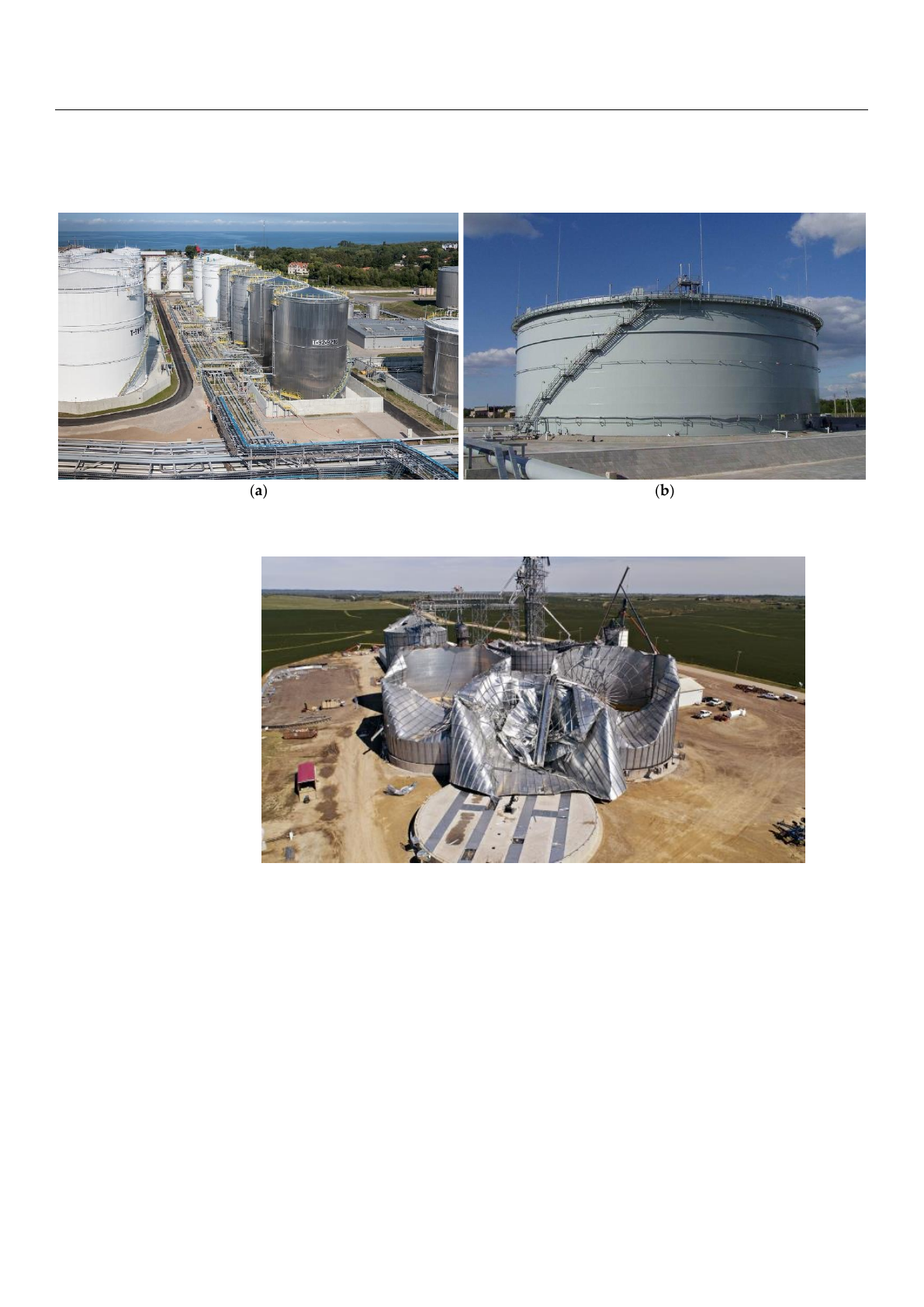
shells are used in many fields due to their special geometric configuration, including silos
and tanks (see Figure 1) in civil engineering, where they are subjected to loads such as
axial pressure, radial pressure, torsion, and combinations of these three types of loads.
The dominant type of damage to cylindrical shells is buckling failure, which is generally
sudden and often leads to the failure of the structure without visible symptoms or even
catastrophic accidents, see Figure 2. Therefore, the buckling of cylindrical shells has long
been a longstanding issue.
Typical cylindrical shell structures are made of (stainless) steel and achieve high
economic efficiency through the optimal utilization of materials. Currently, the increasing
cost of materials and the need for greater sustainability are prompting the manufacturers
of cylindrical shells to rethink the previous concept and to constantly search for new types
of shell structure construction in civil engineering. The application of orthotropic rotation
shells, composed of thin shells with strong ring stiffeners, allows optimal matching to
typical loads, such as wind. Ring stiffeners can contribute to a significant increase in
resistance to wind and negative pressure. Research in the 1960s and 1970s showed that
stiffeners also increased axial compression.
Recently, researchers [
3
] have re-evaluated published experiments on particularly
thin-walled cylindrical shells. The results of parametric studies on closed-ring stiffened
cylindrical shells confirm the high load-bearing capacity expected from published experi-
ments. It has been proven that current standards are too conservative in some areas. In
general, it is important to review the research history and development of ring-stiffened
Appl. Sci. 2022,12, 11665. https://doi.org/10.3390/app122211665 https://www.mdpi.com/journal/applsci
Appl. Sci. 2022,12, 11665 2 of 14
cylindrical shell structures and their application in steel structures for their further devel-
opment and promotion, as well as for their wider application in practice.
Appl. Sci. 2022, 12, x FOR PEER REVIEW 2 of 14
(a)
(b)
Figure 1. Cylindrical shells in Klaipėda (a) and Būtingė (b), Lithuania. [1].
Figure 2. Damaged silos after a storm, Marshalltown, Iowa, USA, 2020 [2].
Recently, researchers [3] have re-evaluated published experiments on particularly
thin-walled cylindrical shells. The results of parametric studies on closed-ring stiffened
cylindrical shells confirm the high load-bearing capacity expected from published exper-
iments. It has been proven that current standards are too conservative in some areas. In
general, it is important to review the research history and development of ring-stiffened
cylindrical shell structures and their application in steel structures for their further devel-
opment and promotion, as well as for their wider application in practice.
2. Classic Shell Structures
Many researchers have conducted extensive research on the stability of cylindrical
shells under axial compressions: a classic problem in mechanics. Due to the thin-walled
nature of the silo structure, steel shells have become the central point of the silo structure.
At the beginning of the twentieth century, researchers such as Lorenz [4] and Timoshenko
[5] started to focus on the buckling of cylindrical shells and came up with theoretical meth-
ods. During the next 20 years, based on numerous experimental research, Flügge [6], Ball-
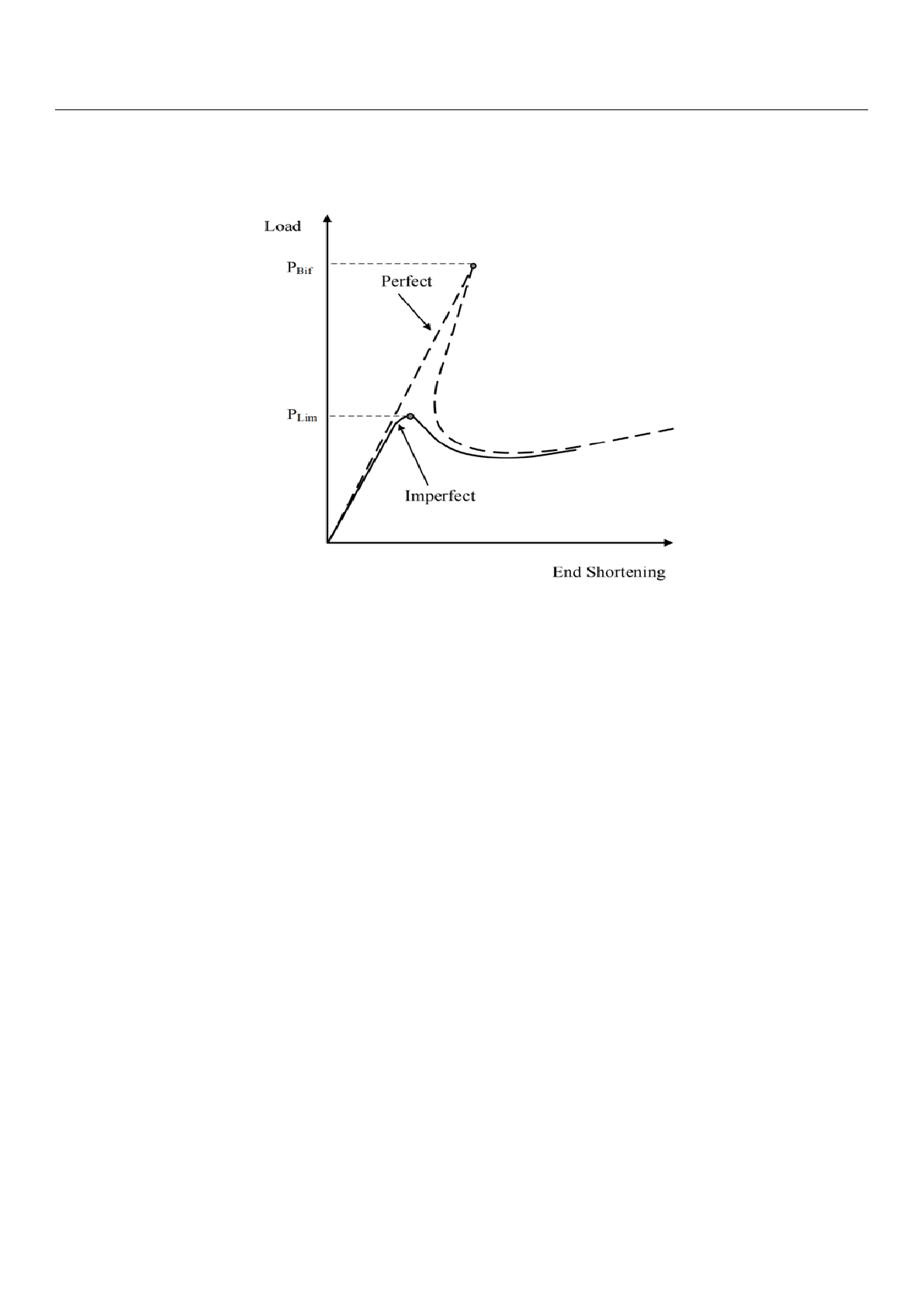
erstedt and Wagner [7], and Kanemitsu and Nojima [8] observed that the buckling load
Plim achieved in the laboratory was considerably lower than the elastic bifurcation load PBif
calculated by the theoretical formulae, achieving less than one-quarter of the theoretical
values. (Figure 3). In addition, the shell buckling loads measured by the tests were found
Figure 1. Cylindrical shells in Klaip˙
eda (a) and B¯
uting˙
e (b), Lithuania. [1].
Appl. Sci. 2022, 12, x FOR PEER REVIEW 2 of 14
(a)
(b)
Figure 1. Cylindrical shells in Klaipėda (a) and Būtingė (b), Lithuania. [1].
Figure 2. Damaged silos after a storm, Marshalltown, Iowa, USA, 2020 [2].
Recently, researchers [3] have re-evaluated published experiments on particularly
thin-walled cylindrical shells. The results of parametric studies on closed-ring stiffened
cylindrical shells confirm the high load-bearing capacity expected from published exper-
iments. It has been proven that current standards are too conservative in some areas. In
general, it is important to review the research history and development of ring-stiffened
cylindrical shell structures and their application in steel structures for their further devel-
opment and promotion, as well as for their wider application in practice.
2. Classic Shell Structures
Many researchers have conducted extensive research on the stability of cylindrical
shells under axial compressions: a classic problem in mechanics. Due to the thin-walled
nature of the silo structure, steel shells have become the central point of the silo structure.
At the beginning of the twentieth century, researchers such as Lorenz [4] and Timoshenko
[5] started to focus on the buckling of cylindrical shells and came up with theoretical meth-
ods. During the next 20 years, based on numerous experimental research, Flügge [6], Ball-
erstedt and Wagner [7], and Kanemitsu and Nojima [8] observed that the buckling load
Plim achieved in the laboratory was considerably lower than the elastic bifurcation load PBif
calculated by the theoretical formulae, achieving less than one-quarter of the theoretical
values. (Figure 3). In addition, the shell buckling loads measured by the tests were found
Figure 2. Damaged silos after a storm, Marshalltown, Iowa, USA, 2020 [2].
2. Classic Shell Structures
Many researchers have conducted extensive research on the stability of cylindrical
shells under axial compressions: a classic problem in mechanics. Due to the thin-walled
nature of the silo structure, steel shells have become the central point of the silo structure. At
the beginning of the twentieth century, researchers such as Lorenz [
4
] and Timoshenko [
5
]
started to focus on the buckling of cylindrical shells and came up with theoretical methods.
During the next 20 years, based on numerous experimental research, Flügge [
6
], Ballerstedt
and Wagner [
7
], and Kanemitsu and Nojima [
8
] observed that the buckling load P
lim
achieved in the laboratory was considerably lower than the elastic bifurcation load P
Bif
calculated by the theoretical formulae, achieving less than one-quarter of the theoretical
values. (Figure 3). In addition, the shell buckling loads measured by the tests were found to
be significantly dispersed, even for identical or similar materials and geometric parameters.
Further studies have shown that initial geometrical imperfections result in significant
differences between the theoretical and experimental results. Defects in the shell also have
a significant impact on the bearing capacity [
9
]. In practice, the maximum axial bearing
Appl. Sci. 2022,12, 11665 3 of 14
capacity of cylindrical shells is almost impossible to calculate accurately on the basis of the
shell theory, ignoring geometric imperfections.
Appl. Sci. 2022, 12, x FOR PEER REVIEW 3 of 14
to be significantly dispersed, even for identical or similar materials and geometric param-
eters. Further studies have shown that initial geometrical imperfections result in signifi-
cant differences between the theoretical and experimental results. Defects in the shell also
have a significant impact on the bearing capacity [9]. In practice, the maximum axial bear-
ing capacity of cylindrical shells is almost impossible to calculate accurately on the basis
of the shell theory, ignoring geometric imperfections.
Figure 3. Equilibrium path of the cylindrical shell under axial pressure.
In recent decades, the stability of the shell has been studied from different perspec-
tives. For structural design purposes, Rotter [10] summarized the relationship between
initial geometric imperfections and the cylindrical shell manufacturing process, updating
the design approach based on Odland’s concepts [11] in which cylindrical shells were di-
vided into different levels depending on the quality of the manufactured components.
Teng [12] gave an exhaustive review of the studies carried out without shell buckling until
the end of the twentieth century. Schmidt [13], as a researcher, teacher, and structural
engineer, focused on the stability design of steel shell structures from a Western European
perspective. Knödel and Ummenhofer [14] evaluated the load-bearing capacity of thin-
walled shell structures based on the different ways of modeling imperfections. Arbocz
and Starnes [15] analyzed the structural reliability of the cylindrical shell buckle from a
database of measured geometrical imperfections. Schenk and Schüeller [16] studied the
influence of random properties of geometric imperfections on the buckling load of thin-
walled cylindrical shells under axial compression using the Monte Carlo simulation ap-
proach and predicted the variation in the buckling load through experimental means.
Recently, Knödel et al. [17] identified the shortcomings of existing Eurocodes for shell
buckling after systematic analysis, including inadequate design rules and a limited debate
of imperfections. Using an artificial neural network (ANN), Tahir et al. [18] analyzed the
experimental data from the literature and estimated the buckling load of the cylindrical
shells. By comparison, it is concluded that the spacecraft design recommendations [19]
issued by NASA and Eurocode for EN 1993-1-6 steel shell structures [20] were extremely
conservative. Wagner et al. [21] proposed an improved knock-down factor method for the
shell design in spacecraft using probability analysis with the generation of random varia-
bles. They discussed the influence of manufacturing imperfections on the buckling load.
They also analyzed the experimental results of shell specimens under axial pressure using
reliability theory and considering geometric imperfections and compared these results
Figure 3. Equilibrium path of the cylindrical shell under axial pressure.
In recent decades, the stability of the shell has been studied from different perspectives.
For structural design purposes, Rotter [
10
] summarized the relationship between initial
geometric imperfections and the cylindrical shell manufacturing process, updating the
design approach based on Odland’s concepts [
11
] in which cylindrical shells were divided
into different levels depending on the quality of the manufactured components. Teng [
12
]
gave an exhaustive review of the studies carried out without shell buckling until the end
of the twentieth century. Schmidt [
13
], as a researcher, teacher, and structural engineer,
focused on the stability design of steel shell structures from a Western European perspective.
Knödel and Ummenhofer [
14
] evaluated the load-bearing capacity of thin-walled shell
structures based on the different ways of modeling imperfections. Arbocz and Starnes [
15
]
analyzed the structural reliability of the cylindrical shell buckle from a database of measured
geometrical imperfections. Schenk and Schüeller [
16
] studied the influence of random
properties of geometric imperfections on the buckling load of thin-walled cylindrical shells
under axial compression using the Monte Carlo simulation approach and predicted the
variation in the buckling load through experimental means.
Recently, Knödel et al. [
17
] identified the shortcomings of existing Eurocodes for shell
buckling after systematic analysis, including inadequate design rules and a limited debate
of imperfections. Using an artificial neural network (ANN), Tahir et al. [
18
] analyzed the
experimental data from the literature and estimated the buckling load of the cylindrical
shells. By comparison, it is concluded that the spacecraft design recommendations [
19
]
issued by NASA and Eurocode for EN 1993-1-6 steel shell structures [
20
] were extremely
conservative. Wagner et al. [
21
] proposed an improved knock-down factor method for the
shell design in spacecraft using probability analysis with the generation of random vari-
ables. They discussed the influence of manufacturing imperfections on the buckling load.
They also analyzed the experimental results of shell specimens under axial pressure using
reliability theory and considering geometric imperfections and compared these results with
the design standards. They found that although the design standards had improved consid-
erably, they were still conservative compared to the experimental values [
22
]. In addition,
recent contributions to the vibration behavior of shell structures can be mentioned [
23
–
25
].

Appl. Sci. 2022,12, 11665 4 of 14
As mentioned above, cylindrical shells have a wide field of applications in many areas
of engineering. The types of loads and working environments to which the cylindrical
shell structures are subjected and the manufacturing processes vary considerably from
one application to another. This has led to a variety of forms for initial imperfections in
cylindrical shells. Therefore, it is necessary to analyze the stability of cylindrical shells in
engineering applications according to the type of load, the working environment condition,
and the main types of geometrical imperfections. Currently, ring-stiffened cylindrical shells
are the typical shell constructions in steel structures.
3. Stiffened Shell Structures
Stiffened cylindrical shells are a common structural form in engineering practice
and are commonly used in civil engineering and aerospace structures. However, the
references to the ring-stiffened cylindrical shells under axial compression are by far not as
comprehensive as those of the axially pressure-loaded isotropic cylinder. The purpose of
stiffening is to improve the stability of a cylindrical shell, which not only increases its critical
buckling load for the same weight but also reduces the sensitivity of the buckling load of the
cylindrical shell to the initial geometrical imperfections [
26
,
27
]. The design of the stiffened
shells is a very real and serious issue in practice. In some aerospace structures, obtaining a
lightweight structure with a high load-carrying capacity is a key design consideration, so
the case of stiffened cylindrical shells is used frequently. Recently, some civil engineers have
noticed this material-saving design solution and have applied it to some real constructions.
However, the mechanical and buckling analysis of the stiffened shells is theoretically a
complex problem because of the coupling of the mechanical behavior between the main
shell structure and the stiffeners. Therefore, in the study of stiffened shells, it is necessary
first to simplify the structure into a calculation model that is easy to process.
3.1. Development and Progress of the Research in the Areas of Ring Stiffened Cylinder
The buckling of stiffened cylindrical shells is one of the main considerations in the
design of stiffened shell structures. In the 1930s, Flügge [
6
] made the first findings on
stiffened shells. One of the first findings was that the stiffener arrangement has an influence
on the load-bearing behavior of the shell. Singer [
28
] presented a review of experimental
and theoretical studies on the buckling of stiffened cylindrical shells. After that, Singer and
Rosen et al. [
29
–
31
] investigated the influences of eccentric loads, geometrical imperfections,
and boundary conditions on the buckling loads of stiffened cylindrical shells, respectively.
An extensive compilation of critically selected tests was published in 1969 by Peterson
in [
32
]. Since intensive research in the 1960s and 1970s, in the twentieth century, research
almost came to a standstill, and only sporadic further research results were published
that dealt with experiments around the topic of ring-strengthened cylinder shells under
axial pressure. In this context, Grove and Didriksen [
33
] studied the buckling behavior
of ring-stiffened cylindrical shells under axial pressure and transverse load at the upper
edge of the specimens. Other publications, such as [
34
], highlighted the larger differences
between welded test specimens and carefully machined cylinders. In the late 1980s and
early 1990s, Seleim [
35
,
36
] investigated theoretically and experimentally the post-buckling
of cylindrical ring-stiffened shells and analyzed the sensitivity of the shell buckling under
external pressure. However, in many early papers, the parameters that determined the
buckling behavior, such as geometrical imperfections associated with the ideal cylindrical
shape and residual stresses, were often not adequately listed in experimental publications.
The work by Baker [
37
] is one of the few publications that provide extensively documented
measurements of the initial geometrical imperfections. They investigated the load-carrying
capacity of eccentrically loaded cylindrical shells with variable ring stiffener spacing
and then subsequently published the test results of the cylindrical shells with stiffeners.
Das et al. [
38
] investigated the buckling behavior of stiffened cylindrical shells under
combined loading based on reliability analysis. Li and Qiao [
39
] presented a post-buckling
analysis of stiffened cylindrical shells under combined external and axial pressure loading.
Appl. Sci. 2022,12, 11665 5 of 14
Barlag [
40
] provides a comprehensive summary of the current research state and validates
the cylindrical stiffened shell on the basis of various design codes. The results show
that none of the current steel structure design codes specify cylinder loading with axial
pressure and ring stiffness. A comparison of the test results using buckling reduction curves
according to DIN 18800-4 shows that the provisions are significantly conservative with
respect to the ring-stiffened cylindrical shell structures. Wirth [
41
] focused more marginally
on stiffened ring shells when he performed tests on small-scale spiral-folded cylinder
specimens under axial pressure and checked the suitability of Eurocode 3 for the design of
the cylindrical shells. Jäger-Canás and Pasternak et al. [
42
] investigated the influence of ring-
stiffeners on the bearing capacity of axially compressed cylindrical shells using a numerical
approach. The potential material savings are suggested, and the beneficial influence of
the ring stiffeners on the buckling load capacity is discussed. In his dissertation [
3
], Jäger-
Canás proposed suggestions to address gaps in design standards. More recently, Li and
Pasternak et al. [
43
–
45
] presented an investigation of cylindrical ring-stiffened shells based
on axial buckling tests and numerical simulations. Several scaled-down welded cylindrical
shell specimens with measured geometric imperfections by 3D laser scanning technologies
were fabricated, tested, and analyzed based on efficient static analysis with accompanying
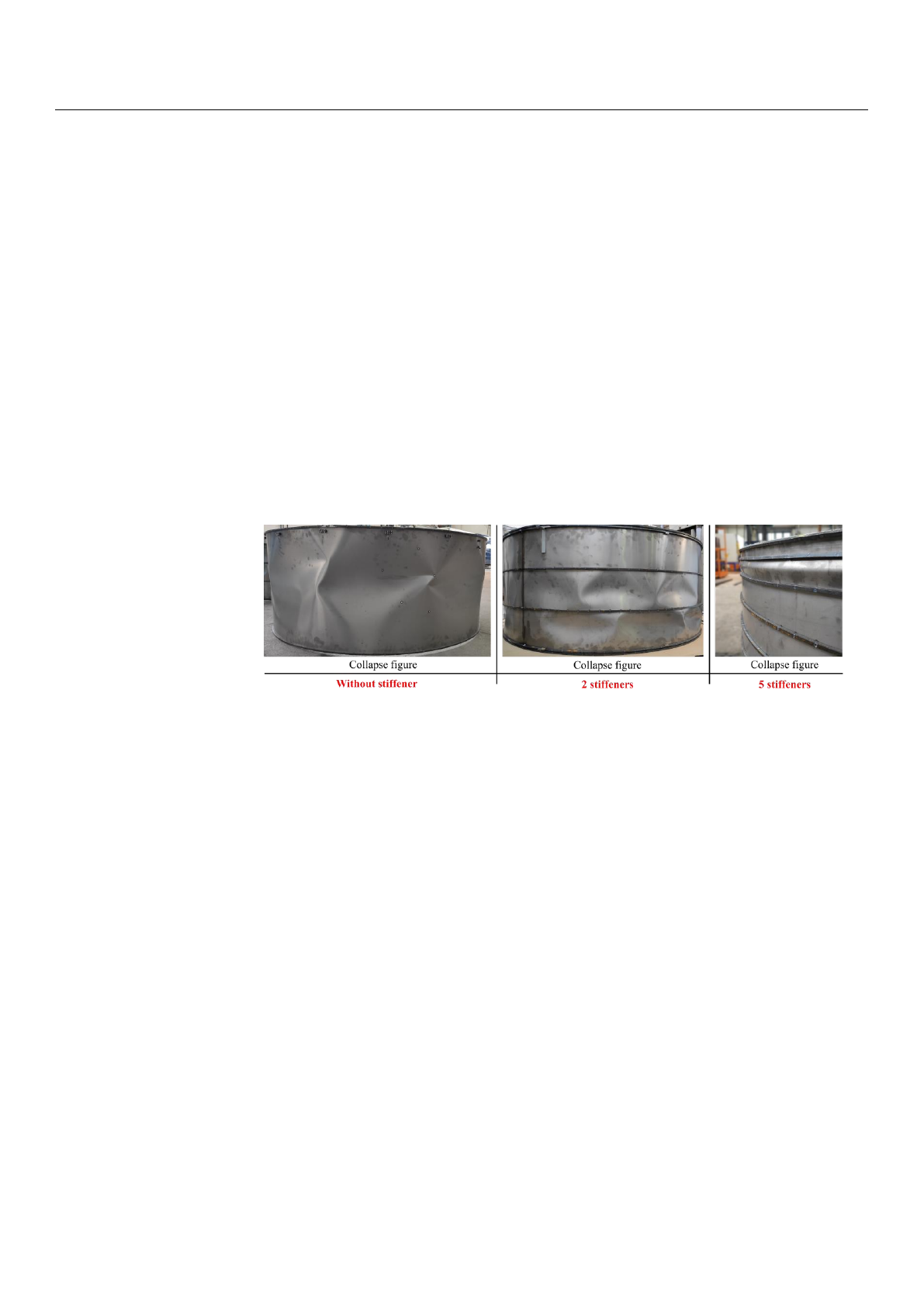
eigenvalue analysis and high-fidelity numerical calculation (Figure 4).
Appl. Sci. 2022, 12, x FOR PEER REVIEW 5 of 14
extensively documented measurements of the initial geometrical imperfections. They in-
vestigated the load-carrying capacity of eccentrically loaded cylindrical shells with varia-
ble ring stiffener spacing and then subsequently published the test results of the cylindri-
cal shells with stiffeners. Das et al. [38] investigated the buckling behavior of stiffened
cylindrical shells under combined loading based on reliability analysis. Li and Qiao [39]
presented a post-buckling analysis of stiffened cylindrical shells under combined external
and axial pressure loading. Barlag [40] provides a comprehensive summary of the current
research state and validates the cylindrical stiffened shell on the basis of various design
codes. The results show that none of the current steel structure design codes specify cyl-
inder loading with axial pressure and ring stiffness. A comparison of the test results using
buckling reduction curves according to DIN 18800-4 shows that the provisions are signif-
icantly conservative with respect to the ring-stiffened cylindrical shell structures. Wirth
[41] focused more marginally on stiffened ring shells when he performed tests on small-
scale spiral-folded cylinder specimens under axial pressure and checked the suitability of
Eurocode 3 for the design of the cylindrical shells. Jäger-Canás and Pasternak et al. [42]
investigated the influence of ring-stiffeners on the bearing capacity of axially compressed
cylindrical shells using a numerical approach. The potential material savings are sug-
gested, and the beneficial influence of the ring stiffeners on the buckling load capacity is
discussed. In his dissertation [3], Jäger-Canás proposed suggestions to address gaps in
design standards. More recently, Li and Pasternak et al. [43–45] presented an investigation
of cylindrical ring-stiffened shells based on axial buckling tests and numerical simula-
tions. Several scaled-down welded cylindrical shell specimens with measured geometric
imperfections by 3D laser scanning technologies were fabricated, tested, and analyzed
based on efficient static analysis with accompanying eigenvalue analysis and high-fidelity
numerical calculation (Figure 4).
Figure 4. Collapse figure of ring-stiffened cylindrical shell structures with different stiffeners.
3.2. Mechanics of Ring Stiffened Cylinder and Numerical Approaches
Due to the high stresses caused by axial pressure, bending, and circumferential pres-
sure, ring stiffeners were often used in combination with thick plates. This resulted in
either the stiffener or the shell failure first considering their isolation, but also the interac-
tion of both components had to be taken into account. Traditionally, there are three main
types of simplified models for stiffened shell structures in stability research. The first is to
consider the stiffened shell structure by simplifying it to an equivalent orthotropic aniso-
tropic structure [46]. This model is more suitable for densely stiffened structures with
equivalent spacing, and it is difficult to determine a consistently satisfied equivalent value
of orthogonal anisotropy for sparsely stiffened structures where the distance between the
stiffeners is possibly greater than the buckling wavelength. In addition, this model is also
difficult to simplify for nonequally spaced, nonuniformly stiffened shell structural types.
The second method, called the beam-column method, is based on the consideration of
stiffeners with their adjacent structural parts of the shell as a slat model [47]. This method
is also not applicable to the cases of sparsely stiffened and non-uniform stiffeners. The
third model is called the finite strip method [48]. The basic idea of this approach is to
Figure 4. Collapse figure of ring-stiffened cylindrical shell structures with different stiffeners.
3.2. Mechanics of Ring Stiffened Cylinder and Numerical Approaches
Due to the high stresses caused by axial pressure, bending, and circumferential pres-
sure, ring stiffeners were often used in combination with thick plates. This resulted in
either the stiffener or the shell failure first considering their isolation, but also the inter-
action of both components had to be taken into account. Traditionally, there are three
main types of simplified models for stiffened shell structures in stability research. The first
is to consider the stiffened shell structure by simplifying it to an equivalent orthotropic
anisotropic structure [
46
]. This model is more suitable for densely stiffened structures with
equivalent spacing, and it is difficult to determine a consistently satisfied equivalent value
of orthogonal anisotropy for sparsely stiffened structures where the distance between the
stiffeners is possibly greater than the buckling wavelength. In addition, this model is also
difficult to simplify for nonequally spaced, nonuniformly stiffened shell structural types.
The second method, called the beam-column method, is based on the consideration of
stiffeners with their adjacent structural parts of the shell as a slat model [
47
]. This method is
also not applicable to the cases of sparsely stiffened and non-uniform stiffeners. The third
model is called the finite strip method [
48
]. The basic idea of this approach is to decompose
the stiffened structure into the main structure and the stiffeners for separate investigations,
which are related by displacement conditions and force equilibrium conditions at the junc-
tions. This model is widely used in numerical methods, such as the finite-strip method
and the finite-difference method. However, when applying the finite bar method for the
stability analysis of stiffened shell and plate structures, it is still difficult to treat the issue of
transverse stiffeners very effectively.
Over the past few decades, researchers have also conducted a large number of experi-
mental studies for ring-stiffened cylindrical shells. According to the experimental results
Loading more pages...