
Marcelo Alves Fávaro, Daniel Ditz, Jin Yang, Sebastian Bergwinkl,
Ashta C. Ghosh, Michael Stammler, Chantal Lorentz, Jérôme
Roeser, Elsje Alessandra Quadrelli, Arne Thomas, Regina Palkovits,
Jérôme Canivet, Florian M. Wisser
Finding the Sweet Spot of PhotocatalysisA Case
Study Using Bipyridine-Based CTFs
Open Access via institutional repository of Technische Universität Berlin
Document type
Journal article | Accepted version
(i. e. final author-created version that incorporates referee comments and is the version accepted for
publication; also known as: Author’s Accepted Manuscript (AAM), Final Draft, Postprint)
This version is available at
https://doi.org/10.14279/depositonce-17781
Citation details
Alves Fávaro, M., Ditz, D., Yang, J., Bergwinkl, S., Ghosh, A. C., Stammler, M., Lorentz, C., Roeser, J.,
Quadrelli, E. A., Thomas, A., Palkovits, R., Canivet, J., & Wisser, F. M. (2022). Finding the Sweet Spot of
PhotocatalysisA Case Study Using Bipyridine-Based CTFs. In ACS Applied Materials amp; Interfaces (Vol. 14,
Issue 12, pp. 14182–14192). American Chemical Society (ACS). https://doi.org/10.1021/acsami.1c24713.
This document is the Accepted Manuscript version of a Published Work that appeared in final form in ACS
Applied Materials Interfaces, copyright © American Chemical Society after peer review and technical editing
by the publisher. To access the final edited and published work see
https://pubs.acs.org/doi/10.1021/acsami.1c24713.
Terms of use
This work is protected by copyright and/or related rights. You are free to use this work in any way permitted by
the copyright and related rights legislation that applies to your usage. For other uses, you must obtain
permission from the rights-holder(s).

1Finding the Sweet Spot of PhotocatalysisA Case Study Using
2Bipyridine-Based CTFs
3Marcelo Alves Fávaro,
#
Daniel Ditz,
#
Jin Yang, Sebastian Bergwinkl, Ashta C. Ghosh, Michael Stammler,
4Chantal Lorentz, Jérome Roeser, Elsje Alessandra Quadrelli, Arne Thomas, Regina Palkovits,*
5Jérome Canivet,*and Florian M. Wisser*
6ABSTRACT: Covalent triazine frameworks (CTFs) are a class of porous organic polymers
7that continuously attract growing interest because of their outstanding chemical and physical
8properties. However, the control of extended porous organic frameworks’structures at the
9molecular scale for a precise adjustment of their properties has hardly been achieved so far.
10 Here, we present a series of bipyridine-based CTFs synthesized through polycondensation, in
11 which the sequence of specific building blocks is well controlled. The reported synthetic
12 strategy allows us to tailor the physicochemical features of the CTF materials, including the
13 nitrogen content, the apparent specific surface area, and optoelectronic properties. Based on a
14 comprehensive analytical investigation, we demonstrate a direct correlation of the CTF
15 bipyridine content with the material features such as the specific surface area, band gap, charge
16 separation, and surface wettability with water. The entirety of these parameters dictates the
17 catalytic activity as demonstrated for the photocatalytic hydrogen evolution reaction (HER).
18 The material with the optimal balance between optoelectronic properties and highest
19 hydrophilicity enables HER production rates of up to 7.2 mmol/(h g) under visible light irradiation and in the presence of a
20 platinum cocatalyst.
21 KEYWORDS: covalent triazine framework, photocatalysis, hydrogen evolution reaction, molecular control, bipyridine
22 ■INTRODUCTION
23 A current challenge in materials science is to keep rigorous
24 control over the increasingly complex assembly of active
25 building blocks in extended porous frameworks while retaining
26 predictive insight into their ultimate performance.
1
The ability
27 to introduce various active building blocks into one porous
28 framework has already allowed the modulation and prediction of
29 physical and chemical properties, improving the capacity to tune
30 fundamental properties including hydrophobicity,
2
porosity,
3,4
31 optical response,
5−8
and catalytic activity.
6,9−11
The capacity to
32 extend the control over optoelectronic properties to the
33 molecular level while retaining the control over other
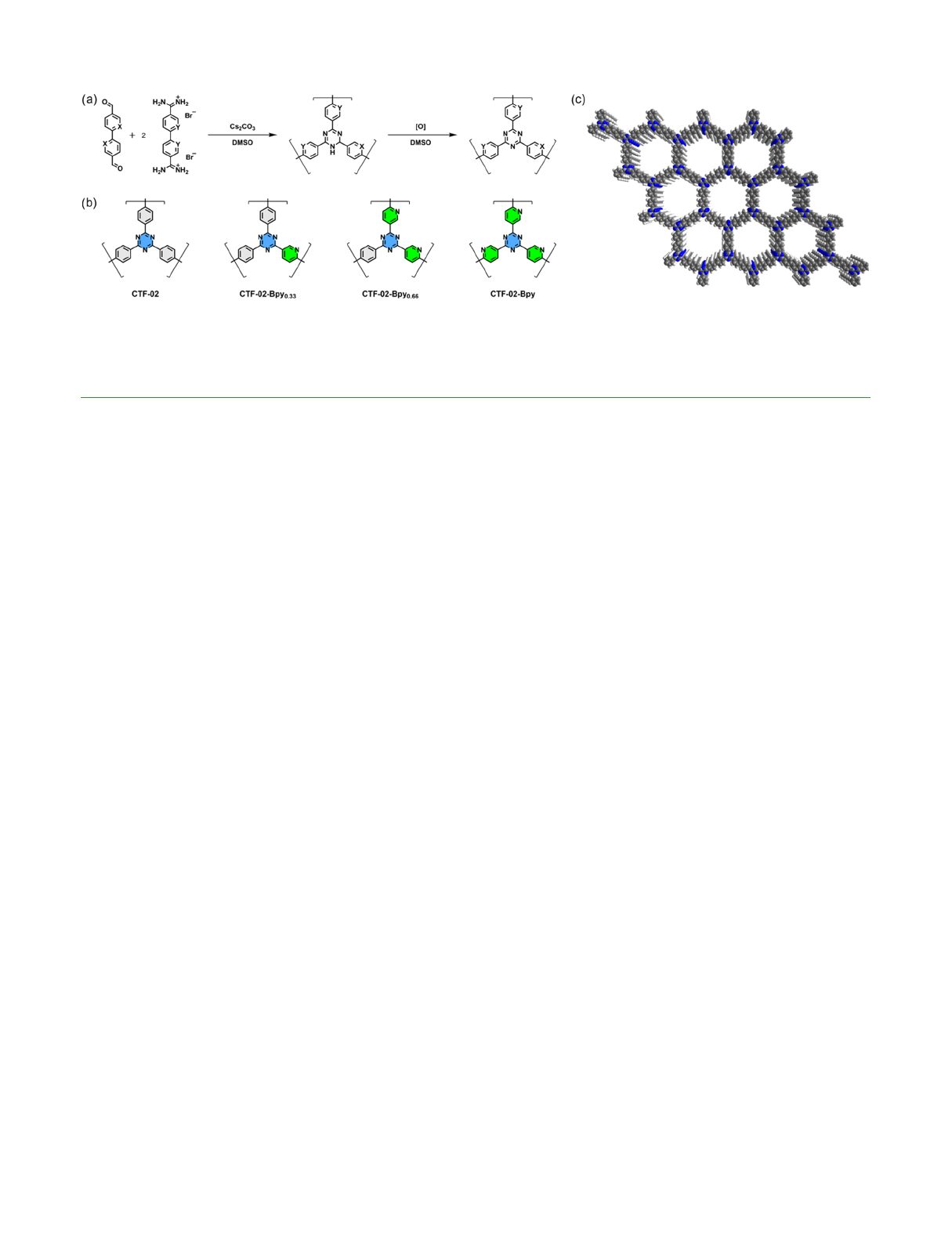
34 physicochemical and structural properties becomes a key in
35 the context of material applications to renewable energy
36 utilization; the capacity to control optoelectronic properties
37 will, in turn, drive the materials’photocatalytic performances.
38 While some interesting results have been achieved in
39 photocatalysis,
12−16
typically, by adding electron acceptor (p-
40 doping) or electron donor atoms or moieties (n-doping) in the
41 final composition of the material,
6,13,17,18
the correlation of the
42 material’s structure with the observed catalytic performance
43 remains phenomenological,
17,19,20
as the observed changes in
44 the electronic properties, geometry, and morphology seemed
45 too intertwined to rationalize the changes in catalytic
46 activity.
21,22
47
One frontier in preparing photoactive multifunctional
48
materials by modular design thus lies in the control and
49
comprehension from the material’s molecular structure up to the
50
macroscopic scale, understanding the material’s performances in
51
its entirety, beyond the description of its molecular units. To
52
address these challenges, a regular, alternating assembly between
53
building blocks containing different functional groups is a route
54
to yield a periodic, sequential copolymer
23
with a uniform
55integration of the dopant.
56
Here, we report (i) a synthetic strategy for the structural
57
control at the molecular level for a series of periodic copolymers,
58
namely, bipyridine-containing covalent triazine frameworks
59
(CTFs), (ii) a general protocol for the consistent measurement
60
of their resulting electronic properties, e.g., frontier orbital
61
position alignment, a feat not described yet, and (iii) their
62correlation with the obtained catalytic performances in the
1
63 photochemical hydrogen evolution reaction (HER), which
64 reaches 7.2 mmol/(h gcat).
65 ■RESULTS AND DISCUSSION
66 Synthesis and Characterization of the Materials. Four
67 CTFs were synthesized via condensation of aromatic diamidine
68 bromides and aromatic dialdehydes. A series of periodic
69 copolymers with the desired quantity and positioning of the
70 dopant in the material were adjusted by the stoichiometric ratio
71 of diamidine and dialdehyde in a 2:1 ratio for in situ
f1 72 polycondensation of the triazine linkage (Figure 1a). This
73 polycondensation approach, recently reported by Cooper, Tan,
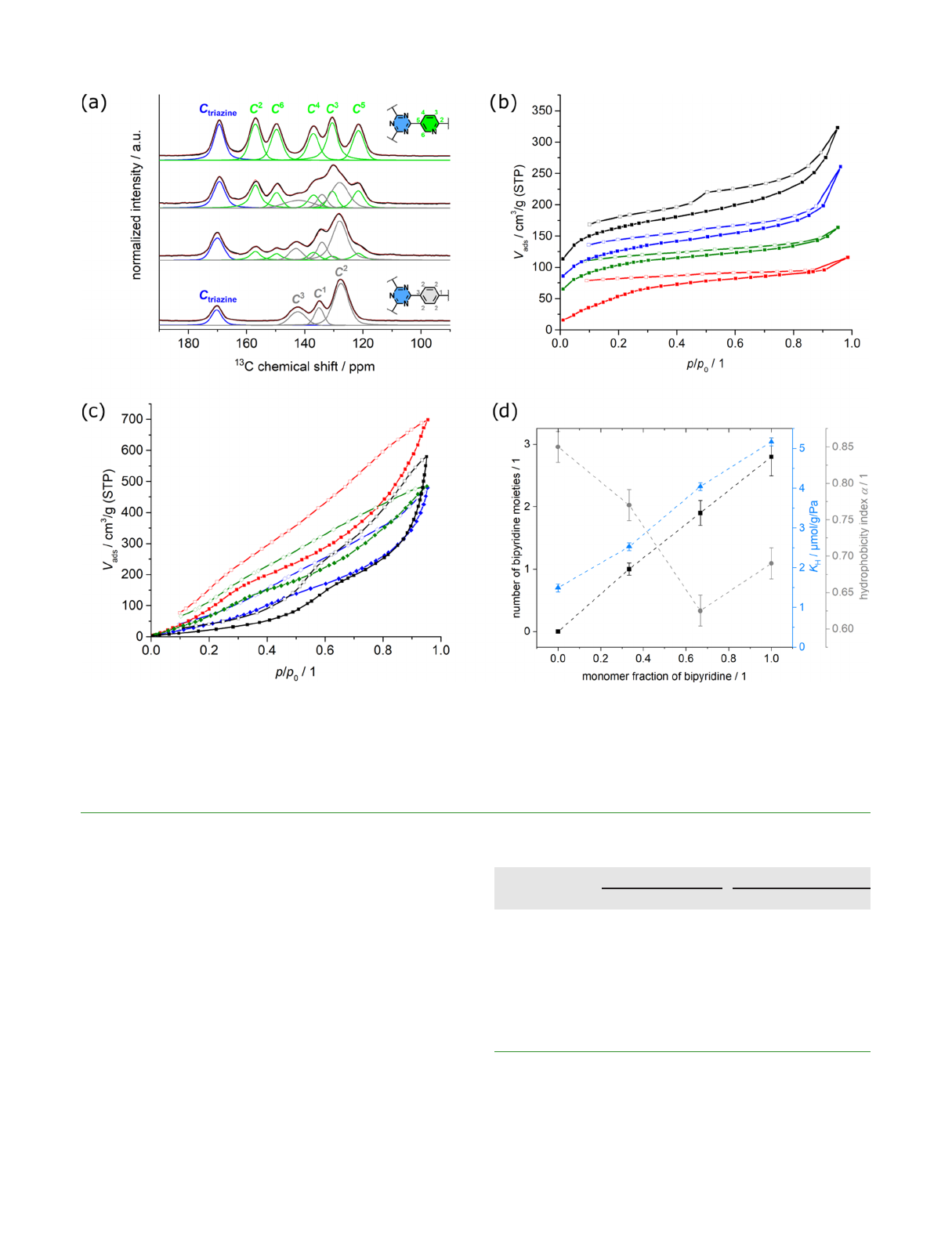
74 and co-workers,
24
provides superior control compared with the
75 well-established ionothermal CTF synthesis,
25
paving the way to
76 master the desired building block sequence in the bipyridine-
77 containing CTF family by applying the principle of orthogonal
78 chemistry.
26,27
However, so far, only a few CTFs obtained by
79 polycondensation are reported, mostly limited to functionalized
80 aromatic aldehydes and nonfunctionalized terephthalamidine or
81 [1,1′-biphenyl]-4,4′-bis(carboximidamide).
28−32
Here, we em-
82 ployed bipyridine and biphenyl aromatic cores as n-doping and
83 nondoping moieties, respectively (Figure 1). Since the aromatic
84 dialdehydes are commercially available, the synthesis of CTFs
85 started with preparing 5,5′-diamidine-2,2′-bipyridine dihalide
86 and 4,4′-biphenyldiamidine dihalide, adapting the previously
87 established procedure.
24
88 As the synthesis of amidine chloride produces a large excess of
89 NH4Cl, its purification is a crucial step. While nonfunctionalized
90 terephthalamidine dichloride could be obtained in good purity,
91 following the procedure established by Shu et al.,
33
all attempts
92 to sufficiently obtain pure 5,5′-diamidine-2,2′-bipyridine by
93 washing or recrystallization from ethanol/acetone mixtures were
94 unsuccessful. Thus, we applied a counterion exchange strategy
95 to transfer the amidine first into tetraphenylborate, which is
96 soluble in acetone, and then into the corresponding bromide
97 (for details, see Supporting Information (SI) Section 2.1). Note
98 that using terephthalamidine dibromide in the synthesis of CTF-
99 1did not affect porosity, band gap, or crystallinity with respect to
100 the synthesis procedure described by Cooper and co-workers,
101 applying terephthalamidine dichloride (see SI Section 3).
24
102 Since two molecules of amidine bromide and one of aldehyde
103 are needed for the synthesis of a triazine core, a series of
104 materials containing 0, 33, 66, and 100% of bipyridine building
105 units were realized (Figure 1b). The materials were named
106
CTF-02,
34
CTF-02-Bpy0.33,CTF-02-Bpy0.66, and CTF-02-
107
Bpy, following the increase in the bipyridine content within the
108
CTF structure. The successful copolymerization was assessed by
109
IR spectroscopy, elemental analysis, and quantitative 13C
110
composite-pulse multiple cross-polarization (ComPmultiCP)
111
MAS NMR spectroscopy, while thermal stability was assessed by
112
thermogravimetric analysis (TGA). TGA under synthetic air
113
reveals that all materials are stable up to 200 °C. Above 200 °C, a
114
slight mass loss is observed for all materials while complete
115
decomposition starts above 400 °C for bipyridine-containing
116
CTFs and above 480 °C for pure biphenyl-based CTF-02
117
(Figure S9). The lower stability of bipyridine-containing CTFs
118
compared to the biphenyl-based CTF-02 might be explained by
119the lower stability of the nitrogen-containing linkers.
35,36
120
In IR spectra, copolymerization can be followed qualitatively,
121
as the characteristic bands of biphenyl moieties at 1416 and
122
1000 cm−1decrease in intensity when going from CTF-02 to
123
CTF-02-Bpy (Figure S10). At the same time, the characteristic
124
bands of bipyridine moieties at 1467, 1050, and 1030 cm−1
125
appear. Moreover, the characteristic vibration of the triazine
126
moiety around ∼1500 cm−1is indicative of the triazine ring
127
formation in the CTF-02 series.
24
Finally, the characteristic
128
amidine N−H stretching vibration bands between 3090 and
129
3340 cm−1as well as the characteristic aldehyde C−H stretching
130
vibration bands between 2740 and 2860 cm−1of the monomers
131
are no longer detectable in CTFs (Figure S11), indicative of a
132
complete conversion of the reactive end-groups into triazine
133moieties.
134
To obtain a detailed and quantitative insight into the
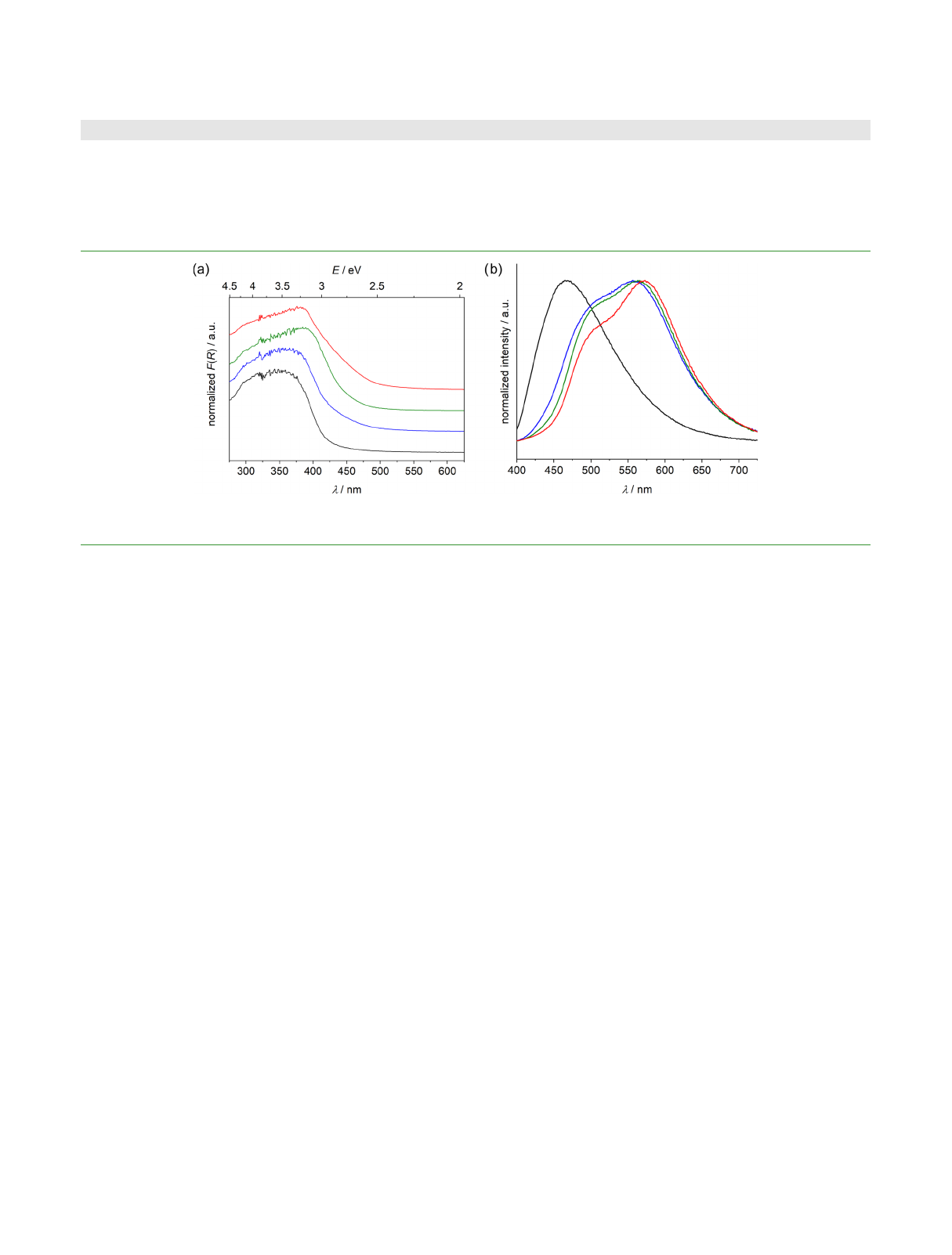
135
composition of CTFs, 13C ComPmultiCP MAS NMR spectra
136
were recorded.
14,38,39
The signal around 170 ppm can be
137
attributed to the triazine core carbon atom, confirming the
138
successful condensation and oxidation of amidine and aldehydes
139
to the triazine core in all materials (Figure 2a). The absence of
140
any signal in the 13C NMR spectra at about 190 and 163 ppm
141
highlights the complete transformation of aldehyde and amidine
142
moieties in all materials (see Figure S20). In the spectrum of the
143
biphenyl-based material CTF-02, signals at 143.0, 135.1, and
144
128.0 ppm in an integrated ratio of 1:1:4 of the biphenyl moiety
145
occur, while in the spectrum of CTF-02-Bpy,five different
146
resonances at 156.9, 149.6, 136.9, 130.5, and 121.6 ppm appear
147
with equal intensities (Figure 2a). In the spectra of the mixed
148
CTFs, containing both biphenyl- and bipyridine-based mono-
149mers, all those signals are present, and their integrated ratio is in
Figure 1. (a) Schematic representation of triazine formation in the CTF-02 series (X,Y= CH/N) synthesized via polycondensation. (b) Repeating
units of the four different CTFs: CTF-02 (X,Y= CH), CTF-02-Bpy0.33 (X=N,Y= CH), CTF-02-Bpy0.66 (X= CH, Y= N), and CTF-02-Bpy (X,Y=
N). Color code: blue, triazine; green, pyridine; and gray, phenyl moieties. (c) Idealized structural model of CTF-02 stacking along the crystallographic
c-direction. Color code: gray, carbon; blue, nitrogen; and white, hydrogen atoms. All materials are partially ordered, characteristic for materials
prepared by the polycondensation approach (Figures S23 and S24).
2
150 line with a 1−2 and 2−1 composition (see Table 1 and SI
151 Section 4.5 for further discussion). This perfect stoichiometric
152 control is further evidenced by elemental analysis. The nitrogen
153 content of these materials increases linearly from 12.8% for
154 CTF-02 to 22.1% for CTF-02-Bpy, while the molar ratio of
155 carbon to nitrogen is in line with the theoretical composition
156 (Table S1). The signal of the triazine carbon atom shifts from
157 170.6 ppm in CTF-02 to 169.1 ppm in CTF-02-Bpy0.66 and
158 CTF-Bpy. This shielding effect reflects the increase in electron
159 density on the triazine moiety with an increasing number of
160 bipyridine ligands, reflecting the enhanced donor capability of
161 the n-doped building block. A further increase from 66%
162 bipyridine to 100% bipyridine did not result in a further
163 shielding effect on the triazine moiety acting as an electron
164 acceptor.
f2t1 165 All materials show a permanent porosity toward nitrogen at 77
166 K, together with the characteristic swelling behavior for CTFs
167 prepared by this methodology (Figure 2b).
24,40
The hysteresis
168 between absorption and desorption branch of the isotherms
169 increases with increasing bipyridine content, indicative of a more
170pronounced swelling of the flexible network structure in the
171CTF-02 series.
41−43
The purely biphenyl-based CTF-02 has the
172highest apparent surface area within the series, achieving 570
173m2/g. As for other CTFs prepared by the condensation
174approach,
24
the apparent surface area of CTF-02 is significantly
175lower than the apparent surface areas obtained under
176ionothermal conditions (1880−2480 m2/g)
25,34
but compara-
Figure 2. (a) 13C ComPmultiCP MAS NMR spectra and corresponding deconvolution for CTF-02,CTF-02-Bpy0.33,CTF-02-Bpy0.66, and CTF-02-
Bpy from bottom to top. In all spectra, a line broadening of 100 Hz was applied. Color code for deconvoluted signals: blue, triazine; green, bipyridine;
and gray, biphenyl carbon atoms (see also Figure 1). Complete NMR spectra are provided in the SI (Figure S20). Signal assignment was done
according to the literature.
11,37
(b) N2physisorption isotherms measured at 77 K and (c) water vapor physisorption isotherms measured at 298 K of
CTF-02 (black), CTF-02-Bpy0.33 (blue), CTF-02-Bpy0.66 (green), and CTF-02-Bpy (red). (d) Experimentally observed evolution of composition
from 13C ComPmultiCP MAS NMR spectroscopy (black), Henry constant (KH, blue), and hydrophobicity (α, gray) obtained from water adsorption
isotherms as a function of monomer fraction. Dashed lines are guidelines for the eye.
Table 1. Monomer Feed Ratios and 13C ComPmultiCP
Integrals of Repeating Units
a
monomer feed monomer ratio from NMR
polymer biphenyl bipyridine biphenyl bipyridine
CTF-02 3 0 2.9 ±0.2 0
CTF-02-Bpy0.33 2 1 1.9 ±0.2 1.0 ±0.1
CTF-02-Bpy0.66 1 2 1.0 ±0.1 1.9 ±0.2
CTF-02-Bpy 0 3 0 2.8 ±0.3
a
Ratios are calculated from the sum of the integrals of all resonances
for each repeating unit, normalized to the triazine resonance (three
carbon atoms) and divided by the number of carbon atoms per
repeating unit.
39
3
177 ble to the apparent surface area of materials prepared by
178 trifluoromethanesulfonic acid (TfOH)-mediated polyconden-
179 sation (560 m2/g).
5,44
The observed lower surface area might be
180 explained by avoiding the partial carbonization that occurs
181 during ionothermal synthesis in molten ZnCl2, which may
182 increase the surface area. ZnCl2may also act as a porogene.
45,46
183 With increasing bipyridine content, and thus with increasing
184 surface polarity (vide infra), the apparent surface area decreases
185 to approx. 400, 370, and 240 m2/g for CTF-02-Bpy0.33,CTF-
t2 186 02-Bpy0.66, and CTF-02-Bpy, respectively (Table 2). A possible
187 explanation for the decrease in the apparent surface area might
188 include a nonfavorable interaction of N2with the more polar
189 surface of the bipyridine-containing materials, different
190 orientation of the quadrupolar N2on the surface that depends
191 on the composition (bipyridine or biphenyl),
47
or a denser state
192 of the flexible bipyridine-containing CTFs after activation and
193 cooling to 77 K.
48
Another explanation might be that the
194 grinding process, to achieve similar particle sizes and thus similar
195 light scattering of the suspension used in photocatalysis (vide
196 infra), may result in delamination or displacement of the two-
197 dimensional (2D) stacks in CTFs. Such delamination causes a
198 broadening or vanishing of peaks in the pXRD patterns (Figure
199 S23) and seems to be stronger for the bipyridine-containing
200 CTFs (for further discussion, see SI Section 4.8). It has been
201 demonstrated by Banerjee and co-workers for similar 2D
202 covalent organic frameworks that delamination results in a
203 reduced apparent surface area.
49
204 Specifically, in heterogeneous catalysis, a high specific surface
205 area in an open material is a key feature to assure accessibility of
206 the active sites. As we aim for aqueous liquid-phase catalysis, not
207 only the apparent surface area but also the interaction and
208 porosity toward a given solvent have to be considered. Water
209 vapor physisorption isotherms revealed a high water vapor
210 uptake at high partial pressure for all materials (Figure 2c). The
211 solid−solvent interaction of the first water molecules with the
212 solid surface, and thus, the wettability of the surface, is reflected
213
by the material’s Henry constant (KH), determined at low p/
214
p0.
50
In this series, KHincreases linearly with an increasing
215
amount of bipyridine from 1.5 ×10⁻⁶mol/(g Pa) for CTF-02,
216
providing the weakest solid−solvent interaction, to 5.2 ×10⁻⁶
217
mol/(g Pa) for CTF-02-Bpy (Table 2 and Figure 2d). In the
218
same way, the degree of pore filling (Ξ)
36
increases from 0.7 to
219
3.1 (Figure S21). Thus, in all bipyridine-CTFs, the pores are
220
completely filled with water, a beneficial characteristic for the
221
intended application in aqueous HER. In the case of CTF-02-
222
Bpy0.66 and CTF-02-Bpy, the H2O-accessible pore volume even
223
strongly increased compared to N2accessible pore volume,
224
highlighting the pronounced swelling of the material and
225
therefore good accessibility of active sites even in the center of
226
the material. An important parameter to evaluate hydrophilicity
227
is the relative partial pressure αat which the capacity for water
228
uptake reaches 50%. In contrast to the Henry constant, which is
229
evaluated at the initial stage of the isotherm, αis determined
230
based on the total water capacity, thus considering the whole
231
isotherm. It describes the hydrophilic/hydrophobic character of
232
a porous solid based on its filling with water: the lower αis, the
233
more hydrophilic is the material.
50
In this series, the highest
234
hydrophilicity is observed for CTF-02-Bpy0.66 (α= 0.63), and
235
the highest hydrophobicity for CTF-02 (α= 0.85, Table 2 and
236
Figure 2d). The higher hydrophilicity of CTF-02-Bpy0.66 when
237
compared to CTF-02-Bpy (α= 0.69) may be explained by its
238
lower total water capacity and degree of pore filling, causing an
239easier, more efficient filling with water.
240
Optical Properties of the Materials. The optical proper-
241
ties of the CTF series were investigated by diffuse reflectance
242 f3
UV−vis spectroscopy (Figure 3a). Following the increase in the
243
bipyridine content within the series, and consequently, increase
244
in n-doping, the light absorbance shifts toward higher wave-
245
lengths, in line with predictions obtained from DFT calculations
246
by Van Speybroeck and co-workers.
51
In the series, the direct
247
band gap depends on the molecular composition, e.g., CTF-02,
248without any bipyridine moieties, holds the largest direct band
Table 2. Porosity and Optical Properties in the Series of CTFs
polymer SBET/m2/g Vtot
aD
/cm3/g Vtot
b
/cm3/g KH/mol/(g Pa) α/1 Edir
cD
/eV Eindir
d
/eV
CTF-02 570 0.71 0.47 1.5 ×10−60.85 3.05 2.86
CTF-02-Bpy0.33 400 0.40 0.39 2.5 ×10−60.77 2.98 2.73
CTF-02-Bpy0.66 370 0.25 0.39 4.0 ×10−60.63 2.90 2.64
CTF-02-Bpy 240 0.18 0.56 5.2 ×10−60.69 2.87 2.37
aD
etermined at 0.95 p/p0from N2physisorption isotherms measured at 77 K.
b
Determined at 0.95 p/p0from H2O vapor physisorption isotherms
measured at 298 K.
cD
irect.
d
Indirect optical band gaps determined via the Tauc plot method (Figure S13).
Figure 3. (a) Solid-state UV−vis spectra and (b) solid-state and steady-state emission spectra after excitation at λexc = 378 nm of CTF-02 (black),
CTF-02-Bpy0.33 (blue), CTF-02-Bpy0.66 (green), and CTF-02-Bpy (red).
4
Loading more pages...