Protocol
Quantitative phenotypic screens of Aspergillus
niger mutants in solid and liquid culture
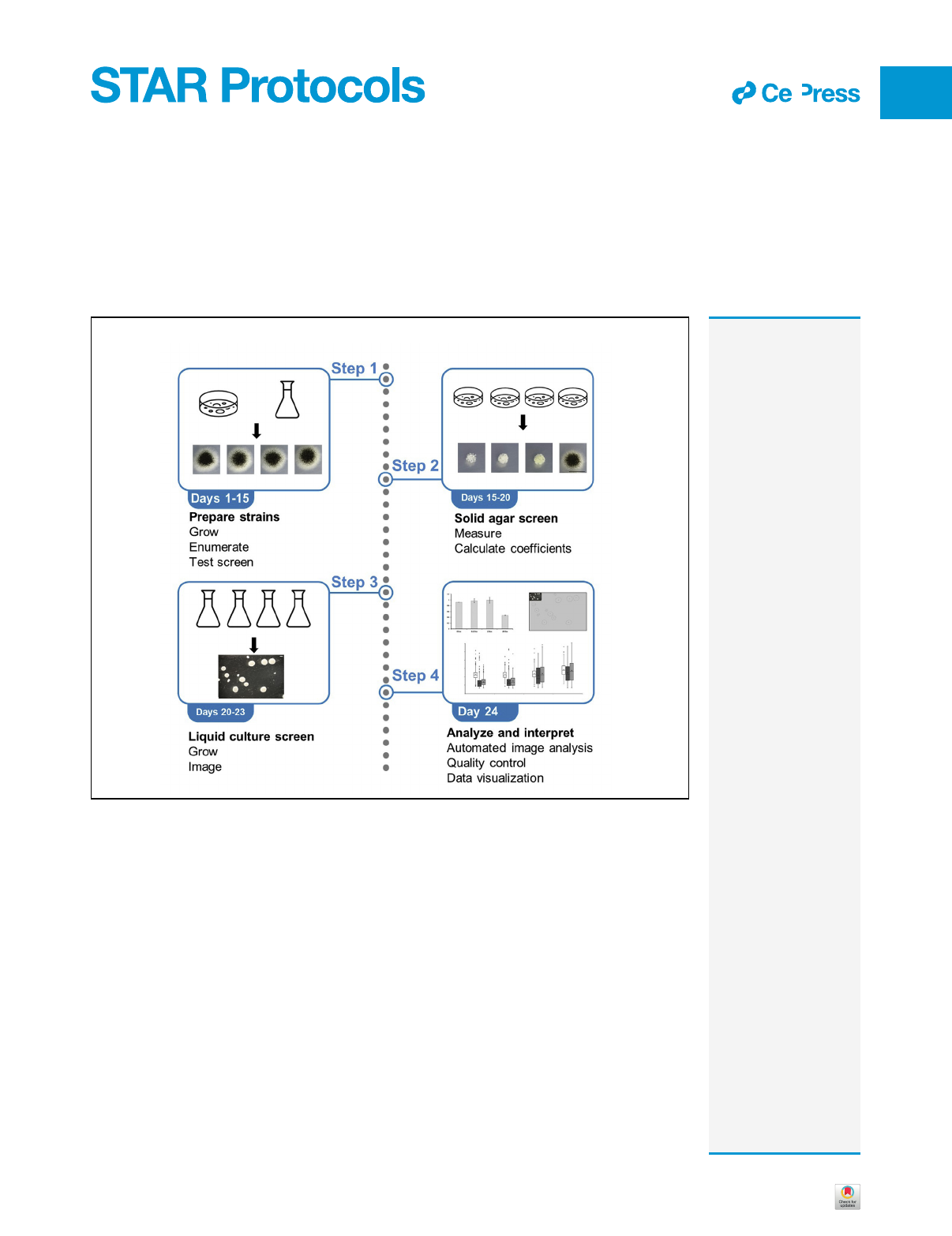
This protocol describes procedures for quantifying Aspergillus niger growth in both solid and
liquid culture. Firstly, by comparing radial growth between mutant and progenitor isolates on
solid agar supplemented with sublethal stressors, susceptibility coefficients can be calculated.
Secondly, analysis of macromorphological growth types in liquid culture allows full quantification
of how a gene of interest affects submerged growth. By combining these assays, an extensive and
quantitative dataset of how a gene of interest impacts growth in this fungus is possible.
Publisher’s note: Undertaking any experimental protocol requires adherence to local institutional
guidelines for laboratory safety and ethics.
Timothy Cairns,
Xiaomei Zheng,
Claudia Feurstein,
Ping Zheng, Jibin
Sun, Vera Meyer
[email protected] (J.S.)
(V.M.)
Highlights
Inoculate Aspergillus
niger in simple solid
and liquid growth
media
Generate
quantitative
measurements of
strain fitness on
sublethal stress
Analyze
macromorphology
during submerged
culture
Obtain a detailed and
quantitative picture
of strain growth
Cairns et al., STAR Protocols 3,
101883
December 16, 2022 ª2022
The Authors.
https://doi.org/10.1016/
j.xpro.2022.101883
ll
OPEN ACCESS

Protocol
Quantitative phenotypic screens of Aspergillus niger
mutants in solid and liquid culture
Timothy Cairns,
1,2,6
Xiaomei Zheng,
2,3,4,5
Claudia Feurstein,
1
Ping Zheng,
2,3,4,5
Jibin Sun,
2,3,4,5,
*
and Vera Meyer
1,7,
*
1
Chair of Applied and Molecular Microbiology, Institute of Biotechnology, Technische Universita
¨t Berlin, 10263 Berlin,
Germany
2
Tianjin Institute of Industrial Biotechnology, Chinese Academy of Sciences, Tianjin 300308, China
3
Key Laboratory of Systems Microbial Biotechnology, Chinese Academy of Sciences, Tianjin 300308, China
4
University of Chinese Academy of Sciences, Beijing 100049, China
5
National Technology Innovation Center of Synthetic Biology, Tianjin 300308, China
6
Technical contact: t.cairns@tu-berlin.de
7
Lead contact
https://doi.org/10.1016/j.xpro.2022.101883
SUMMARY
This protocol describes procedures for quantifying Aspergillus niger growth in
both solid and liquid culture. Firstly, by comparing radial growth between mutant
and progenitor isolates on solid agar supplemented with sublethal stressors,
susceptibility coefficients can be calculated. Secondly, analysis of macromorpho-
logical growth types in liquid culture allows full quantification of how a gene of
interest affects submerged growth. By combining these assays, an extensive
and quantitative dataset of how a gene of interest impacts growth in this fungus
is possible.
For complete details on the use and execution of this protocol, please refer to
Cairns et al. (2019)
1
and Cairns et al. (2022).
2
BEFORE YOU BEGIN
This protocol details quantification of growth using tet-on conditional expression mutants in
A. niger isolate MA70.15.
3
However, this protocol can be adapted for any progenitor and deriv-
ative isolate(s), including classical gene deletion/disruption, constitutive overexpression, or muta-
genized strains. Moreover, while we exclusively refer to A. niger, this protocol can be adapted to
any filamentous fungus which is able to grow under standard laboratory culture. For the solid agar
experiments, we describe several stress conditions. However, this list is not exhaustive, and many
others can be added to enable further predictions of gene function. Finally, we describe applica-
tions of the morphology of pelleted and dispersed (MPD) image analysis in a single growth media
(minimal media, MM). However, it is applicable to many different liquid media and cultivation
conditions.
Institutional permissions
This protocol uses the filamentous ascomycete fungus A. niger, which is has generally regarded as
safe (GRAS) status. Nevertheless, all safety certification for use of sporulating fungi should be ob-
tained from relevant authorities and followed carefully. Additionally, this protocol involves the anal-
ysis of genetically modified strains, and thereforenecessary permission to work with these organisms
should be obtained prior to commencing this protocol. All work with A. niger described in this pro-
tocol should be conducted in a class II microbiological safety cabinet.
STAR Protocols 3, 101883, December 16, 2022 ª2022 The Authors.
This is an open access article under the CC BY license (http://creativecommons.org/licenses/by/4.0/). 1
ll
OPEN ACCESS

Download and install ImageJ/Fiji and the MPD plugin
Analysis of liquid growth is conducted using ImageJ/Fiji.
4
Download the current version from:
https://imagej.net/software/fiji/downloads. The updated version of the MPD plugin
1
is contained
in Data S1. To install, close ImageJ/Fiji, unzip the Data S1, and copy it to the ‘plugins’ folder con-
tained in ImageJ/Fiji directory.
KEY RESOURCES TABLE
MATERIALS AND EQUIPMENT
Trace element solution
In a beaker, prepare 500 mL double-distilled water. Add the compounds in the order they are pre-
sented in the recipe table, adjusting the pH to 6.0 using 1 M NaOH after addition of each compound.
When all components are dissolved, adjust the final volume to 1 L using double-distilled water and
adjust the pH to 4.0 using 1 M HCl. Finally, filter sterilize.
REAGENT or RESOURCE SOURCE IDENTIFIER
Experimental models: Organisms/strains
A. niger MA70.15 (Meyer et al.
3
) Not applicable
A. niger TC18.1 (Cairns et al.
1
) Not applicable
A. niger TC18.3 (Cairns et al.
1
) Not applicable
Chemicals, peptides, and recombinant proteins
Agar, granulated Formedium Cat#AGR10
CaCl
2
Sigma-Aldrich Cat#C1016
Caspofungin diacetate Sigma-Aldrich Cat#SML0425
CoCl
2
$6H
2
O Sigma-Aldrich Cat#C8661
Congo red Sigma-Aldrich Cat#C6767
CuSO
4
$5H
2
O Sigma-Aldrich Cat#C8027
Doxycycline hydrochloride Sigma-Aldrich Cat#D3072
EDTA Sigma-Aldrich Cat# E9884
FeSO
4
$7H
2
O Sigma-Aldrich Cat#215422
Hydrochloric acid Sigma-Aldrich Cat#1101652500
Hydrogen peroxide Sigma-Aldrich Cat#1086001000
MnCl
2
$4H
2
O Sigma-Aldrich Cat#M3634
NaCl Sigma-Aldrich Cat#S9888
NaOH Sigma-Aldrich Cat#S5881
Na
2
MoO
4
$2H
2
O Sigma-Aldrich Cat#M1003
Sodium dodecyl sulfate Sigma-Aldrich Cat#L3771
Uridine Merck Cat#U3750
ZnSO
4
$7H
2
O Sigma-Aldrich Cat#Z0251
Software and algorithms
ImageJ/Fiji (Schindelin et al.
4
)https://imagej.net/software/fiji/downloads
Morphology of Pelleted and
Dispersed Mycelia plugin
Supplemental information Not applicable
Other
Miracloth Sigma-Aldrich Cat#475855
Zeiss Axioscope 5 Zeiss Microscopy Not applicable
Leica DM5000 Leica Microsystems Not applicable
Olympus SZX7 Olympus Microsystems Not applicable
Canon DS126251 Canon Not applicable
Heratherm General Protocol Incubator Thermo Cat#51028130
INFORS HT Multitron Standard INFORS HT Not applicable
ll
OPEN ACCESS
2STAR Protocols 3, 101883, December 16, 2022
Protocol

Asp + N 503
Adjust the final concentration to 500 mL when all components are dissolved and autoclave at 121C
for 20 min.
MgSO
4
5003
Autoclave at 121C for 20 min once dissolved.
Glucose 503
Prepareinwarm(50
C–60C water). When glucose is fully dissolved, make up to 1 L and autoclave at
121C for 20 min.
Minimal media (MM)
Calculate the amount of water necessary for the final volume of MM (see table below).
For solid media, autoclave water at 121C for 20 min with 1.5% (w/v) agar.
Allow to cool to 50C in a water bath or temperature-controlled heating oven before adding the
following:
Reagent Final concentration Amount
EDTA 1.00% 10.00 g
ZnSO
4
$7H
2
O 0.44% 4.40 g
MnCl
2
$4H
2
O 0.10% 1.01 g
CoCl
2
$6H
2
O 0.032% 0.32 g
CuSO
4
$5H
2
O 0.032% 0.32 g
Na
2
MoO
4
$H
2
O 0.03% 0.30 g
CaCl
2
0.11% 1.47 g
FeSO
4
$7H
2
O 0.10% 1.00 g
ddH
2
O N/A to 1 L
Store at room temperature for up to one month.
Reagent Final concentration Amount
KCl 350 mM 13.04 g
KH
2
PO
4
550 mM 37.42 g
NaN0
3
3.5 M 148.73 g
ddH
2
O N/A to 500 mL
Store at room temperature for up to one month.
Reagent Final concentration Amount
MgS0
4
1 M 120.36 g
ddH
2
O N/A to 1 L
Store at room temperature for up to one month.
Reagent Final concentration Amount
Glucose 50% (w/v) 500 g
ddH
2
O N/A to 1 L
Store at room temperature for up to one month.
ll
OPEN ACCESS
STAR Protocols 3, 101883, December 16, 2022 3
Protocol

Minimal media should be kept molten at 50C–65C and poured as agar plates the same day. Min-
imal media plates can be stored at 4C for up to a week before use. MM plates supplemented with
doxycycline should be stored at 4C in the dark for a maximum of 24 h before use.
CRITICAL: For auxotrophic A. niger mutants, add necessary supplements after auto-
claving. For example, for uridine auxotrophs, add filter sterilized uridine to a final concen-
tration of 4 mM.
Optional: For titration of gene expression using the tet-on cassette, supplement MM with 0,
0.2, 2, or 20 mg/mL doxycycline immediately prior to pouring the plate.
Microscope and camera
For counting fungal spores, a standard light microscope and counting chamber are required. We use
an Ernst Leitz Wetzlar microscope and a 25 3objective, with a Paul Marienfeld Neubauer Improved
counting chamber (catalog number 0640810).
For MPD analysis of fungal macromorphology, a range of microscopes and camera setups are
appropriate; three examples we have used are:
Zeiss Axioscope 5.
Leica DM5000.
Olympus SZX7 stereomicroscope connected to a Canon DS126251.
Static incubator
This protocol requires a general laboratory static incubator. We use a Thermo Scientific Heratherm
General Protocol Incubator.
Shaking incubator
This protocol requires a general laboratory shaking incubator. We use an INFORS HT Multitron
Standard.
STEP-BY-STEP METHOD DETAILS
Prepare individual spore solutions of progenitor and mutant isolates
Timing: 1 day preparation, 10 days incubation
Purified A. niger spores suspended in water with a defined density are required for inoculating solid
and liquid growth media.
1. Inoculate solid growth media from long term storage.
a. Pour minimal media (MM) plates and air dry (1 plate per strain). See materials and equipment
section for MM recipe.
b. Retrieve strains from long term storage. We store isolates as spore suspensions in 25% glyc-
erol stocks at 80C.
i. Keep glycerol stocks on ice and do not allow to defrost.
Reagent Final concentration Amount
Asp + N 1 35mL
Glucose 50 31% (v/v) 5 mL
MgSO
4
2 mM 500 mL
Trace element solution 1 3250 mL
ddH
2
O N/A to 250 mL
ll
OPEN ACCESS
4STAR Protocols 3, 101883, December 16, 2022
Protocol
Loading more pages...