
water
Communication
Is the Hyporheic Zone Relevant beyond the
Scientific Community?
Jörg Lewandowski 1,2,* , Shai Arnon 3, Eddie Banks 4, Okke Batelaan 4,
Andrea Betterle 5,6 , Tabea Broecker 7, Claudia Coll 8, Jennifer D. Drummond 9,
Jaime Gaona Garcia 1,10,11 , Jason Galloway 1,2 , Jesus Gomez-Velez 12 ,
Robert C. Grabowski 13 , Skuyler P. Herzog 14 , Reinhard Hinkelmann 7, Anja Höhne 1,15 ,
Juliane Hollender 5, Marcus A. Horn 16,17 , Anna Jaeger 1,2 , Stefan Krause 9,
Adrian Löchner Prats 18 , Chiara Magliozzi 13,19 , Karin Meinikmann 1,20 ,
Brian Babak Mojarrad 21 , Birgit Maria Mueller 1,22 , Ignacio Peralta-Maraver 23 ,
Andrea L. Popp 5,24 , Malte Posselt 8, Anke Putschew 22 , Michael Radke 25 ,
Muhammad Raza 26,27 , Joakim Riml 21 , Anne Robertson 23 , Cyrus Rutere 16 ,
Jonas L. Schaper 1,22 , Mario Schirmer 5, Hanna Schulz 1,2 , Margaret Shanafield 4,
Tanu Singh 9, Adam S. Ward 14 , Philipp Wolke 1,28 , Anders Wörman 21 and Liwen Wu 1,2
1Department Ecohydrology, Leibniz-Institute of Freshwater Ecology and Inland Fisheries, 12587 Berlin,
2Geography Department, Humboldt University of Berlin, 12489 Berlin, Germany
3Zuckerberg Institute for Water Research, The Jacob Blaustein Institutes for Desert Research, Ben-Gurion
4National Centre for Groundwater Research and Training (NCGRT), College of Science & Engineering,
5Eawag, Swiss Federal Institute of Aquatic Science and Technology, 8600 Dübendorf, Switzerland;
[email protected] (M.S.)
6AAWA-Autoritàdi distretto idrografico delle Alpi Orientali, 38122 Trento, Italy
7
Chair of Water Resources Management and Modeling of Hydrosystems, Technische Universität Berlin, 10623
8Department of Environmental Science and Analytical Chemistry (ACES), Stockholm University, 11418
9School of Geography, Earth and Environmental Sciences, University of Birmingham, Birmingham B15 2TT,
10 Biology, Chemistry and Pharmacy Department, Free University Berlin, 14195 Berlin, Germany
11 Civil and Environmental Engineer Department, University of Trento, 38123 Trento, Italy
12 Department of Civil and Environmental Engineering, Vanderbilt University, Nashville, TN 37205, USA;
13 School of Water, Energy and Environment, Cranfield University, Cranfield MK43 0AL, UK;
14 O’Neill School of Public and Environmental Affairs, Indiana University, Bloomington, IN 47405, USA;
15 School of Earth Sciences, University of Western Australia, Crawley, Western Australia 6009, Australia
16 Department of Ecological Microbiology, University of Bayreuth, 95440 Bayreuth, Germany;
17 Institute of Microbiology, Leibniz University of Hannover, 30419 Hannover, Germany
18 Naturalea Conservació, SL, 08211 Castellar del Vallès, Spain; [email protected]
19 Istituto di Scienza e Tecnologie dell’Informazione (ISTI) National Research Council (CNR), Area della
Ricerca CNR di Pisa, 56124 Pisa, Italy
Water 2019,11, 2230; doi:10.3390/w11112230 www.mdpi.com/journal/water

Water 2019,11, 2230 2 of 32
20 Julius Kühn-Institute, Institute for Ecological Chemistry, Plant Analysis and Stored Product Protection,
14195 Berlin, Germany
21 Department of Sustainable Development, Environmental Science and Engineering, KTH Royal Institute of
Technology, 10044 Stockholm, Sweden; [email protected] (B.B.M.); [email protected] (J.R.); [email protected] (A.W.)
22 Department of Environmental Science and Technology, Chair Water Quality Engineering, Technische
23 Department of Life Sciences, University of Roehampton, London SW15 4JD, UK;
24 Department of Environmental Systems Science, ETH Zurich, 8000 Zurich, Switzerland
25 Institute for Hygiene and Environment, Free and Hanseatic City of Hamburg, 20539 Hamburg, Germany;
26 IWW Water Centre, 45476 Mülheim an der Ruhr, Germany; [email protected]
27 Institute of Applied Geosciences, Technische Universität Darmstadt, 64287 Darmstadt, Germany
28 Department of Earth Science, Free University Berlin, 12249 Berlin, Germany
*Correspondence: [email protected]; Tel.: +49-30-64181-668
Received: 29 September 2019; Accepted: 21 October 2019; Published: 25 October 2019
Abstract:
Rivers are important ecosystems under continuous anthropogenic stresses. The hyporheic
zone is a ubiquitous, reactive interface between the main channel and its surrounding sediments
along the river network. We elaborate on the main physical, biological, and biogeochemical drivers
and processes within the hyporheic zone that have been studied by multiple scientific disciplines for
almost half a century. These previous efforts have shown that the hyporheic zone is a modulator for
most metabolic stream processes and serves as a refuge and habitat for a diverse range of aquatic
organisms. It also exerts a major control on river water quality by increasing the contact time with
reactive environments, which in turn results in retention and transformation of nutrients, trace
organic compounds, fine suspended particles, and microplastics, among others. The paper showcases
the critical importance of hyporheic zones, both from a scientific and an applied perspective, and
their role in ecosystem services to answer the question of the manuscript title. It identifies major
research gaps in our understanding of hyporheic processes. In conclusion, we highlight the potential
of hyporheic restoration to efficiently manage and reactivate ecosystem functions and services in
river corridors.
Keywords:
hyporheic zone; hyporheic exchange flow; surface water–groundwater exchange;
ecosystem services; nutrient turnover; refuge; hyporheos; removal of trace organic compounds;
emerging pollutants; self-purification capacity
1. Introduction
The “hyporheic zone” (HZ) is a unique habitat that is located at the interface of surface water and
groundwater within river corridors. While the term hyporheic zone is sometimes used as a synonym
for the streambed, it is more accurately the zone in which surface water and groundwater mix. The HZ
is an interfacial zone important to many key stream processes and organisms. Because of the large
surface area of sediment grains within the streambed and the high activity of microbes living in the HZ,
it plays a key role as a reactive zone, transforming pollutants and natural solutes, as well as providing
a habitat for benthic communities [1].
The term hyporheic zone was originally proposed by Orghidan in 1955 in Romanian, who
described this interface as a discrete streambed compartment hosting a distinctive community [
2
].
Today, HZ research encompasses fields such as ecology, hydrology, hydrogeology, microbiology,
geomorphology, biogeochemistry, environmental engineering, and conservation [
3
]. Therefore, a
general definition and delineation of the HZ covering all disciplines is extraordinarily challenging [
4
].

Water 2019,11, 2230 3 of 32
Definitions of the HZ differ between disciplines, and sometimes even within the same discipline [
5
,
6
].
In ecology, it is generally assumed that the HZ is located just below the surface layer of the streambed
(also known as the benthic zone) and that its thickness typically oscillates in the centimeter range. In
hydrology, and especially in modelling studies, the HZ is defined as the zone that contains all the
flowpaths that begin and end at the sediment–water interface, whereas in biogeochemistry, it is defined
as a zone where surface water and groundwater mix and where at least a certain percentage (e.g.,
10%) of surface water is present [
5
]. The depth to which the HZ extends can vary over time because
fluctuations of surface water level, surface water flow velocity, groundwater table level, and water
temperature impact subsurface flow paths. In contrast to the lower boundary, the upper boundary of
the HZ is clearly determined by the sediment surface. A comprehensive discussion and comparison of
these definitions can be found in Gooseff[
5
], Gomez-Velez et al. [
7
], and Ward [
6
]. Here, we use the
definition that the HZ comprises (1) saturated, porous streambed sediments (2) with a characteristic
hyporheic community, either with (3) flowpaths originating from and returning to surface water or (4)
a mixture of groundwater and at least 10% of surface water, and (5) with hyporheic residence times on
time scales relevant for the processes of interest [
6
]. The flow of water into, in, out, or across the HZ is
termed hyporheic exchange flow, or equally hyporheic exchange flux, both abbreviated as HEF [
8
]. In
our definition, HEF is a specific type of surface water–groundwater exchange, but the terms HEF and
surface water–groundwater exchange are not interchangeable. While some authors have used HEF to
describe the general exchange between surface water and groundwater [
9
,
10
], a HZ may not always
exist. For example, in river sections with strong up- or downwelling flow, the HZ could be minimized
or vanish, but there would still be fluxes within the saturated, porous streambed sediments [
11
]. Thus,
surface water–groundwater exchange is a broad term describing exchange between the aquifer and
river, while HEF is a specific exchange under the prerequisite that a HZ is present.
Since 1955, there has been a steady increase in HZ research and several key papers have been
published. For example, Brunke and Gonser [
12
] reviewed the ecological significance of exchange
processes between groundwater and rivers and discussed human impacts and alterations of natural
exchange processes, such as reduced connectivity due to colmation by fine particle loads or organic
and toxic contamination of surface water. Hancock [
13
] also reviewed human impacts on HZs and
their ecosystem services and suggested that the HZ should be considered in river management.
Boulton et al. [14]
focused more on transport processes and biogeochemical turnover in the HZ itself.
Their review includes the relevant mechanisms, the fate of major chemical compounds, and involved
organisms. Fischer et al. [
15
] investigated hyporheic processes from a microbial perspective and
highlighted the importance of the activity and composition of the microbial communities for biochemical
reactions in the HZ. Due to its significance for carbon and nitrogen cycling, they called the HZ “the
river’s liver”. Krause et al. [
16
] published a review of HZ functions and discussed how to advance HZ
process understanding across disciplinary boundaries. This was further elaborated by
Krause et al. [17],
who discussed the high biogeochemical activity of the HZ. The review by
Boano et al. [1],
focusing on
modelling water, heat, and dissolved and sediment transport processes, directed research towards the
scale and magnitude of HZ fluxes [
18
], while Magliozzi et al. [
11
] summarized the five main drivers
(i.e., hydrological, topographical, hydrogeological, ecological, and anthropogenic) at catchment, valley,
and reach scales that control spatial and temporal HEF variations.
Ward [
6
] stated that our understanding of coupled, interacting hyporheic processes is still
quite limited and that there is an urgent need for cross-site comparisons that consider hydrological,
ecological, and biogeochemical processes. Recent research has deepened our understanding of the
ecological importance of the HZ and the response of communities to hydrological extremes. For
example, Stubbington [
19
] and Dole-Olivier [
20
] discuss HZ function as a potential refuge for benthic
invertebrates, especially during floods, low flows, and drying events. Other authors have investigated
interactions between ecology and chemical processes; for example, Peralta-Maraver et al. [
21
] focused on
the hierarchical interplay of hydrology, community ecology, and fate of nutrients, as well as pollutants
in the HZ. Methodological advances have increased the precision and resolution of measurements of

Water 2019,11, 2230 4 of 32
HEF, which has been essential for biogeochemical research. For example, Anderson [
22
],
Rau et al. [23],
and Ren et al. [
24
] reviewed the use of heat as a tracer to study HEF. Knapp et al. [
25
] outlined the
application of the “smart” tracer system resazurin–resorufin to study HEF and biogeochemical turnover
in the HZ, as described in more detail below. Kalbus et al. [
26
] and Brunner et al. [
27
] gave an overview
of the manifold measurement and modelling techniques for HEF processes. Further research has
investigated biogeochemical processing in the HZ. While earlier studies focused on nutrients [
28
,
29
]
and mining-derived pollutants, such as metals [
30
], recent papers have begun to investigate emerging
pollutants, such as microplastics [
31
], pesticides [
32
], organic stormwater contaminants [
33
], and
pharmaceuticals [
34
,
35
]. Even though there has been so much HZ research published in recent decades,
it is unclear whether the hyporheic zone is of any relevance beyond the scientific community. This will
be addressed with the present manuscript.
Despite the advancements in our scientific understanding of the HZ, further work is needed to
link hydrological, ecological, and biogeochemical processes to develop a conceptual framework of the
HZ and its associated ecosystem services [
36
,
37
]. Such ecosystem services are defined as “the benefits
people obtain from ecosystems” by the Millennium Ecosystem Assessment [
38
], which also categorizes
the services according to four main aspects: provisioning (e.g., food), regulating (e.g., water quality),
supporting (e.g., nutrient cycling), and cultural services (e.g., recreation). From the history of HZ
research, it is clear that the HZ provides ecosystem services, for example by supporting fish spawning
and by serving as a “bioreactor”, improving water quality. Ecosystem services provided by HZs are
one option to show the relevance of the HZ beyond the research community. The ecosystem services
framework has been criticized as overly anthropocentric and reductionist in its consideration of nature
in purely monetary terms. Despite these shortcomings, we use ecosystem services provided by the HZ
to illustrate the relevance of the HZ in a broader context, but avoid any monetary quantification in
this review.
The aims of the present paper are (i) to provide a brief overview of recent developments in HZ
research, (ii) to identify major research and knowledge gaps, and (iii) to show the relevance of the HZ
beyond research focusing on HZ processes. Therefore, we identify ecosystem services provided by
HZs and discuss the HZ’s impact on the adjacent compartments, as well as on entire ecosystems.
2. Hyporheic Zone Drivers and Processes
2.1. Physical Drivers of Hyporheic Exchange Flows
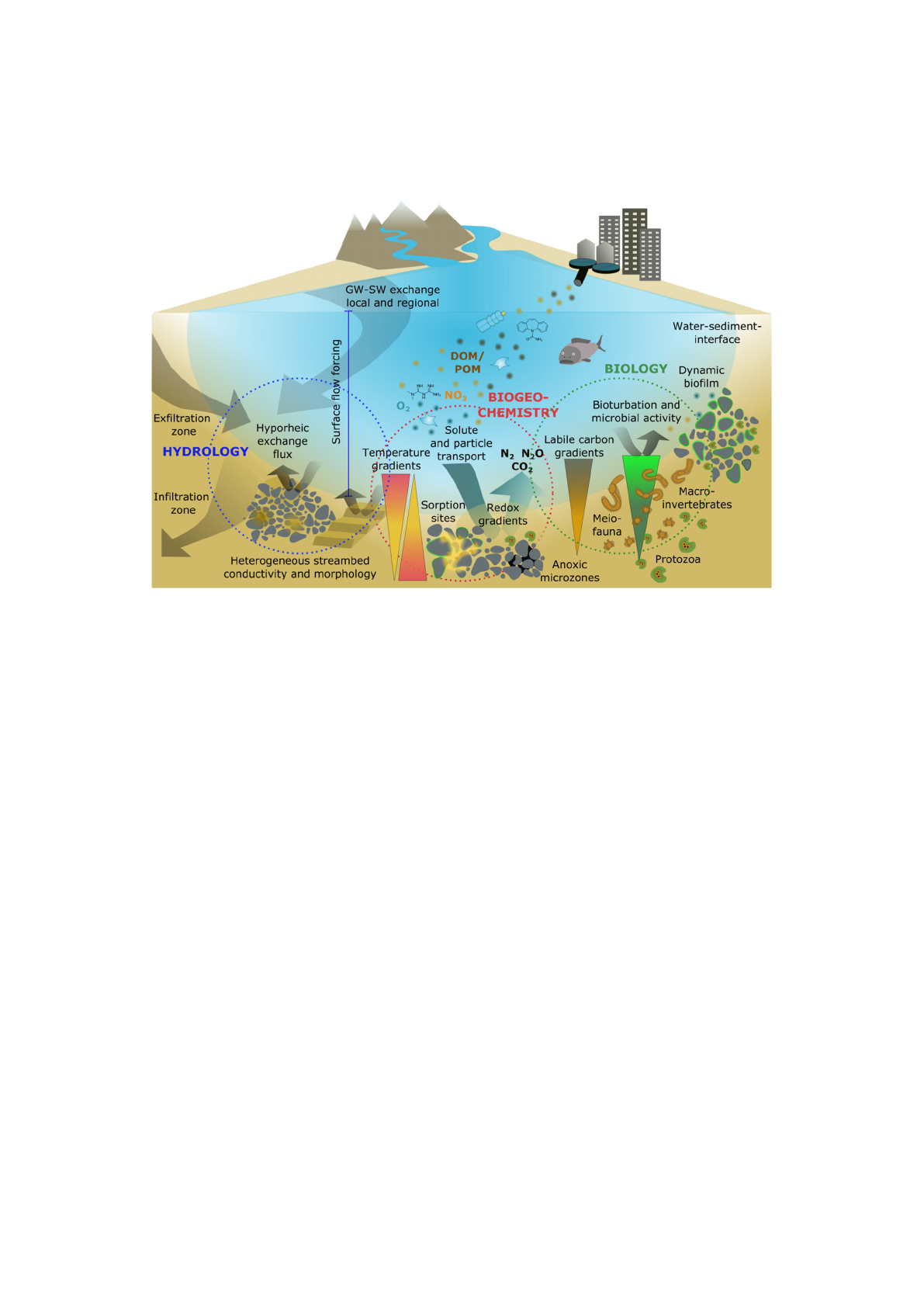
HEFs (Figure 1) are driven by pressure gradients created by local streambed topographic variations
and modulated by subsurface sediment architecture, combined with large-scale geomorphological and
hydrogeological characteristics of the river network and adjacent aquifer systems, which can critically
impact the spatial variability of HEF patterns [
9
,
39
–
41
]. At the scale of the HZ, very small water level
fluctuations drive changes in the hydraulic gradients across streambed bedform structures.
The hydrogeology (i.e., the location, hydraulic conductivity, recharge, and discharge zones of
local to regional aquifers) governs the overall spatio-temporal fluxes of surface water–groundwater
exchange, and therefore the general gaining or losing character of rivers and river sections [
42
]. As
discussed in the introduction, the HZ is the zone where flowpaths originate from and return to surface
water. This zone may be compressed or absent in gaining and losing sections of streams [
8
,
43
], because
gaining and losing flows that do not originate from the stream or terminate in the stream, respectively,
are considered surface water–groundwater exchange flows, but not HEFs. Of course, gain or loss flows
can still be highly relevant from an ecohydrological perspective. The absolute gaining or losing of
water from streams is a dynamic feature which can vary spatially and temporally. The fragmentation
of coherent gaining or losing zones at the streambed interface strongly depends on the regional
groundwater contribution [
41
]. In gaining streams, local regional groundwater systems discharge
groundwater through the HZ into surface waters. This is common in humid climates, where rivers
drain groundwater systems. However, in (semi-)arid climates, losing rivers are predominant (i.e.,
Water 2019,11, 2230 5 of 32
groundwater pressures below streams are often lower than the stream water pressure, resulting in
infiltration of stream water) [44].
Water 2019, 11, 2230 5 of 33
losing rivers are predominant (i.e., groundwater pressures below streams are often lower than the
stream water pressure, resulting in infiltration of stream water) [44].
HEFs can also be induced by hydrodynamic pressure gradients along the stream bed arising
from the flowing surface water [45,46]. On a rugged streambed surface, the surface water flow field
produces a heterogeneous pressure distribution acting on the exchange between surface and
subsurface water. In this setting, the streambed morphology and the overlying flow field control the
spatial patterns of pressure gradients and boundary shear stress along the surface–subsurface water
interface. The pressure distribution on the streambed surface significantly differs between ripples
and dunes. Therefore, determining the stream water level (reflecting the hydrostatic pressure), as
well as the hydrodynamic pressure arising from inertia effects along the streambed surface, is crucial
for HEF investigations.
Figure 1. Conceptual model of the major hyporheic zone drivers and processes, as discussed in
Section 2 of the present review. Dashed circles indicate the separation of disciplines in current
hyporheic research, despite the high system complexity and manifold interconnections of hyporheic
processes. GW-SW exchange is groundwater-surface water exchange; DOM and POM are dissolved
or particulate organic matter, respectively.
At large scales, the stream water surface follows the streambed topography very closely, but as
scales decrease the water surface tends to be smoother in comparison to the bed surface. This
impedes direct use of the streambed topography to estimate the hydrostatic head, especially at small
spatial scales, since very fine topographic features are often not reflected as similar features at the
water surface. Recent investigations have suggested a scale (wavelength)-dependent ratio between
stream water and bed surface fluctuations, thus providing a way to estimate the hydrostatic head
distribution based on the streambed topography [40,41]. Pressure gradients might also be caused by
flow of stream water over and around obstacles in the water body, such as woody debris [47–49].
Hydrodynamic pressure gradients and turbulent momentum transfer into the streambed sediments
can control HEFs that are generally characterized by surficial flowpaths and short residence times. In
particular, hyporheic exchange triggered by turbulent momentum transfer and by shear stresses at
the sediment–water interface can be relevant, especially in the case of permeable sediments with
large grain sizes [50,51]. This is due to the fact that increasing sediment permeability results in
higher HEFs. Moreover, a larger grain size increases shear stress at the water–sediment interface and
turbulence intensity of the boundary layer, which control the HEFs.
Figure 1.
Conceptual model of the major hyporheic zone drivers and processes, as discussed in Section 2
of the present review. Dashed circles indicate the separation of disciplines in current hyporheic research,
despite the high system complexity and manifold interconnections of hyporheic processes. GW-SW
exchange is groundwater-surface water exchange; DOM and POM are dissolved or particulate organic
matter, respectively.
HEFs can also be induced by hydrodynamic pressure gradients along the stream bed arising
from the flowing surface water [
45
,
46
]. On a rugged streambed surface, the surface water flow
field produces a heterogeneous pressure distribution acting on the exchange between surface and
subsurface water. In this setting, the streambed morphology and the overlying flow field control the
spatial patterns of pressure gradients and boundary shear stress along the surface–subsurface water
interface. The pressure distribution on the streambed surface significantly differs between ripples and
dunes. Therefore, determining the stream water level (reflecting the hydrostatic pressure), as well
as the hydrodynamic pressure arising from inertia effects along the streambed surface, is crucial for
HEF investigations.
At large scales, the stream water surface follows the streambed topography very closely, but
as scales decrease the water surface tends to be smoother in comparison to the bed surface. This
impedes direct use of the streambed topography to estimate the hydrostatic head, especially at small
spatial scales, since very fine topographic features are often not reflected as similar features at the
water surface. Recent investigations have suggested a scale (wavelength)-dependent ratio between
stream water and bed surface fluctuations, thus providing a way to estimate the hydrostatic head
distribution based on the streambed topography [
40
,
41
]. Pressure gradients might also be caused
by flow of stream water over and around obstacles in the water body, such as woody debris [
47
–
49
].
Hydrodynamic pressure gradients and turbulent momentum transfer into the streambed sediments
can control HEFs that are generally characterized by surficial flowpaths and short residence times. In
particular, hyporheic exchange triggered by turbulent momentum transfer and by shear stresses at the
sediment–water interface can be relevant, especially in the case of permeable sediments with large
grain sizes [
50
,
51
]. This is due to the fact that increasing sediment permeability results in higher HEFs.
Loading more pages...