
Citation: Todorov, V.T.; Rakov, D.;
Bardenhagen, A. Enhancement
Opportunities for Conceptual Design
in Aerospace Based on the Advanced
Morphological Approach. Aerospace
2022,9, 78. https://doi.org/10.3390/
aerospace9020078
Academic Editors: Spiros Pantelakis,
Andreas Strohmayer and Liberata
Guadagno
Received: 15 December 2021
Accepted: 27 January 2022
Published: 1 February 2022
Publisher’s Note: MDPI stays neutral
with regard to jurisdictional claims in
published maps and institutional affil-
iations.
Copyright: © 2022 by the authors.
Licensee MDPI, Basel, Switzerland.
This article is an open access article
distributed under the terms and
conditions of the Creative Commons
Attribution (CC BY) license (https://
creativecommons.org/licenses/by/
4.0/).
aerospace
Article
Enhancement Opportunities for Conceptual Design in
Aerospace Based on the Advanced Morphological Approach
Vladislav T. Todorov 1,*, Dmitry Rakov 2and Andreas Bardenhagen 1
1
Aircraft Design and Aerostructures, Institute of Aeronautics and Astronautics,
Technische Universität Berlin
,
2Blagonravov Mechanical Engineering Research Institute (IMASH), Russian Academy of Sciences,
*Correspondence: vladislav[email protected]
Abstract:
The current challenges facing the aerospace domain require unconventional solutions,
which could be sought in new configurations of future aircraft and spacecraft. The choice of optimal
concepts requires the consideration of a significant amount of competing engineering solutions
and takes place under conditions of uncertainty. Such a problem can be addressed by enhancing
existing methods for analysis and synthesis solutions, such as the Advanced Morphological Approach
(AMA). It uses morphological analysis to provide a more exhaustive overview of possible problem
solutions, relies on expert evaluations of alternative technological options and applies clustering
to the solution space. Although an intuitive method for structured concept generation, the AMA
exposes the need for more robust problem structuring, improved objectivity of options evaluation
and accounting for uncertainties. The current article suggests ways to overcome these challenges
and their possible integration in the process. In particular, the integration of fuzzy sets is proposed
to model uncertainties during the evaluation of technological options by the experts. The Fuzzy
Analytical Hierarchy Process is adapted for integration into the AMA and for the conceptual design
of aerospace vehicles.
Keywords: conceptual design in aerospace; advanced morphological approach; fuzzy sets
1. Introduction
The most important stage in the design of innovative aircraft systems is the concept
design phase [
1
]. Mistakes at this stage might lead to significant increases in cost and lead
time and could have a fatal impact on the project. The configuration of the aircraft obtained
in the conceptual design stage is numerically simulated and modified in the preliminary
design. In most cases, preliminary design approaches are based on development trends
derived from databases and statistics [
2
]. However, this is not the case when aiming to
develop innovative aircraft configurations, since breakthrough technologies lack experi-
mental and statistical data. The non-metric character of design parameters, as well as the
conflicting criteria, represent further challenges of conceptual design. The target function of
a potential optimization problem could hardly be solved by common theoretical methods
since it is discontinuous; it cannot always be defined; it exists in the operator notation; it is
not based on analytical expressions; it is not differentiable, not unimodal, not separable and
not additive [
3
]. Additionally, the circumstances in the aviation domain put forward the
necessity for a technological breakthrough. The sector is forced to address the demands for
higher efficiency and drastic emission reduction, while no short-term technological answer
is yet in sight [4,5].
Along with heuristic methods, morphological analysis (MA) is used during the con-
ceptual design phase [
2
,
6
]. It allows the generation of a significantly wider space of possible
problem solutions than conventional methods such as brainstorming and helps to avoid the
Aerospace 2022,9, 78. https://doi.org/10.3390/aerospace9020078 https://www.mdpi.com/journal/aerospace
Aerospace 2022,9, 78 2 of 17
aforementioned conceptual design challenges. This is achieved by decomposing the prob-
lem into (sub-)functional and characteristic components (denoted as “attributes”). Each
attribute is assigned to a set of appropriate technological options (denoted in the following
as “options”). The attributes and their corresponding options are organized in a morpho-
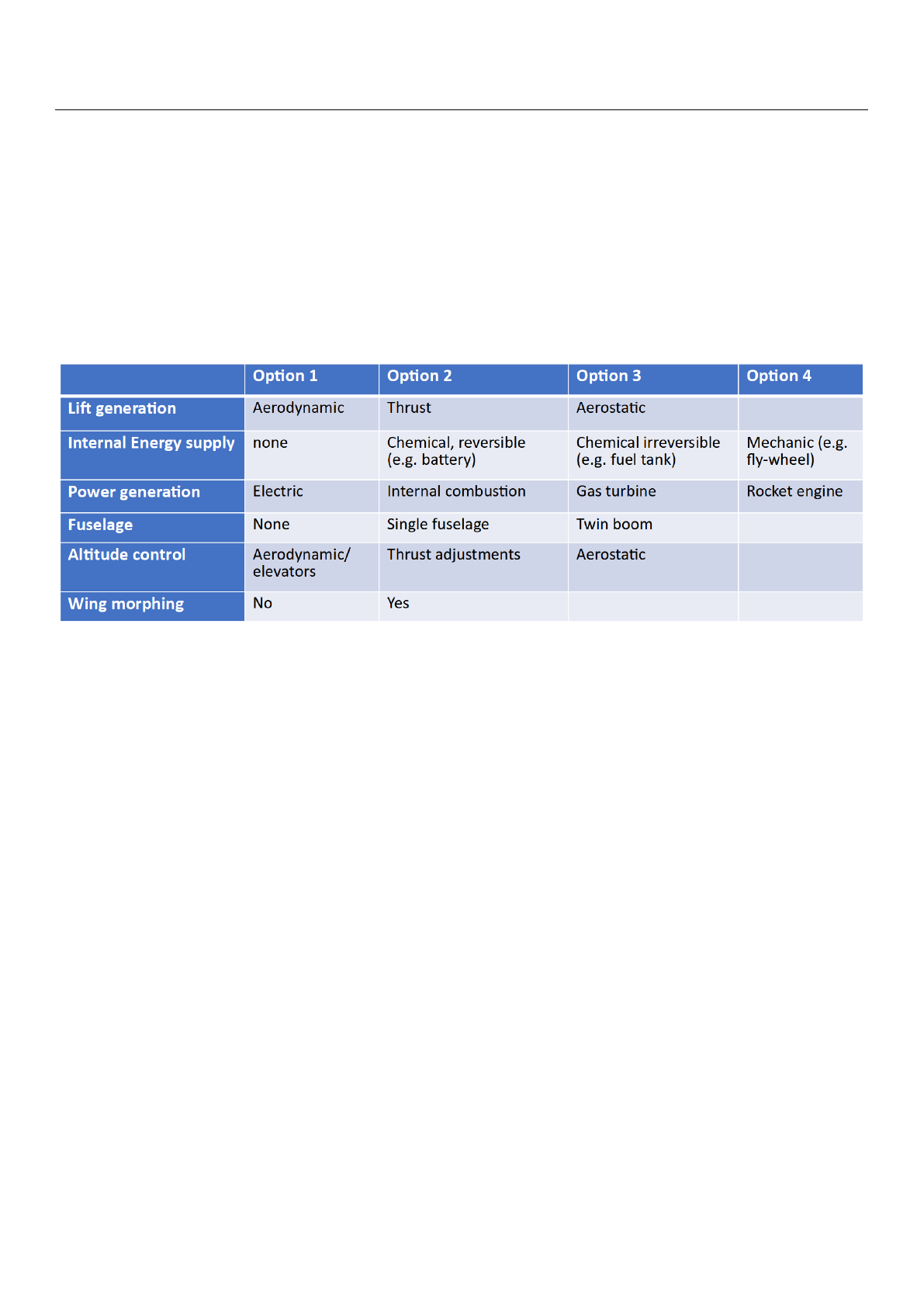
logical matrix (MM). An example MM excerpt for the conceptual design of an unmanned
aerial system is shown in Figure 1. The entity of all possible attribute–option combinations
defines the solution space. The significant amount of synthesized configurations in such a
way increases the possibility to find the optimal solution even for a non-conventional or
demanding problem statement. In such situations, the optimal solutions can be overseen
by conventional idea generation methods.
Figure 1.
An excerpt from the morphological matrix for the structural synthesis of an unmanned
aerial system. Data from ref. [7].
MA has been applied to the conceptual design of aerospace vehicles within the Ad-
vanced Morphological Approach (AMA), developed by Rakov and Bardenhagen [
7
,
8
].
The method extends the classical MA by integrating qualitative expert evaluations of the
options and by offering an intuitive solution space exploration. The AMA steps can be
summarized as follows [
7
–
9
]: (1) problem statement definition; (2) definition of the MM and
a set of evaluation criteria; (3) evaluation of the technological options by domain experts
according to each criterion; (4) inclusion of reference solutions based on existing aerospace
vehicle configurations; (5) definition of impossible combinations of options for different
attributes; (6) generation of the solution space; (7) clustering of the generated solutions
based on the given expert evaluations; (8) visualization and reporting.
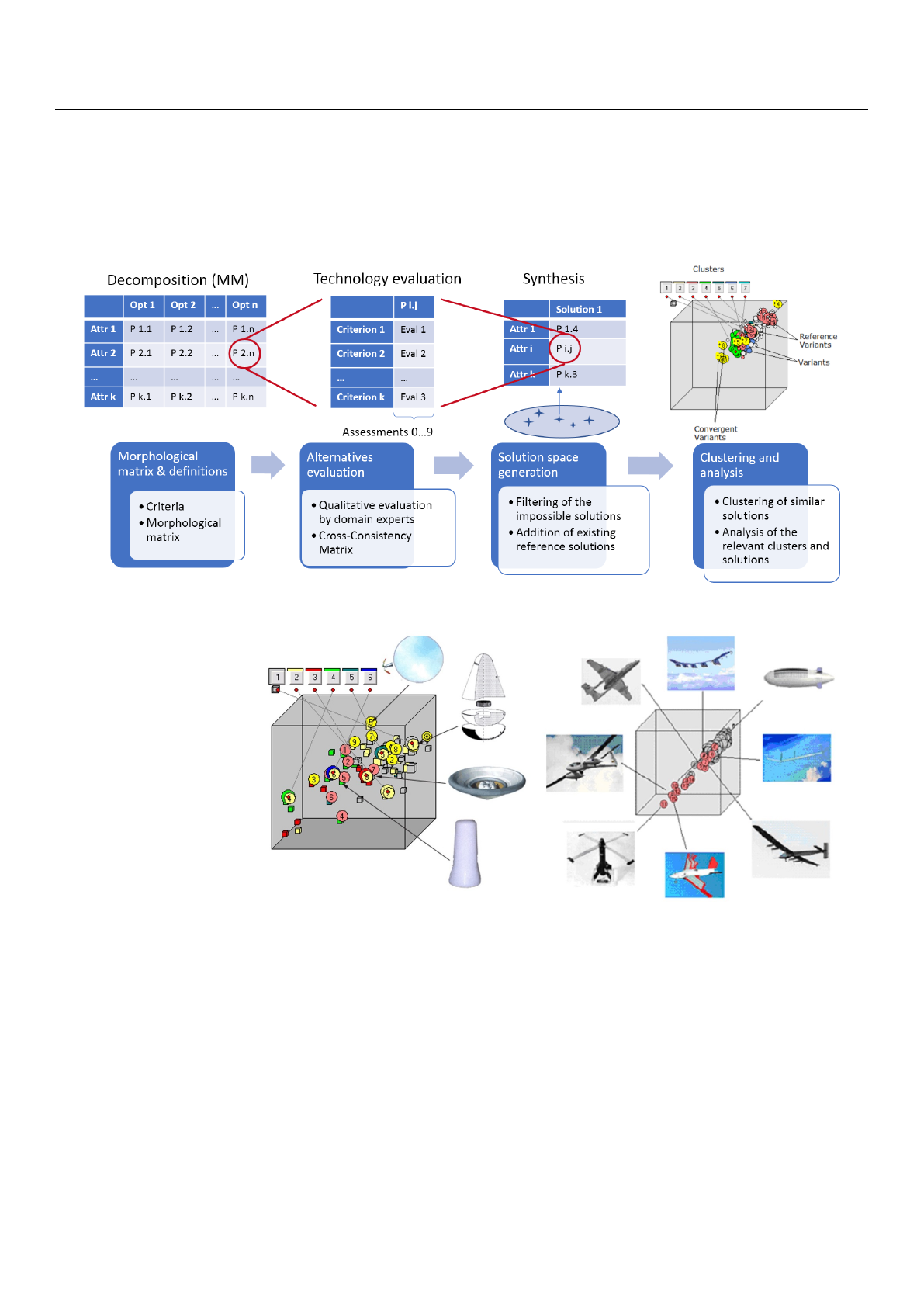
A simplified diagram of the methodology is presented in Figure 2. From the generated
vast solution space in the MM, the method picks a limited amount of superior solutions
based on their criteria evaluations [
7
,
10
]. Hence, the AMA represents a structured way
to intuitively find optimal solutions to a given problem and avoid the aforementioned
challenges of conceptual design. The application of AMA in the aerospace domain has
been demonstrated on the conceptual design of unmanned aerial vehicles [
7
] and orbital
reentry vehicles [11] (Figure 3).
Along with the mentioned benefits, the current AMA comes with a set of challenges
and corresponding improvement possibilities, which have been presented by Todorov et al.
in [
12
]. These are namely (a) uncertainty handling, (b) improved problem structuring and
(c) multidisciplinary expert judgment elicitation.
The issue of dominating uncertainties (a) within AMA is faced during step 3 of
the process: the evaluation of options by domain experts (further referred to as “experts”,
“decision-makers” or DMs). The method requires the DMs to evaluate each option according
to a certain criterion by assigning an integer value from the qualitative scale between 1
(worst) and 9 (best). However, it is not always clear whether the quality of option A is,
for example, “very good” or just “good”. Such hesitation could result in a deviation of
Aerospace 2022,9, 78 3 of 17
several units on the scale from the answer that is “ultimately correct” and thus reduces the
reliability of the final results. This uncertainty could further increase due to the fact that
the evaluation objects are innovative technologies lacking statistical and experimental data.
Although the DMs are domain experts in the best-case scenario, they could naturally also
lack precise knowledge on an untested or non-introduced technology.
Figure 2. An overview of the AMA method. Reprinted from ref. [12].
Figure 3.
Reference solutions in the morphological solution space for the conceptual design tasks for
an orbital reentry vehicle (
left
) and an unmanned aerial vehicle (
right
). Reprinted from refs. [
7
,
11
].
Further inaccuracy in the AMA outcome could result from the lack of consideration of
technological options’ interactions. Along with their separate evaluations mentioned above,
certain technological combinations may additionally increase the overall value of particular
configurations, which should also be reflected in the results. This aspect is acknowledged
and is outlined in the future work recommendations for the improvement of the AMA.
Problem structuring (b) becomes an issue when the product to be designed represents
a complex engineering solution such as an aerospace vehicle. This case requires a more
thorough structural decomposition and the appropriate organization and weighting of
components and criteria. This is necessary to properly reflect the complex functional
division of sub-systems. The selection of appropriate problem structuring also requires
the definition of evaluation aspects such as which evaluation scale to use or whether the
evaluations should be absolute or pairwise comparative. Furthermore, the issue is also
linked to the choice of an uncertainty modeling method.

Aerospace 2022,9, 78 4 of 17
The current article addresses the issues and the improvement possibilities for address-
ing uncertainties (a) and defining a robust problem structuring (b) for the AMA. Section 2
will first handle the classification of uncertainties and outline which uncertainties one faces
during the option evaluations within the AMA. The choice of ordinary or Type 1 fuzzy sets
as an approach for addressing the uncertainties among other possibilities is explained. Af-
ter introducing their general definition, different types of fuzzy sets are briefly summarized.
A way to integrate fuzzy numbers in the AMA is then suggested. Section 3will address the
issue of problem structuring. First, a classification of Multiple-Criteria Decision-Making
methods is presented and the advantages of using Fuzzy Multiple-Attribute Decision-
Making methods for the enhancement of the AMA are justified. Ultimately, an approach is
suggested to incorporate the Fuzzy Analytic Hierarchy Process for the conceptual design
of aerospace vehicles with the AMA.
2. Addressing Uncertainties
The conceptual design of a new aircraft generation is characterized by a significant
amount of unknown information on innovative technologies. At the same time, the deci-
sions made during this design phase also influence the development of the next design
stages [
7
]. For aerospace vehicles, incorrect conceptual decisions can result in project delays
and financial drawbacks. For this reason, situations associated with a significant lack of
data require the anticipation of possible deviations and thus suitable models to describe
uncertainties. This is the case with evaluations of options by expert groups in the AMA.
2.1. Uncertainty Classification
The most used taxonomy to classify uncertainties comes from the field of risk assess-
ment and considers two main types: aleatory and epistemic uncertainty [
13
,
14
]. Aleatory
(also stochastic) uncertainty is defined as the inherent variation of a system or the envi-
ronment. Although well recognizable, it cannot be reduced or avoided. At the same time,
epistemic uncertainty (also cognitive or subjective) results from the inaccurate modeling
of a system or a process due to a lack of knowledge. Increasing the available data or
knowledge on the matter could thus help to reduce epistemic uncertainty.
Worth noting is also the taxonomy suggested by Thunnissen [
14
,
15
], which introduces
further types of uncertainty besides the ones already presented. These are the ambiguity in
terms of imprecision or vagueness, as well as the uncertainty caused by the interaction of
multiple disciplines or events (interaction uncertainty).
When focusing on the design of complex systems such as aerospace vehicles, further
uncertainty classes have been suggested that relate rather to more precise modeling of
system parameters [
14
]. These are the uncertainties coming from inaccurate design prob-
lem formulations, such as due to the operational environment, measurement, as well as
modeling and numerical errors.
However, the conceptual design phase implies the definition of the initial vehicle struc-
ture. This task depends vastly on efficient interdisciplinary communication. The “correct”
decision-making at this early stage requires proper qualitative modeling of technologies
with scarce available knowledge rather than the reduction of measurement or numerical
errors. For this reason, one can outline epistemic uncertainty, ambiguity and disciplinary
interaction as the primary sources of deviations from the optimal conceptual design of
new aerospace vehicle generations. Since the latter two categories involve a lack of knowl-
edge and sub-optimal information exchange, these will be also considered as epistemic
uncertainties in the current article.
This classification helps to identify the types of uncertainties that need to be addressed
or at least acknowledged within the AMA method. Potential sources of uncertainties can
be found in the evaluation of technological options. Particularly, subjective results could be
obtained in the following cases:
1.
When an expert estimates the quality of an option according to a certain criterion.
Subjective assessments can be due to the following drawbacks:
Aerospace 2022,9, 78 5 of 17
-
Epistemic uncertainty—the lack of knowledge on untested or non-introduced
technologies;
-
Cognitive bias—the unconscious heuristics people use to solve uncertain tasks,
which may lead to systematic errors [16].
2.
During group discussions of a certain technology by experts from different expertise
domains (disciplinary interaction).
3.
As a result of aggregation of multiple expert opinions—be it behavioral (group dis-
cussions) or mathematical.
The current article suggests that epistemic uncertainty during option evaluation
could be accounted for by introducing an appropriate modeling approach, which will be
discussed in the following. Handling cognitive bias, disciplinary interaction and assessment
aggregation from multiple experts could be considered as research topics linked to the
development, structuring and conduction of the expert workshops and are not discussed
in the present work.
2.2. Uncertainty Modeling Approaches
The main requirement for the modeling of epistemic uncertainty is the ability to
quantify and map the uncertain areas during decision-making onto an intuitive and robust
process. It is thus necessary to find a proper mathematical and computational representation
of this uncertainty type.
Zang et al. [
17
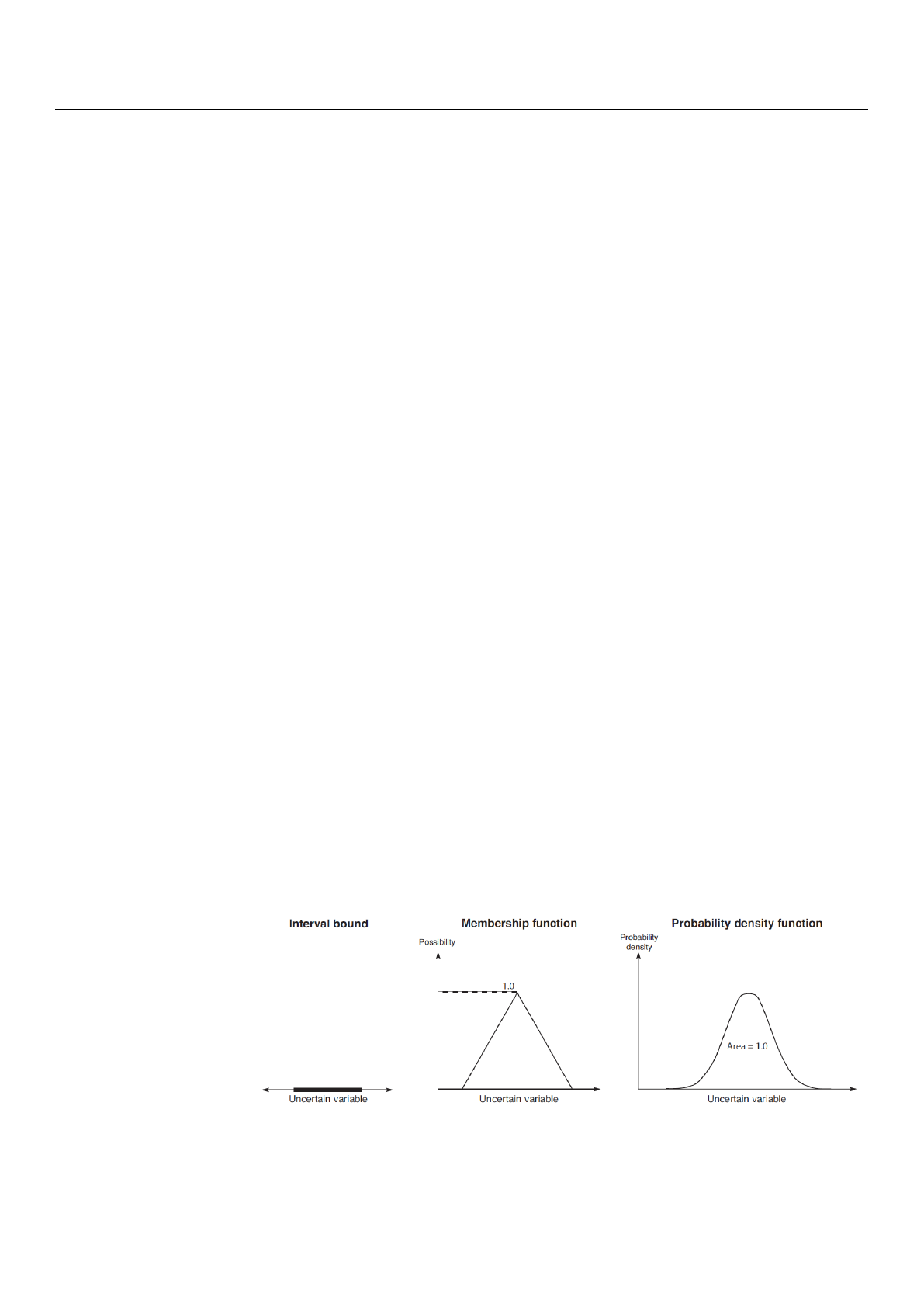
] summarize three ways to represent uncertainties in a computer code
used for modeling and simulation. These are the interval bound, the membership function
and the probability density function (PDF), shown in Figure 4. The methods incorporate dif-
ferent theories to describe uncertainties. Based on the classical probability theory, the PDF
offers uncertainty modeling with the highest detail among the three mentioned options.
However, it hides certain drawbacks when dealing with problem statements lacking sta-
tistical data [
18
]. Firstly, the choice of a suitable probability distribution requires prior
experimental data. Secondly, PDFs aim to “represent one’s degree of belief that a specific
realization of a parametric value, physical process, or event can occur” [
18
] (p. 2). This type
of uncertainty modeling has already been applied in the aerospace domain. The works of
Monroe [
19
] and Unal et al. [
20
] describe an expert judgment elicitation methodology for the
conceptual design of innovative launch vehicles. They use qualitative expert input in order
to quantify the uncertainties through probability distributions. The parameters that were
estimated by the experts referred to deterministic characteristics such as system weight
and cost. Since the technologies used for the design in those works were supposed to be
“extrapolated” from existing systems of that time [
20
], one could assume that the aerospace
experts involved had some initial experience and statistical data on the technologies to
lean on.
Figure 4. Ways to describe uncertainty. Reprinted from ref. [17].
However, the AMA strives not only to include technological options derived from
ones already in operation, but also to consider technologies lacking any prior experimental
data. Therefore, the uncertainties to be modeled are not referred to the concrete estimation
Loading more pages...