
SPECIAL ISSUE ARTICLE
Creative cognition: A multidisciplinary and integrative
framework of creative thinking
Felix Pinkow
Chair of Technology and Innovation
Management, Technische Universität Berlin,
Berlin, Germany
Correspondence
Felix Pinkow, Chair of Technology and
Innovation Management, Technische
Universität Berlin, Straße des 17. Juni
135, 10623 Berlin, Germany.
Email: [email protected]
Extant research provides vast information on antecedents to creativity. However,
creative thinking is oftentimes treated as a black box, requiring input and producing
creative output. Cognitive processes occurring during creative thinking tend to be
neglected, although they can provide a bridge between the inputs to creativity and
the resulting outputs. Literature offers different perspectives on creative thinking
processes, such as the separation of divergent and convergent thinking, different
stages of creativity or the concept of creative cognition. This variety of concepts
underlying creativity has led to confusion and misinterpretations of some concepts.
Moreover, the overemphasis on creative outcomes and divergent thinking has
resulted in a neglect of a more comprehensive view on cognitive dimensions of crea-
tivity. Through reviewing and synthesizing multidisciplinary literature on creativity,
an integrative framework is developed positioning cognitive elements of creativity
within a system including organizational antecedents to creativity and creative out-
comes. The framework seeks to offer pathways to increasingly incorporate the con-
cept of creative cognition into future research. Suggesting different forms of creative
cognition that individuals engage in during creative thought, this theoretical work fur-
ther offers a theoretical development of creativity concepts that intends to inspire
future research designs and facilitates cross-disciplinary knowledge transfer.
KEYWORDS
cognitive processes, conceptual framework, creative cognition, creativity, divergent and
convergent thinking, idea generation, literature review
1|INTRODUCTION
Innovation is considered a cornerstone of a firm's success and compet-
itiveness (Salomo et al., 2007), and as such creativity, a central compo-
nent of innovation, is a fundamental asset for innovation (Amabile &
Pratt, 2016; Anderson et al., 2014; Bergendahl et al., 2015). Research
in innovation management offers a vast amount of studies determining
antecedents to creativity, such as leadership (Caniëls et al., 2014;
Scott & Bruce, 1994), psychological aspects (Amabile, 2017) organiza-
tional resources (Caniëls et al., 2014) or individual creative abilities
(Scott & Bruce, 1994; Tierney & Farmer, 2002). While knowledge
about these factors is central to the ability of organizations to influ-
ence and facilitate employee creativity, there is still a lack of under-
standing of the underlying creative thinking processes. As creative
thinking itself is essentially a cognitive process (Mensel, 2004), ante-
cedents to creativity and cognitive processes underlying creative
thinking form an expedient relationship. A profound understanding on
how cognition relates to creative thinking and its antecedents facili-
tates the decision which actions managers can take to foster creative
thinking and which potential cognitive barriers must be addressed.
Received: 9 November 2021 Revised: 9 December 2022 Accepted: 16 December 2022
DOI: 10.1111/caim.12541
This is an open access article under the terms of the Creative Commons Attribution License, which permits use, distribution and reproduction in any medium,
provided the original work is properly cited.
© 2022 The Author. Creativity and Innovation Management published by John Wiley & Sons Ltd.
472 Creat Innov Manag. 2023;32:472–492.
wileyonlinelibrary.com/journal/caim

However, in particular, organizational research focuses on ante-
cedents to creative performance (Anderson et al., 2014; Caniëls
et al., 2014) and tends to assess creativity ex-post, after ideas have
been generated (e.g. Im et al., 2013; Nakata et al., 2018). Undoubt-
edly, this research approach has proven useful in identifying the cen-
tral factors that shape creativity, in terms of creative outcomes. The
downside of this ex-post approach is that it factors out the creative
process itself, treating creative thinking as a black box that requires
input and produces measurable output. In fact, recent literature high-
lights that the prevalent overemphasis on creative output neglects the
importance of researching the underlying creative processes
(Fortwengel et al., 2017; Sonenshein, 2016).
The complexity of researching creative thinking processes lies not
only in the difficulty to observe what happens in the minds of individ-
uals but also in the multidisciplinary nature of creativity, resulting in a
plethora of different conceptualizations. Organizational research on
creativity tends to offer a procedural perspective by distinguishing cre-
ative stages or phases (e.g. the dynamic componential model of creativ-
ity of Amabile & Pratt, 2016). This perspective assigns a series of
distinct but interrelated goals to creativity, such as perceiving, observ-
ing and identifying a problem, developing solutions or generating and
evaluating ideas. Research in cognitive psychology offers several per-
spectives on creativity. For one, it offers insight into cognitive thinking
processes relevant to creativity, whereby two widely distributed proto-
typical forms of creative thought have emerged that are divergent and
convergent thinking (Benedek & Fink, 2019; Guilford, 1967). Alterna-
tively, cognitive psychology also offers the concept of creative cogni-
tion, which refers to the cognitive processes individuals engage in
during creative thought (Benedek & Fink, 2019; Ward, 2007;Ward
et al., 1995). In particular, there are different forms of creative cogni-
tion, such as recombining existing knowledge or expanding existing
knowledge through novel insight (Ward, 2007;Wardetal.,1995).
Research on creativity across all disciplines experienced signifi-
cant growth, and regardless of the particular discipline, their common
object of interest is creativity. Yet, studies on creativity tend to remain
within their respective discipline and focus, for instance, on either
organizational characteristics that are relevant to creativity or on cog-
nitive dimensions of creativity. For example, Hughes et al. (2018) find
an overemphasis on motivational processes in organizational research
in the context of how leadership can influence creativity, while cogni-
tive aspects remain understudied. In contrast, research focusing on
cognitive processes offers insight into how creative outcomes are
achieved but often lacks the ability to relate cognitive processes to an
organizational context (e.g. Hagtvedt et al., 2019; Reiter-Palmon &
Murugavel, 2018). In attempts to explain creative thinking processes,
creativity has been increasingly viewed through a cognitive lens in
management research. This has, however, led to conceptual misunder-
standings. In particular, the importance of the role of divergent think-
ing for creativity is argued to be unrealistically inflated (Runco, 2015).
But even more problematic are misunderstandings in adopting the
concept of divergent thinking in management research. The concept
of divergent thinking became so widespread that it even has been
treated synonymously to creativity (Piffer, 2012; Runco, 2012). On
the one hand, from a theoretical perspective, this false understanding
makes it difficult to compare studies on creativity that are not fully
transparent on how creativity is conceptualized. One the other hand,
this misunderstanding is even more concerning from a managerial per-
spective. As studies that misunderstand concepts of creative thinking
derive managerial implications based on false premises with respect
to the underlying theoretical concepts, the derived managerial advice
may not hold true in practice or may even mislead practitioners into
applying wrong measures to stimulate creativity.
Thus, this work seeks to clarify the conceptual underpinnings of
creativity from a managerial perspective and outline the relationships
between creative process models from organizational research and
concepts from cognitive psychology on creative thinking processes.
On the basis of the integration of cross-disciplinary creativity con-
cepts, a conceptually refined framework of creative thinking is sug-
gested that connects central organizational aspects, such as
leadership as antecedent to creativity, with cognitive dimensions of
creativity. This conceptual cross-disciplinary integration can facilitate
knowledge transfer among creativity researchers and disciplines and
offers guidance for understanding the various terms and concepts
that are increasingly used in organizational research on creativity.
From a theoretical perspective, the envisaged integrative frame-
work conceptually bridges research on antecedents to creativity and
creative output by positioning a cognitive layer between input to crea-
tivity and creative output. Through a comprehensive review of litera-
ture, this work not only serves as an overview on recent developments
in creativity research but also seeks to identify relationships and inter-
dependencies across research disciplines. The framework thereby sets
stage for future research to discuss empirical evidence on creativity
from a multidisciplinary perspective and to position future studies
accordingly in the framework. This work thus offers a route to more
fine-grained analyses by taking relationships between cognitive aspects
of creative thinking and organizational factors into consideration.
From a managerial perspective, there is a large pool of underuti-
lized knowledge stemming from research in cognitive psychology that
is relevant to organizations and practitioners. Creating awareness con-
cerning which antecedents and intended outcomes of creativity relate
to creative cognitive processes supports a more deliberate decision-
making on actions that seek to improve creative performance of
employees. An understanding of different creative cognitive pro-
cesses, how individuals engage in certain cognitive processes and
which potential cognitive barriers can emerge allows to stimulate cre-
ative thinking more effectively and to address certain cognitive bar-
riers purposefully. Likewise, individuals engaging in creative thinking
can equally benefit from knowledge concerning creative cognition, as
the awareness of factors determining creativity on the cognitive level
can be utilized to improve one's own creative performance.
2|CREATIVITY AND COGNITION
The definition that widely finds acceptance in both innovation and
creativity literature is understanding creativity as the production of
PINKOW 473

new and useful ideas (Amabile et al., 1996; Amabile & Pratt, 2016;
Anderson et al., 2014; Baron, 2007; Oldham & Cummings, 1996). This
definition comprises two distinct criteria—to be considered creative,
an idea must be new or original and be useful. While the originality of
an idea is undoubtedly required, the second criterion, the usefulness
of an idea, is often disputed (Runco & Jaeger, 2012). Runco and Jaeger
(2012) argue that originality or novelty alone is not sufficient for crea-
tivity but emphasize that creative ideas must also be effective or use-
ful. Unique or uncommon ideas can be original but not creative given
a lack of usefulness. Therefore, the understanding of creativity boils
down to the assessment whether an original idea is useful and thus
potentially creative, or not useful, and thus merely original.
Yet, a vast amount of research on creativity focuses on idea gen-
eration (Anderson et al., 2014), emphasizing the production of ‘the
new’. Although considered a central phase of creativity, idea genera-
tion requires a goal, such as a problem to be solved or an opportunity
to be addressed. In fact, ideation does not only require the discovery
of a problem or opportunity, but the problem or opportunity must also
be clearly identified and defined to prepare for the subsequent gener-
ation of ideas and solutions (Runco & Chand, 1995). In other words,
as Ward (2004, p. 176) states, a fundamental obstacle to generate
novelty is the ‘truism that one cannot produce something from
nothing—ex nihilo nihil fit’. Hence, generating novelty requires knowl-
edge about a problem or opportunity to be addressed. This kind of
knowledge is described as declarative knowledge, referring to factual
information (Runco & Chand, 1995). However, the ability to think cre-
atively requires more than mere declarative knowledge. It also
requires the knowledge about how to engage in creative thinking,
which is described as procedural knowledge, or in other words ‘know-
how’(Runco & Chand, 1995).
Knowledge, both declarative and procedural, is hence a funda-
mental asset for creativity, and can be both facilitative and inhibitive
(Runco & Chand, 1995). As creative thinking happens in the minds of
individuals, it is considered a cognitive process (Cropley &
Cropley, 2008; Mensel, 2004), that is, enabled through knowledge
(Runco & Chand, 1995). Knowledge is a broad concept comprising
various elements but at its core is information. Davenport and Pru-
sak (2000, p. 4) define knowledge as ‘a fluid mix of framed experience,
values, contextual information, and expert insight that provides a
framework for evaluating and incorporating new experiences and
information.’Considering this link between knowledge and informa-
tion, cognition essentially is inseparable from knowledge, and so is
creativity. Taking a broader perspective, cognition refers to how indi-
viduals process, obtain, organize and store information
(Cropley, 1999). The definition of cognition from the APA Dictionary
of Psychology (n.d.) highlights the intertwined nature of cognition and
creativity, stating that cognitions refers to ‘all forms of knowing and
awareness, such as perceiving, conceiving, remembering, reasoning,
judging, imagining and problem solving.’This definition encompasses
the very process of creativity—imagining, conceiving and problem-
solving through perceiving a problem that requires a solution. Creative
cognition hence refers to the cognitive processing of information with
the goal to achieve creative outcomes. Runco and Chand (1995)
acknowledge that cognitive research on creativity can be rather non-
obvious, since the underlying cognitive processes of creativity are
only recognized if one is explicitly interested in understanding creativ-
ity. However, identifying these processes enhances our understanding
of creative thinking itself and thus caters the purpose of refining rec-
ommendations to practitioners how to effectively foster creativity.
2.1 |The relationship between divergent and
convergent thinking processes and creativity
In order to determine cognitive processes of creativity, it is pertinent
to consider that creative thinking is not a unitary construct. The emer-
gence of two separate, central concepts of creative thinking is
ascribed to the works of Guilford (1967,1970). Guilford (1967,1970)
states that the most relevant abilities for creativity can be separated
into divergent and convergent thinking. Divergent thinking is under-
stood as a broad way of thinking, including the ability to make unusual
associations, and to produce a variety of original ideas through uncon-
ventional and flexible thinking (Cropley, 2006; Palmiero et al., 2020;
Runco & Acar, 2012). Convergent thinking is referring to analytical,
logical thinking processes, concerned with the production of one or
few correct ideas instead of a broad variety (Cropley, 2006; Runco &
Acar, 2012). This rather intuitive separation of creative thought into
divergent and convergent thinking has also been increasingly adopted
in management literature. The shortcoming of these two fundamental
concepts is their broad definition (Ward, 2007), which does not offer
sufficient insight into how individuals eventually achieve creative out-
comes. They merely describe characteristics of different thinking pro-
cesses but not the actual cognitive processes individuals engage in
during creative thought (Ward, 2007). Although creativity researchers
acknowledge that divergent and convergent thinking processes are
both necessary for creativity (Brophy, 1998; Runco & Acar, 2012),
there is still ambiguity on how these thinking processes are related to
the superordinate act of creative thinking, how they interact and how
to position them within the system that surrounds creative thinking.
It is particularly problematic that literature oftentimes remains
vague with the understanding of what is considered an ‘idea’or a
‘creative idea’in this context. Regularly, divergent and convergent
thinking are linked to specific outcomes from creative processes, in
terms of final ideas such as solutions to a problem or the identification
of a problem or opportunity to be addressed. Gielnik et al. (2014), for
instance, state that identifying business opportunities is rather related
to divergent than to convergent thinking. In fact, either divergent or
convergent thinking processes may be dominant during creative
thinking (Goldschmidt, 2016), such as in the creative process of identi-
fying a business opportunity. However, neglecting either divergent or
convergent thinking completely implicitly considers them as mutually
exclusive. It relates to an understanding of divergent or convergent
thinking processes to provide a final idea and relates one thinking pro-
cess immediately to an outcome. This factors out all potential other
processes that may occur between an initial input, such as an initial
perception, a glimpse of what could be a business opportunity, and
474 PINKOW

the output, the identification and description of a concrete business
opportunity. A final outcome is, in most cases, not the result of a sin-
gle thought. As Cropley (2006) states, there might be rare instances of
‘lucky hits’that may turn out as novel and useful ideas, but in a nor-
mal course of events, it is rather unlikely that a single divergent
thought results in a creative idea. Instead, viewing final ideas as a con-
struct of accumulated multiple individual thoughts offers a more logi-
cal and integrative understanding of creativity. Goldschmidt (2016)
offers sound support for this perspective on divergent and convergent
thinking processes. Building on literature arguing that creativity is
facilitated by shifting and iterating between divergent and convergent
thinking (e.g. Basadur et al., 1990; Gabora, 2010); Goldschmidt (2016)
reports in her study that the shifts are so frequent that they can be
considered as concurrent processes and that only their interplay
results in creative outcomes.
Returning to Gielnik et al.'s (2014) example, convergent thoughts
can therefore equally contribute to the very identification of a busi-
ness opportunity. Logically recombining existing knowledge, which
refers to converging multiple pieces of already existing information
into a new piece of information, can, for instance, result in a novel
opportunity but is rather to be characterized as a convergent process.
Alternatively, identifying a glimpse of an opportunity in a different
and distant knowledge domain may result from a divergent thought,
but analysing and logically interpreting this initial perception and
applying it to a task at hand is not a strict divergent process anymore.
This logical, analytical process of matching an analogy with familiar
knowledge can be referred to as a convergent process. The subse-
quent cognitive processing to understand the opportunity, to deter-
mine unique aspects and promising avenues resulting from the
opportunity for the own organization, can again well be subject to
divergent processes. Yet, it is only the interplay of single convergent
and divergent thinking processes, or in other words individual
thoughts, that ultimately result in a final, holistic and comprehensible
definition and description of the initial thought, the perceived busi-
ness opportunity.
In fact, we do not know how individuals achieve ideas and solu-
tions without analysing their brain activities or explicitly asking them.
As Ward (2007) describes along the example of the commonly used
alternative use task to assess an individual's divergent thinking ability,
individuals may use a broad variety of different forms of creative cog-
nition to generate ideas. Prompting individuals to generate as many
different uses for a shoe as possible, individuals may use their past
experiences, may remember that a shoe has laces which can serve
alternative purposes or may interpret the shoe as a container through
abstraction (Ward, 2007). What is apparent from these examples,
however, is that Ward (2007) implicitly relates all exemplary
approaches to generate ideas in relation to existing declarative knowl-
edge. In his examples, all forms of creative cognition require the
knowledge of a shoe, that is, knowing how it looks like or being aware
of its features. Taking a more general perspective, Welling (2007)
argues that even the generation of fundamentally new ideas is built
on top of existing knowledge. Hence, matching any novel thoughts
with existing knowledge is a precursor to creative ideas. Thus, it does
not only require the mere identification of novel information but also
requires the convergence of novelty with familiar knowledge and
therefore, again, the interplay of divergent and convergent thoughts.
This consideration links to what Toubia and Netzer (2017) call the
‘beauty of averageness’in the context of creative idea generation and
evaluation. Building on a theoretical proposal by Ward (1995), Toubia
and Netzer (2017) find that ideas that achieve a balance of novelty
and familiarity are ultimately judged as more creative.
Conflating these considerations to the initial argument that there
is often a lack of a clear understanding on what is considered an idea,
it is argued that ideas are the accumulation of individual thinking pro-
cesses or, as such, individual thoughts. Individual thoughts in the con-
text of creativity, in turn, are cognitive processes that aim at
evaluating, perceiving, judging or interpreting novel or existing infor-
mation against the backdrop of further existing knowledge. These
individual thoughts can be either subject to divergent or convergent
thinking processes, and their interplay can result in what is considered
a‘creative idea’. The understanding of divergent and convergent
thinking processes as individual thoughts, constituting the yardstick
for how to relate divergent and convergent thinking processes to cre-
ativity, also offers a complementary perspective to traditional stage
models of creativity.
1
The difference to established stages of creativ-
ity is the unit of time. Individual thoughts can take place for seconds
or at maximum minutes. Creative stages can take place for days,
weeks or even months and include a plethora of individual thoughts.
Typical stages of creative thinking that are prevalent in organiza-
tional research, for instance, include problem recognition or opportu-
nity identification, problem definition and research, idea generation
2
and idea evaluation and selection (Amabile & Pratt, 2016;
Lubart, 2001). It is noteworthy that these stages form an idealized
process (Amabile & Pratt, 2016) and do not necessarily constitute a
fixed sequence (Lubart, 2001). These stages are also found in litera-
ture on design thinking. Design thinking is a method concerned with
promoting creativity (Mahmoud-Jouini et al., 2019), and hence, com-
parisons can be drawn to creative thinking processes. Conceptually,
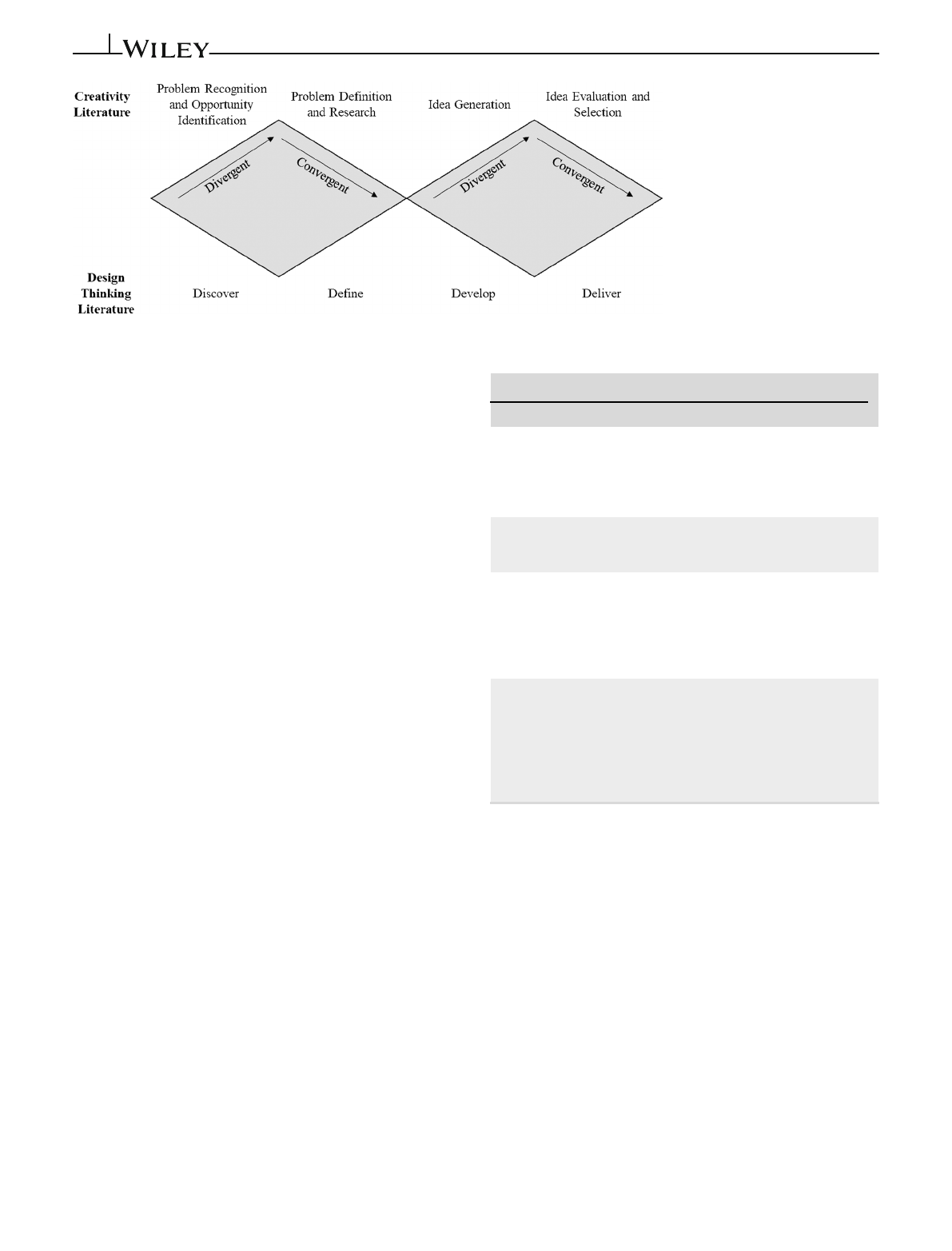
design thinking is separated into several stages. The double diamond
model, which is rooted in design thinking, suggests four stages, start-
ing with discovery, followed by definition, development and delivery
(Discover—Define—Develop—Deliver) (Ferreira et al., 2015). These
four stages resemble the four stages of creativity similarly prevalent in
creativity and innovation management literature. In addition, the dou-
ble diamond model further enhances these four stages (Ferreira
et al., 2015; Tschimmel, 2012). The model illustrates creativity as iter-
ating divergent and convergent stages, whereby the discovery and
development stage constitute divergent stages, and the definition and
delivery phase constitute convergent stages (Ferreira et al., 2015;
Tschimmel, 2012).
The stages of creative thinking resembling literature on creativity
and design thinking are illustrated in Figure 1. The problem with this
illustration is, again, that divergent or convergent stages are seemingly
linked to specific outcomes, such as recognizing a problem or generat-
ing ideas or solutions for a given problem or opportunity. As delin-
eated above, divergent and convergent thinking may characterize
PINKOW 475
individual thoughts, but they should not be considered general
approaches to think creatively. Individuals do not engage in divergent
or convergent thinking as distinct means for creative thinking, but
individuals engage in more general forms of creative thinking. These
forms comprise a range of different thinking processes that can be
characterized as more divergent or convergent, whereby one can be
dominant (in line with Goldschmidt, 2016), yet not exclusive to a cer-
tain stage. Moreover, design research has emphasized that in practice,
design processes rarely follow the seemingly prescribed fixed
sequences of creativity methods and that the design process is more
erratic (Howard et al., 2008). It has further been shown that individ-
uals engage in different strategies to approach a problem when given
a similar design task requiring creativity (Dorst & Cross, 2001). Hence,
to enhance knowledge on creativity, it is vital to understand the vari-
ety of approaches how individuals eventually engage in creative think-
ing. Applying a cognitive lens and connecting it to organizational
research can thereby offer a window on how processes such as diver-
gent and convergent thinking are embedded in more general creative
approaches. This conceptual integration thereby also corresponds to
calls emerging from design studies to increasingly adopt a multidisci-
plinary approach to creativity research (Howard et al., 2007).
2.2 |Forms of creative cognition
Instead of considering divergent or convergent thinking processes as
self-reliant and individual approaches to creativity, it is reasonable to
think in terms of specific forms of creative cognition that comprise
both divergent and convergent processes. This understanding is rather
in line with creativity researchers who consider divergent and conver-
gent thinking as predictors for actual creativity but not as synonyms
(Runco & Acar, 2012). Skills in divergent and convergent thinking
enable individuals to engage in creative thinking. Extant literature pro-
vides reasonable evidence for four such distinct forms of creative cog-
nition along a continuum determined by the share of existing or novel
information being processed. In a literature review, Welling (2007)
synthesizes creativity theories and empirical evidence and suggests
that the central four forms of creative cognition that emerged are the
application of existing knowledge, drawing an analogy from one
knowledge domain to another, the combination of two or more
concepts into one new idea and lastly the abstraction of knowledge
intended to create fundamentally new knowledge. In a further study,
through a grounded theory approach, Lassig (2013) similarly finds that
individuals engage in creative thinking through four separate ways,
which he labels adaptation, transfer, synthesis, and genesis. Illustrated
and described in Table 1, both studies have come up with four compa-
rable forms of creative cognition, one through reviewing theory and
extant literature (Welling, 2007), and one provides evidence that
these forms are grounded in empirical data (Lassig, 2013).
Notably, these forms of creative cognition are independent of a
specific goal, as any can be used to identify a problem or opportu-
nity, to gather information that is required to define a problem or to
generate ideas. Hence, these forms do not contradict extant stage
models of creativity as outlined in Figure 1but illustrate how indi-
viduals engage in creative thought that can be utilized in any crea-
tive stage.
FIGURE 1 Idealized creative
thinking process
TABLE 1 Four forms of creative cognition
Forms of creative cognition
Lassig (2013) Welling (2007)
Adaptation: Adapting existing
ideas within a particular
domain through modifying,
varying, manipulating or
rearranging existing work.
Application: Adaptive use of
existing knowledge, adaption of
existing conceptual structures.
Transfer: Transferring ideas
from one task or domain to
another.
Analogy: Transportation of a
conceptual structure from one
context to another context.
Synthesis: Combining two or
more existing ideas, either
from the same or a different
domain, whereby the
combination results in
novelty.
Combination: Merging of two or
more concepts into one new
idea, which requires creation of
new conceptual structures.
Genesis: Aggregating ideas and
experiences to create
outcomes that are
significantly different from
existing work, whereby no
clear source or origin of ideas
can be identified.
Abstraction: New, abstract
knowledge is built on top of
existing knowledge, including
discovery of new information.
476 PINKOW
Loading more pages...