Protocol
Protocol for gene characterization in
Aspergillus niger using 5S rRNA-CRISPR-Cas9-
mediated Tet-on inducible promoter
exchange
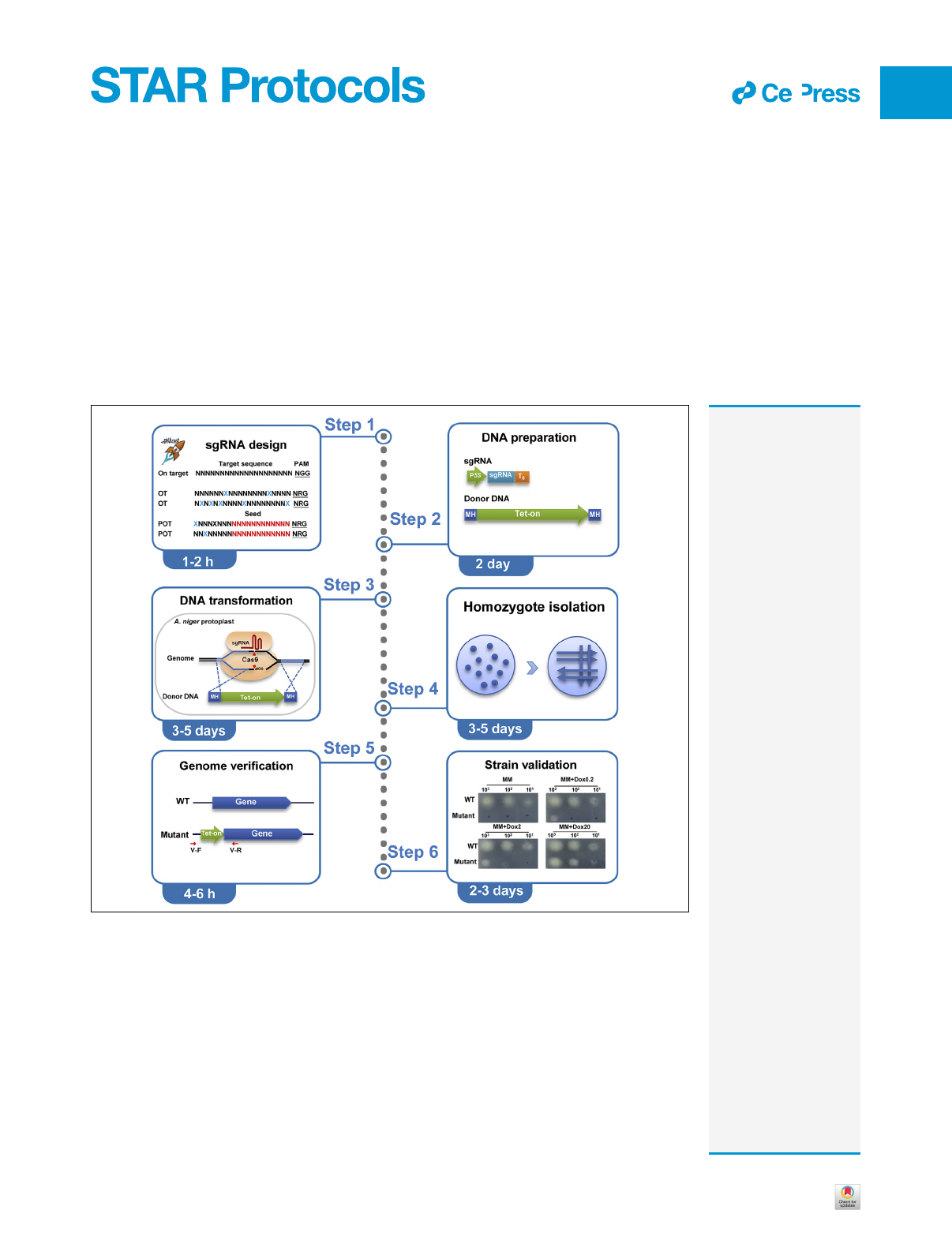
This protocol presents an efficient genetic strategy to investigate gene function in the fungus
Aspergillus niger. We combined 5S rRNA-CRISPR-Cas9 technology with Tet-on gene switch to
generate conditional-expression mutants via precisely replacing native promoter with inducible
promoter. We describe the design and DNA preparation for sgRNAs and donor DNA. We then
detail the steps for DNA co-transformation into A. niger protoplasts by PEG-mediated
transformation, followed by homozygote isolation. Finally, we describe the genome verification
and strain validation of the isolates.
Publisher’s note: Undertaking any experimental protocol requires adherence to local institutional
guidelines for laboratory safety and ethics.
Xiaomei Zheng,
Timothy Cairns, Ping
Zheng, Vera Meyer,
Jibin Sun
(X.Z.)
[email protected] (P.Z.)
[email protected] (J.S.)
Highlights
Protocol for highly
efficient 5S rRNA-
CRISPR-Cas9
genome editing in A.
niger
Gene
characterization via
promoter exchange
of Tet-on switch in
filamentous fungi
Detailed description
of DNA co-
transformation by
PEG-mediated
protoplast
transformation
Zheng et al., STAR Protocols 3,
101838
December 16, 2022 ª2022
The Author(s).
https://doi.org/10.1016/
j.xpro.2022.101838
ll
OPEN ACCESS

Protocol
Protocol for gene characterization in Aspergillus niger
using 5S rRNA-CRISPR-Cas9-mediated Tet-on inducible
promoter exchange
Xiaomei Zheng,
1,2,3,4,6,
*Timothy Cairns,
1,2,5
Ping Zheng,
1,2,3,4,7,
*Vera Meyer,
5
and Jibin Sun
1,2,3,4,
*
1
Tianjin Institute of Industrial Biotechnology, Chinese Academy of Sciences, Tianjin 300308, China
2
Key Laboratory of Systems Microbial Biotechnology, Chinese Academy of Sciences, Tianjin 300308, China
3
University of Chinese Academy of Sciences, Beijing 100049, China
4
National Technology Innovation Center of Synthetic Biology, Tianjin 300308, China
5
Chair of Applied and Molecular Microbiology, Institute of Biotechnology, Technische Universita
¨t Berlin, 10263 Berlin,
Germany
6
Technical contact
7
Lead contact
https://doi.org/10.1016/j.xpro.2022.101838
SUMMARY
This protocol presents an efficient genetic strategy to investigate gene function
in the fungus Aspergillus niger. We combined 5S rRNA-CRISPR-Cas9 technology
with Tet-on gene switch to generate conditional-expression mutants via pre-
cisely replacing native promoter with inducible promoter. We describe the
design and DNA preparation for sgRNAs and donor DNA. We then detail the
steps for DNA co-transformation into A. niger protoplasts by PEG-mediated
transformation, followed by homozygote isolation. Finally, we describe the
genome verification and strain validation of the isolates.
For complete details on the use and execution of this protocol, please refer to
Zheng et al. (2019).
1
BEFORE YOU BEGIN
Filamentous fungi are of great economic importance as cell factories in the biotechnology industry,
especially for bulk manufacturing of high-value products.
2–4
Owing to its high production capacity,
secretion efficiency, and robust growth, Aspergillus niger has been widely exploited as workhorses
for producing organic acids, proteins, and enzymes.
2,5
In spite of its industrial importance, due to its
low frequency of homologous recombination, highly efficient genetic tools are limited, hampering
the fundamental study of A. niger.
6
New genetic manipulation strategies that enable to characterize
genes will contribute to key gene target discovery and validation for strain improvement of this vital
fungal cell factory.
Herein, this protocol describes a detailed workflow to study the function of genes of interest by re-
placing its native promoter with the Tet-on inducible promoter
7,8
using the 5S rRNA-CRISPR/Cas9
technology.
1
This strategy enables investigation of various phenotypes of conditional expression
mutants caused by addition of the metabolite-independent inducer doxycycline (Dox). Briefly, we
provide detailed instructions for sgRNAs and donor DNA design, co-transformation of sgRNA
and donor DNA with a Cas9 encoding plasmid, to result in the desired Tet-on system exchange
at the DNA double-strand break caused by Cas9 protein. Owing to the tight regulation of Tet-on
switch by doxycycline, this technique is beneficial for gain-of-function and loss-of-function analysis
STAR Protocols 3, 101838, December 16, 2022 ª2022 The Author(s).
This is an open access article under the CC BY-NC-ND license (http://creativecommons.org/licenses/by-nc-nd/4.0/). 1
ll
OPEN ACCESS
using a single isolate, which obviated experimentally costly generation of multiple mutant strains in
A. niger.
With this strategy, we have successfully generated several mutants of gene involved in the cell
morphology, protein secretion, and citric acid production.
9–13
sgRNACas9 software environment setting
Timing: 0.5–1 h
1. Manually download and install Java (also known as Java Runtime Environment or JRE) from the
website: http://www.java.com/en/.
2. Manually download and install Perl from the website: https://www.perl.org/get.html.
3. Manually download and install the latest version of the sgRNACas9 software
14
(sgRNAcas9_3.0.5)
from website: http://www.biootools.com/software.html.
Plasmid preparation
Timing: 1–2 h
4. Inoculate E. coli Trans-T1 strains containing psgRNA6.0
1
and pTC1.13
10
plasmids in LB liquid me-
dia with 100 mg/mL Ampicillin and incubate at 37C and 220 rpm for 16–20 h.
5. Extract the plasmid with a Miniprep kit (TIANGEN BIOTECH., Cat#DP103) according to the man-
ufacturer’s handbook (TIANprep Mini Plasmid Kit_Plasmid DNA & DNA Clean Up_Product_TIAN-
GEN).
6. Quantify plasmid concentration with the NanoDrop.
7. Store the plasmids at 20C.
Media and solution preparation
Timing: 4–6 h
8. Prepare the LB agar plates
15
and LB liquid media
16
containing 100 mg/mL Ampicillin for E. coli
using standard lab recipes (Cold Spring Harbor Protocols, 2009).
9. Prepare the CM liquid media, CM plates, MM plates and MMSN plates for A. niger using standard
lab recipes.
17
When necessary, add 150 mg/mL of hygromycin B for the selection marker hygrom-
ycin B phosphotransferase (hph).
KEY RESOURCES TABLE
REAGENT or RESOURCE SOURCE IDENTIFIER
Bacterial and virus strains
E. coli Trans-T1 TransGen Biotech Cat#CD501-02
Chemicals, peptides, and recombinant proteins
Ampicillin Sigma-Aldrich Cat#A9393
Hygromycin B Sigma-Aldrich Cat#V900372
Doxycycline Sigma-Aldrich Cat#D3072
Yeast extract powder Formedium Cat#YEA02
Agar Formedium Cat#AGR10
Tryptone Thermo Fisher Scientific Cat#211705
Casamino Acids Thermo Fisher Scientific Cat#223050
NaCl Sigma-Aldrich Cat#S9888
(Continued on next page)
ll
OPEN ACCESS
2STAR Protocols 3, 101838, December 16, 2022
Protocol
Continued
REAGENT or RESOURCE SOURCE IDENTIFIER
CaCl
2
Sigma-Aldrich Cat#C4901
MES Sigma-Aldrich Cat#M3671
Tris-HCl Sigma-Aldrich Cat#648313
PEG-6000 Sigma-Aldrich Cat#528877
Sucrose Sigma-Aldrich Cat#V900116
NaNO
3
Sigma-Aldrich Cat#S5506
KH
2
PO
4
Sigma-Aldrich Cat#P0662
KCl Sigma-Aldrich Cat#P3911
MgSO
4
7H
2
O Sigma-Aldrich Cat#230391
ZnSO
4
$7H
2
O Sigma-Aldrich Cat#Z0251
MnCl
2
$4H
2
O Sigma-Aldrich Cat#M3634
CoCl
2
$6H
2
O Sigma-Aldrich Cat#C8661
CuSO
4
$5H
2
O Sigma-Aldrich Cat#C8027
Na
2
MoO
4
$2H
2
O Sigma-Aldrich Cat#M1003
Uridine Sigma-Aldrich Cat#U3003
Sobitol Sigma-Aldrich Cat#PHR1006
Ethylenedinitrilotetraacetic acid (EDTA) Sigma-Aldrich Cat#M6758
Lysing Enzyme Sigma-Aldrich Cat#L1412
Critical commercial assays
TIANprep Mini Plasmid Kit TIANGEN BIOTECH Cat#DP103
TIANquick Mini Purification Kit TIANGEN BIOTECH Cat#DP203
Genomic DNA extract kit TIANGEN BIOTECH Cat#DP305
T4 DNA Ligase Reaction Buffer New England Biolabs Cat#B0202S
T4 DNA Ligase New England Biolabs Cat#M0318S
BbsI New England Biolabs Cat#R0535S
FastPfu Fly PCR SuperMix TransGen Biotech Cat#AS231-01
Experimental models: Organisms/strains
Aspergillus niger: Strain background: D353 Shanghai Industrial
Microbiology Institute Tech. Co.
SIMI: M203
Oligonucleotides
sgRNA-pyrG-F Zhang et al.
11
caccGAGTAGTTCGAAGTTTCGAC
sgRNA-pyrG-R Zhang et al.
11
aaacGTCGAAACTTCGAACTACTC
MHi-sgRNA-pyrG-F Zhang et al.
11
gtatccgcgcacgtctctggatttacgaatcag
ggtccaGACGTTAACTGATATTGAAG
MHi-sgRNA-pyrG-R Zhang et al.
11
ggcacgggcagtgtaggtcaatcgcgacttg
gaggacatGGTGTTTAAACGGTGATGTC
pyrG-g-F Zhang et al.
11
CATGTGCAGCAGGGAATACGAG
pyrG-g-R2 Zhang et al.
11
GAGCCTTAAGTCCCTCAATGGTC
M13F Zhang et al.
11
TGTAAAACGACGGCCAGT
M13R Zhang et al.
11
CAGGAAACAGCTATGACC
Recombinant DNA*
psgRNA6.0 Zheng et al.
1
N/A
psgRNA6.15 Zhang et al.
11
N/A
pCas9-hph Zhang et al.
11
N/A
pTC1.13 Cairns et al.
10
N/A
Software and algorithms
sgRNACas9 Xie et al.
14
http://www.biootools.com
FungiDB Stajich et al.
18
https://fungidb.org
Java Java Software Foundation http://www.java.com
Perl Perl Software Foundation https://www.perl.org
Other
NanoDrop 2000 Spectrophotometer Thermo Scientific Cat#ND-2000
Thermal Cycler Bio-Rad Cat#186-1096
Miracloth Calbiochem Cat#475855
*All the recombinant plasmids are available on request.
ll
OPEN ACCESS
STAR Protocols 3, 101838, December 16, 2022 3
Protocol
MATERIALS AND EQUIPMENT
LB liquid medium
Reagent Final concentration Amount
Yeast extract 0.5% (w/v) 5 g
Tryptone 1% (w/v) 10 g
NaCl 1% (w/v) 10 g
ddH
2
O N/A to 1 L
Autoclave at 121C for 20 min and add supplements afterward before use
100 mg/mL ampicillin 100 mg/mL 1 mL
Store at room temperature (RT, 25C). Stable for one month.
LB agar plate
Reagent Final concentration Amount
Yeast extract 0.5% (w/v) 5 g
Tryptone 1% (w/v) 10 g
NaCl 1% (w/v) 10 g
Agar 1.2% 12 g
ddH
2
O N/A to 1 L
Autoclave at 121C for 20 min
and add supplements afterward before use
100 mg/mL ampicillin 100 mg/mL 1 mL
Store at RT (25C). Stable for one month.
SMC buffer
Reagent Final concentration Amount
Sorbitol 1.33 M 242.32 g
CaCl
2
(5 M) 50 mM 10 mL
MES buffer (200 mM, pH5.8) 20 mM 100 mL
ddH
2
O N/A to 1 L
Filter-sterilize. Store at 4C. Stable for three months.
TC buffer
Reagent Final concentration Amount
Sorbitol 1.33 M 242.32 g
CaCl
2
(5 M) 50 mM 10 mL
Tris-HCl buffer (1 M, pH7.5) 10 mM 10 mL
ddH
2
O N/A to 1 L
Filter-sterilize. Store at 4C. Stable for three months.
STC buffer
Reagent Final concentration Amount
Sorbitol 1.33 M 242.32 g
CaCl
2
(5 M) 50 mM 10 mL
Tris-HCl buffer (1 M, pH7.5) 10 mM 10 mL
ddH
2
O N/A to 1 L
Filter-sterilize. Store at 4C. Stable for three months.
ll
OPEN ACCESS
4STAR Protocols 3, 101838, December 16, 2022
Protocol
Loading more pages...