
Frontiers in Psychology | www.frontiersin.org 1 February 2022 | Volume 13 | Article 775165
ORIGINAL RESEARCH
published: 17 February 2022
doi: 10.3389/fpsyg.2022.775165
Edited by:
Jing Yu,
Southwest University, China
Reviewed by:
Vanessa R. Simmering,
University of Kansas, UnitedStates
Xiaoru Wanyan,
Beihang University, China
*Correspondence:
Rebecca Wiczorek
Specialty section:
This article was submitted to
Psychology of Aging,
a section of the journal
Frontiers in Psychology
Received: 13 September 2021
Accepted: 21 January 2022
Published: 17 February 2022
Citation:
Wiczorek R and Protzak J (2022) The
Impact of Visual and Cognitive Dual-
Task Demands on Traffic Perception
During Road Crossing of Older and
Younger Pedestrians.
Front. Psychol. 13:775165.
doi: 10.3389/fpsyg.2022.775165
The Impact of Visual and Cognitive
Dual-Task Demands on Traffic
Perception During Road Crossing of
Older and Younger Pedestrians
RebeccaWiczorek * and JannaProtzak
Department of Psychology and Ergonomics, Junior Research Group FANS, Technische Universität Berlin, Berlin, Germany
With the help of the current experiment, wewanted to learn more about the impact of
visually demanding vs. cognitively demanding secondary tasks on the attention allocation
of older pedestrians during the phase of traffic perception within the process of road
crossing. For this purpose, weused two different road crossing tasks as well as two
different secondary tasks. The road crossing “stop task” was a signal detection task,
where an approaching car had to bedetected. The road crossing “go task” was a dynamic
visual search task, where the resolution of a busy road situation had to beidentified. The
visual secondary task was a static visual search task and the cognitive secondary task
was a 1-back (memory) task. One younger group (≤ 30 years) and one older group (≥
65 years) of participants completed the tasks as single vs. dual-tasks in all possible
combinations. Performance was measured through errors and response time; in addition,
the subjective workload was assessed via NASA-TLX. Analyses show that the visual
secondary task reduces performance in the road crossing more strongly than the cognitive
task, while the visual task itself is less impaired by the road crossing tasks than is the
cognitive task. Overall, performance diminishes from single to dual-task completion.
Results further indicate age effects in terms of increased errors and response time for
older compared to younger participants. In addition to these age effects, age-specific
dual-task effects emerge for response time in the go task along with the visual task as
well as for response time in the cognitive task along with the go task. Subjective workload
is higher in the dual-task conditions than in the single tasks. Findings are discussed with
regard to theoretical and practical implications.
Keywords: older pedestrians, road crossing behavior, dual-task, traffic perception, visual attention
INTRODUCTION
Walking supports both physical and psychological health (Cirkel and Juchelka, 2007). Therefore,
it is a key factor for self-determent living and social participation (Limbourg and Matern,
2009; Hefter and Götz, 2013). Its relevance increases with older age, as more and more
everyday tasks, such as shopping for groceries or visiting the doctor, are carried out on foot

Wiczorek and Protzak Elderly Dual-Tasking in Road Crossing
Frontiers in Psychology | www.frontiersin.org 2 February 2022 | Volume 13 | Article 775165
(Follmer et al., 2010). In the meantime, the use of other
transportation methods, such as car, bicycle, or public
transportation, diminishes (Follmer etal., 2010). However, with
increasing age, the risk of also getting injured as pedestrians
in a car accident increases (Rytz, 2006).
Age-related declines of sensory, cognitive, and motoric
functions are the underlying reasons for many of these accidents
(cf. Oxley etal., 2004). However, it is not the decline of abilities
per se that causes the crashes. It is rather an interplay of
certain elements of the complex task of road crossing with
specific impairments of older people. According to Older and
Grayson (1974), the process of road crossing can be divided
into five phases. The existing broad body of research regarding
older pedestrians has not focused on all of these phases with
the same intensity yet. Only a few studies exist regarding phase
one “selection of crossing location” (i.e., Holland and Hill,
2007; Bernhoft and Carstensen, 2008) and phase two “traffic
perception” (i.e., Snowden and Kavanagh, 2006; Tapiro et al.,
2016; Stafford et al., 2019). Most of the studies regard a
combination of phase three and four “traffic analysis” and
“crossing-decision” (i.e., Oxley et al., 1997; Holland and Hill,
2010; Dommes and Cavallo, 2011; Lobjois et al., 2013; Naser
et al., 2017) or focus on phase five “actual crossing” (i.e.,
Carmeli et al., 2000; Oxley et al., 2005; Bollard and Fleming,
2013; Dommes etal., 2014; Butler etal., 2016; Geraghty etal.,
2016; Duim et al., 2017). For an overview, see the systematic
review of Wilmut and Purcell (2021).
However, police statistics of Berlin indicate that the most
prevalent (~60%) pedestrian-related reason for older pedestrians
becoming the victim of a car accident is the lack of attention
toward the ongoing traffic (Statistisches Amt Berlin Brandenburg,
2020). Thus, the intention of the current research was to focus
on phase two “traffic perception” investigating why older
pedestrians do not look for cars sufficiently when crossing a road.
Older Pedestrians Lack of Attention
Toward Traffic
With the help of an earlier observation study and a group
discussion, wecould identify potential reasons why older pedestrians
sometimes overlook upcoming cars (Wiczorek et al., 2016). One
important reason seems to be the engagement in concurrent
visual tasks, namely, scanning the ground for obstacles. To further
analyze this finding in a next step, a photo-based questionnaire
was given to a group of younger and a group of older pedestrians.
They were shown different crossing scenarios at various streets
and were then asked about their behavior with regard to scanning
the ground in case of uneven floors and high curb stones. The
results of this quantitative method confirmed findings from the
qualitative group discussion and the observation study. Older
people indicated significantly more often to check the floor for
obstacles compared to younger pedestrians (Wiczorek etal., 2016).
This finding based on self-reports is in line with findings of
an observation study by Avineri et al. (2012). They found a
positive correlation between checking the ground and established
fear of falling, which is more pronounced in older than younger
people (Tinetti et al., 1994; Schott, 2008). It is further in line
with a laboratory experiment using head tracking by Zito et al.
(2015). They compared head and eye movements of younger
and older people in a virtual reality road crossing scenario. Even
though there were no obstacles on the floor, older people looked
down at their feet (instead of looking at the street) significantly
more often than younger. Additionally, Tapiro etal. (2016) found
older participants to focus longer on the planned walking path
(instead of on the traffic) compared to younger participants.
After identifying this behavior as being typical for older
pedestrians, we wanted to investigate its potential impact on
road crossing performance within a laboratory experiment.
Thus, the current study investigates the impact of a visual
secondary task on visual attention in two different road crossing
scenarios with older and younger people. The visual secondary
task was additionally contrasted to a cognitive secondary task,
which was integrated in this experiment to learn more about
the specific resources requested by different road crossing tasks.
Before we go into detail, we would like to give an overview
about the state of the art in dual-task research regarding older
pedestrians’ performance in road traffic.
Dual-Task Research Regarding Older
Pedestrians in Road Traffic
The impact of dual-task requirements on road crossing of older
pedestrians has not been studied excessively, but there are
some interesting studies thus far. Neider etal. (2011) compared
older people (between 59 and 81 years) with college students,
while crossing a road in a pedestrian simulator on a treadmill,
varying dual-task requirements. They either crossed the street
without an additional task, with the task of listening to music,
or with the task of talking at the phone to a real person
asking questions. Furthermore, gap lengths between cars served
as an additional factor. When gaps were small, road crossing
performance of older people decreased when parallel talking
on the phone. All the other conditions did not reveal dual-
task costs. However, a similar study conducted only with
younger subjects could show a negative effect of listing to
music while crossing a road (Schwebel etal., 2012). This might
have been the case as there was auditory traffic information,
which was not present in the study of Neider et al. (2011).
Nagamatsu et al. (2011) used the same paradigm and task
as Neider et al. (2011) and divided their group of older
participants (above the age of 65) into two groups based on
their scores in a risk of falling questionnaire. While both
groups’ crossing showed decreased performance in the
dual-task with the phone call, the group with higher fall risk
performed significantly worse than the one with the lower risk.
Butler et al. (2016) investigated older people’s (aged between
70 and 90 years) road crossing performance with and without
an additional task on a simulated road using a mock-up car
made from Styrofoam and aluminum. The additional task consisted
of putting balls of one color from a jar with balls of two different
colors in another jar. When facing the additional task, they
turned their back toward the street. Instructions regarding road
crossing were to cross as close in front of the car as possible
while still being safe. In the single-task conditions, all the subjects

Wiczorek and Protzak Elderly Dual-Tasking in Road Crossing
Frontiers in Psychology | www.frontiersin.org 3 February 2022 | Volume 13 | Article 775165
crossed the street safely. When being engaged in the additional
task, 24% of the subjects started their crossing significantly later
than in the single-task condition and had either to interrupt
their attempt or got hit by the car. Further perceptual, physical,
and cognitive tests indicated a positive relation of these functions
with the presented road crossing performance.
Dommes (2019) compared the behavior of younger participants
in street-crossing dual-task situations in a pedestrian simulator
with the performance of younger-old participants (between 60
and 72 years old) and older-old participants (between 73 and
82 years old). The single task of crossing the street without
traffic was compared to two different dual-task crossing situations.
One was crossing the street with a signal-reaction task (visual
and auditory), and the other one was crossing the street with
traffic. All groups walked faster in the single-task condition
compared to the dual-task conditions. However, while the younger
group walked identically slow in both dual-task conditions, the
older groups walked faster in the crossing with traffic condition
than in the crossing with signal-reaction task condition. As
they prioritized fast walking over scanning for traffic, they were
hit by cars significantly more often than younger participants.
The studies described here investigated the impact of different
secondary tasks on traffic analysis, crossing decision and actual
crossing (road crossing phase three to five, Older and Grayson,
1974), while the current study focusses on phase two “traffic
perception.” They all found certain reductions of older pedestrians’
road crossing performance in different dual-task situations.
However, there are some differences regarding interference of
different combinations of secondary and road crossing tasks. For
example, Schwebel et al. (2012) and Neider et al. (2011) had
different results regarding the interference of road crossing with
the secondary task of “listening to music.” According to their
plausible interpretation, this was due to the different nature of
road crossing task that either involved or did not involve auditory
information. While findings generally point in the same direction,
it is not possible to explain why certain secondary tasks interfere
with certain road crossing tasks based on recent findings. On
reason is the use of close to naturalistic secondary tasks that
makes understanding of required resources difficult. The other
reason is that most studies keep the road crossing task constant
and only vary the secondary tasks. Thus, the impact of differences
in road crossing tasks on the interference cannot be assessed.
Current Study
Within the current study, we aim to learn more about the
nature of different road crossing task demands to understand
why they interfere (stronger) with different secondary tasks.
For this purpose, wedesigned two different road crossing tasks
as well as two different secondary tasks. The road crossing
tasks were kept as realistic as possible, while the secondary
tasks were rather artificial to increase internal validity regarding
the required resources.
According to the Multiple Resource Model (MRM; Wickens,
2002), tasks incorporate three stages: perception, cognition, and
response. Perception can use two different modalities (visual and
auditory), and response can use two different modalities (manual
and verbal). Two tasks interfere with each other when requiring
the same resource and when the overall sum of required resource
exceeds the available amount. Dual-task costs manifest in reduced
performance as a result of parallel completion and can befound
in one or in both tasks (i.e., Norman and Bobrow, 1975). A
special type of this cost is the age-specific dual-task cost, where
the increase in cost from single to dual-task is more pronounced
in older than in younger subjects (i.e., Riby et al., 2004).
The two road crossing tasks resemble different everyday tasks.
The one task consists of seeing a car and indicating to stop
walking (stop task). The other one consists in understanding
that a busy traffic situation has resolved and indicating to initiate
walking (go task). Both tasks require mainly visual perceptual
resources but involve of course cognitive resources for the decision
making. The stop task can be characterized as signal detection
task, which requires very little capacity of the working memory.
The go task instead resembles a dynamic visual search task.
With several cars involved it requires more capacity of the
working memory as well as the ability for inhibition, that is
often impaired in older age (i.e., Tipper, 1991). As we want to
focus on phase two “traffic perception” (cf. Older and Grayson,
1974), we reduced the motoric demands of the tasks to a
minimum. Instead of initiating a whole body movement,
participants have to indicate their decision in the road crossing
task by pulling or pushing a joystick. Reduction of physical
requirements is important as we know form dual-task basic
research that older people tend to give priority to motoric tasks
over cognitive tasks (posture first effect, Schäfer, 2014).
The secondary tasks were designed in order to create
interference with the different stages (perception and cognition)
of the road crossing tasks. The original study further included
a motoric other task. Due to the very different nature of task
and corresponding hypothesis, we published the results of the
respective analyses elsewhere (Protzak and Wiczorek, 2017;
Siegmann et al., 2017). The one secondary task (visual task)
demands resources mainly in the stage of perception. It is a
visual search task that requires enhanced visual attention. The
other secondary task (cognitive task) demands resources mainly
in the stage of cognition. It is a 1-back memory task that is
given auditory and requires no visual perceptual resources.
The two secondary tasks include no manual action. Instead,
wechose the verbal response modality for both secondary tasks.
Table 1 compares the modalities and required amounts of
resources of the road crossing and the secondary tasks. Tasks
should interfere when using the same modality and when the
required amount of resource per stage exceeds the available amount.
We do not frame the experiment with different priorities
for the two tasks. Instead, participants are told that both tasks
are equally important. This instruction is given to create a
competitive situation between the two tasks that resemble
reality. Prioritization of tasks is part of the dual-task requirements
and allows us to investigate whether the different combinations
of road crossing tasks and secondary tasks trigger different
behavioral strategies.
Within the current study, we want to investigate if and
how different secondary tasks interfere with the phase of “traffic
perception” in two different road crossing tasks. We expect
the visual task to interfere more with the road crossing tasks

Wiczorek and Protzak Elderly Dual-Tasking in Road Crossing
Frontiers in Psychology | www.frontiersin.org 4 February 2022 | Volume 13 | Article 775165
than the cognitive task. Furthermore, weexpect an age-specific
dual-task effect. Performance decrements from single to dual-
task conditions should be greater for older compared to
younger participants.
MATERIALS AND METHODS
“Ethik-Kommission des Instituts für Psychologie und
Arbeitswissenschaft (IPA) der TU Berlin” approved the study
under the name: “Laborstudie zum Verhalten im Straßenverkehr”
(serial numbers SIE_01_20160329). All procedures were
performed in accordance with the Declaration of Helsinki, in
compliance with relevant laws and institutional guidelines.
Written informed consent was obtained from each participant
and privacy rights were observed.
Participants
Thirty-eight participants were recruited for the study. Half of
them was labeled “younger,” and ranged from age 18 to 30
(M = 25.58; SD = 3.56), six of them were male, 13 were female.
The other group of participants was labeled “older,” and ranged
from age 67 to 82 (M = 71.16; SD = 3.73), six of them were
male, 13 were female. All participants completed a test of
visual ability (younger: M = 99%; SD = 22%; older: M = 63%;
SD = 15%) and the Montreal Cognitive Assessment (MoCA,
Nasreddine etal., 2005; younger: M = 27.53; SD = 1.92; M = 25.84;
SD = 2.77). All participants of both groups stated to walk on
a regular basis. The younger participants were recruited from
the participants data base of the “Institute of Psychology” of
the “Technische Universität Berlin” that contains mainly students,
while the older participants were recruited from a participants
data base of the research group “FANS” of the “Technische
Universität Berlin” that contains people with an age between
60 and 90 years. Younger and older subjects received a
participation compensation of 10€ and 12€ per hour, respectively.
Task Environment and Apparatus
The experiment took place in the pedestrian simulation laboratory
of the FANS research group at the Technische Universität
Berlin. Participants wore a headset and were standing at a
standing desk equipped with a joystick. In front of them was
a 1.5× 5 m (high × wide) projection of a street environment
(3,810 × 1,080 pixel), displayed by two projectors (Acer S1283
HNE). Videos of street scenes for the road crossing tasks were
built with the open-source software Blender. Road crossing
and other tasks were presented using the python-based open-
source software package PsychoPy (Peirce, 2007).
The two road crossing tasks consist of short videos of
street scenes. In total, wehave six different street scenes, three
for each road crossing task. The stimuli are crossing cars,
while some of the videos also contain distractors in the shape
of e-bikes driving in the opposite sidewalk. In each experimental
block, participants conduct either the stop task or the go task.
A block consists of 15 videos à 20s, five videos of each street
scene. While the order of streets is counterbalanced, the five
street scenes of the same street are always presented in a row
to make prediction of events more difficult.
In the road crossing stop task, participants see an empty
road. At a non-predictable moment, a car crosses the street
from the left or from the right side. Participants’ task is to
pull the joystick when they see a car, indicating they would
stop. They are instructed to respond as fast and as correct as
possible. Non-responding to a car is counted as an error as
well as pulling the joystick in the absence of a car (for example,
as a reaction to an e-bike). The stop task is a signal detection
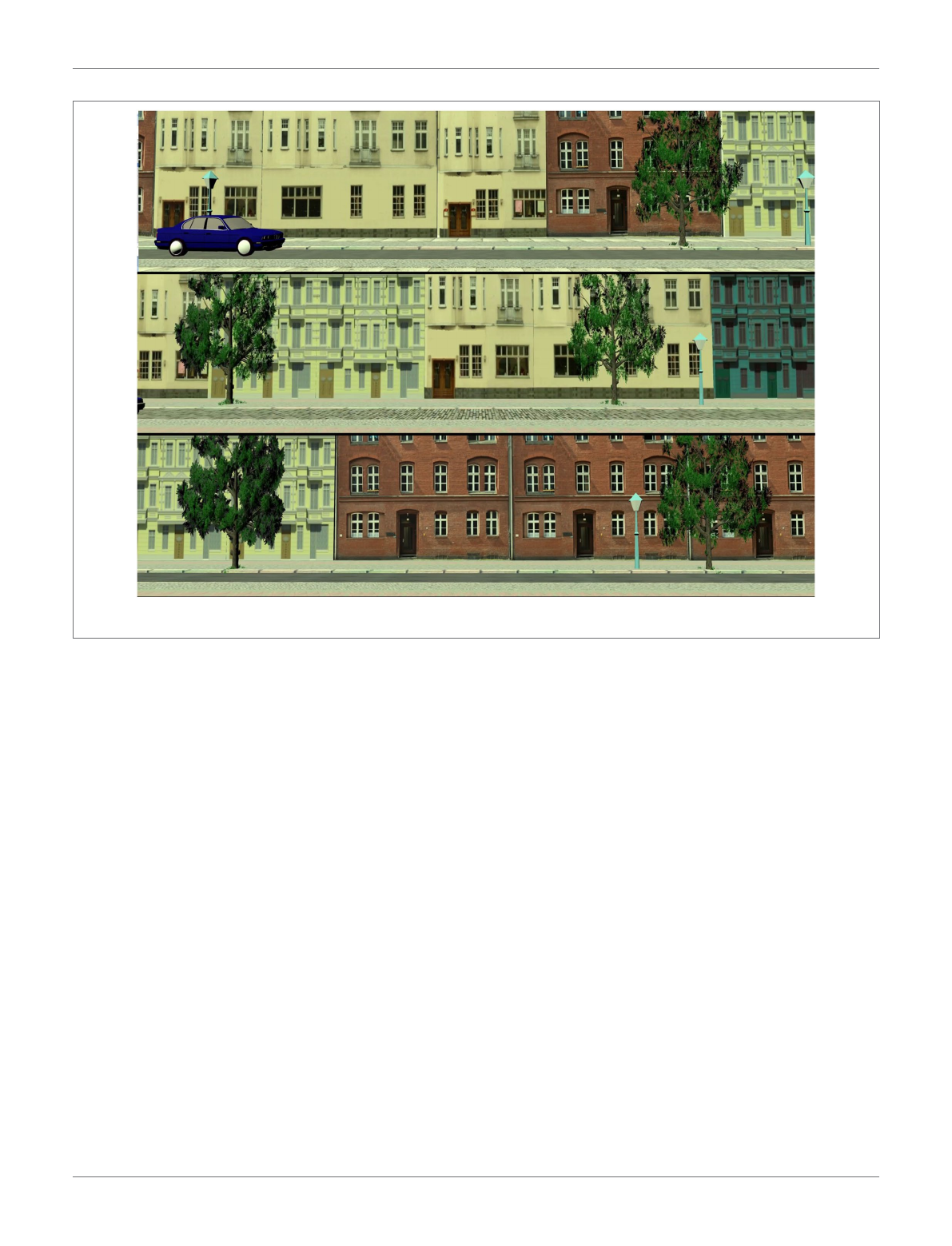
task. Figure1 shows the three street scenarios of the stop task.
In the road crossing go task, participants see a busy road
with cars crossing form the left and the right side. At a
non-predictable moment, no new cars appear and the road turns
empty (and stays empty for the rest of the scene). Participants’
task is to push the joystick, indicating they would “go,” i.e., start
crossing the street. They are instructed to respond as fast and
correct as possible. Non-responding is counted as an error as
well as responding to early (i.e., before the street is finally empty).
This task is similar to often used gap selection tasks (e.g.,
Oxley et al., 2005). However, there are important differences
with regard to the underlying abilities required for the task. The
main focus of a gap acceptance task is to decide whether an
approaching car is far enough away and slow enough to allow
a crossing. Thus, this task challenges the ability to correctly judge
speed and distance, and, to integrate these two pieces of information
to make a decision. Instead, the main focus of the present go
task is to quickly notice when a busy situation is resolving.
Hence, the required ability is the inhibition of distractors, which
is often found to be diminished in older people (i.e., Tipper,
1991). Therefore, the go task is a sort of dynamic visual search
task. Figure 2 shows the three street scenarios of the go task.
The visual secondary task is displayed in the upper middle
part of the scene. It consists of a 5×6 matrix of white squares
on black ground (or vice versa, color type is alternating to indicate
changes of stimuli). Squares are open at one of the four sides.
Each matrix either contains one or zero squares that are open
at the top side. Participants respond “yes” (for matrices with
squares that are open at the top) or “no” (for matrices with no
such square) via headphone and a new matrix appear. They are
instructed to respond as fast and as correct as possible. Errors
are either saying “yes” in the absence of a top-open square or
saying no, when one was present. This task is a static visual
search task. Figure3 shows the visual task along with the stop task.
TABLE1 | Modalities and amount of required resources for the road crossing
and the secondary tasks.
Task Perception stage Cognition stage Response stage
Stop task High visual
requirement
Low cognitive
requirement
Low motor
requirement
Go task High visual
requirement
Medium cognitive
requirement
Low motor
requirement
Visual task High visual
requirement
Low cognitive
requirement
Low verbal
requirement
Cognitive task Medium auditory
requirement
High cognitive
requirement
Low verbal
requirement
Colors indicate modalities and color intensity indicates amount of required resource
(Stronger) interference is expected for same colors with medium to high intensities.
Wiczorek and Protzak Elderly Dual-Tasking in Road Crossing
Frontiers in Psychology | www.frontiersin.org 5 February 2022 | Volume 13 | Article 775165
The cognitive secondary task is an auditory 1-back task.
Numbers from zero to nine are read out loud via speakers
in a random order and participants have to remember the
penultimate number and repeat it verbally after the ultimate
number. Participants are instructed to respond as fast and as
correct as possible. Errors are either calling the wrong number
or calling no number at all. This task is a memory task.
Design and Dependent Measures
The experiment consists of a between-within mixed design with
road crossing task and secondary task as within-subjects factors
and age group as between-subjects factor. Both age groups perform
the road crossing stop task and the road crossing go task as
single tasks as well as with the visual secondary task and with
the cognitive secondary task as dual-tasks.
Performance and subjectively perceived workload serve as
dependent measures. Performance in the road crossing tasks
and in the secondary tasks is operationalized as response time
as well as errors and proportion of errors, respectively. While
the two road crossing tasks were similar in with regard to the
number of possible errors, the two secondary tasks’ structures
were less similar to each other. This is why the comparison
of error proportions is more suitable than the analysis of the
total number of errors. Perceived workload is assessed with
the NASA Task Load Index (NASA TLX; Hart and Staveland,
1988). This questionnaire allows the assessment of subjective
workload via rating scales on the six dimensions: mental demand,
physical demand, effort, performance, and frustration level.
Procedure
Subjects participated in single subject sessions. On arrival, they
read instructions and gave informed consent. Before the start
of the experiment, a test of visual acuity (Landolt-Ring according
to DIN EN ISO 8596) was performed. After training the visual
and the cognitive task separately for 5 min each, baselines of
performance in the secondary tasks were recorded. Then, they
trained the two road crossing tasks. The experiment consisted
of eight blocks. The first two blocks were single-task blocks
of the two different road crossing tasks that served as baseline
measures. Afterward, participants performed four dual-task
blocks with all possible combinations of road crossing and
secondary tasks in a counter balanced order. The last two
blocks were again single-task baseline measures of the road
crossing tasks. We decided to take two baselines, one in the
beginning and one in the end to control for effects of learning
and fatigue.
Each block had a duration of 5 min, containing 15 videos
à 20s. After each of the experimental blocks (single and dual-
task blocks), participants filled in the NASA TXL. In the end
of the experiment, they answered the MoCA and a demographic
questionnaire. Subsequently, they received financial compensation
were thanked and dismissed.
FIGURE1 | The three different street scenarios of the stop task, with one car approaching from the left side in the first scenario.
Loading more pages...