
Covalent Organic Frameworks Hot Paper
Solar Light Driven H2O2Production and Selective Oxidations Using a
Covalent Organic Framework Photocatalyst Prepared by a
Multicomponent Reaction
Prasenjit Das,* Jérôme Roeser, and Arne Thomas*
Abstract: A chemically stable 2D microporous COF
(PMCR-1) was synthesized via the multicomponent
Povarov reaction. PMCR-1 exhibits a remarkable and
long-term stable photocatalytic H2O2production rate
(60 h) from pure and sea water under visible light. The
H2O2production is markedly enhanced when benzyl
alcohol (BA) is added as reductant, which is also due to
a strong π–π interaction of BA with dangling phenyl
moieties in the COF pores introduced by the multi-
component Povarov reaction. Motivated by the concom-
itant BA oxidation to benzaldehyde during H2O2
formation, the photocatalytic oxidation of various
organic substrates such as benzyl amine and methyl
sulfide derivatives was investigated. It is shown that the
well-defined micropores of PMCR-1 enable size-selec-
tive photocatalytic oxidation.
Introduction
Hydrogen peroxide (H2O2) is one of the most important
oxidants and widely utilized for many relevant applications
in wastewater treatment, paper bleaching, disinfection,
chemical synthesis and also in fuel cells.[1–4] This has
increased its global annual demand to currently 4 million
tons and to estimated 5.7 million tons by 2027.[5,6] Further-
more, due to the comparable energy density between com-
pressed hydrogen and aqueous H2O2along with the facile
storage and transportation of H2O2, it has become an
alternative source to store energy. Currently, the anthraqui-
none (AQ) process is mainly utilized for industrial H2O2
production involving the hydrogenation of AQ over Pd and
subsequent oxidation reaction with O2. This process is
energy intensive and produces hazardous waste.[7] As an
alternative, H2O2can be synthesized directly from H2/O2
mixtures using Pd or AuPd metal catalysts which however
requires several safety measures.[8] For a sustainable, eco-
friendly and cost-efficient H2O2production, alternative
technologies are thus demanded. In this context, photo-
catalytic H2O2production from water and oxygen through
molecular oxygen reduction has become a sustainable
alternative.[9–12] In this process light irradiation triggers the
generation of oxygen-containing intermediates such as
superoxide (*O2), singlet oxygen (1O2) or hydroxyl radicals
(*OH) summarized as reactive oxygen species (ROS).[13]
These ROS act as vital intermediates in various chemical
and environmental applications such as degradation of toxic
pollutants and chemical oxidation reactions.[14,15] Therefore,
the development of efficient photocatalysts for ROS
production is required for several chemical processes.
Organic semiconductors with tunable optical and elec-
tronic properties are promising photocatalysts for solar-
driven H2O2production. Materials like carbon nitrides,[16–20]
linear conjugated polymers,[21] conjugated microporous
polymers,[22,23] and covalent triazine frameworks[24–26] have
been investigated for photocatalytic H2O2generation. In
recent years, significant advances have been made to
develop entirely organic, crystalline materials formed by
covalent linkages via reversible reactions, named covalent
organic frameworks (COFs).[27,28] Recently, several COFs
have been reported for photocatalytic H2evolution[29–33] and
also a few for H2O2generation.[34–38] However, their often-
low stability in water, especially at higher or lower pH
values, make their applicability for long-term photocatalytic
processes challenging. To develop chemically robust COFs,
an intriguing linkage chemistry has been developed recently
including reversible CC-binding reactions,[39–41] post-syn-
thetic modification[42,44] and multi-component reactions
(MCRs).[36,45–51] The latter MCR process enables a facile
synthetic approach by combining multiple components in
one pot to form robust aromatic linkages and thus chemi-
cally and temperature stable COFs.
Beside hydrogen and hydrogen peroxide production,
COFs have also been applied as photocatalysts for organic
transformation reactions.[51–56] To synthesize diverse fine
chemicals, selective oxidation of both aliphatic and aromatic
compounds are elemental reactions. The conventional
oxidation processes carried out industrially employ harsh
conditions and hazardous oxidants, yielding production of
waste byproducts and increased operational cost with drastic
[*] P. Das, J. Roeser, A. Thomas
Department of Chemistry, Functional Materials,
Technische Universität Berlin
10623 Berlin (Germany)
E-mail: [email protected]
© 2023 The Authors. Angewandte Chemie International Edition
published by Wiley-VCH GmbH. This is an open access article under
the terms of the Creative Commons Attribution License, which
permits use, distribution and reproduction in any medium, provided
the original work is properly cited.
Angewandte
Chemie
Research Articles www.angewandte.org
How to cite: Angew. Chem. Int. Ed. 2023,62, e202304349
doi.org/10.1002/anie.202304349
Angew. Chem. Int. Ed. 2023,62, e202304349 (1 of 8) © 2023 The Authors. Angewandte Chemie International Edition published by Wiley-VCH GmbH
impact on the environment. Therefore, the use of stable and
recyclable photoactive COFs for the synthesis of value-
added organic products is also demanded for a sustainable
production of chemicals.
In this work, the one-pot synthesis of COFs by using the
multicomponent Povarov reaction (PMCR-1) is reported.
This process yields a novel quinoline-linked microporous
MCR COF with phenyl moieties pointing into the pores.
PMCR-1 produces high amounts of H2O2in both water and
sea water under natural sunlight over a long period of time
(60 h) without loss in catalytic activity. When benzyl alcohol
(BA) is added as sacrificial agent, the production of H2O2is
markedly increased together with a selective oxidation of
BA to the corresponding aldehyde. Such a selective
oxidation is also achieved with other organic compounds
such as amines and sulfides. Furthermore, a size-dependent
substrate-selectivity in the aerobic oxidation process is
observed.
Results and Discussion
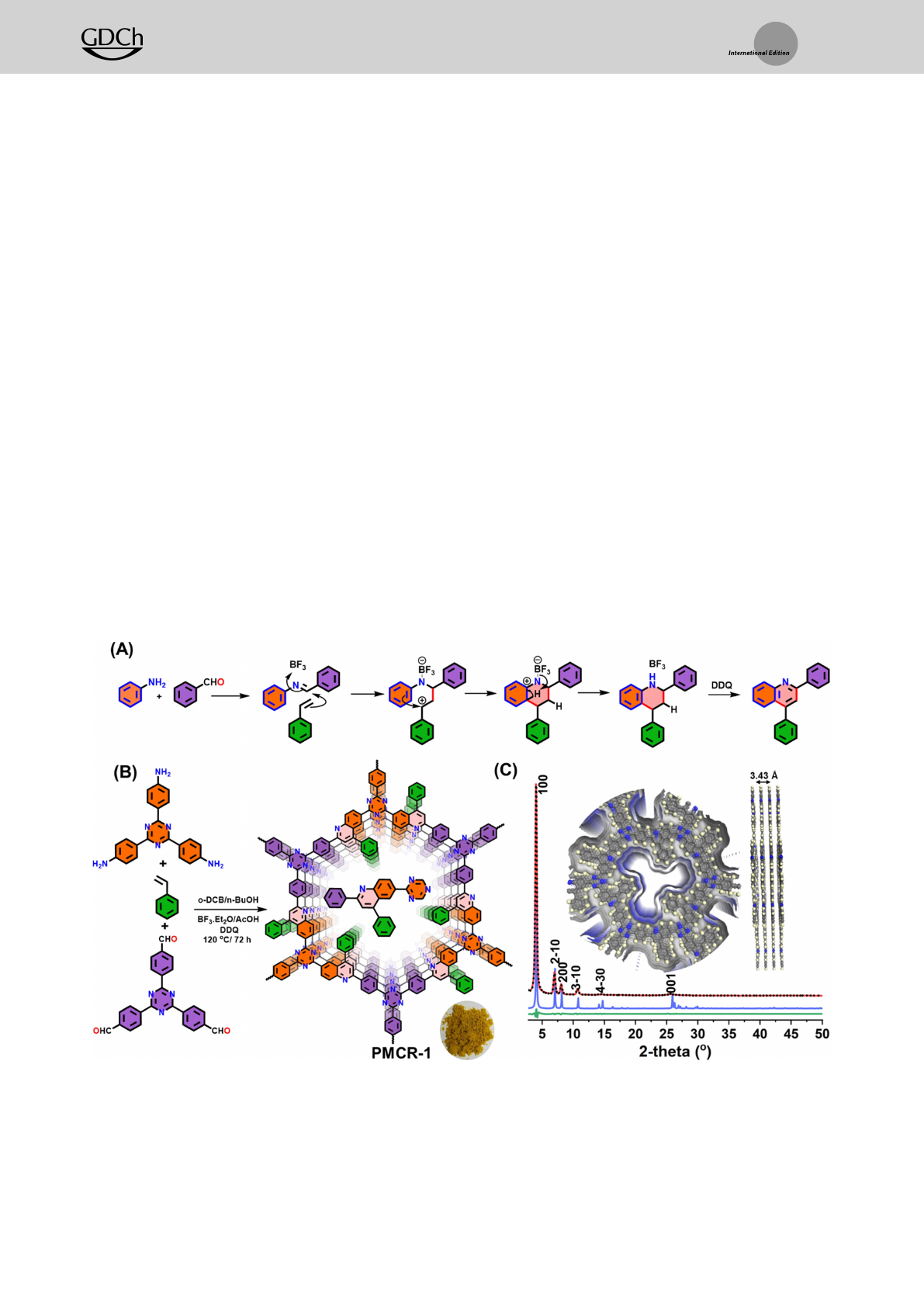
A MCR-COF with quinoline linkages and phenyl groups
pointing into the pores was synthesized via the three-
component one-pot Povarov reaction, which involves alde-
hyde, amine and substituted vinyl compounds (Figure 1A).
The suggested reaction course is verified using similar
conditions with molecular model compounds with 3,4-
dimethoxy aniline, salicylaldehyde and styrene (Scheme S1
and Figures S1–S2). PMCR-1 was synthesized via the three-
component reaction, using 2,4,6-Tris(4-aminophenyl)triazine
(TAT), 4,4’,4’’-(1,3,5-triazine-2,4,6-triyl)tribenzaldehyde
(TTA) and styrene in a solvent mixture of o-dichloroben-
zene/n-butanol (1:1), in presence of BF3.Et2O, AcOH (6 M)
and 2,3-dichloro-5,6-dicyano-1,4-benzoquinone (DDQ) at
120°C for 72 h. The 4-phenyl-quinoline-linked COF was
collected as a golden yellow colored powder in 95% yield
(Figure 1 and Scheme S2).
The crystallinity of PMCR-1 was confirmed by powder
X-ray diffraction (PXRD) analyses. PMCR-1 exhibits an
intense reflection in the low-angle region at 4.0 degrees 2θ
(Figure 1C). An additional set of lower symmetry reflections
that could not be assigned to the starting monomers
indicated the formation of a crystalline framework. The
experimental pattern showed a similar set of reflections
(Figure 1C), suggesting the formation of the expected 2D
layered structure. Hexagonal layered structural models with
hcb topology and with different stacking sequences were
constructed and geometrically optimized. Comparison of the
theoretical with the experimental PXRD pattern suggested
the formation of 2D hexagonal layers with an eclipsed AA
stacking arrangement in the c direction (Figure S3). Pawley
fitting over the full profile was carried out to refine the final
unit cell parameters (Table S1). PMCR-1 was fully charac-
terized by solid-state cross-polarization magic-angle-spin-
ning (CP-MAS) 13C NMR and Fourier transform infrared
(FTIR), and X-ray photoelectron spectroscopy (XPS). The
CP-MAS 13C NMR spectrum of PMCR-1 revealed the
Figure 1. Synthesis, structure and characterization of PMCR-1: (A) Mechanism of the Povarov reaction; (B) Synthesis Scheme for PMCR-1;
(C) PXRD pattern for PMCR-1: experimental (black dotted line) and Pawley refined (red line) patterns and corresponding difference plot (green
line). The theoretical PXRD pattern for an eclipsed AA stacking model of PMCR-1 is provided as blue line. Top and side view of AA stacking in
PMCR-1. (Color code: C, gray spheres; O, red spheres; N, blue spheres, H, pale yellow spheres).
Angewandte
Chemie
Research Articles
Angew. Chem. Int. Ed. 2023,62, e202304349 (2 of 8) © 2023 The Authors. Angewandte Chemie International Edition published by Wiley-VCH GmbH
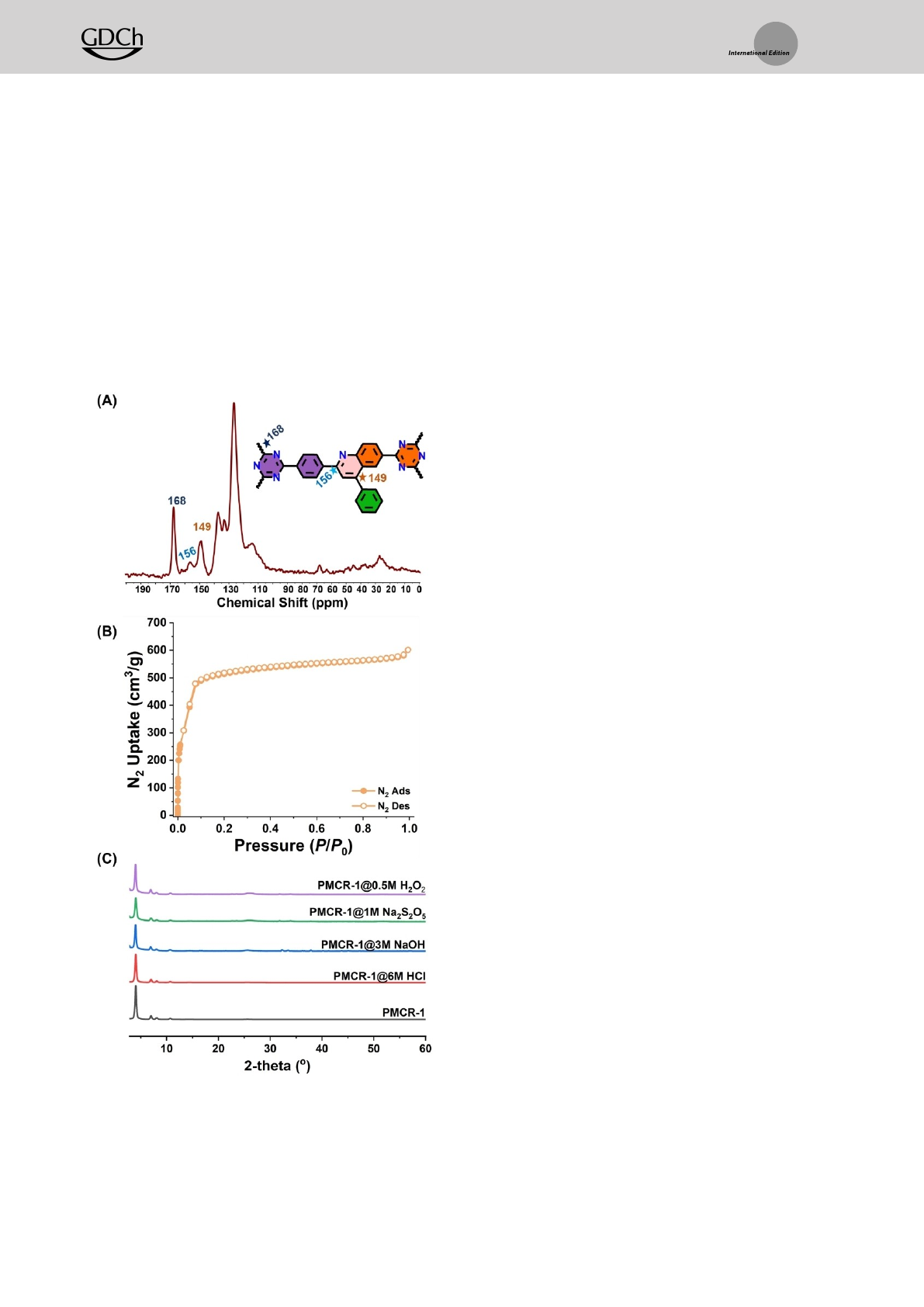
generation of new signals characteristic for quinoline groups
at 156 and 149 ppm which is well corroborated by the
13C NMR spectrum of the model monomer, where these
peaks appear at 155.9 and 148.6 ppm, respectively (Fig-
ure 2A and S1).
Also, the signals that can be assigned to the benzene ring
pointing into the pores are observed in the aromatic region
(115–130 ppm) of the 13C NMR spectrum. The presence of
the strong characteristic peaks at 1579 cm1in the FTIR
spectrum corresponding to pyridyl stretching frequencies
from quinoline of PMCR-1 (Figure S4) also confirmed the
formation of the expected heterocyclic aromatic linkage.
XPS spectra further validated the formation of quinoline
linkages in PMCR-1 with the characteristic peak of N 1s
present at 400.1 eV (quinoline N) (Figure S5).[36,46] The
porosity of PMCR-1 was investigated by N2sorption experi-
ments at 77 K. N2sorption displayed a type-I sorption
isotherm from which an apparent BET surface area of
1756 m2g1was calculated. The measured value suggests
that PMCR-1 reaches its maximum theoretical uptake which
is calculated to be 1739 m2g1(Figure 2B). The pore size of
PMCR-1 was found to be 7.0 Å and 10.0–14.0 Å using DFT
method which is well correlated with the simulated structure
(Figure S6). From the TGA profile a minimal weight loss is
observed until a temperature of 500°C measured at N2
atmosphere (Figure S7). The chemical stability was deter-
mined by immersing PMCR-1 in 6 M HCl, 3 M NaOH, 1 M
Na2S2O5and 0.5 M H2O2for 4 days and PXRD analyses of
the recovered samples. Quantitative recovery of PMCR-1
and no sign of a loss in crystallinity in the collected PXRD
patterns confirmed the high chemical stability of the
synthesized COF (Figure 2C).
Field emission scanning electron microscopy (FESEM)
image of PMCR-1 showed the formation of branched rod-
like structures from aggregated crystallites (Figure S8).
Transmission electron microscopy (TEM) images confirmed
these aggregated structures while the high-resolution TEM
(HRTEM) image displayed crystalline lattice fringes (Fig-
ure S9).
The UV/Vis reflectance spectra of PMCR-1 displayed an
absorption starting at approx. 475 nm with a maximum at
400 nm (Figure S10). Based on solid-state UV/Vis and
valence band (VB) XPS, the VB and CB of PMCR-1 was
calculated to be 6.49 and 3.78 eV vs. vacuum, respec-
tively, which is consistent with the calculated HOMO and
LUMO energy obtained from DFT calculation (Figur-
es S11–S13).[57] The calculated frontier orbitals of PMCR-1
indicate that triazine groups and phenyl quinoline moieties
act as electron-withdrawing and electron-donating centers,
respectively. To prove the charge separation efficiency,
photocurrent and solid-state electron paramagnetic reso-
nance (EPR) CB spectra (g=2.005) were measured in the
dark and after illumination with visible light. Both photo-
current and solid-state EPR displayed a significant intensity
increase when the light is switched on indicating the efficient
photogeneration of charge carriers via the electron transfer
from the VB to the CB (Figure 3A and 3B). Also, from the
band position it can be anticipated that the reduction of O2
to *O2and oxidation of H2O to H2O2should be possible
because their redox potentials are in between the CB and
VB levels of PMCR-1. Consequently, photocatalytic H2O2
production was tested using PMCR-1 as photocatalyst
(10 mg of COF in 22 mL water or 10:1 water:alcohol
mixtures, measured after 1 h at 25°C and λ>420 nm, O2
purge 10 min, see Supporting Information for details, Fig-
ure S14). A H2O2production of 1294 μmolh1g1was
observed in pure water and air, which can be slightly
increased (1445 μmolh1g1) when pure oxygen is used
(Figure 3C). When sacrificial hole scavengers like ethanol or
isopropanol (IPA) were added (10:1, v/v water/alcohol), the
production of H2O2increased. This can be due to the more
efficient hole utilization of the added reductants and also to
a better dispersion of the rather hydrophobic COF, with its
pendant phenyl groups. PMCR-1 showed H2O2generation
Figure 2. (A) Solid-state 13C NMR spectrum for PMCR-1; (B) N2sorp-
tion at 77 K; (C) Chemical stability of PMCR-1 after 4 days treatment
with 6 M HCl, 3 M NaOH, 1 M Na2S2O5and 0.5 M H2O2.
Angewandte
Chemie
Research Articles
Angew. Chem. Int. Ed. 2023,62, e202304349 (3 of 8) © 2023 The Authors. Angewandte Chemie International Edition published by Wiley-VCH GmbH
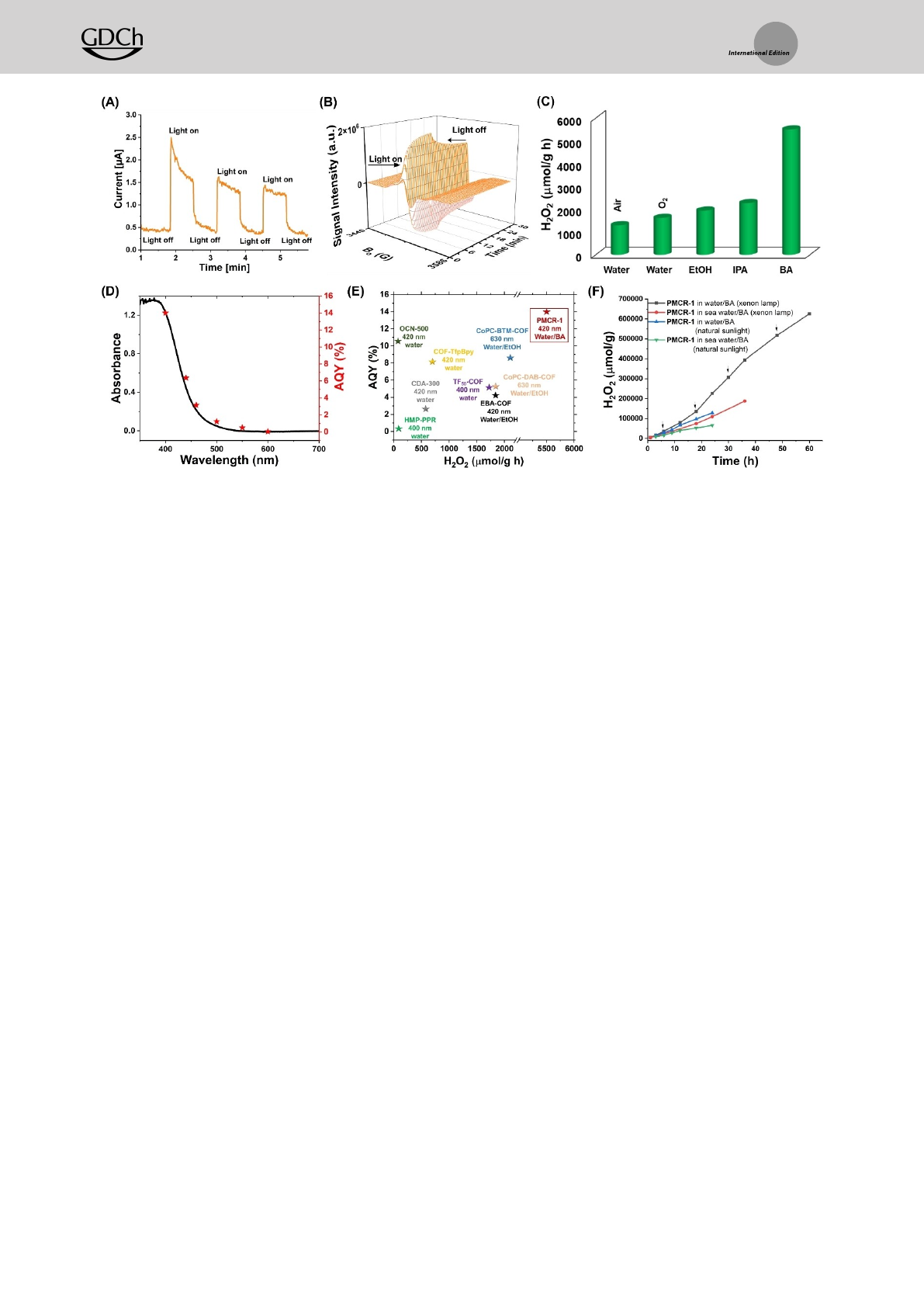
rates of 1941 and 2265 μmolh1g1using ethanol and IPA as
sacrificial agents, respectively. However, when benzyl alco-
hol (BA) is used, H2O2production by PMCR-1 is markedly
increased (5500 μmolh1g1) (Figure 3C). It can be assumed
that this high activity is due to a benzene-benzene
interaction between the pending phenyl groups within the
pores and BA, leading to efficient transfer of holes. The
interaction of BA with PMCR-1 was confirmed by TGA
measurements (Figure S15). Furthermore, a two-phase
(liquid-liquid) system if formed from water and BA. Recent
reports illustrated that metal organic framework (MOF) and
COF photocatalysts can achieve better H2O2production
from such binary phase system.[12,36–38,58]
The two-phase system of BA/water allows the dispersion
of PMCR-1 in the organic phase, thus that H2O2production
presumably occurs at the BA/water interphase while the
produced H2O2is dissolved in the water phase (Figure S16).
This avoids the back reaction by H2O2removal, and
separation from the catalyst which plays a key role for
efficient H2O2production and also inhibit H2O2
decomposition.[12,36,37] An apparent quantum yield (AQY) of
14% at 420 nm in water/BA was found for PMCR-1 in
presence of O2(Figure 3D). The activity of PMCR-1 in
H2O2production is favorably comparable to other reported
COFs in the literature (Figure 3E and Table S2).
Motivated by this H2O2production activity, the practical
applicability of PMCR-1 was tested for long-term H2O2
production in pure and seawater in presence of BA.
Production of H2O2from the water/BA two-phase mixture
steadily increased over time (226,450 to 625,790 μmolg1
after 24 to 60 h, respectively) (Figure 3F). Also, under
natural sunlight a high and steady production of H2O2is
observed reaching 129,028 μmolg1after 24 h. The catalyst
can be easily isolated from the organic phase of the reaction
mixture by filtration. After washing and drying, PXRD and
XPS pattern showed almost no change in the structure of
PMCR-1 after the long-term activity test (Figures S17 and
S18). HRTEM images displayed the retained morphology
and crystallinity after long-term photocatalysis (Figure S19).
1H NMR analysis of the filtrate confirmed the formation of
benzaldehyde (Figure S20). The amount of benzaldehyde is
slightly higher than the amount of H2O2produced indicating
the partial decomposition of H2O2in the long-term produc-
tion process.[37,58]
To gain more insight into the photocatalytic H2O2
production mechanism, different conditions were applied
during the tests. Under Ar atmosphere, the production of
H2O2was nearly not detectable suggesting that it occurs via
oxygen reduction. In absence of light, no H2O2production
was observed even after 48 h proving the photocatalytic
process.
Furthermore, different trapping agents such as benzoqui-
none (BQ) as superoxide radical (*O2), t-butyl alcohol
(TBA) as hydroxyl radical (*OH), and Ag(NO3) as electron
scavenger, respectively, were used to further reveal the
mechanism of the photocatalytic reaction. Addition of BQ
quenched the H2O2production, suggesting that *O2is
involved in the process. H2O2production also decreased
Figure 3. (A) Photocurrent measurement of PMCR-1; (B) EPR conduction band (CB) electron spectra of PMCR-1 in the dark and after illumination
(λ>420 nm, 300 W Xe lamp); (C) Photocatalytic H2O2production using PMCR-1 in the presence of water and different sacrificial donors (10 mg of
COF in 22 mL water or 10:1 water:alcohol mixtures, at 25°C, λ>420 nm, O2purge 10 min); (D) Wavelength dependent AQY measurement in
water/BA; (E) Comparison of H2O2production and AQY with other COF and polymer based photocatalysts; (F) Long-term photocatalytic H2O2
production of PMCR-1 in water in presence of BA (10 mg of COFs in 10:1 water:BA (22 mL) at 25°C and λ>420 nm, black arrow sign
corresponding to O2flow for 10 min).
Angewandte
Chemie
Research Articles
Angew. Chem. Int. Ed. 2023,62, e202304349 (4 of 8) © 2023 The Authors. Angewandte Chemie International Edition published by Wiley-VCH GmbH
after adding Ag(NO3), indicating that photogenerated
electrons play a crucial role in the oxygen reduction
reaction. On the other hand, addition of TBA has not much
influence on the H2O2production, which shows that *OH
radicals are not taking part in the photocatalytic process
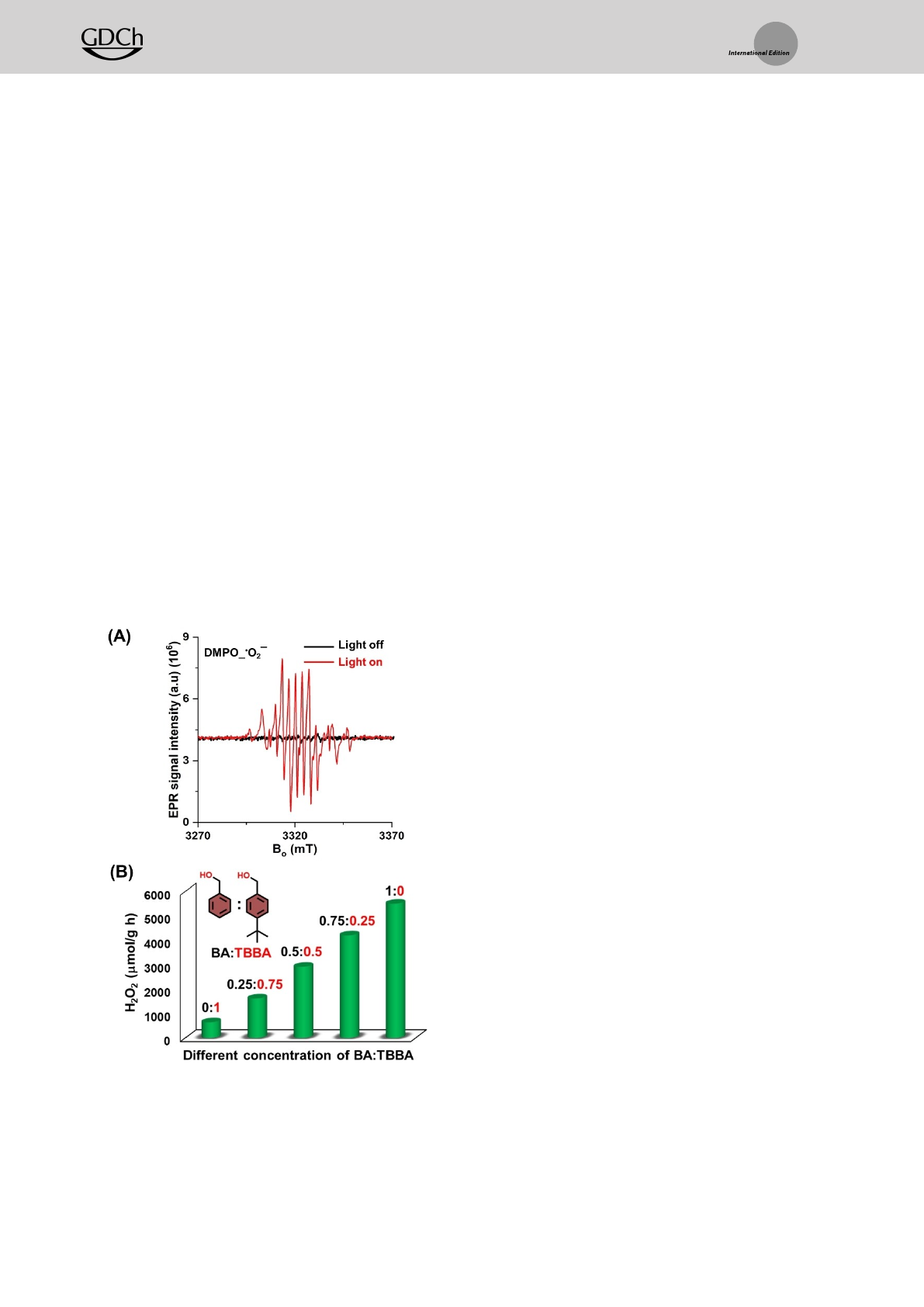
(Figure S21). To elucidate the formation of the ROS (e.g.
*O2and *OH), EPR measurements were performed. 5,5-
dimethyl-1-pyrrolidine N-oxide (DMPO) was used as a spin
trap to detect the ROS. A strong signal of *O2was
distinguished, which indicates reduction of O2upon illumi-
nation while no signal can be seen in absence of light
(Figure 4A). Finally, possible O2interaction sites and bind-
ing energies (BE) on PMCR-1 were investigated by
configurational bias Monte Carlo (CBMC) simulation (Fig-
ure S22). The triazine (CH···O: 2.36–2.93 Å) and quinoline
moities (CH···O: 2.68–2.94 Å), as well as the pendent phenyl
group (CH···O: 2.68–2.94 Å) of PMCR-1 seem to be
preferred binding sites for the O2molecules. These results
strongly suggest that photocatalytic H2O2production is
indeed occurring by reduction of O2as initial step and
produced superoxide radicals along with another electron
and two protons (from alcohol to aldehyde) to generate
H2O2(Figure S23).
To gain further insight into the interaction of the COF
with the sacrificial reductant, alcohols with a different
sterical hindrance were investigated. When the bulky
sacrificial donor 4-t-butylbenzylalcohol (TBBA) was used,
the production of H2O2was found to be much lower (700
μmolh1g1) than for pure BA (Figure 4B). After addition
of different amounts of BA to TBBA (0:1, 0.25:0.75,
0.5:0.5, 0.75:0.25, 1:0 of BA:TBBA), the H2O2production
increased nearly linearly (from 700 to 5500 μmolh1g1)
(Figure 4B). This result indicates that π-π interactions of the
COF with the SA might be an important factor for an
efficient hole transfer, as such interactions will be much
reduced when a sterically hindered alcohol is used.
Benzyl alcohol to benzaldehyde oxidation should be
however rather regarded as model oxidation reaction as,
even when coupled to H2O2production, the economic
feasibility of this process is questionable. However, this
might change for light driven, selective oxidations of other
alcohols and further chemicals. Therefore, different benzyl
amines and thiols were applied to investigate the versatility
of the presented photocatalytic system. Prior works[54,60]
have reported that benzyl amine generates N-benzyl-1-
phenylmethanimine when applied as sacrificial agent via
phenylmethanimine (PhCH=NH) in photocatalytic H2O2
production (Figure S23). Here, the same reaction was
attempted in the binary phase system water/benzyl amine
while H2O2was detected in the water phase. Notably, when
natural sunlight was used as a light source, already with a
very low amount of benzyl amine in water (0.01:1), a H2O2
production of 4529 μmolg1was observed after 1 h under O2
atmosphere. Similarly, thioanisole in water (0.1:1) produces
a two-phase system but in this case H2O2production is lower
(905 μmolh1g1) compared to BA or benzyl amine.
Inspired by these findings, the aerobic oxidation of
further molecular compounds was attempted, as the photo-
catalytic oxidation produce valuable products for the
chemical and pharmaceutical industry.[59] Recently, various
heterogeneous catalysts were used for such photocatalytic
selective oxidations, however, stability and thus reusability
are critical issues in the presence of highly reactive ROS. In
this respect it can be assumed that the strong covalent bonds
in PMCR-1 will also be beneficial to ensure its stability in
presence of ROS. At first, oxidation of different benzyl-
amine derivatives was tested using PMCR-1 as catalyst
(Table 1). PMCR-1 was dispersed in CH3CN and the amine
and purged with O2for 10 min. For pure benzyl amine
complete conversion was observed after 4 h. Under inert
conditions (Ar purge) a much lower conversion was
observed (12% after 4 h, note that O2cannot be completely
removed from the reaction system). For the other amines,
substrates with electron-donating groups (EDGs) show
better activity compared to electron-withdrawing groups
(EWGs) (Table 1). Again, sterically more demanding groups
yield to lower catalytic conversions. Additionally, the
oxidation of sulfides was tested using PMCR-1. Also, for
this reaction a higher activity for substrates with small and
EDGs groups is observed (Table 2).
These results are pointing to a size-selective effect as
bulkier substrates oxidize much slower than smaller ones.
For larger substrates like t-butylbenzylamine (Entry 8) and
phenylbenzylamine (Entry 9), the conversion is comparably
low (Table 1). When a larger EWG substrate e.g. 3,5-
bis(trifluoromethyl)benzylamine (BTBA) was used the con-
version is even lower (Entry 7, 8, Table 1). Similar results
Figure 4. (A) EPR trapping experiment with DMPO which showed the
formation of DMPO-*OO spin adduct (g=2.006; AN=13.2, and
AH=10.1; (B) H2O2production from sacrificial donor BA:TBBA
mixtures.
Angewandte
Chemie
Research Articles
Angew. Chem. Int. Ed. 2023,62, e202304349 (5 of 8) © 2023 The Authors. Angewandte Chemie International Edition published by Wiley-VCH GmbH
Loading more pages...