
www.afm-journal.de
© 2021 The Authors. Advanced Functional Materials published by Wiley-VCH GmbH
2103601 (1 of 14)
ReseaRch aRticle
In Situ Formed “Sn1–XInX@In1–YSnYOZ” Core@Shell
Nanoparticles as Electrocatalysts for CO2 Reduction
to Formate
Laura C. Pardo Pérez, Detre Teschner, Elena Willinger, Amandine Guiet, Matthias Driess,
Peter Strasser, and Anna Fischer*
Electrochemical reduction of CO2 (CO2RR) driven by renewable energy has
gained increasing attention for sustainable production of chemicals and fuels.
Catalyst design to overcome large overpotentials and poor product selectivity
remains however challenging. Sn/SnOx and In/InOx composites have been
reported active for CO2RR with high selectivity toward formate formation. In
this work, the CO2RR activity and selectivity of metal/metal oxide composite
nanoparticles formed by in situ reduction of bimetallic amorphous SnInOx thin
films are investigated. It is shown that during CO2RR the amorphous SnInOx
pre-catalyst thin films are reduced in situ into Sn1–XInX@In1–YSnYOz core@
shell nanoparticles composed of Sn-rich SnIn alloy nanocores (with x<0.2)
surrounded by InOx-rich bimetallic InSnOx shells (with 0.3 < y<0.4 and z≈ 1).
The in situ formed particles catalyze the CO2RR to formate with high faradaic
efficiency (80%) and outstanding formate mass activity (437AgIn+Sn
−1 @
−1.0V vs RHE in 0.1m KHCO3). While extensive structural investigation during
CO2RR reveals pronounced dynamics in terms of particle size, the core@shell
structure is observed for the different electrolysis conditions essayed, with high
surface oxide contents favoring formate over hydrogen selectivity.
DOI: 10.1002/adfm.202103601
1. Introduction
The exhaustive use of carbon-based fossil fuels has led to a pro-
nounced increase of CO2 emissions over the past century.[1–3]
The environmental impact of these emissions has drawn atten-
tion to the necessity to stabilize and eventually decrease the
L. C. Pardo Pérez,[+] A. Guiet,[++] M. Driess, A. Fischer
Institute of Chemistry—Inorganic Chemistry
Technical University Berlin
Straße des 17.Juni 135, 10623 Berlin, Germany
E-mail: [email protected]
The ORCID identification number(s) for the author(s) of this article
can be found under https://doi.org/10.1002/adfm.202103601.
L. C. Pardo Pérez, A. Fischer
Institute of Inorganic and Analytical Chemistry
University of Freiburg
Albertstraße 21, 79104 Freiburg, Germany
D. Teschner, E. Willinger
Department of Inorganic Chemistry
Fritz-Haber-Institute der Max-Planck-Gesellschaft
Faradayweg 4–6, 14195 Berlin, Germany
D. Teschner
Department of Heterogeneous Reactions
Max-Planck-Institute for Chemical Energy Conversion
Stiftstraße 34–36, 45470 Mülheim an der Ruhr, Germany
P. Strasser
Institute of Chemistry—Technical Chemistry
Technical University Berlin
Straße des 17.Juni 124, 10623 Berlin, Germany
A. Fischer
FMF—Freiburger Materialforschungszentrum
University of Freiburg
Stefan-Meier-Straße 21, 79104 Freiburg im Breisgau, Germany
CO2 atmospheric concentrations.[4–6] In
this context, the electrochemical conver-
sion of CO2 into fuels driven by a renew-
able energy input has attracted increasing
attention as a promising approach to
chemically store renewable energy in
C-based fuels. Electrochemical reduction
of CO2 allows converting CO2 in fuels
under mild chemical conditions, such as
aqueous media and ambient temperature
and pressure. However, energy efficiency
remains elusive as overpotentials as large
as 1V are required to bring the process to
a desired production rate.
The CO2 reduction reaction, abbrevi-
ated as CO2RR, is a complex process that
requires multiple electron and proton
transfer reactions which can lead to a
wide variety of products including CO,[7–14]
HCOOH,[7,10,11,13,15–17] hydrocarbons
(mainly methane and ethylene),[13,14,18–21]
or CH3OH.[22–26] In aqueous medium
CO2RR is in competition with H2 evolu-
tion (HER). Accordingly, selectivity control in CO2RR is a major
challenge. Early studies of CO2 electroreduction in aqueous
media were primarily focused on electrode materials with a
large HER overpotential such as Hg.[27–31] In addition, the pio-
neering work of Hori,[9,14] Vassiliev,[32] and further contributions
of Azuma[7] and Ito[10,13] provided a large pool of experimental
[+]Present address: Electrochemical Conversion of CO2 group,
Helmholtz-Zentrum Berlin für Materialien und Energie,
Hahn-Meitner-Platz 1, 14109 Berlin, Germany
[++]Present address: Institut des Molécules et Matériaux du Mans
(IMMM), UMR 6283 CNRS, Le Mans Université, Avenue Olivier
Messiaen, Le Mans Cedex 9 72085, France
© 2021 The Authors. Advanced Functional Materials published by
Wiley-VCH GmbH. This is an open access article under the terms of the
Creative Commons Attribution License, which permits use, distribution and
reproduction in any medium, provided the original work is properly cited.
Adv. Funct. Mater. 2021, 31, 2103601

www.afm-journal.dewww.advancedsciencenews.com
© 2021 The Authors. Advanced Functional Materials published by Wiley-VCH GmbH
2103601 (2 of 14)
results for CO2 reduction on various metal electrodes. The
metals have been empirically classified according to the major
CO2RR reduction product in aqueous media. While metals like
Pt were found to have negligible activity for CO2RR, Ag and
Au were found to favor the production of CO. Interestingly,
Cu was found to catalyze the production of higher reduction
products such as hydrocarbons. In contrast, metallic Sn and In
electrodes have been found to catalyze the conversion of CO2
preferentially to formate (HCOO−).[7,9,10,13,14,32]
Formic acid or formate salts have multiple possible appli-
cations as building blocks for re-utilization of CO2. They can
be used as direct fuel in direct formic acid fuel cells (DFAFC),
potentially offering a CO2 neutral fuel cycle, as hydrogen storage
vector or as raw material in industry.[33–35] However so far, the
reported faradaic efficiencies offered by metallic Sn[36] and In
catalysts[37] (in potential windows between −1.0V to −1.5V vs
RHE) vary significantly among reports[7,9,43–49,13,16,17,38–42] At
applied potentials around −1.0V versus RHE, Sn and In were
found to provide formate faradaic efficiencies between 63–88%
and 69–95% respectively, while at larger reductive bias, that is,
in the range of −1.3 to −1.5V versus RHE, the production of
H2 is favored, thereby decreasing the faradaic efficiency for for-
mate to only 5.2% and 33.3% for Sn and In respectively.[7]
Recent reports have pointed out that the origin of the vari-
ability of formate faradaic efficiencies reported on Sn and In
based catalysts could be associated with the native oxide layer
present at the surface of these metals. For instance, Kanan
reported that at low applied potential of −0.7V versus RHE, a
tin foil with a native oxide layer exhibits a formate faradaic effi-
ciency of about 19%, while a freshly acid-etched foil, without a
native oxide layer virtually produced no formate, as indicated
by the extremely low value of 0.3% of the formate faradaic effi-
ciency.[38] To gain further understanding on the influence of
SnOx surface oxide species on the activation of CO2 to formate,
the authors also reported the simultaneous electrodeposition
of Sn° and SnOx (SnOx/Sn°) on a titanium foil, during CO2
electrolysis experiments at −0.7V versus RHE. A CO2 conver-
sion faradaic efficiency of 85–98% (Formate 40% + CO 58%)
was thereby found. The high selectivity toward CO2 conversion
into CO and HCOO− over HER on these electrodes strongly
suggests a boost of CO2 conversion over H2 evolution due to
the presence of surface oxides (of the type SnOx). However, the
electrodeposited SnOx/Sn° composite tends to lose its conduc-
tivity upon contact with air and consequently its activity.
A study on a hierarchical dendrite Sn structure electrodepos-
ited on a tin foil[39] revealed that the high surface area structure
could deliver higher current densities and that increasing the
oxygen content in the material's surface through heat treat-
ment in air led to significant improvement in the formate
faradaic efficiency (from 32% to 55.9% at −1.06V vs RHE). A
step further in the investigation of the role of SnOx moieties
on the CO2RR electrocatalytic activity was proposed by Meyers
group,[40] who reported in situ electrochemically reduced tin
oxide nanoparticles capable of catalyzing the conversion of CO2
into formate in NaHCO3 aqueous solutions with faradaic effi-
ciencies as high as 86.2% at −1.2V versus RHE.
An analogous behavior was reported on Indium surfaces.
Bocarsly's group reported that Indium electrodes with a native
oxide layer could provide up to 75% faradaic efficiency for
formate formation at −0.9V versus RHE. However, the stability
was limited, as over 2 h of operation, the faradaic efficiency
for formate dropped below 20%; a value typically obtained for
freshly acid-etched In electrodes. Anodized In electrodes pro-
vided a stable faradaic efficiency of 35–40% over 6 h.[41] The
same group reported a comparative study of the activity of
In(OH)3, In2O3 and metallic In nanoparticles.[42] High faradaic
efficiencies (>70%) could be reached with these catalysts at
moderate applied potentials (−0.9 to −1.2V vs RHE). Interest-
ingly, In° NP's with native InOH and InO surface species
were found to provide virtually 100% faradaic efficiency toward
formate, while pure In(OH)3 and In2O3 nanoparticles reached
lower faradaic efficiencies and required larger overpotentials,
probably due to their lower conductivity, when compared to the
metallic nanoparticles.
In regard of the mechanisms of formate production on
Sn- and In-based catalysts two possible pathways have been
proposed. Correlation of experimentally observed partial
current densities and theoretical insights on intermediates
binding strength indicate that the production of formate on
metal surfaces proceeds through an oxygen bound interme-
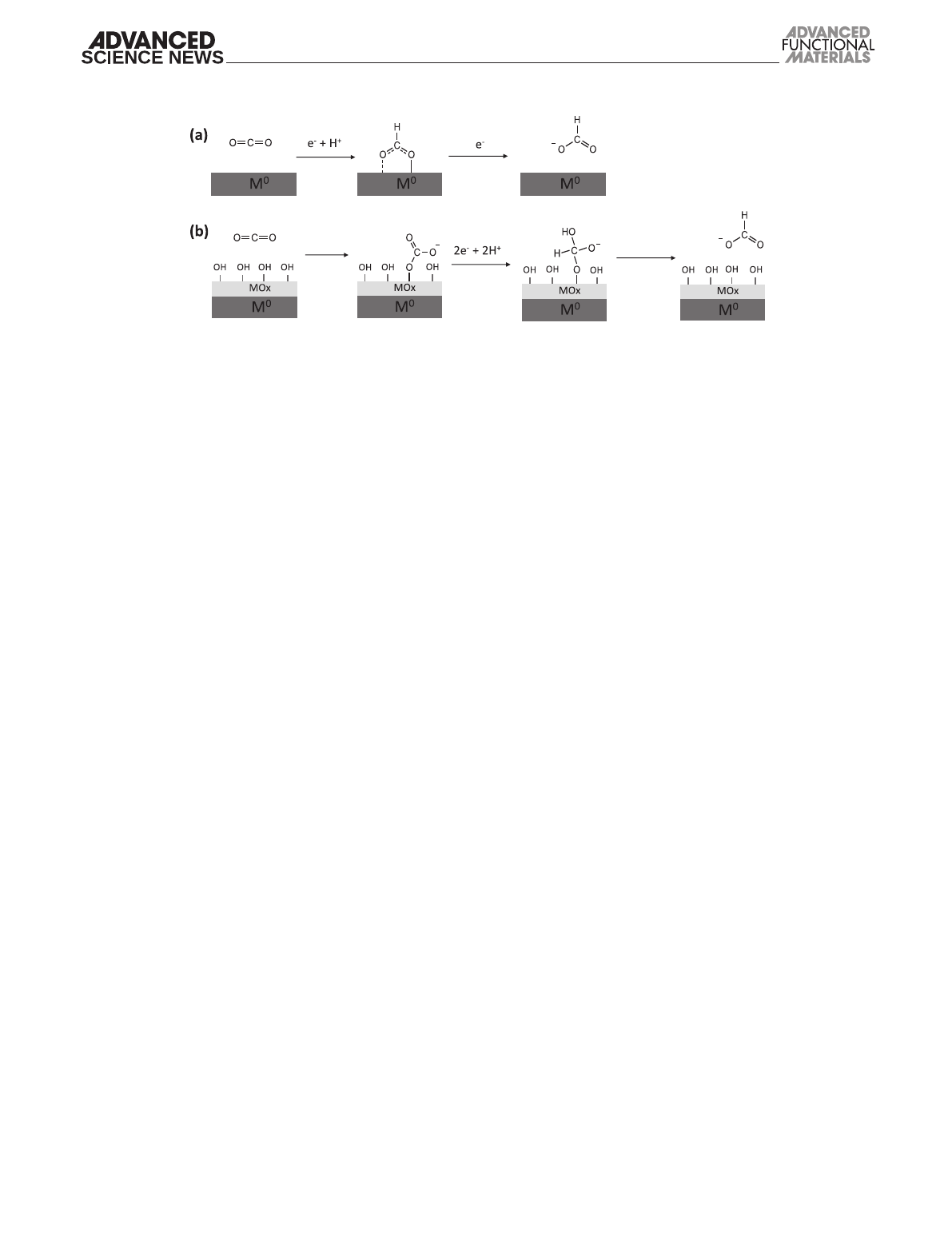
diate *OCHO[50] as depicted in Scheme1a. ATR-IR studies on
the effect of surface oxidized species of the types MOx in Sn-
and In-based catalysts[41,43] indicate an alternative mechanism.
These studies conclude that the presence of an oxide layer on
Sn and In surfaces leads to the formation of hydroxylated sur-
faces (MOH) in aqueous media that react with dissolved CO2
to form an adsorbed carbonate (MCO3−) intermediate that is
proposed to undergo a two-electron reduction to yield formate
as depicted in Scheme1b. The mechanism proceeding through
an MCO3− was also found viable by DFT studies conducted
on hydroxyl terminated SnO surfaces.[51] The proposed mecha-
nisms implicate the persistence of SnOx or InOx surface spe-
cies at potentials relevant for CO2RR. A recent investigation on
SnO2 nanoparticles (4nm) supported on graphene by in situ
Raman spectroscopy and XAS[52] revealed that SnO2 and SnO
surface moieties persist at the catalyst surface in the potential
range where the best formate faradaic efficiency is observed
(–0.8V vs RHE in KHCO3 pH 8.5); providing further evidence
that persistent oxides play a key role in CO2RR.
To summarize, Indium has been consistently found to pro-
vide higher faradaic efficiencies at larger overpotentials than
Tin.[7,9,13,16,17,40–43] For both electrode materials, recent reports
point out that MOx enriched surfaces (with M being In or Sn) or
M0/MOx composites both boost the faradaic efficiency toward
formate. However, in view of the overall system conductivity, a
compromise must be met between the amount of metal and
metal oxide to preserve the material's high conductivity.[38,42]
In this context, amorphous bimetallic indium tin oxide thin
films (SnInOx)[53–56] appear as an interesting class of material
for CO2RR electrocatalysis. Such amorphous yet conductive
SnInOx thin films enable the investigation of possible syner-
gies between Sn and In for the electrocatalytic conversion of
CO2 to formate, while simultaneously providing an oxygen-rich
matrix for the formation of stable metal oxide surface species
(such as InOx and/or SnOx), known to favor the production of
formate with high faradaic efficiency. In the present paper, the
study of amorphous SnInOx thin films as (pre)electrocatalysts
for oxide-derived CO2RR reduction catalysts as well as a detailed
Adv. Funct. Mater. 2021, 31, 2103601
www.afm-journal.dewww.advancedsciencenews.com
© 2021 The Authors. Advanced Functional Materials published by Wiley-VCH GmbH
2103601 (3 of 14)
investigation of their activity toward CO2 reduction along with
in-depth insights into material reduction and restructuration
upon CO2RR reaction are presented.
Our results revealed that SnInOx thin films act as pre-cat-
alysts for the in situ formation under CO2 electroreduction
conditions of metal@metal oxide core@shell nanoparticles,
composed of Sn-rich Sn1-XInX alloyed nanocores (with x<0.2)
surrounded by InOx-rich bimetallic In1-YSnYOZ shells (with 0.3
< y<0.4 and z≈ 1). The investigation of these in situ formed
nanoparticles under diverse applied electrolysis potentials and
extended electrolysis time revealed a dynamic particle size evo-
lution during CO2RR. Interestingly, despite the particle size
changes the “Sn1-XInX@In1-YSnYOZ” core@shell structures
with a ≈3nm oxide surface layer were found to be intrinsically
favored in all conditions essayed. Similar In surface segregation
in form of In(OH)3 has been previously observed under CO2RR
conditions for bimetallic Cu–In catalysts.[57] Such core@shell
structures offer potential advantages for electrocatalysis. For
instance, they maximize the exposition of the shell component
to the electrolyte as has been used to increase utilization of
precious metals for ORR application.[58,59] They can also offer
the possibility of tuning CO2R selectivity through cooperation
between core and shell components as has been demonstrated
for Ag@SnOx[60,61] and Cu@In(OH)3[57] catalysts for CO2RR.
2. Results and Discussion
Amorphous SnInOx thin films with a film thickness of
20–25 nm were deposited onto glassy carbon plate-like sub-
strates by spin coating using a single source precursor approach
(for details see experimental part as well as HR-SEM and TEM
images in Figure S1, Supporting Information). The composition
of the as-obtained SnInOx thin films was investigated by energy
dispersive x-ray spectroscopy (EDX), induced coupled plasma-
optical emission spectroscopy (ICP-OES), and x-ray photoelec-
tron spectroscopy (XPS), revealing an average In:Sn ratio of 0.4
(Table1). The CO2RR electrocatalytic activity of the SnInOx film
was evaluated in a two-compartment cell provided with a con-
stant inlet of CO2 at 30mLmin−1 using CO2 saturated 0.1m
KHCO3 (pH 6.8) as an electrolyte. A fritted tube was used to
separate the counter electrode to prevent re-oxidation of CO2RR
products. Further details can be found in the experimental
section and supporting information (Figure S2a, Supporting
Information). The electrolysis experiment comprised a linear
sweep voltammetry (LSV) in the reductive direction from
+0.4V to −1.0V versus RHE followed by a chronoamperometry
at −1.0Vversus RHE for 10 min. The gaseous products such
as H2 and CO were analyzed by gas chromatography, while the
products in the liquid phase were analyzed by 1H-NMR.
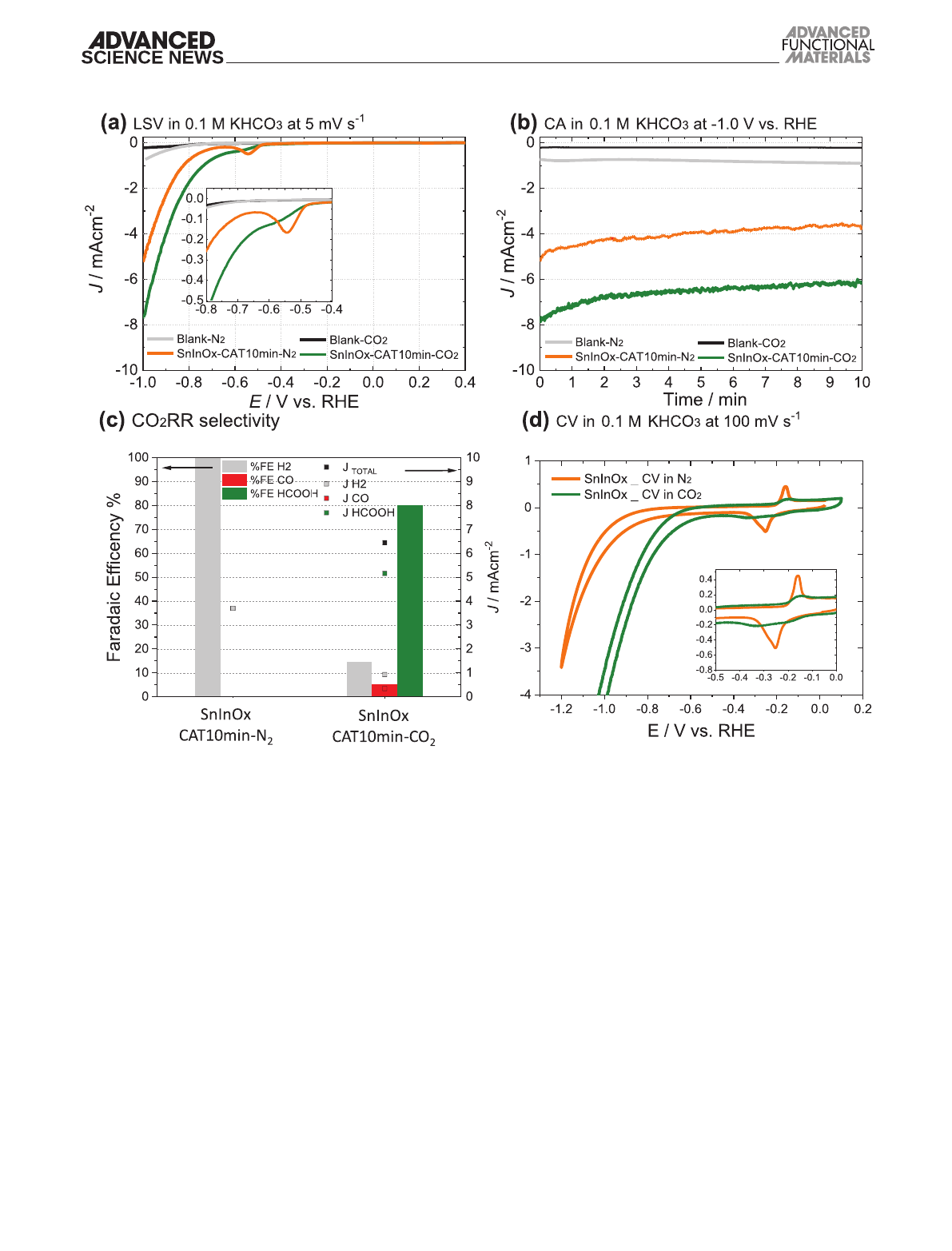
In the cathodic LSV in CO2 saturated electrolyte, the SnInOx
films exhibit an intrinsic reduction peak at −0.58V versus RHE,
which appears to overlap with the onset of CO2RR and corre-
sponds to the reduction of bimetallic SnInOx to the respective
metallic form (Figure1a and inset in Figure 1a). The overall
catalytic current reaches −7.8mAcm−2 at −1.0V versus RHE.
During the chronoamperometry step, the current decays within
the first minutes and stabilizes at −6.4mAcm−2 (Figure1b).
The product analysis revealed that the main CO2 reduction
product is formate with a faradaic efficiency of 80%. Addition-
ally, CO was produced with a faradaic efficiency of 5.4%, while
H2 was produced with a faradaic efficiency of 14.5% (Figure1c).
For comparison, a cathodic LSV was performed for an
SnInOx film in CO2-free, N2-saturated electrolyte. Under
these conditions, only HER is expected. During the LSV the
SnInOx intrinsic reduction peak appears at −0.54 V versus
RHE (Figure1a). The catalytic current sets on at lower poten-
tial (−0.65V vs RHE) than it was observed in the presence of
CO2 and reaches −5.2mAcm−2 at −1.0V versus RHE, while
decaying to −3.7 mAcm−2 during the 10min chronoamperom-
etry test. The product analysis revealed, as expected, the sole
production of H2 with 100% faradaic efficiency (Figure1c).
The electrolysis experiments conducted in both N2 and CO2
saturated electrolytes (Figure1a) revealed that both CO2 reduc-
tion and H2 evolution onset after the electrochemical reduction
of the SnInOx films. The extent of SnInOx film reduction will
be discussed in detail in the next section (vide infra). In short,
TEM and SEM characterization revealed that the amorphous
SnInOx thin films act as precatalysts and are reduced in situ
during the CO2RR reaction to form core@shell nanoparticles
composed of Sn-rich metallic alloy cores of the type Sn1-XInX
(x<0.2) surrounded by indium-rich indium tin oxide shells of
the type In1-YSnYOZ with y= 0.4 and z≈ 1, denoted “Sn1-XInX@
In1-YSnYOZ”core@shell in the following.
It is important to note that HER activity is heavily sup-
pressed in CO2 saturated electrolyte for these SnInOx-derived
Scheme 1. Mechanisms of formate production for In- or Sn-based catalysts proposed in literature: a) Production of formate via *OCHO interme-
diate,[50] b) Production of formate via M-CO3− intermediate.[41,43] Note: M corresponds to Sn or In and MOx refers to surface oxide species on these
metal surfaces.
Adv. Funct. Mater. 2021, 31, 2103601

www.afm-journal.dewww.advancedsciencenews.com
© 2021 The Authors. Advanced Functional Materials published by Wiley-VCH GmbH
2103601 (4 of 14)
nanoparticle films (Figure1b,c). Indeed, in situ reduced SnInOx
provides a partial HER catalytic current density of −3.7mAcm−2
in N2 saturated electrolyte and a 100% faradaic efficiency toward
H2 evolution. However, in CO2 saturated electrolyte, the fara-
daic efficiency for H2 evolution drops down to 14.5% accounting
for a H2 partial current of only −0.92mAcm−2. These results
indicate that although the in situ reduced SnInOx does cata-
lyze H2 evolution, in the presence of CO2 it exhibits a marked
affinity and higher activity toward the activation of CO2.
The affinity of the SnInOx derived composites for CO2 can fur-
ther be observed by comparing the reduction of SnInOx in N2 and
CO2 saturated electrolyte by voltammetry (Figure1a,d). The inset
in Figure1a displays the redox peaks observed upon the reduction
of SnInOx films in the first cathodic sweep in N2 and CO2 satu-
rated electrolyte, respectively. In N2-saturated electrolyte, a sharp
reduction peak ascribed to the reduction of InOx (Inδ+) to metallic
In0 and SnOx (Snδ+) to metallic Sn0 is observed at −0.54V, while
the onset of hydrogen evolution current is observed at higher
reductive bias. In the presence of CO2 however, the redox peak
located at −0.58V is less sharp and overlaps with the onset of CO2
reduction current. It is during this first reduction sweep that the
SnInOx film is transformed into “Sn1-XInX@In1-YSnYOZ”core@
shell nanoparticles. Figure1d displays a stable CV profile in N2
and CO2 saturated electrolyte after 5 cycles at 100 mVs−1. While
the redox peaks associated to the InSnOx reduction are still clearly
seen in N2 saturated electrolyte, their intensity is strongly dimin-
ished in the presence of CO2. This behavior has been previously
observed for both Sn[43] and In[41,42] based catalysts and has been
ascribed to the reaction of SnOx and InOx surfaces moieties with
dissolved CO2 to form a surface confined M-CO3− intermediate
(Scheme1b). This intermediate is reduced during CO2RR cata-
lytic turnover (i.e., at larger reductive bias) to yield formate and
the metal site in its oxidized state, thus decreasing the magnitude
of the MOx/M0 redox peaks.
As already mentioned, “Sn1-XInX@In1-YSnYOZ” core@shell
nanoparticles derived from in situ reduction of SnInOx provide
a high CO2RR catalytic activity with a formate faradic efficiency
of 80% at an overall current density of −6.4± 0.5mAcm−2 at
−1.0V versus RHE, corresponding to a formate production rate
of 95.5 µmol h−1 cm−2. Considering the ultra-low mass of In
and Sn present in the SnInOx films as determined by ICP-OES
(m(Sn+In)= 12µgcm−2, mSn= 8 µgcm−2, mIn= 4.3µgcm−2),
this performance corresponds to a remarkably high formate
mass activity of 437± 15Ag−1(Sn+In) when referred to the total
mass of Sn and In, as well as to a (theoretically) high mass
activity of 640± 21AgSn−1 and 1190± 50AgIn−1 when referred
to the mass of Sn and In separately, assuming each metal as
the single CO2RR active component. With this mass activity,
the SnInOx-films derived electrocatalysts presented in this work
outperform the best reported Sn and closely match the best
reported In based electrocatalysts reported in H-cell configura-
tion so far. For comparison, the best Sn nanoparticulate system,
that is, in situ reduced SnO2 nanoparticles (diameter = 5nm)
supported on graphene,[40] was reported to have a mass activity
of 266AgSn−1 at −1.16V versus RHE, while the most active In
based catalysts, that is, In nanoparticles (diameter = 6.1 nm)
and In2O3 nanoparticles (9.77nm) supported on Vulcan were
reported with 215 AgIn−1 and 450 AgIn−1at −0.96V versus RHE
respectively.[42] Further reports and comparisons of activity and
selectivity of In and Sn-based electrocatalysts can be found in
Table S1, Supporting Information.
2.1. In Situ SnInOx Film Reduction and Restructuring during
CO2RR Electrolysis
As pointed out previously, the SnInOx films act as precatalysts
and are reduced in situ during CO2 electrolysis and strong
Table 1. Composition of as synthesized SnInOx films and in situ formed “Sn1-XInX@In1-YSnYOZ” core@shell nanoparticles during CO2 reduction
determined by different analytical methods (ICP, EDX, XPS).
Technique Sna) Ina) O/Mb) In:Sn
As synthesized
SnInOx films
ICP 0.69 0.31 – 0.44
SEM-EDXc) 0.71 0.29 1.5 0.40
XPS (500eV)c) 0.78 0.22 2.0 0.29
Sn1-XInX@In1-YSnYOZ”
core@shell
particles
in
SnInOx_CAT@-1V_10min
ICP (bulk) 0.63 0.37 – 0.58
SEM-EDX (bulk)c) 0.63 0.37 3.3-6.3 0.59
STEMc) Core 0.85 0.15 0.4 0.18
Shell 0.14 0.86 1.9 6.05
XPS*d) 200 eV 0.42 0.58 – 1.33
500 eV 0.45 0.55 1.1 1.23
1000 eV 0.48 0.52 – 1.10
XPSc) 500 eV 0.42 0.58 1.7 1.39
a)Sn and In fraction referred to the total metal content; Sn = at%Sn/(at%Sn+ at%In); b)Oxygen to total metal ratio O/M = at%O/(at%Sn+ at%In); c)Characterization con-
ducted on samples exposed to air; d)* denotes characterization conducted on samples handled, stored, and transferred under inert atmosphere.
Adv. Funct. Mater. 2021, 31, 2103601
www.afm-journal.dewww.advancedsciencenews.com
© 2021 The Authors. Advanced Functional Materials published by Wiley-VCH GmbH
2103601 (5 of 14)
structural changes occur. In order to investigate these changes,
the SnInOx films were subjected to different CO2 electrolysis
experiments and the resulting samples were denoted SnInOx-
CAT@E-t, where E is the electrolysis potential (vs RHE) and t
is the duration of the CO2 electrolysis test (i.e., the duration of
the chronoamperometry step in the presence of CO2). The post
electrolysis samples SnInOx-CAT@E-t were then characterized
by ex situ by SEM, TEM, STEM, and GI-RXD (Note that unless
otherwise specified, the ex situ characterization of samples is
conducted on samples exposed to air after electrolysis tests).
After a typical CO2RR electrolysis experiment at −1.0V versus
RHE held for 10 min, denoted SnInOx_CAT@-1V_10min, the
originally planar and continuous SnInOx thin film (see SEM
top view image, Figure2b) is restructured into an array of nan-
oparticles with a size mode between 30 and 35nm (SEM top
view image, Figure2c). The overall metal composition of the
SnInOx_CAT@-1V_10minsamples was assessed and EDX (per-
formed in SEM top view mode, Figure S8, Supporting Informa-
tion) and ICP-OES analysis revealed an overall In:Sn ratio of 0.6
(Table1). Compared to the initial In:Sn ratio of 0.4 found for the
starting SnInOx films, the composition of the reduced samples
indicates a partial dissolution of Sn (≈1.5–2µgcm−2) during the
in situ reduction of planar SnInOx films to nanoparticles.
A detailed examination of the formed nanoparticles in a
sample after 10min of CO2 electrolysis at −1Vversus RHE (i.e.,
in SnInOx_CAT@-1V_10min)by transmission electron micros-
copy (TEM) (Figure2d,f) revealed that each particle possesses a
core@shell structure. From high-resolution transmission elec-
tron microscopy (HR-TEM) images (Figure2d), a single crystal-
line core with a d-spacing of 2.8Å (Figure2d) was identified;
Figure 1. Electrocatalytic tests in aqueous 0.1m KHCO3 performed with SnInOx planar films deposited on Glassy Carbon plate electrodes (GCE):
a) cathodic linear sweep voltammetry (first sweep at 5mVs−1, inset displays an enlarged figure of the redox peak region associated to SnInOx reduc-
tion), followed by b) chronoamperometry at −1.0V versus RHE for SnInOx in CO2 saturated electrolyte (SnInOx_CO2, dark green) and SnInOx in N2
saturated electrolyte (SnInOx_N2, orange). Note: The blank measurements were done with pristine GCE plates. c) Faradaic efficiencies toward products
such as formate (green bar), carbon monoxide (red bar) and H2 (grey bar) and respective current density (black dot). d) Stable cyclic voltammetry
profile (typically after the fifth cycle) of SnInOx films cycled at 100mVs−1 in CO2 (dark green) or N2 (orange) saturated 0.1 m KHCO3 and inset showing
the potential region where SnInOx redox peaks occur.
Adv. Funct. Mater. 2021, 31, 2103601
Loading more pages...