Review
Washability of E-Textiles: Failure Modes and Influences on
Washing Reliability
Sigrid Rotzler * and Martin Schneider-Ramelow
Citation: Rotzler, S.;
Schneider-Ramelow, M. Washability
of E-Textiles: Failure Modes and
Influences on Washing Reliability.
Textiles 2021,1, 37–54. https://
doi.org/10.3390/textiles1010004
Academic Editor: Philippe Boisse
Received: 7 April 2021
Accepted: 6 May 2021
Published: 21 May 2021
Publisher’s Note: MDPI stays neutral
with regard to jurisdictional claims in
published maps and institutional affil-
iations.
Copyright: © 2021 by the authors.
Licensee MDPI, Basel, Switzerland.
This article is an open access article
distributed under the terms and
conditions of the Creative Commons
Attribution (CC BY) license (https://
creativecommons.org/licenses/by/
4.0/).
Research Centre for Microperipheric Technologies, Technische Universiät Berlin, Gustav-Meyer-Allee 25,
*Correspondence: r[email protected]; Tel.: +49-30-3147-2889
Abstract:
E-textiles, hybrid products that incorporate electronic functionality into textiles, often need
to withstand washing procedures to ensure textile typical usability. Yet, the washability—which
is essential for many e-textile applications like medical or sports due to hygiene requirements—is
often still insufficient. The influence factors for washing damage in textile integrated electronics
as well as common weak points are not extensively researched, which makes a targeted approach
to improve washability in e-textiles difficult. As a step towards reliably washable e-textiles, this
review bundles existing information and findings on the topic: a summary of common failure modes
in e-textiles brought about by washing as well as influencing parameters that affect the washability
of e-textiles. The findings of this paper can be utilized in the development of e-textile systems with
an improved washability.
Keywords:
electronic textiles; e-textiles; smart textiles; wash testing; washability; reliability;
failure modes
1. Introduction and Context
If conceived to be worn on or near the body—and even for some non-wearable
applications—hybrid electronic textiles (e-textiles), products that incorporate electronic
or electrically conductive functionality into textiles, need to be clean- and washable [
1
].
Only e-textiles that exhibit a textile typical usability (which includes washability) will be
accepted by users and, thus, lead to commercially successful products [
2
]. Although many
experts agree that a lacking washability is one of the major hurdles that e-textiles need to
overcome, there is still only limited research into the topic. While numerous publications
on e-textiles do feature wash testing, washability is rarely the main issue, but rather one
of a range of reliability tests run to evaluate the developed e-textiles. A difficulty in
comparably assessing the washing results that are presented in these publications arises
from the very different wash testing methods, an issue that is addressed in a previous
publication [
3
]. While some wash according to, or at least loosely follow, different existing
textile washing standards, others use a variety of household washing procedures or even
alternative washing methods, like placing the samples in a beaker with water. Not only do
the washing methods differ greatly, but also the number of cycles run to assess washability
(between one and more than 50 cycles) as well as the use and type of detergent, the washing
temperatures, and the subsequent drying of the samples [3].
To improve the washability of e-textile systems, insight is needed into both of the fac-
tors influencing the washing outcome as well as the typical damages brought about by
washing and weak points in the e-textile that will fail first if subjected to washing proce-
dures. This knowledge will allow researchers and developers a targeted approach towards
e-textiles with improved washing reliability. Existing research into those topics is rarely
done systematically, as washability is not the main focus in most e-textile related publica-
tions, as mentioned above. This review tries to alleviate this lack of insight, by bundling
Textiles 2021,1, 37–54. https://doi.org/10.3390/textiles1010004 https://www.mdpi.com/journal/textiles

Textiles 2021,138
findings on influencing factors on washability as well as common failure modes. The pre-
sented overview can be used as a basis for improved e-textile designs with enhanced
washability. Detailed information regarding the employed washing methods for most
of the cited sources can be found in a previous review of wash testing practices for e-
textiles [
3
]. An extensive research into relevant scientific publications was used as a basis.
Only sources including both wash tests on e-textiles, as well as findings on how different
parameters can affect the washability and/or findings on specific failure modes, were
included. Similar information on commercially available e-textiles is rarely published; thus,
the review is limited to academic research. In a number of publications, e-textiles, which
are claimed to be highly washable, are presented—but without any parameter variation.
Silver coated cotton by Wand et al. withstands 200 of their washing cycles [
4
]. Matsouka
et al. wash textile electrodes for 50 cycles and retain functionality [
5
]. The textile based
tribo-electric nano-generators in research by Sala de Medeiros et al. show no performance
degradation or other damages after 50 washing cycles [
6
], just to name a few examples.
These sources have not been included in the review, because of their widely differing
wash testing methods. Because of these different test methods, a comparison between
studies—and with it an estimation which factors will lead to an improved washability—is
difficult. An e-textile that is claimed to be washable using one test method might not be
(as) washable if another testing method is used.
The main review is preceded by a short section on how e-textiles can be negatively
affected by washing. Subsequently, different failure modes in e-textiles as a result of
washing are presented, with a focus on the specific damages to different structures of an e-
textile system. The next section lists influencing factors on e-textile washability, including
both of the factors originating from the e-textile and its composition as well as the external
factors processing and cleaning parameters. A summary of the findings is given at the end
of the section.
2. Effects of Washing on E-Textiles
During any washing process, the cleanable items are subjected to the four washing factors
time, temperature, mechanical action, and chemistry/biology, also known as
Sinners factors [7,8].
The magnitude of these interdependent factors determines the outcome of a washing procedure,
both the desired effects—cleanliness and hygiene—as well as the unwanted, so-called secondary
washing effects (e.g., damages, ageing, or changes in shape or color) [
1
]. Because of the influence
of the four factors in combination with the washing water, an e-textile might exhibit any or all of
the following secondary washing effects:
•
changes in electrical properties: the loss of conductivity or increase in resistance,
altered capacitance [1,9–55]
•
changes in function: (partial) loss of function of one or more components (LEDs, ...)
or the whole e-textile system [16,22,40,49,56–62]
•
changes in characteristics: e.g., changes in sensor ranges, antenna spectra, decreased
read ranges, ... [10,11,19,30,38,40,52,53,63–72]
•
changes in integrity: e.g., delamination, loosening of wires, loss of components ...
[1,13,20,32,39,42,49,58,61]
•
changes in appearance: e.g., darkening, changes of the textile surface (pilling, fuzzing),
wrinkling, shrinkage ... [15,19,22,30,42,53,58,69,72]
The extent of one or more of these changes after a certain number of washing cycles is
used as an indicator of washability for e-textiles. The parameter(s) chosen often correlate
with the complexity or the composition of the tested system. Most often—especially
when testing only conductive textiles—a change in resistance is the parameter of choice to
assess washability. Researchers washing antennas or sensors frequently evaluate changes
in characteristics and, if added components are present (like LEDs) or fully functional
systems are tested, then the estimation of washing reliability is often tied to a change
in function [
3
]. Because maintaining conductivity and/or functionality (within tolerances)
is more of an issue when washing e-textiles than the textile integrity, changes in appearance

Textiles 2021,139
and other textile changes are less often employed to assess the washability of e-textiles [
3
].
Although, in some cases, a change in appearance and changes in resistance go hand-in-
hand, as in research by Gaubert et al.: the amount of bleaching agents in the detergents
used does not only influence the extent of darkening in the examined metallized textiles,
but also reduces their conductivity accordingly [19].
3. Washing Related E-Textile Failure Modes
When textile integrated electrically conductive or electronic components are subjected
to (repeated) washing, damages can occur, which impairs the e-textile’s function, appear-
ance, or characteristics. Because e-textiles are a very diverse group of products—not all
of which can be found in a literary source featuring wash testing—the following listing is
not exhaustive. Likewise, as new e-textiles are developed, previously non-existent failure
modes might occur.
3.1. Damages to Conductive Coatings and Printed Conductive Structures
Zeagler et al. find that their silver-based printed conductive tracks exhibit cracks after
six washing cycles, which results in increased resistance. They reason that the swelling
of the hydrophilic cotton substrate, as well as bending occurring during washing, are
responsible. In some samples, the printed ink is not only cracked, but also flaking off [
55
].
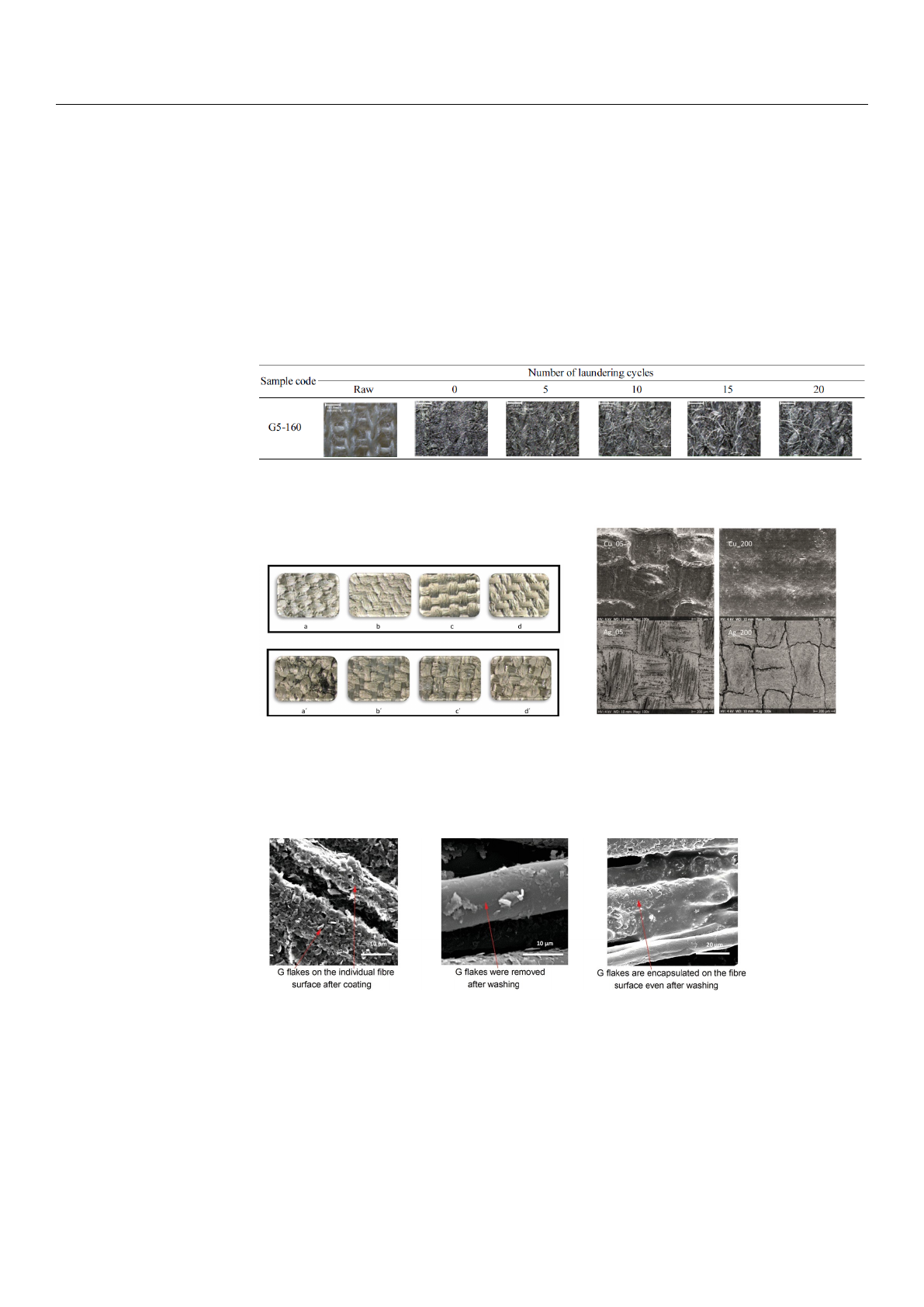
Kim et al. wash aramid textiles coated with a graphene and polyurethane (PU) composite.
After repeated washing, the graphene is (partially) lost and the fibers of the underlying
textile substrate loosened and entangled (see Figure 1a). The collision of the samples
with other materials during the washing process is suspected to be the reason [
30
]. When
testing the washing reliability of differently formulated, metal based conductive coatings,
Malm et al. observe a loss of and cracks in coating, with the severity of damages—and
subsequent increase in resistance—being strongly dependent on the formulation and
thickness of the coating (see Figure 1c) [
38
]. In woven fabric that is coated with graphene
based ink, Afroj et al. observe a loss of graphene flakes after washing, which results
in an increase in resistance (see Figure 1d) [
9
]. Shahariar et al. report crack formation
of varying severity in their printed-on silver-based paste, as well as a delamination of
the paste from the substrates [
45
]. Other sources also suspect the loss of conductive coating
or ink as the reason for increased resistance after washing [
10
,
48
]. In a larger study with two
types of silver-based conductive ink printed onto 14 different woven textiles, Kazani et al.
observe a lost ink and resulting increased resistance for all samples, with differing severity
dependent on the material combinations (see Figure 1b) [
29
]. Screen printed antennas
in another publication by Kazani et al. also exhibit cracks after washing [67].
3.2. Damages to Metallization Layers
Failures that are similar to those described in the previous section occur when washing
metallized yarns and textiles. Cai et al. measure the silver content of the washing water of
their metallized textile and observe an increase after several cycles, indicating a gradual
loss of the silver coating [
64
]. Dhanawansha et al. also observe lost silver, but find
that, with an increasing number of washing cycles, the amount of silver lost decreases,
which suggests that silver loss is greatest during the first few washing cycles [
65
]. In one
publication, the loss of metallization is suspected to be the reason for increased resistance
after washing, but not further investigated [
53
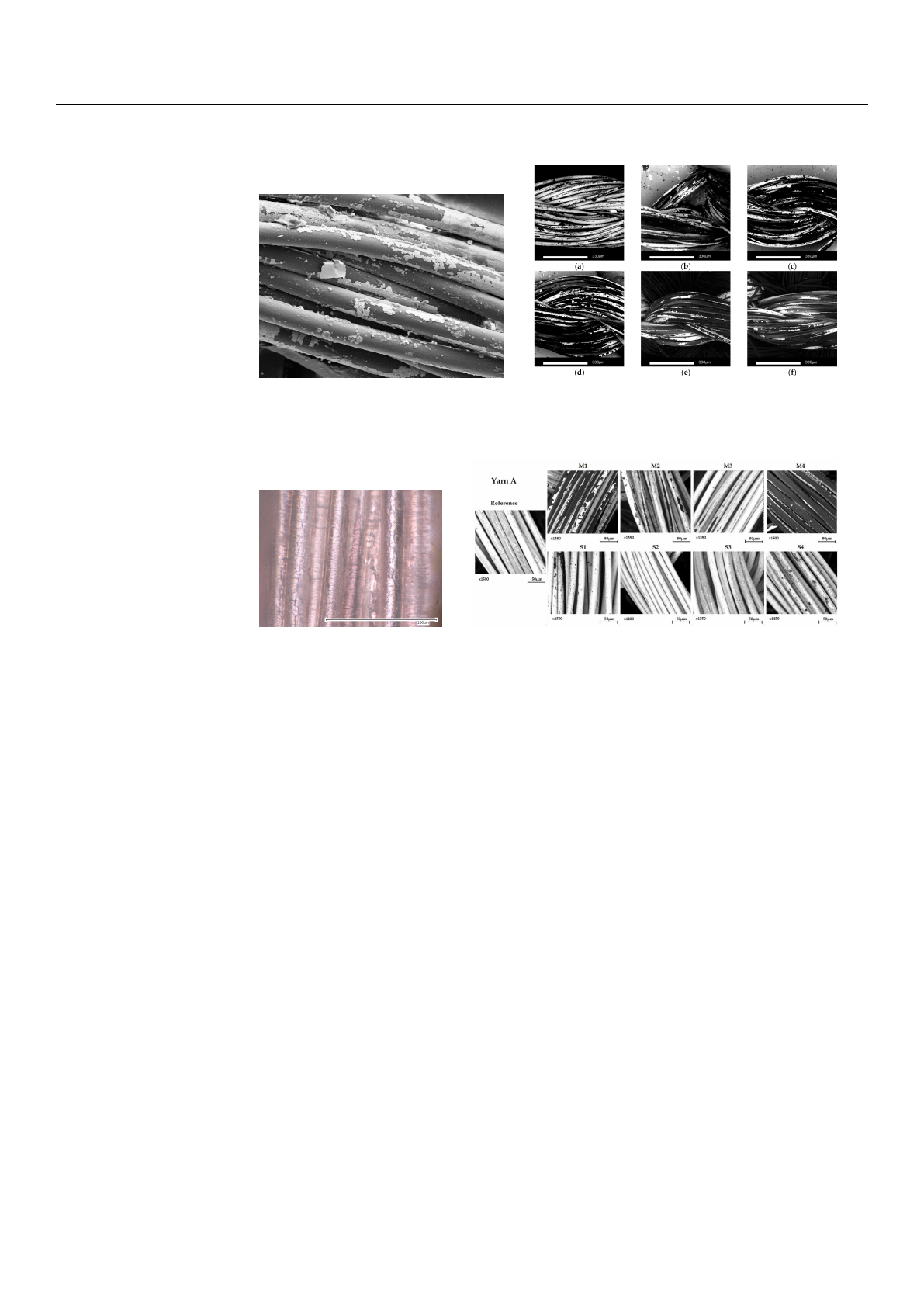
]. Rotzler observes a loss of the metallization
layer for knitted silver coated nylon fabric, which is dependent on the employed washing
program
(see Figure 2a) [42].
Similar observations are made by Gerhold [
20
] and Foerster,
who supposes the friction between the test samples and other textiles during washing
is responsible for the loss of metallization [
18
]. Other studies with similar damages to
metallized yarns include Tao et al. and Gaubert et al. They observe that the amount of lost
metallization increases with the number of washing cycles (see Figure 2b) [
49
], and it is
dependent on the washing parameters (see Figure 2d) [
19
]. Lee et al. find the amount of
metal lost, and related increase in resistance, is dependent on the combination of involved
Textiles 2021,140
materials [
34
]. uz Zaman et al. presume that mechanical wear is responsible for peeled
off and abraded metal layers in metallized nylon fabric [
50
–
52
]. When washing gold and
copper coated yarns, Schwarz observes cracks in and a loss of metallization, also suspecting
mechanical forces as the main cause [
43
]. Depending on the washing conditions, cracks
in the metallization can even occur when the conductive textile is covered by a protective
layer of thermoplastic polyurethane (TPU) (see Figure 2c), as a study by Rotzler et al. shows.
The authors reason that, due to the conductive textile being covered by a protective layer,
mechanical wear and abrasion are not the main cause of damages. Cyclic temperature
changes during washing are more damaging to the silver layer, due to a mismatch of
the thermal expansion coefficient in the involved materials [1].
(
a
) Loss of coating and roughing of textile surface after repeated washing. (Adapted with permission
from [30]. Copyright 2018 Springer Nature)
(
b
) Conductive ink on textiles before (upper row)
and after (lower row) washing. (Reprinted with
permission from [
29
]. Copyright 2012 Fibers and
Textiles in Eastern Europe)
(
c
) Damage dependent on coating com-
position and thickness (upper row:
copper based,
5µm
&
200µm
; lower
row: silver based,
5µm
&
200µm
).
(Reprinted from [38])
(
d
) Loss of graphene flakes after laundering, less pronounced with TPU coating.
(Adapted from [9])
Figure 1. Examples of damages to conductive textile coatings after washing.
Textiles 2021,141
(
a
) Depleated silver layer on nylon fila-
ments. (Reprinted from[42])
(
b
) Increased loss of metallization dependent
on wash cycle ((a)-(f): before washing, af-
ter 5,10,20,40,50 cycles). (Reprinted from [49])
(
c
) Cracks in metallization
layer of TPU encaspu-
lated conductive textiles.
(Reprinted from [42])
(
d
) Amount of loss of metallization dependent on washing
parameters (1-4: detergent with bleach, detergent without
bleach, no detergent, bleaching agent; M: machine wash, S:
soaking). (Adapted from [19])
Figure 2. Examples of loss of metallization after washing.
3.3. Damages to Wires, Conductive Tracks and Connections
When washing strips of flexible circuit board woven into textiles, Komolafe et al.
observe cracks in the copper tracks, located only at the transition zone between tracks
and bond pads, identifying these zones as weak points of the circuit [
57
]. Hardy et al.
wash different e-yarns of similar composition—wires that are wrapped around a textile
core, with and without added functional components. They see wire breakages along
the whole length of yarns, as well as broken and torn off wires at the added components,
see
Figure 3c [22].
Rotzler et al. conduct a washability study with different types of conduc-
tive tracks. In tracks made from meander shaped copper foil embedded in thermoplastic
polymer (so-called stretchable circuit boards, SCB), they observe breakages in the copper
mostly at the transition from conductive tracks to contacting pads, see Figure 3b, as well as
near the added dummy interposer. Torn litz wires occur in conductive yarn, embroidered
onto the textile substrates using the tailored fibre placement (TFP) technique, see
Figure 3a
.
Similar to the results for the SCB tracks, the torn wires occur at a larger number at the con-
tacting points and the interposer, and to a lesser extent along the length of the tracks [
1
].
SCB tracks that were washed by Veske et al. also exhibit breakages in the tracks, located
exclusively at the top and bottom of the meander shapes of the tracks, see Figure 3d [
62
].
Tao et al. register an increase in broken litz wires corresponding to the number of wash
cycles. Another failure mode occurring are broken contacts between the embroidered and
interwoven tracks and added LEDs [49].
When washing PU coated copper wires that were knitted into textiles, Li et al. observe
breakages of the wires, leading to an increase in the resistance or complete electrical failure.
The authors suspect the mechanical strain during washing and resulting deformation of
Loading more pages...