The
Reagan
Effect:
Self-presentation
in
humans
and
computers
ROLAND
POSNER
In
the
sports section
of a
German newspaper
we
read:
It
is a
long
and
rocky
road.
But the
world boxing champion Henry Maske
appears
to
have already come
a
long way.
The
Light Heavyweight Champion
says
of
himself:
'Now
I am
more like
the
Henry Maske
that
I
really
am'.
(Der
Tagesspiegel,
December
11,
1993:
12)
The
author
of the
article explains what Maske meant:
The
positive
image
that
he has
built
up
during
his
four
short years
as a
professional
boxer
should
now pay
off'.
A
fashion consultant instructs
us:
'If
I no
longer know where
I
stand
and
why,
I
have
to at
least
be
standing
in a
positive
light'
(Sommer
and
Wind
1991: 213).
He
justifies
this theoretically
as
follows:
The
external presentation
of the
self
no
longer conveys
Ί
am
such
and
such',
but
rather
Ί
could
be
such
and
such'.
The
expression becomes
a
simple impres-
sion. This
is
evidenced
in
politics:
The
politician simulates
a
person
who is
fighting
for
certain
purposes,
the
professional simulates
a
person
who has the
profession
that
he or she is
currently carrying out. Whether this
is
his/her profes-
sion
is not
important: What counts
is the
professional execution,
the
impressive
performance.
A
psychoanalyst writes about
a
colleague:
I
have never
met
another analyst,
who ... was
more unavoidably himself
than
Donald
W.
Winnicott.
This
invulnerable
way of
being himself made
it
possible
for
him to be a
different
person
to
each
of the
most
different
kinds
of
people.
Those
who
have
met him had
their
own
Winnicott. Winnicott never threatened
the
pictures that
the
others
had
made
of him by
trying
to
force
his own way of
being
on
them.
And
that
is why he
always remained
so
unyieldingly himself:
Winnicott. (Khan 1977: 348)
Let
me
assume that
you are
willing
to
participate
in a
discourse
of
this
type. Then
you
might
ask
yourself along with
me:
what does
it
mean
Semiotica
128-3/4
(2000),
445-486
0037-1998/00/0128-0445
©
Walter
de
Gruyter
Bereitgestellt von | Technische Universität Berlin
Angemeldet
Heruntergeladen am | 11.10.18 15:42
446
R.
Posner
'to
be
unavoidably
oneself
— is not
everyone this?
How can
'being
invulnerably
oneself
lead someone
to be
seen
differently
by
every
other
person?
How can
someone
be
'unyieldingly
himself
by not
forcing
'his
own way of
being'
on
others?
These
questions
lay out the
subject
of the
following deliberations.
My
topic
is the
self
as a
reality, that
is,
another's self
as
well
as
your
own
self.
As you
will
see,
the
creation
of a
reality such
as
this
involves
self-
presentation
and
self-development,
simulation
and
illusion. Therefore,
I
will
examine
in the first
part
of
this paper
the
types
of
selves;
in the
second
part,
the
kinds
of
presentation;
and in the
third
part,
the
processes
of
self-presentation.
In
doing
so, and in
accordance with
a
success-
ful
strategy
of
artificial intelligence research,
I
will
talk about people:
people like
you and me. I
will
generalize
the
results, however,
so
that they
can be
applied
to all
interactive cognitive systems. This
will
allow
me to
define
the
minimum requirements
that
a
cognitive system must meet
in
order
to
develop
a
self.
To
gain
a
clearer understanding,
it is
helpful
to
keep
a
specific
person
and a
certain cognitive system
in
mind.
In the
latter case, just consider
your
PC and ask
yourself
how you
would have
to
improve
its
hardware
and
software
so
that
you
could regard
it as
unavoidably, invulnerably,
and
unyieldingly
being itself
in the
manner described
by the
psychoanalyst.
Ronald Reagan
as
self-presenter
As
an
example
of a
human cognitive system
I
have chosen
a
person,
whom
you all
know through
the
media
— the
greatest self-presenter
of
the
eighties:
the
stage performer, radio announcer, football reporter,
movie star, labor leader, corporate spokesman, politician
in the
roles
of
Governor-maker, Governor
of
California
(1967-1974),
President
of
the
United States
(1980-1988),
and
elder statesman Ronald
W.
Reagan
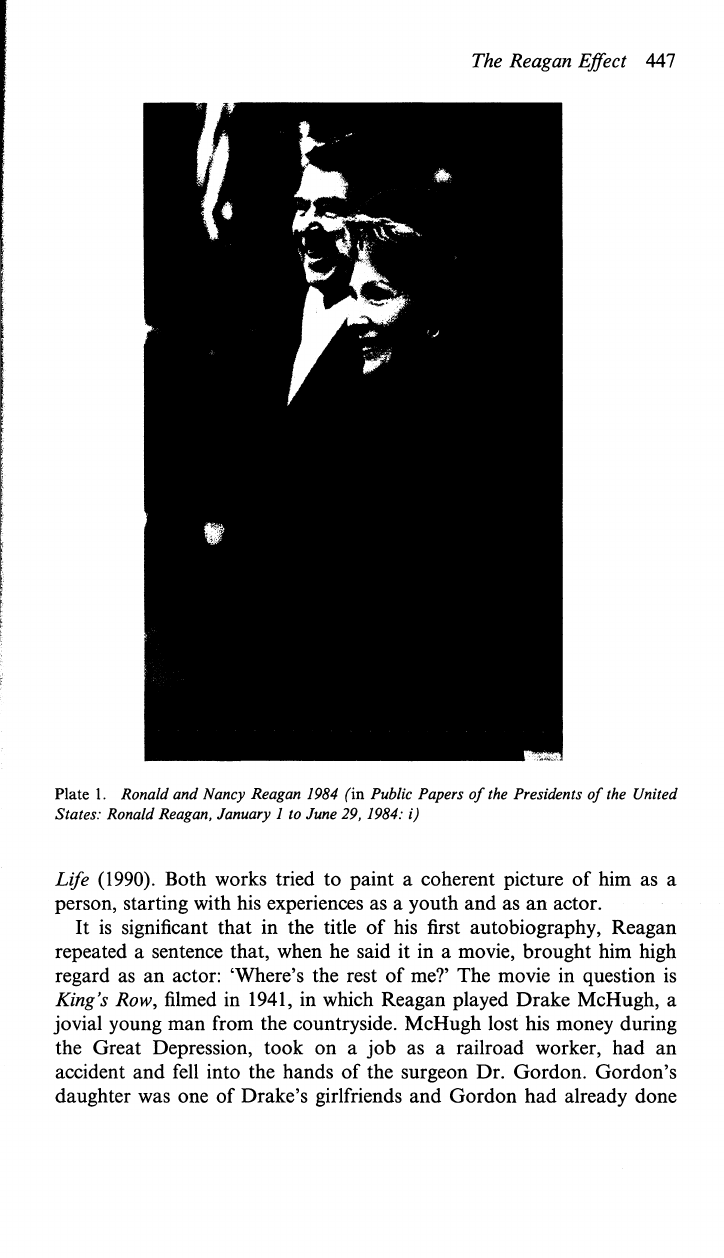
(shown
in
Plate
1
together with
his
wife,
Nancy).
Does this person have
a
self
at
all?
you
might ask.
Was he not a
ball
bounced around
in
changing contexts?
Did he
ever have
a
personality
of
his
own?
If he
really
did
practice
self-presentation, what
was it
that
he
presented?
His own
personality
or the one
that each
different
role
provided
him
with:
the
role
as an
actor,
as a
reporter,
as an
official,
as
a
politician?
As
a
public person, Reagan
did not
manage
his
self
carelessly.
He
wrote
(or had
others write)
two
autobiographies
and he
encouraged
a
number
of
authors
to
write
his
biography.
His first
autobiography
was
titled
Where's
the
Rest
of Me?
(1965)
and the
second,
An
American
Bereitgestellt von | Technische Universität Berlin
Angemeldet
Heruntergeladen am | 11.10.18 15:42
The
Reagan
Effect
447
Plate
1.
Ronald
and
Nancy
Reagan 1984
(in
Public
Papers
of
the
Presidents
of the
United
States:
Ronald
Reagan,
January
1 to
June
29,
1984:
i)
Life
(1990).
Both works tried
to
paint
a
coherent picture
of him as a
person, starting with
his
experiences
as a
youth
and as an
actor.
It is
significant
that
in the
title
of his first
autobiography, Reagan
repeated
a
sentence
that,
when
he
said
it in a
movie, brought
him
high
regard
as an
actor:
'Where's
the
rest
of
me?'
The
movie
in
question
is
King's
Row,
filmed in
1941,
in
which Reagan played Drake McHugh,
a
jovial young
man
from
the
countryside. McHugh
lost
his
money during
the
Great Depression, took
on a job as a
railroad worker,
had an
accident
and
fell
into
the
hands
of the
surgeon
Dr.
Gordon.
Gordon's
daughter
was one of
Drake's
girlfriends
and
Gordon
had
already done
Bereitgestellt von | Technische Universität Berlin
Angemeldet
Heruntergeladen am | 11.10.18 15:42
448
R.
Posner
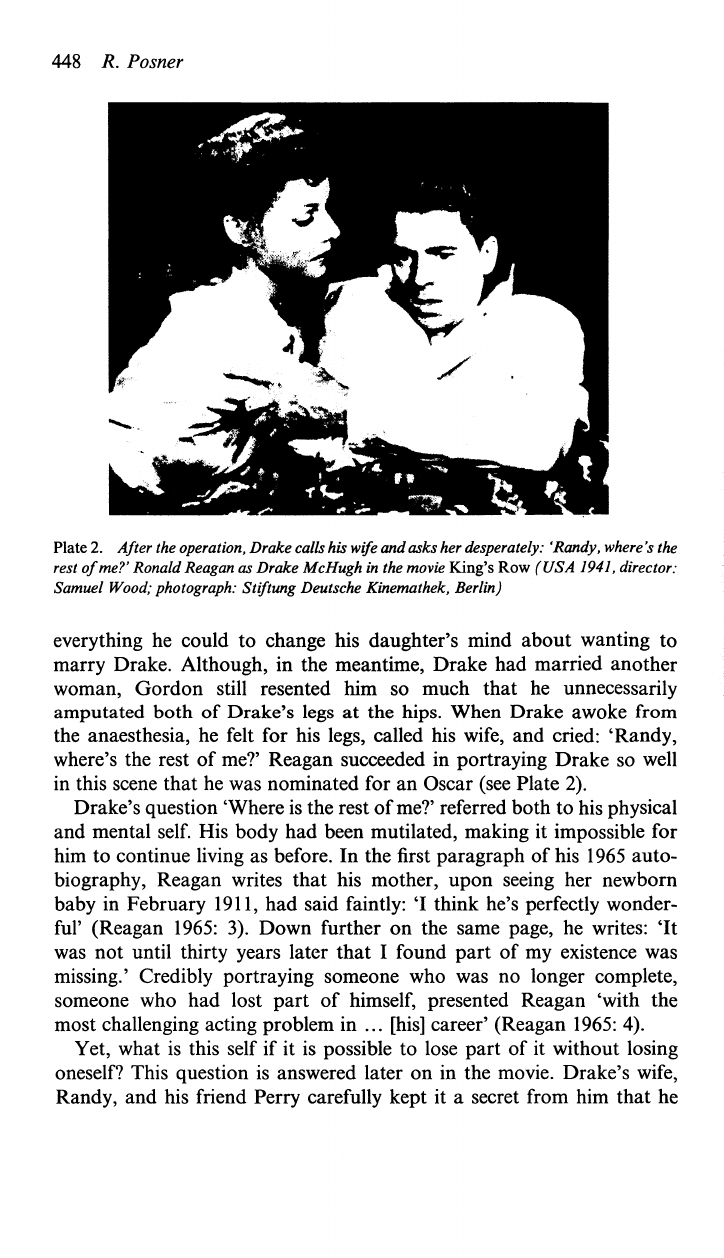
Plate
2.
After
the
operation, Drake
calls
his
wife
and
asks
her
desperately:
'Randy,
where
's
the
rest
of
me?'
Ronald Reagan
as
Drake
McHugh
in the
movie
King's
Row
(USA 1941, director:
Samuel
Wood;
photograph:
Stiftung
Deutsche
Kinemathek,
Berlin)
everything
he
could
to
change
his
daughter's
mind about wanting
to
marry Drake. Although,
in the
meantime, Drake
had
married another
woman,
Gordon still resented
him so
much that
he
unnecessarily
amputated both
of
Drake's
legs
at the
hips. When Drake awoke
from
the
anaesthesia,
he
felt
for his
legs, called
his
wife,
and
cried:
'Randy,
where's
the
rest
of
me?'
Reagan succeeded
in
portraying Drake
so
well
in
this scene that
he was
nominated
for an
Oscar (see Plate
2).
Drake's
question
'Where
is the
rest
of
me?'
referred both
to his
physical
and
mental self.
His
body
had
been mutilated, making
it
impossible
for
him
to
continue living
as
before.
In the first
paragraph
of his
1965
auto-
biography, Reagan writes
that
his
mother, upon seeing
her
newborn
baby
in
February
1911,
had
said faintly:
Ί
think he's perfectly wonder-
ful'
(Reagan 1965:
3).
Down further
on the
same page,
he
writes:
'It
was
not
until thirty years later
that
I
found part
of my
existence
was
missing.'
Credibly portraying someone
who was no
longer complete,
someone
who had
lost
part
of
himself, presented Reagan
'with
the
most challenging acting problem
in
...
[his]
career'
(Reagan 1965:
4).
Yet, what
is
this self
if it is
possible
to
lose part
of it
without losing
oneself?
This question
is
answered later
on in the
movie. Drake's
wife,
Randy,
and his
friend
Perry carefully kept
it a
secret
from
him
that
he
Bereitgestellt von | Technische Universität Berlin
Angemeldet
Heruntergeladen am | 11.10.18 15:42
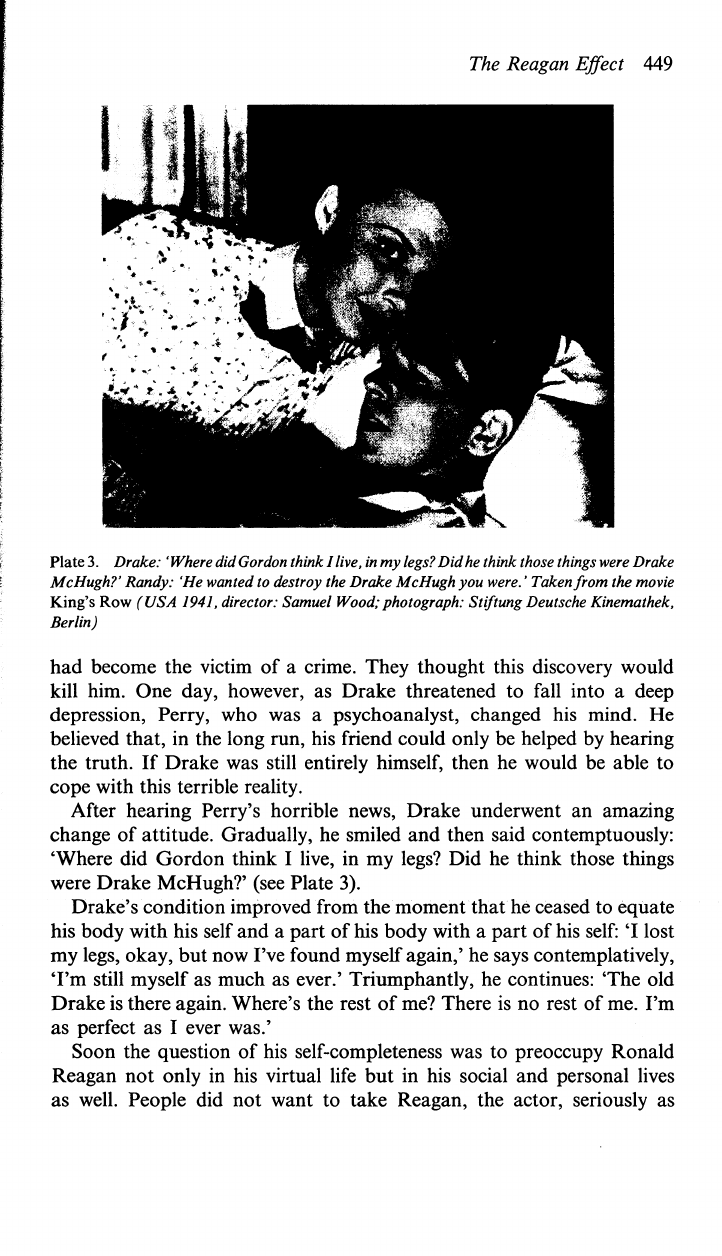
The
Reagan
Effect
449
Plate
3.
Drake:'
Where
did
Gordon
think
I
live,
in my
legs?
Did he
think those things were Drake
McHugh?'
Randy:
'He
wanted
to
destroy
the
Drake
McHugh
you
were.'
Taken
from
the
movie
King's
Row
(USA 1941, director: Samuel Wood; photograph: Stiftung Deutsche
Kinemathek,
Berlin)
had
become
the
victim
of a
crime. They thought this discovery would
kill
him.
One
day, however,
as
Drake
threatened
to
fall
into
a
deep
depression, Perry,
who was a
psychoanalyst, changed
his
mind.
He
believed
that,
in the
long run,
his
friend could only
be
helped
by
hearing
the
truth.
If
Drake
was
still entirely himself, then
he
would
be
able
to
cope with this terrible reality.
After
hearing Perry's horrible news, Drake underwent
an
amazing
change
of
attitude. Gradually,
he
smiled
and
then said contemptuously:
'Where
did
Gordon
think
I
live,
in my
legs?
Did he
think those things
were
Drake
McHugh?'
(see Plate
3).
Drake's
condition improved
from
the
moment that
he
ceased
to
equate
his
body with
his
self
and a
part
of his
body with
a
part
of his
self:
Ί
lost
my
legs, okay,
but now
I've found myself
again,'
he
says contemplatively,
Tm
still myself
as
much
as
ever.'
Triumphantly,
he
continues:
'The
old
Drake
is
there again. Where's
the
rest
of me?
There
is no
rest
of me. I'm
as
perfect
as I
ever
was.'
Soon
the
question
of his
self-completeness
was to
preoccupy Ronald
Reagan
not
only
in his
virtual
life
but in his
social
and
personal lives
as
well. People
did not
want
to
take Reagan,
the
actor, seriously
as
Bereitgestellt von | Technische Universität Berlin
Angemeldet
Heruntergeladen am | 11.10.18 15:42
Loading more pages...