
Citation: Nitsche, B.; Mensah, H.K.;
Straube, F.; Barigye, V. Leveraging the
Potential of the African Continental
Free Trade Area: Logistics Challenges
and Development Paths for Future
Value Chains in Africa. Logistics 2024,
8, 25. https://doi.org/10.3390/
logistics8010025
Academic Editor: Robert Handfield
Received: 15 November 2023
Revised: 13 February 2024
Accepted: 23 February 2024
Published: 29 February 2024
Copyright: © 2024 by the authors.
Licensee MDPI, Basel, Switzerland.
This article is an open access article
distributed under the terms and
conditions of the Creative Commons
Attribution (CC BY) license (https://
creativecommons.org/licenses/by/
4.0/).
logistics
Article
Leveraging the Potential of the African Continental Free Trade
Area: Logistics Challenges and Development Paths for Future
Value Chains in Africa
Benjamin Nitsche 1,* , Henry Kofi Mensah 2, Frank Straube 1and Vianney Barigye 3
1Chair of Logistics, Institute of Technology and Management, Technische Universität Berlin,
10623 Berlin, Germany
2Department of Human Resource and Organisational Development, School of Business, Kwame Nkrumah
3Department of Procurement, Logistics and Transport, College of Business and Economics, University of
*Correspondence: [email protected]
Abstract: Background: With a rapidly growing young population, the African continent provides a
high but barely exploited economic potential. Creating an African free trade zone is one of the African
Union’s major initiatives to increase prosperity. Even though the AfCFTA has already come into
force, its potential has not yet been fully exploited. This study investigates the logistics challenges
associated with the AfCFTA and potential solutions and development paths for future value chains.
Methods: The study builds upon a two-stage research process. First, applying the Nominal Group
Technique with a group of 19 industry experts, current challenges and strategies to deal with them
are conducted, and statements about potential development paths emerging from the AfCFTA are
synthesized. Second, a questionnaire among additional industry experts is done to assess the results
of the first stage. Results: The article sheds light on the barely untapped field of logistics challenges
hindering the AfCFTA to leverage its potential. Strategy fields to address current challenges are
explained, and the first indications of how the AfCFTA will shape supply chains in the mid-term
are outlined. Conclusions: The article underlines the importance of logistics in the development of
pan-African value chains and highlights potential development paths that may arise in the medium
term. It also emphasizes the growing need for cooperation between politics, business, and research to
overcome current logistics challenges and leverage the potential of the AfCFTA.
Keywords: free trade; Africa; international logistics networks; supply chains; trade agreements;
regional value chains; intra-continental trade
1. Introduction
The African Continental Free Trade Area (AfCFTA) is one of the world’s most ambi-
tious and promising trade agreements. While trade between African countries has long
been possible only with major hurdles and, above all, costs, the agreement aims to create
one of the largest free trade areas in the world [
1
]. If this succeeds, there will be great
potential for the reorganization of value creation networks and the associated logistics
networks. There are currently about 1.2 billion people living on the African continent. This
number is expected to double by 2050, creating a very young population that will need jobs,
prosperity, and political and economic stability. The AfCFTA can play an important role in
helping to achieve this. Duty-free access to a huge market will encourage manufacturers
and service providers in different industries to take advantage of economies of scale and
will attract foreign investors to create regional value-creation structures [2–4].
Intracontinental trade is important to create a stable economic region and to stop being
too dependent on exports from other regions. Currently, intra-African trade accounts for
Logistics 2024,8, 25. https://doi.org/10.3390/logistics8010025 https://www.mdpi.com/journal/logistics

Logistics 2024,8, 25 2 of 16
about 15% of total trade. Comparing this figure with other economic regions, a large gap
is noticeable. For example, intracontinental trade is 61% in Asia and 67% in Europe [
5
].
Suppose the project to generate an African free trade area succeeds. In that case, this can
help Africa grow as a continent, connect Africa with the world, and integrate it more than
currently into international value creation systems.
Previous studies on the AfCFTA have prominently focused on assessing and quantifying
its future potential in intra-African trade, often taking a macroeconomic perspective [
6
–
9
].
And even though the role of logistics in intra-African trade and the development of regional
value chains is undisputed, there are hardly any studies from a logistics point of view that
outline the current logistics challenges of the AfCFTA that should be overcome for regional
value chains to be formed.
The impact of logistics on the development of the African continent under the AfCFTA
is huge, but there is little discussion on the different impacts of the AfCFTA on more and
less developed member AfCFTA states, especially concerning the logistics and supply chain
industry [
10
,
11
]. The logistics challenges, especially in sub-Saharan Africa, are immense [
12
–
14
]
but often left out of the conversation when discussing the potential of the AfCFTA. The pure
availability of a trade agreement does not necessarily result in regional or intra-African logistics
and value-creation networks. Such an agreement has to be more understood as a basis for
those developments, but additional barriers need to be removed to exploit the full potential. To
address the dearth of research on the role of logistics in the AfCFTA, the study aims to examine
current logistics challenges associated with the AfCFTA, including a discussion of the strategies
to overcome these challenges. Finally, building on industry experts, statements about potential
development paths for future supply chains emerging from the AfCFTA are summarized
and assessed. Within this study, logistics challenges are understood as barriers that hinder
companies from building regional or intra-African value chains despite the availability of the
trade agreement. The study aims to contribute to the following research objectives (RO):
RO1:
What are the current logistics challenges that hinder companies from leveraging the full
potential of the AfCFTA?
RO2:
What are the key strategies to overcome those challenges?
RO3:
What potential development paths for future logistics networks emerge from the AfCFTA?
The remainder of the article is structured as follows: In the next section, the theoretical
background of the AfCFTA and the role of logistics is outlined. Here, a brief history of
the AfCFTA, in combination with recent literature in the field, is presented. In the next
section, the research design is explained and how it contributes to the above-mentioned RO.
Afterward, in Section 4, the logistics challenges (RO1) and associated strategies (RO2) to
overcome them are outlined, based on a moderated group exercise applying the Nominal
Group Technique (NGT) among 19 logistics and supply chain professionals. Moreover,
in this section, a discussion of potential development paths emerging from the AfCFTA
is presented (RO3), based on a questionnaire among 41 logistics and supply chain profes-
sionals to gather insights on emerging developments from a logistics point of view. In
the following section, the implications of the results for industrial practice, governmental
actors as well as researchers in this field are discussed. The article closes with Section 6that
points out the limitations of this research and proposes potential future research fields.
2. Theoretical Background
The AfCFTA, established by the African Union (AU), is a comprehensive legal pact
designed to bolster continental economic integration and enhance intra-trade, aiming to
improve African nations’ socioeconomic development [
15
]. As a coalition, the AfCFTA
endeavors to forge a unified African market and drive intra-African trade by dismantling
trade barriers among member states [
16
]. This accord is anticipated to bolster deeper
economic integration, promote competitiveness within domestic industries, streamline re-
source allocation, and enhance the region’s attractiveness for foreign direct investment [
17
].
Additionally, it represents a strategic step forward in industrialization and overall economic
advancement across Africa [
18
]. The AfCFTA is poised to simplify, align, and enhance

Logistics 2024,8, 25 3 of 16
coordination among trade frameworks, mitigating challenges stemming from overlapping
trade agreements across the continent [
17
]. The agreement establishes a single market by
eliminating tariffs and non-tariff obstacles, thereby supporting industrial capacity devel-
opment, creating continental value chains, promoting intra-African trade, and creating
jobs [19]. The AfCFTA promotes economic progress and prosperity in Africa.
Furthermore, the AfCFTA, as a regional bloc, presents a distinct and fertile ground for
impactful international business research, with its inception sparking a surge in scholarly
studies examining its execution, results, advantages, and hurdles [
16
]. Encompassing a
market of approximately 1.2 billion individuals and a Gross Domestic Product (GDP) of
USD 3.4 trillion, the AfCFTA holds substantial potential to foster robust cooperation and
trade ties among African nations [
18
]. The AfCFTA seeks to facilitate trade creation and
diversification, potentially enhancing collaboration and commerce across the continent [
17
].
The agreement enhances Africa’s long-term competitiveness with a focus on job generation,
industrial growth, and investment promotion [
16
]. Foreseen to exert a significant influence
across various sectors, including industrial and manufacturing expansion, intra-African col-
laboration, tourism, and broader economic growth, the AfCFTA stands as a transformative
initiative [15].
Previous studies conducted by Fiorini et al. (2023) [
20
] indicate that the liberalization
of service trade yields beneficial outcomes for both the manufacturing and service sectors.
Similarly, research by [
21
] suggests that the agreement has the potential to uplift one
million individuals from poverty and increase national incomes, albeit certain nations may
encounter challenges related to food security. There is no doubt that the agreement will be
accompanied by increased movement of people, goods, services, and capital, serving as an
additional catalyst for growth in the region.
Effectively executing the AfCFTA policy requires significant improvement in logistics
and supply chain infrastructure across the region [
22
]. It is also essential to establish a logis-
tics framework tailored to Africa’s socioeconomic landscape and cultural nuances to ensure
the successful implementation of the AfCFTA policy [
23
]. For instance, it is reported that
the establishment of efficient and dependable transportation systems encompassing roads,
railways, and ports; robust and resilient supply chain networks with less cumbersome
trade facilitation procedures is imperative for facilitating seamless movement of goods
across African nations [22].
Despite the burgeoning academic interest in AfCFTA, studies remain quiet on exam-
ining its implication on logistics and supply chains. Existing studies have predominantly
focused on potential economic benefits and challenges across various sectors, inadvertently
overlooking the pivotal role of the logistics sector within the context of the AfCFTA [
16
].
There is a noticeable dearth of research dedicated explicitly to examining how the im-
plementation of the AfCFTA agreement affects supply chain management and logistics
operations [
15
]. This gap in the literature prompts inquiries into the intricate relationship
between the AfCFTA and logistics frameworks within Africa’s distinct socioeconomic and
political context. Additionally, the current literature does not comprehensively explore how
the AfCFTA can optimize its supply chain and logistics processes [
15
]. Again, scholarly
works tend to be primarily conceptual and offer varied perspectives on the implications
of the AfCFTA [
24
,
25
]. Even more worrying is the apparent quietness on the differential
impact of AfCFTA on developed versus less developed member states, particularly con-
cerning the supply chain and logistics sector [
10
,
11
]. Against this backdrop, this study
attempts to address these gaps by investigating the logistical challenges associated with
the AfCFTA and proposing potential solutions and developmental pathways for future
supply chains.
Despite the potential benefits of the AFCFTA, various problems must be addressed,
particularly in the logistics industry. The AfCFTA faces significant challenges in providing
economic infrastructure to allow trade between member nations [
26
]. Moreover, AfCFTA
faces significant hurdles, including language barriers, diverse currencies, porous borders,
external interference, political instability, inadequate human development and infrastruc-

Logistics 2024,8, 25 4 of 16
ture, and a state-centric approach to integration initiatives [
27
]. AfCFTA may consider
developing efficient and reliable transportation networks encompassing roads, railways,
and ports to facilitate seamless trade among African nations and reduce transportation
expenses [
22
]. Additionally, AfCFTA could allocate resources towards establishing logistics
infrastructure such as warehouses, distribution centers, and cold chains. Further, this initia-
tive would help mitigate spoilage and enhance the quality of traded goods [
23
]. Moreover,
as indicated by [
28
], AfCFTA should streamline and standardize border trade procedures to
facilitate the seamless movement of goods across African nations, thereby reducing both the
time and costs associated with customs formalities and paperwork. Furthermore, AfCFTA
must actively encourage participation by businesses and civil society in the integration
process [
27
]. Such engagement could foster the development of inclusive and responsive
logistics infrastructure tailored to the needs of African populations. Moreover, according
to [
29
], the AfCFTA can potentially encourage the uptake of digital technologies such as
electronic data exchange and electronic customs management systems. This adoption could
enhance logistical efficiency and reduce trade expenses.
The AfCFTA is a monumental step towards fostering economic integration and growth
across the African continent. By providing a platform for increased trade and investment,
the AfCFTA aims to leverage the principles of international trade to benefit member coun-
tries and promote sustainable development. However, to fully harness the potential of
this agreement, addressing logistics challenges is crucial. Efficient transportation, mod-
ernized customs procedures, and improved infrastructure are essential for seamless trade
facilitation and effective implementation of the AfCFTA. As the agreement continues to
evolve and more African countries join the initiative, leveraging logistics will play a pivotal
role in making the AfCFTA a catalyst for economic transformation and prosperity across
the continent.
3. Methodology
The research design of this study is based on a multi-stage process that aims to
systematically extract knowledge and perceptions of logistics and supply chain managers
in a structured process and to assess the results afterward. More precisely, the research
process is divided into an industry group exercise based on the Nominal Group Technique
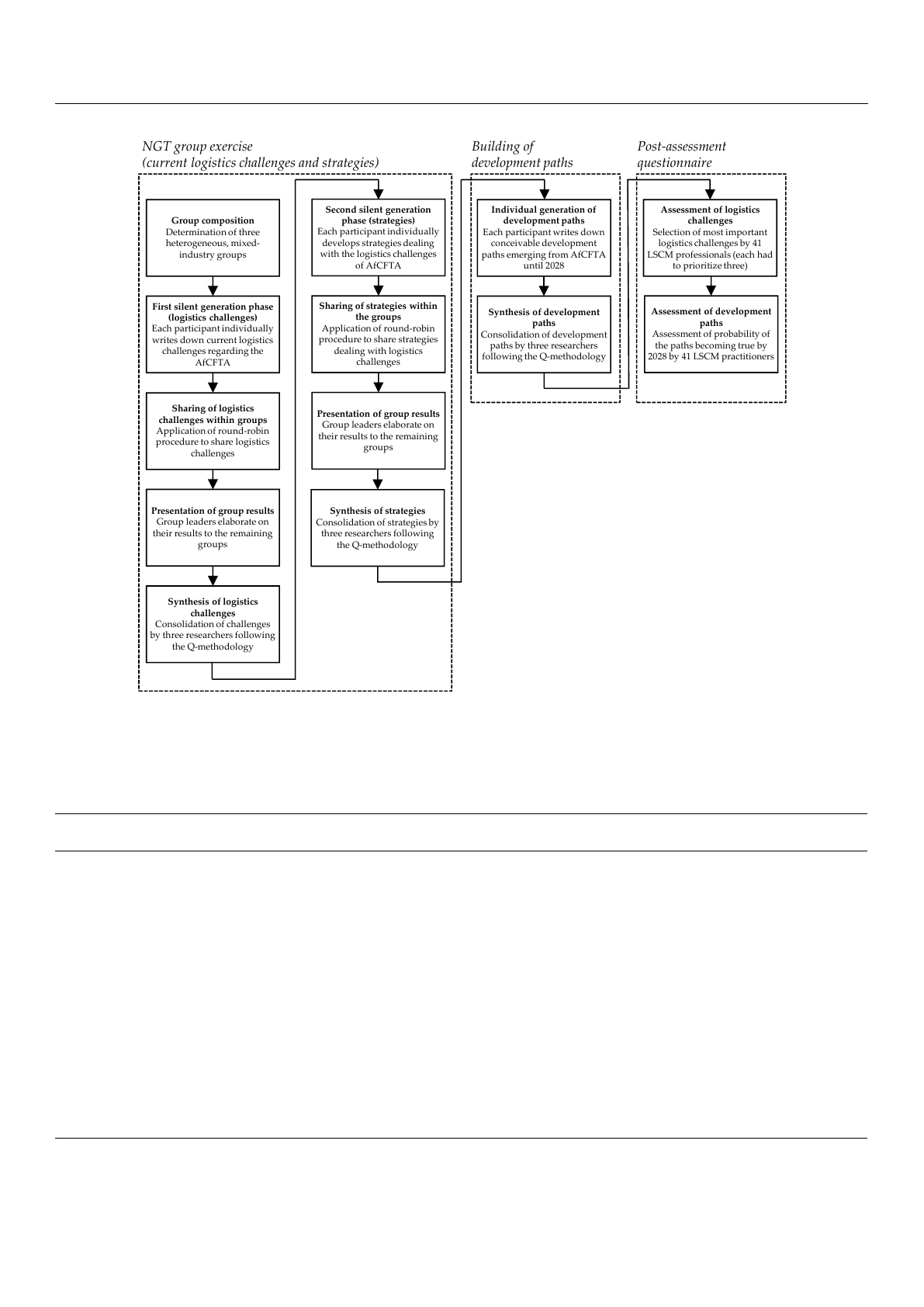
(NGT) and a post-workshop questionnaire. The research process is shown in Figure 1.
NGT group exercise: From a methodological point of view, group exercises in qualitative
social research are divided into focus groups, Delphi groups, and nominal groups. While
participants in Delphi panels do not meet in person and no interaction is foreseen [
30
],
focus groups are in contrast to this. For focus groups, a bias could occur from the open
discussions on set topics if less confident participants of the group do not contribute to the
discussion to the same extent [
31
]. The NGT is positioned between both approaches and
tries to simultaneously mitigate the shortcomings of Delphi and focus groups [
32
]. Due to
the advantages of NGT over other group exercise methods, it is often used in qualitative
logistics and supply chain research to systematically extract practitioner knowledge in an
inductive bottom-up approach [33,34].
To set up an expert panel to discuss the current logistics challenges that hinder compa-
nies from leveraging the full potential of the AfCFTA, 19 experienced logistics and supply
chain managers have been invited to an on-site meeting in Kigali, Rwanda, in September
2022. Managers participating in the panel were coming from different industrial back-
grounds. This setup was designed intentionally to bring insights from different industries
and views into the discussion about this vital but less-researched topic. To set a group of
experienced managers that can contribute to the topic, we directly invited companies (and
institutions) to propose people who have a good understanding of current AfCFTA devel-
opments, have at least two years of experience in the logistics and supply chain domain
and—if coming from companies—are responsible for redesigning logistics networks in
their companies under the new AfCFTA opportunities.
Logistics 2024,8, 25 5 of 16
Logistics 2024, 8, x FOR PEER REVIEW 5 of 17
Figure 1. Research procedure (own illustration).
To set up an expert panel to discuss the current logistics challenges that hinder com-
panies from leveraging the full potential of the AfCFTA, 19 experienced logistics and sup-
ply chain managers have been invited to an on-site meeting in Kigali, Rwanda, in Septem-
ber 2022. Managers participating in the panel were coming from different industrial back-
grounds. This setup was designed intentionally to bring insights from different industries
and views into the discussion about this vital but less-researched topic. To set a group of
experienced managers that can contribute to the topic, we directly invited companies (and
institutions) to propose people who have a good understanding of current AfCFTA devel-
opments, have at least two years of experience in the logistics and supply chain domain
and—if coming from companies—are responsible for redesigning logistics networks in
their companies under the new AfCFTA opportunities.
The sample demographics of the panel participants can be seen in Table 1.
Table 1. Sample demographics of NGT group exercise.
No.
Industry Type
Number of
Employees
Annual Turnover
Participant Management
Level
Years of Professional
Experience
1
Manufacturing, machinery
Up to 50
prefer not to say
Team member
2
2
Manufacturing, consumer
goods
Up to 50
50–250 m €
General manager
10
3
Logistics service provider
51–250
10–50 m €
Member of the board
20
4
Association
Up to 50
n/a
Department manager
5
5
Raw material industry
51–250
prefer not to say
Team member
2
First silent generation phase
(logistics challenges)
Each participant individually
writes down current logistics
challenges regarding the
AfCFTA
Group composition
Determination of three
heterogeneous, mixed-
industry groups
Sharing of logistics
challenges within groups
Application of round-robin
procedure to share logistics
challenges
Presentation of group results
Group leaders elaborate on
their results to the remaining
groups
Synthesis of logistics
challenges
Consolidation of challenges
by three researchers following
the Q-methodology
Second silent generation
phase (strategies)
Each participant individually
develops strategies dealing
with the logistics challenges
of AfCFTA
Sharing of strategies within
the groups
Application of round-robin
procedure to share strategies
dealing with logistics
challenges
Presentation of group results
Group leaders elaborate on
their results to the remaining
groups
Synthesis of development
paths
Consolidation of development
paths by three researchers
following the Q-methodology
Individual generation of
development paths
Each participant writes down
conceivable development
paths emerging from AfCFTA
until 2028
NGT group exercise
(current logistics challenges and strategies)
Building of
development paths
Assessment of logistics
challenges
Selection of most important
logistics challenges by 41
LSCM professionals (each had
to prioritize three)
Synthesis of strategies
Consolidation of strategies by
three researchers following
the Q-methodology
Assessment of development
paths
Assessment of probability of
the paths becoming true by
2028 by 41 LSCM practitioners
Post-assessment
questionnaire
Figure 1. Research procedure (own illustration).
The sample demographics of the panel participants can be seen in Table 1.
Table 1. Sample demographics of NGT group exercise.
No. Industry Type Number of
Employees Annual Turnover Participant
Management Level
Years of Professional
Experience
1 Manufacturing, machinery Up to 50 prefer not to say Team member 2
2 Manufacturing, consumer goods Up to 50 50–250 m €General manager 10
3 Logistics service provider 51–250 10–50 m €Member of the board 20
4 Association Up to 50 n/a
Department manager
5
5 Raw material industry 51–250 prefer not to say Team member 2
6 Governmental organization More than 10,000 n/a Team leader 19
7 Manufacturing, textile Up to 50 10–50 m €General manager 2
8 Logistics service provider Up to 50 50–250 m €General manager 2
9 Raw material industry 251–500 50–250 m €
Department manager
3
10 Manufacturing, textile 51–250 Up to 10 m €
Department manager
5
11 Manufacturing, machinery 51–250 Up to 10 m €General manager 7
12 Logistics service provider Up to 50 50–250 m €General manager 18
13 Logistics service provider Up to 50 prefer not to say Team member 20
14 Consulting Up to 50 Up to 10 m €Team leader 16
15 Logistics service provider Up to 50 50–250 m €
Department manager
11
16 Governmental organization Up to 50 n/a Team member 2
17 Raw material industry Up to 50 prefer not to say General manager 8
18 Manufacturing, textile Up to 50 50–250 m €
Department manager
5
19 Raw material industry 51–250 10–50 m €Member of the board 22
The NGT process separates the problem identification and the problem solution into
two separate discussion rounds. In the specific case of this study, in the first NGT round,
Loading more pages...