
REVIEW
www.advancedscience.com
Perovskite BaTaO2N: From Materials Synthesis to Solar
Water Splitting
Mirabbos Hojamberdiev,* Ronald Vargas, Fuxiang Zhang, Katsuya Teshima,
and Martin Lerch
Barium tantalum oxynitride (BaTaO2N), as a member of an emerging class of
perovskite oxynitrides, is regarded as a promising inorganic material for solar
water splitting because of its small band gap, visible light absorption, and
suitable band edge potentials for overall water splitting in the absence of an
external bias. However, BaTaO2N still exhibits poor water-splitting
performance that is susceptible to its synthetic history, surface states,
recombination process, and instability. This review provides a comprehensive
summary of previous progress, current advances, existing challenges, and
future perspectives of BaTaO2N for solar water splitting. A particular
emphasis is given to highlighting the principles of photoelectrochemical (PEC)
water splitting, classic and emerging photocatalysts for oxygen evolution
reactions, and the crystal and electronic structures, dielectric, ferroelectric,
and piezoelectric properties, synthesis routes, and thin-film fabrication of
BaTaO2N. Various strategies to achieve enhanced water-splitting performance
of BaTaO2N, such as reducing the surface and bulk defect density, engineering
the crystal facets, tailoring the particle morphology, size, and porosity, cation
doping, creating the solid solutions, forming the heterostructures and
heterojunctions, designing the photoelectrochemical cells, and loading
suitable cocatalysts are discussed. Also, the avenues for further investigation
and the prospects of using BaTaO2N in solar water splitting are presented.
M. Hojamberdiev, M. Lerch
Institut für Chemie
Technische Universität Berlin
Straße des 17. Juni 135, 10623 Berlin, Germany
E-mail: [email protected]
R.Vargas
InstitutoTecnológicodeChascomús(INTECH)–ConsejoNacionalde
InvestigacionesCientíficasyTécnicas(CONICET)
UniversidadNacionaldeSanMartín(UNSAM)
AvenidaIntendenteMarino,Km8,2,(B7130IWA),Chascomús,Provincia
deBuenosAiresArgentina
The ORCID identification number(s) for the author(s) of this article
can be found under https://doi.org/10.1002/advs.202305179
© 2023 The Authors. Advanced Science published by Wiley-VCH GmbH.
This is an open access article under the terms of the Creative Commons
Attribution License, which permits use, distribution and reproduction in
any medium, provided the original work is properly cited.
DOI: 10.1002/advs.202305179
1. Photoelectrochemical (PEC)
Water Splitting
To tackle the rising global energy demand
and to reduce greenhouse gas emissions
from the combustion of diminishing fos-
sil fuels, the development of renewable en-
ergy is indispensable. Hydrogen is regarded
as a potential zero-emission energy car-
rier with the highest gravimetric energy
density (120 MJ kg−1) despite its low vol-
umetric energy density (8 MJ L−1)[1] and
it can play a vital role in the successful
implementation of the Paris Agreement,[2]
which is essential for the achievement of
the 17 United Nations Sustainable De-
velopment Goals. However, the current
global hydrogen production still heavily
relies on fossil fuels (>95%), which is
the cheapest option in most parts of the
world.[3,4] Solar-driven water splitting is one
of the most environmentally benign chem-
ical processes to convert abundant solar en-
ergy into storable and transportable green
hydrogen.[5–8] Solar-driven water splitting
proceeds over cocatalyst-assisted semicon-
ductor according to three consecutive steps
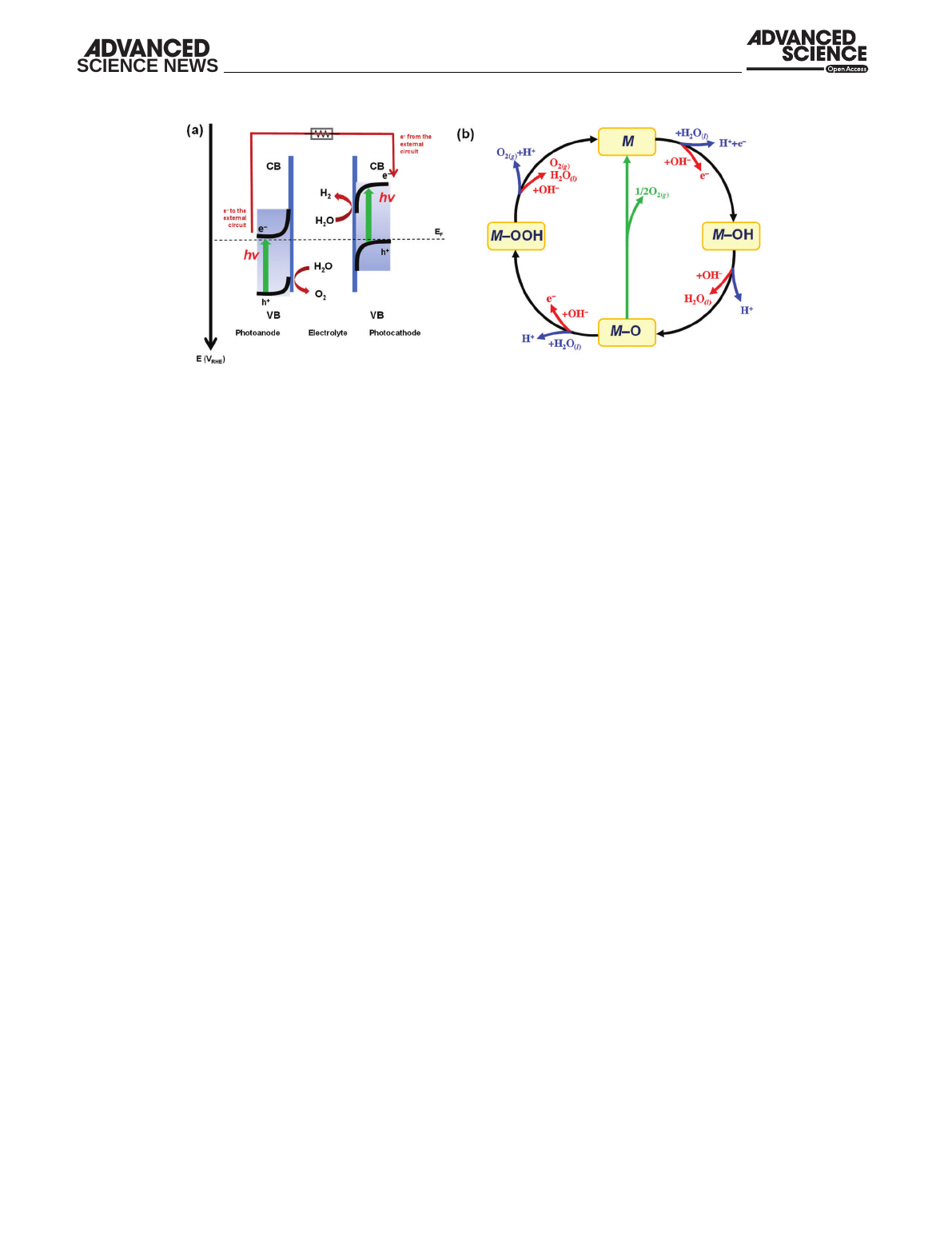
(Figure 1a): i) the absorption of pho-
tons with higher energy values to excite
R. Vargas
Escuela de Bio y Nanotecnologías
Universidad Nacional de San Martín (UNSAM)
Avenida Intendente Marino, Km 8,2, (B7130IWA), Chascomús, Provincia
de Buenos Aires Argentina
F. Zhang
State Key Laboratory of Catalysis
iChEM
Dalian Institute of Chemical Physics
Chinese Academy of Sciences
Dalian National Laboratory for Clean Energy
Dalian 116023, P.R. China
K. Teshima
Department of Materials Chemistry
Shinshu University
4-17-1 Wakasato, Nagano 3808553, Japan
K. Teshima
Research Initiative for Supra-Materials
Shinshu University
4-17-1 Wakasato, Nagano 3808553, Japan
Adv. Sci. 2023,10, 2305179 © 2023 The Authors. Advanced Science published by Wiley-VCH GmbH
2305179 (1 of 47)
www.advancedsciencenews.com www.advancedscience.com
Figure 1. a) Working principle of the photoelectrochemical cell for water splitting using a photoanode and a photocathode. b) OER mechanism for acid
(blue line) and alkaline (red line) conditions. The black and green lines indicate that the oxygen evolution involves the formation of a peroxide (M–OOH)
intermediate and the direct reaction of two adjacent oxo (M–O) intermediates, respectively. Reproduced with permission.[16] Copyright 2017, The Royal
SocietyofChemistry.
electrons from the valence band to the conduction band, ii) the
separation and transfer of photo-excited charge carriers (elec-
trons and holes) from the bulk to the surface of the semiconduc-
tor, and iii) the initiation of water redox reactions by the involve-
ment of photo-excited charge carriers[9]:
Hydrogen evolution reaction (HER):
2H++2e−→H2(acidic media)(1)
2H2O+2e−→H2+2OH−(alkaline media)(2)
Oxygen evolution reaction (OER):
2H2O→O2+4e−+4H+(acidic)(3)
4OH−→O2+4e−+2H2O(alkaline)(4)
Particularly, photoelectrochemical (PEC) water splitting is a
powerful yet complex process, where the redox potentials for the
decomposition of water determine the required band gap energy
and band-edge potentials for semiconductors to be used as pho-
toanodes and photocathodes. However, to efficiently and sustain-
ably split water into H2and O2, several key criteria must be met
simultaneously: i) sufficient voltage must be generated upon irra-
diation to split water, ii) the bulk band gap must be small enough
to absorb a significant portion of the solar spectrum, iii) for the
unbiased operation of a PEC cell, the band edge potentials at
the surfaces must straddle the hydrogen and oxygen redox po-
tentials (the conduction band minimum must be more negative
than E0(H+/H2)=0 V versus RHE at pH 0 and the valence band
maximummustbemorepositivethanE0(O2/H2O) =1.23 V ver-
sus RHE at pH 0), iv) the system must be stable for a long period
of reaction time, v) charge transfer from the semiconductor sur-
face to the electrolyte must be facile to minimize energy losses,
and vi) low-cost and earth-abundant elements must be used.[10]
In addition to these important requirements, the photoelec-
trode materials must exhibit at least >10% solar-to-hydrogen
(STH) conversion efficiency for their commercial viability.[11] The
U.S. Department of Energy estimated the cost of green hydrogen
produced by the PEC process to be US$5.7 kg−1in 2020 (with a
20% STH efficiency) and to lower to US$2.1 kg−1(with a 25%
STH efficiency) in the more distant future.[12] It has also been
suggested that the STH efficiency of 25% and the photoelectrode
lifetime of 10 years are required for the PEC systems to be eco-
nomically consistent with fossil fuel-based hydrogen production
processes.[13] Recently, monolithic systems and integrated PEC
modules under light concentration reached STH efficiencies as
high as 17.12%[14] and 19%.[15] However, the high capital and
operational costs significantly hamper their economic viability.
To date, no cost-effective and highly efficient PEC systems have
been developed to satisfy all those key criteria despite significant
progress in this field. Thus, further studies are necessary to dis-
cover novel materials with unprecedented physicochemical and
optoelectronic properties that can simultaneously meet those key
criteria set for the design and application of the PEC system for
green hydrogen production.
As one of the two key reactions of overall water splitting,
the water oxidation reaction proceeds via the following gen-
eral steps (Figure 1b)[16]: i) water dissociation and formation of
surface-bonded OHads, ii) the further oxidation of OHads to Oads,
and iii) the formation of OOHads, which is a precursor for O2
evolution[17,18]:
H2O⇄OHads +H++e−(5)
OHads ⇄Oads +H++e−(6)
H2O+Oads ⇄OOHads +H++e−(7)
OOHads ⇄O2+H++e−(8)
Using first-principles periodic density functional theory (DFT)
calculations, Man et al.[19] proposed that the binding energies of
reaction intermediates (e.g., HO*, O*, and HOO*) are responsi-
ble for the origin of OER activity over select oxide surfaces. When
the binding energy of oxygen is quite high, the OER overpoten-
tial is limited by the formation of HOO* species, and otherwise,
the formation of HO* species is dominant. Therefore, various
Adv. Sci. 2023,10, 2305179 © 2023 The Authors. Advanced Science published by Wiley-VCH GmbH
2305179 (2 of 47)
21983844, 2023, 33, Downloaded from https://onlinelibrary.wiley.com/doi/10.1002/advs.202305179 by Technische Universitaet Berlin, Wiley Online Library on [06/12/2023]. See the Terms and Conditions (https://onlinelibrary.wiley.com/terms-and-conditions) on Wiley Online Library for rules of use; OA articles are governed by the applicable Creative Commons License
www.advancedsciencenews.com www.advancedscience.com
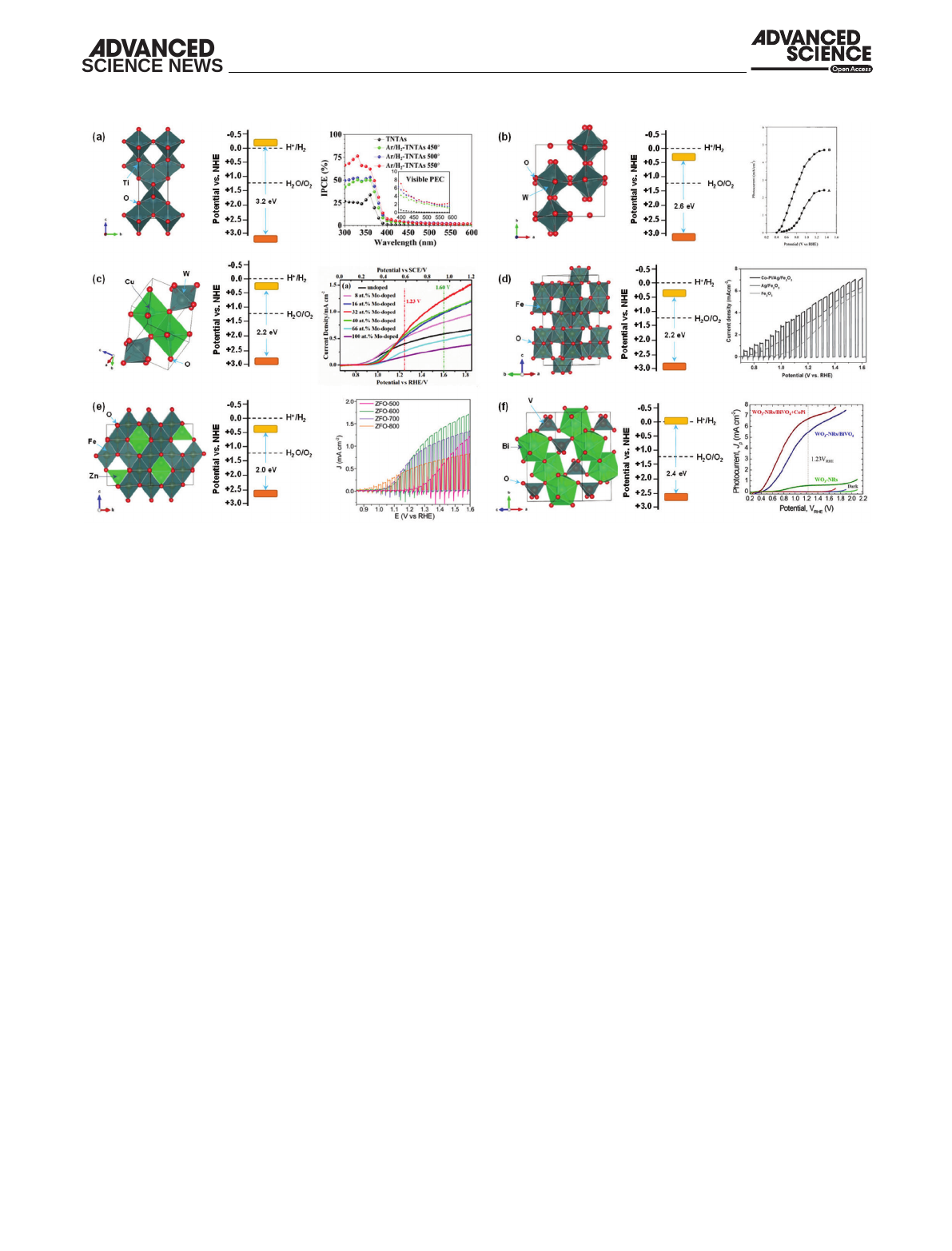
Figure 2. a) Crystal and band structures of TiO2and IPCE spectra of reduced TiOxnanotube arrays before and after Ar/H2treatment at different
temperatures. Reproduced with permission.[30] Copyright 2017, WILEY-VCH Verlag GmbH & Co. KGaA. b) Crystal and band structures of WO3and
photocurrent-potential plots for a 2-μm-thick WO3electrode illuminated with AM 1.5G simulated sunlight: in 1 M aq. HClO4(curve A) and after the
addition of 0.1 mol dm 0−3of methanol (curve B). Reproduced with permission.[36]. Copyright 2001, American Chemical Society. c) Crystal and band
structures of CuWO4and linear potential sweep curves of the doped CuWO4nanoflake photoanodes with different Mo doping concentrations. Re-
produced with permission.[39] Copyright 2019, Elsevier. d) Crystal and band structures of Fe2O3and photoelectrochemical performance of Fe2O3,
Ag/Fe2O3,andCo-Pi/Ag/Fe
2O3photoelectrodes under chopped light illumination in 1 M NaOH (pH 13.6). Reproduced with permission.[47] Copyright
2016, WILEY-VCH Verlag GmbH & Co. KGaA. e) Crystal and band structures of ZnFe2O4and linear scanning J–V curves of ZnFe2O4photoanodes
in 1 M NaOH under intermittent 1 sun illumination (100 mW cm−2). Reproduced with permission.[51] Copyright 2018, WILEY-VCH Verlag GmbH &
Co. KGaA. f) Crystal and band structures of BiVO4and I-V characteristics of the optimized WO3-nanorods (green), WO3-nanorods/BiVO4(blue) and
WO3-nanorods/BiVO4+CoPi (red) samples. Reproduced with permission.[56] Copyright 2015, Springer Nature AG & Co. KGaA.
strategies to stabilize HOO* species compared with HO* species
were developed.[20] The suitable photoanodes must satisfy the
expected conditions: ΔG(OHads)=CO=1.23 eV, ΔG(Oads)=2×
CO=2.46 eV, and ΔG(OOHads)=3×Co =3.69 eV.[18] The water
oxidation reaction requires the transfer of four electrons and four
protons, which needs high overpotential, with the simultaneous
formation of the O–O bond in comparison to the two-electron-
transfer water reduction reaction.[21] Therefore, water oxidation
is thermodynamically and kinetically more challenging than
water reduction. As shown in Figure 1b, a sufficient amount of
energy must be supplied in each step to drive the water oxidation
reaction. Thus, it leads to high energy barriers and slow kinetics
in addition to the uphill reaction thermodynamics.[22] A sluggish
water oxidation reaction is the rate-determining step that gov-
erns the reaction rate of water splitting.[23] The water oxidation
reaction is generally enhanced by modifying the photoanodes
with oxygen evolution cocatalysts that promote the efficient
charge separation of photo-excited electron-hole pairs.[24]
According to the three basic stages of water splitting, the effi-
ciency of the water oxidation reaction is mainly determined by the
light absorption, the separation efficiency of photo-excited charge
carriers, and the surface catalytic reaction[9]:
𝜂=𝜂absorption ×𝜂separation ×𝜂reaction (9)
which can be controlled by modulating the physicochemical, op-
toelectronic, and surface properties of n-type semiconductors.
Also, the valence band edge potentials of photocatalysts must be
more positively positioned than that of E0(O2/H2O) and the water
oxidation active sites must be sufficient on the photocatalyst sur-
face to hinder the recombination of photo-excited electrons and
holes.[25]
2. Oxide-Based Photocatalysts for PEC OER
Since the first successful demonstration of solar-induced unas-
sisted water splitting over a TiO2photoanode by Honda and
Fujishima,[26] a large number of studies have been conducted
to maximize the STH efficiency of various heterogeneous oxide-
based semiconductors but few have shown relatively outstanding
water oxidation performance and stability. The overview of some
n-type oxide semiconductors for PEC OER is shown in Figure 2
and Table 1.[27]
TiO2is one of the most widely studied oxide semiconductors
because of its low cost, chemical stability, earth abundance,
non-corrosiveness, and non-toxicity. TiO2typically exists in
three crystalline structures: anatase (tetragonal, I41/amd), rutile
(tetragonal, P42/mnm), and brookite (orthorhombic, Pbca). In
addition to other factors, the STH efficiency of TiO2depends
Adv. Sci. 2023,10, 2305179 © 2023 The Authors. Advanced Science published by Wiley-VCH GmbH
2305179 (3 of 47)
21983844, 2023, 33, Downloaded from https://onlinelibrary.wiley.com/doi/10.1002/advs.202305179 by Technische Universitaet Berlin, Wiley Online Library on [06/12/2023]. See the Terms and Conditions (https://onlinelibrary.wiley.com/terms-and-conditions) on Wiley Online Library for rules of use; OA articles are governed by the applicable Creative Commons License

www.advancedsciencenews.com www.advancedscience.com
Table 1. Overview of some n-type oxide semiconductors for PEC OER.
Compound Structure type and
symmetry
Band gap Theoretical STH efficiency
and photocurrent density
Performance/efficiency Limitations Reference
TiO2Tetragonal anatase,
I41/amd
3.2 eV 1.3%,
1.1 mA cm−2
75% IPCE fast recombination rate, rapid backward
reaction, and a large overpotential for
HER, and bandgap limits the STH
efficiency to ≈1%
[29–31]
WO3Monoclinic, P21/n2.6 eV 4.8%,
3.9 mA cm−2
75% IPCE,
2.4 mA cm−2at 1.23 V vs RHE
rapid recombination rate, slow charge
transfer at semiconductor/electrolyte,
a restricted light absorption up to
450 nm, instability at pH>5, and
limited theoretical STH efficiency
[31, 36]
CuWO4Triclinic distorted
wolframite, P
1
2.2 eV ≈13%,
10.7 mA cm−2
>20% IPCE,
≈0.15-0.16 mA cm−2,
and 0.62 mA cm−2at 1.23 V vs
RHE
low light absorption coefficient and
high bulk charge transfer resistance
[37–42]
𝛼-Fe2O3Trigonal corundum, R
3c2.0-2.2 eV 16.8%,
12.6 mA cm−2
≈18% IPCE,
≈6mAcm
−2at 1.23 V vs RHE,
≈40% IPCE, and ≈0.55% STH
a low absorption coefficient, short
excited-state lifetime, short
hole-diffusion length, low charge
carrier mobility, poor electric
conductivity, and poor OER kinetics
[44–47]
ZnFe2O4Cubic spinel, Fd
3m2.0 eV 20%,
≈11 mA cm−2
25% IPCE
1.0 mA cm−2at 1.23 V vs RHE
rapid surface and bulk recombination
rate and poor minority career
[49, 51]
BiVO4Monoclinic scheelite,
C2/c
2.4 eV 9.1%,
7.4 mA cm−2
6.72 mA cm−2at 1.23 V vs RHE,
≈90% IPCE, 8.1% STH, and
1.75% ABPE at 0.6 V vs RHE
high recombination rate, poor charge
transport properties, low carrier
collection efficiency, inadequate water
oxidation kinetics, and limited
theoretical STH efficiency
[31, 56, 58]
on its polymorphs. The photocatalytic overall water splitting
reaction can take place on rutile but hardly on anatase and
brookite and becomes feasible for anatase and brookite only
under prolonged UV light irradiation.[28] Recently, compact
anatase TiO2layers fabricated on the FTO by introducing a Ti
interlayer and suboxide TiO2nanotubes exhibited the highest
incident photon-to-current efficiency (IPCE) value of 75% at
300 nm[29] and 340 nm (Figure 2a),[30] respectively. Although
the anatase-TiO2polymorph has better electron mobility and
conductivity in comparison to the rutile-TiO2and brookite-TiO2
polymorphs, its theoretical STH efficiency and photocurrent
density can only reach the maximum of 1.3% and 1.1 mA cm−2,
respectively, because of wide optical bandgap energy of 3.2 eV.[31]
In addition to the low STH efficiency, a fast recombination
rate of photo-excited charge carriers, a rapid backward reaction
(recombination of H2and O2), and a large overpotential for the
HER also hamper the practical application of TiO2in solar water
splitting despite considerable progress.[32,33]
The monoclinic phase with space group P21/nis the most sta-
ble polymorph of WO3at room temperature and has a perovskite-
like structure without an A-site ion. Theoretical studies on the
correlation between the crystal structure and the band gap of
WO3revealed that the bandgap energy values of different WO3
polymorphs decrease in the following order: monoclinic >or-
thorhombic >triclinic >tetragonal ≥cubic.[34] Also, the struc-
tural modification by introducing the nitride ions into the lattice
of the monoclinic WO3phase led to the reduction of the bandgap
energy from 2.6 eV to 1.9 eV.[35] Highly transparent nanoporous
WO3films fabricated by layer-by-layer deposition of a colloidal so-
lution of tungstic acid and annealing exhibited a maximum IPCE
of 75% and a photocurrent density of 2.4 mA cm−2at 1.23 V ver-
sus RHE under simulated solar irradiation (Figure 2b).[36] How-
ever, the rapid recombination of photo-excited charge carriers,
slow charge transfer at the WO3/electrolyte, restricted light ab-
sorption up to 450 nm, instability at pH >5, and a theoreti-
cal STH efficiency of 4.8% and a photocurrent density of 3.9
mA cm−2still limit its application.[31]
To circumvent the drawbacks of WO3, triclinic CuWO4with
a distorted wolframite crystal structure (space group P
1) offers
a smaller bandgap energy and limits the formation of soluble
tungstates due to the strong covalency in the metal oxo bonds,
yielding higher photocurrent in neutral pH under visible light
irradiation.[37] The CuWO4photoanodes exhibited photocurrent
densities of ≈0.15–0.16 mA cm−2and 0.62 mA cm−2at the ther-
modynamic potential for water oxidation (1.23 V versus RHE) un-
der simulated solar irradiation (Figure 2c)[37–39] and an IPCE effi-
ciency of >20%.[40] Despite its theoretical STH efficiency of ≈13%
and photocurrent density of 10.7 mA cm−2, the PEC performance
of CuWO4is significantly hindered by its low light absorption co-
efficient and high bulk charge transfer resistance.[41,42]
𝛼-Fe2O3with a trigonal structure (space group R
3c) has been
intensively explored as a promising photoanode material for PEC
water splitting due to its small bandgap energy, suitable valence
band edge potential to thermodynamically drive the water oxida-
tion reaction, excellent stability under alkaline conditions, earth
abundance, and environmentally friendliness.[43,44] With the
reported bandgap energy of 2.0-2.2 eV, 𝛼-Fe2O3has the potential
to reach a theoretical maximum STH efficiency of 16.8% and a
Adv. Sci. 2023,10, 2305179 © 2023 The Authors. Advanced Science published by Wiley-VCH GmbH
2305179 (4 of 47)
21983844, 2023, 33, Downloaded from https://onlinelibrary.wiley.com/doi/10.1002/advs.202305179 by Technische Universitaet Berlin, Wiley Online Library on [06/12/2023]. See the Terms and Conditions (https://onlinelibrary.wiley.com/terms-and-conditions) on Wiley Online Library for rules of use; OA articles are governed by the applicable Creative Commons License

www.advancedsciencenews.com www.advancedscience.com
photocurrent density of 12.6 mA cm−2,[45] which manifestly
exceeds the STH benchmark efficiency of 10% required for
practical applications. The 𝛼-Fe2O3nanowires-based photo-
electrode, which was fabricated by a chemical bath deposition
method followed by hydrogen treatment and then loaded with
ultrathin TiO2overlayer and CoPi cocatalyst, exhibited a stable
photocurrent density of ≈6mAcm
−2at 1.23 V versus RHE
over 100 h under AM 1.5G simulated sunlight and an IPCE
value of ≈18% at 420 nm owing to its excellent light absorption
and bulk charge separation capacity, the enhanced electrical
conductivity, and the decreased surface recombination.[46] A
hematite nanosheets-based electrode modified by Ag and CoPi
nanoparticles showed an IPCE value of ≈40% at 420 nm and an
STH efficiency of ≈0.55% due to the improved light harvesting
and the facilitated charge transfer by Ag nanoparticles and the
reduction of surface/bulk recombination and the stabilization
of the photoelectrode surface by CoPi cocatalyst (Figure 2d).[47]
However, several limitations, such as low absorption coefficient
due to an indirect band gap, short excited-state lifetime (≈10−12
s), short hole-diffusion length (2-4 nm), low charge carrier mo-
bility (≈10–2 to ≈10–1 cm2V−1s−1), poor electric conductivity, and
poor OER kinetics still hinder achieving the practical maximum
STH efficiency of 𝛼-Fe2O3.[44,48]
Cubic spinel ZnFe2O4(space group Fd
3m) also received much
interest due to its narrow bandgap energy (Eg=1.9 eV), high en-
ergy level conduction band minimum, outstanding photochem-
ical stability, low cost, and magnetic recyclability.[49,50] Interest-
ingly, ZnFe2O4with a relatively poor crystallinity but a higher
spinel inversion degree (due to cation disorder) shows a superior
efficiency in photo-excited charge carrier separation and an im-
proved majority charge carrier transport compared to ZnFe2O4
with higher crystallinity but a lower inversion degree.[51] The op-
timization of these factors and the addition of a nickel-iron cocat-
alyst overlayer resulted in a new benchmark photocurrent den-
sity of 1.0 mA cm−2at 1.23 V versus RHE, and an IPCE value
of about 25% was reached for ZnFe2O4nanorod photoanode
(Figure 2e).[51] At potentials between 0.8 and 1.3 V versus RHE,
ZnFe2O4can exhibit a considerably higher charge transfer effi-
ciency due to a slower surface charge recombination rate.[52] De-
spite its maximum theoretical STH efficiency of about 20% and
a photocurrent density of ≈11 mA cm−2,[49,51] the efficiency of
ZnFe2O4is substantially limited by a rapid surface and bulk re-
combination rate of photo-excited charge carriers and poor mi-
nority career.
BiVO4crystallizes in three different polymorphs: monoclinic
scheelite, tetragonal scheelite, and tetragonal zircon. The mon-
oclinic scheelite BiVO4(space group C2/c)isann-type semi-
conductor with a direct bandgap energy of 2.4 eV and a valence
band edge potential of ≈2.4 V versus RHE, which is sufficiently
positive than E0(O2/H2O) =1.23 V versus RHE.[53,54] Therefore,
the monoclinic scheelite BiVO4shows the highest photocatalytic
water oxidation activity among the three polymorphs.[55] Apho-
tocurrent density of 6.72 mA cm−2at 1.23 V versus RHE and
an IPCE of ≈90% were achieved by the combination of BiVO4
with more conductive WO3nanorods in the form of core-shell
heterojunction (Figure 2f).[56] The high recombination rate of
photo-excited charge carriers was significantly reduced by creat-
ing a thin absorber layer of BiVO4, which was thinner than the
carrier diffusion length. The tandem device constructed with a
GaAs/InGaAsP solar cell exhibited an STH efficiency of 8.1%.[56]
The charge separation efficiency of 97.1% and charge trans-
fer efficiency of 90.1% at 1.23 V versus RHE were obtained by
engineering the hierarchical nanoporosity of BiVO4,[57] and an
applied bias photon-to-current conversion efficiency (ABPE) of
1.75% was found at a potential as low as 0.6 V versus RHE for
nanoporous BiVO4photoanodes.[58] However, the water oxida-
tion efficiency of BiVO4is still limited by a high electron-hole
recombination rate, poor charge transport properties, a low car-
rier collection efficiency, inadequate water oxidation kinetics, and
the bandgap energy limiting an AM 1.5G solar photocurrent den-
sity to 7.4 mA cm−2and an STH efficiency to 9.1%.[31]
Despite their encouraging and relatively outstanding perfor-
mance achieved so far, TiO2,WO
3,CuWO
4,Fe
2O3,ZnFe
2O4,and
BiVO4alone are unlikely to satisfy the criteria set for ensuring the
practical application in solar to chemical energy conversion. This
paved the way for the development of novel materials, including
mixed-anion compounds, for PEC applications.
3. Crystal and Electronic Structures of Perovskite
BaTaO2N
Mixed-anion compounds, containing more than one anionic
species in a single phase, are an emerging class of advanced
materials with the potential to contribute to solar fuel produc-
tion in the future.[59] Unlike single-anion compounds, mixed-
anion compounds exhibit diverse structures, chemical and phys-
ical properties, and new functionalities because of different an-
ionic characteristics, such as ionic radii, valency, electronegativ-
ity, and polarizability.[60] Also, the combination of hetero-anions
can realize the structures of compounds that cannot be gener-
ally stabilized by homo-anions. Especially, to develop photocat-
alytic materials that can efficiently function under visible light,
anions less electronegative than oxygen can be simultaneously
introduced. Having similar chemical, structural, and electronic
properties, oxygen and nitrogen substitute each other in the an-
ion site to form oxynitrides.[61] In oxynitrides, the nitride anions
(N3−) having atomic orbitals with potential energy higher than O
2p atomic orbitals of the oxide anions (O2−) shift the valence band
maximum upward without affecting the conduction band mini-
mum, leading to the increased covalency of metal-anion bonds,
the improved absorption property, and the decreased optical band
gap (Figure 3a).[62,63] Also, most d0transition metal oxynitrides
can absorb photons with absorption band edges in the range of
500–760 nm and have theoretical STH conversion efficiencies in
the range of 8–32% and suitable conduction and valence band
edge potentials straddling the proton reduction and water oxida-
tion reaction potentials, respectively, and can drive the overall wa-
ter splitting reaction (Figure 3b).[64]
As a typical representative of the AB(O,N)3perovskites,
BaTaO2N is regarded as one of the promising photocatalysts
for solar water splitting due to its absorption of visible light up
to 660 nm, small bandgap energy (Eg=1.9 eV), good stability
under light irradiation in concentrated alkaline solutions, and
nontoxicity.[65] Moreover, the conduction band minimum and
valence band maximum of BaTaO2N are located at –0.4 V and
1.5 V versus NHE at pH 0, respectively, which should theoret-
ically drive the water-splitting reaction in the absence of an ex-
ternal bias.[66] BaTaO2N can generate a photocurrent density of
Adv. Sci. 2023,10, 2305179 © 2023 The Authors. Advanced Science published by Wiley-VCH GmbH
2305179 (5 of 47)
21983844, 2023, 33, Downloaded from https://onlinelibrary.wiley.com/doi/10.1002/advs.202305179 by Technische Universitaet Berlin, Wiley Online Library on [06/12/2023]. See the Terms and Conditions (https://onlinelibrary.wiley.com/terms-and-conditions) on Wiley Online Library for rules of use; OA articles are governed by the applicable Creative Commons License
Loading more pages...