
water
Article
Water Lice and Other Macroinvertebrates in Drinking Water
Pipes: Diversity, Abundance and Health Risk
Günter Gunkel 1,2,* , Ute Michels 2,3 and Michael Scheideler 2,4
Citation: Gunkel, G.; Michels, U.;
Scheideler, M. Water Lice and Other
Macroinvertebrates in Drinking
Water Pipes: Diversity, Abundance
and Health Risk. Water 2021,13, 276.
https://doi.org/10.3390/w13030276
Academic Editor: Avi Ostfeld
Received: 23 December 2020
Accepted: 20 January 2021
Published: 24 January 2021
Publisher’s Note: MDPI stays neutral
with regard to jurisdictional claims in
published maps and institutional affil-
iations.
Copyright: © 2021 by the authors.
Licensee MDPI, Basel, Switzerland.
This article is an open access article
distributed under the terms and
conditions of the Creative Commons
Attribution (CC BY) license (https://
creativecommons.org/licenses/by/
4.0/).
1Department of Water Quality Control, Berlin University of Technology, 10623 Berlin, Germany
2INWERT Institute for Biological Drinking Water Quality, 45721 Haltern am See, Germany;
3AquaLytis, 15745 Wildau, Germany
4Scheideler Dienstleistungen, 45721 Haltern am See, Germany
*Correspondence: guenter.gunkel@water-quality-control.de
Abstract:
Activities to ensure and maintain water quality in drinking water networks, including
flushing, are presented after standardized hydrant sampling combined with a stainless-steel low
pressure–high flow rate (NDHF) filter and a 100
µ
m mesh size was used to separate pipe inhabitants.
A databank of more than 1000 hydrant samples in European lowland areas was developed and
used to analyze the diversity and abundance of macroinvertebrates in drinking water networks.
Load classes for water louse (Asellus aquaticus) and oligochaetes are given with three evaluation
classes: normal colonization, increased colonization, and mass development. The response of Asellus
aquaticus in drinking water networks to environmental conditions are presented as are their growth
and reproduction, promotion of a third generation by climate change effects, food limitations, and
the composition and stability of their feces. Finally, the health risks posed by dead water lice and
water lice feces with bacterial regrowth and the promotion of microbe development on house filters
are analyzed.
Keywords:
drinking water quality; drinking water pipes; biological stability; Asellus aquaticus;
oligochaete; climate change effect; biofouling
1. Introduction
Drinking water quality and acceptance by consumers is highly important to human
welfare, and strategies for providing drinkable tap water are associated with sustainable
environmental policy. These strategies include the protection of raw water, advanced
drinking water treatment, and good maintenance of piping networks. House filters with
<100
µ
m mesh size retain many invertebrates but have a risk of microbial contamination [
1
].
Alternatives such as end of pipe technologies with nano-filters are not acceptable for water
consumers due to environmental eco-balances.
Control and evaluation of drinking water quality is accomplished by physical-chemical
criteria and, increasingly, by hygienic-pathogen criteria. However, the ongoing occurrence
of small invertebrates in drinking water networks and their effects on water quality have
been a topic of discussion over the last ten years [
1
–
3
]. Water quality is influenced by
the development of biofilms embedded with harmful bacteria, as well as species diver-
sity, abundance, biomass, and deposition of water lice feces pellets. Accordingly, large
increases in invertebrate abundance leads to increases in crude and fine particulate organic
matter (POM; this means living animals and their feces, and dead animals) and increases
in microbe abundance [
4
,
5
]. Indeed, this influences the biological stability of drinking
water [6,7] as well as biological drinking water quality [8].
The biological stability of drinking water describes the processes that occur in dis-
tribution networks and impact drinking water quality; accordingly, the goal of biological
stability is minimum change in water quality during transport processes within distribution
Water 2021,13, 276. https://doi.org/10.3390/w13030276 https://www.mdpi.com/journal/water
Water 2021,13, 276 2 of 17
networks. In 2006, the World Health Organization (WHO) pointed out the importance of bi-
ological stability of drinking water in the context of microbiological safety. Specifically, they
stated that water entering distribution systems should be ideally biologically stable [
9
,
10
].
A comprehensive assessment of biological stability is given by [
7
]. Biological stability is
a complex, multifactorial process that encompasses interactions between water temper-
ature, ingredients, materials, the structure of pipes, biofilm formation and colonization
by invertebrates. Key parameters for the evaluation of the biological stability of drinking
water are assimilable organic carbon (AOC) and biodegradable dissolved organic carbon
(BDOC). Current research approaches include studies of the development of biofilms in
pipe networks [
11
], functions of invertebrates in pipe networks [
3
,
12
], microbiology [
5
,
13
],
and optimization of flushing methods [14,15].
The concept of “biological drinking water quality” describes colonization of drinking
water networks by invertebrates, the food web and interactions with microorganisms of
the biofilm (bacteria and fungi), and the dissolved and particulate organic constituents of
water (DOC, particulate organic carbon POC) as food resources for the invertebrates [
12
].
POC is formed by the introduction of materials from water treatment plants, water lice
feces and iron/manganese oxidizing bacteria. This organic material together with iron and
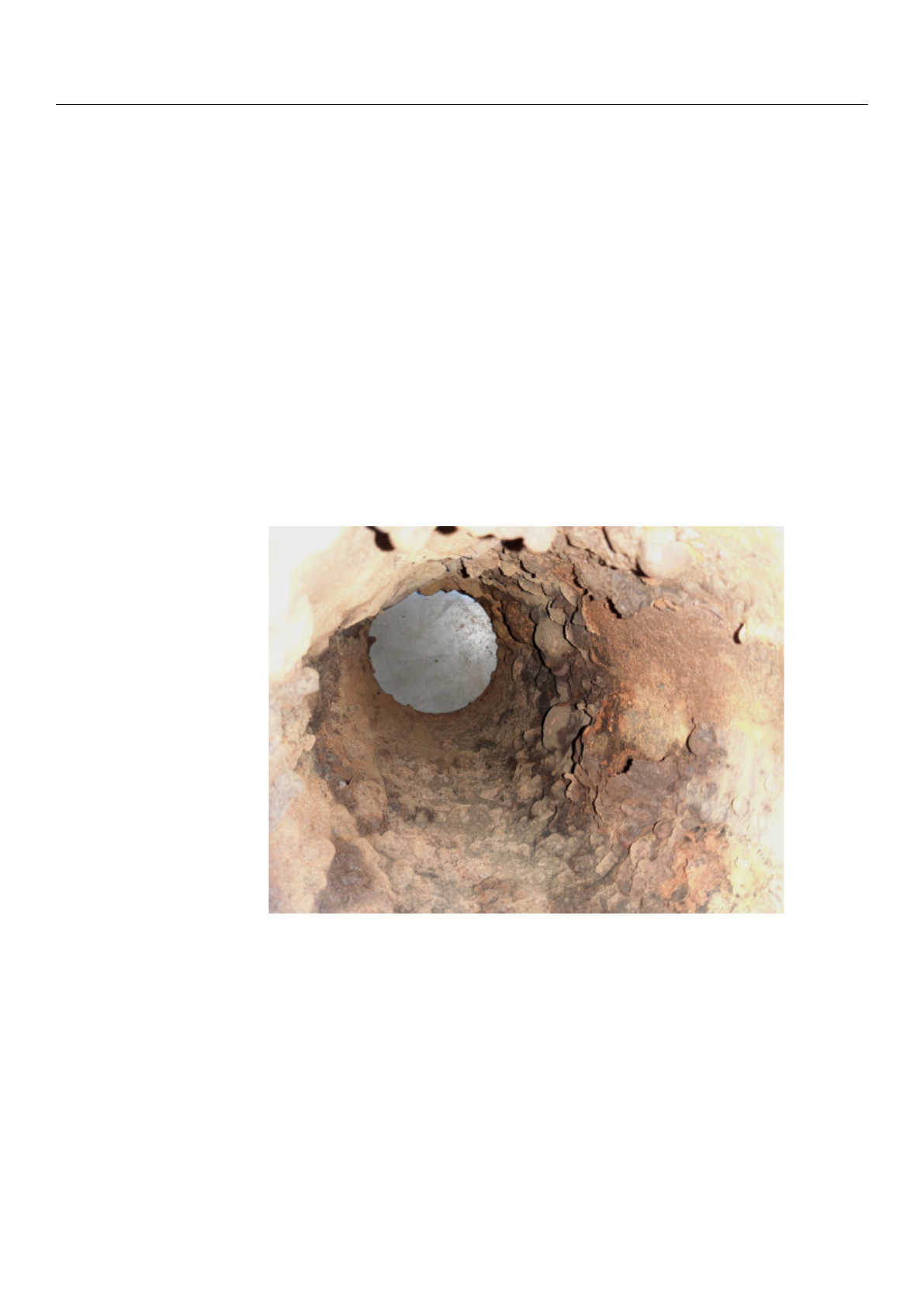
carbonate precipitation and sand form the deposits in the pipes (Figure 1).
Water 2021, 13, x FOR PEER REVIEW 3 of 19
Figure 1. Drinking water pipe (normal diameter 200) gray cast iron pipe as habitat for
invertebrates, typical are incrustations and biofilm coating.
Groundwater used as drinking water generally possesses low levels of nutrients;
however, some groundwater inhabitants are only occasionally flushed out into drinking
water treatment systems, after which they can migrate into drinking water distribution
systems. These groundwater organisms are characterized by high sensitivity to water
heating, are adapted to low nutrient levels and have small growth rates [16,17]. Thus,
drinking water quality problems associated with such organisms are rare. In contrast,
surface water and bank filtration water possess higher nutrient levels and therefore pose
a greater risk of migration of surface water organisms into water treatment and
distribution systems [18,19,20]. In temperate climate zones, many freshwater
invertebrates are characterized by high tolerance to environmental conditions, fast growth
(e.g., several generations per year) and high fertility. When these invertebrates enter
drinking water distribution systems, they can survive and reproduce in the pipes, which
leads to impacts on drinking water quality [21].
Most species found in drinking water systems are typical freshwater organisms that
do not occur in raw water; thus, other mechanisms for their spread must be considered
[3]. Introduction of freshwater macroinvertebrates can occur via sand filter outflow but
only a few (small) animals can pass through a sand filter [22]. More important routes of
entry seem to be via maintenance, construction of drinking water pipes, leakage of pipes
without enough pressure to avoid the introduction of raw water and through mobile
hydrant standpipes. Conversely, the introduction of midge larvae (chironomids) into
drinking water networks occurs primarily via entry of adult animals through
incompletely sealed drinking water tanks.
Overall, the frequency of macroinvertebrate introduction into drinking water
networks is rare and a secondary problem. The main problem associated with these
organisms is their propagation within the pipes.
The occurrence of invertebrates in drinking water networks has been known for at
least 100 years, when reported that small water lice (Asellus aquaticus) and freshwater
shrimps (Gammarus pulex) entered homes via their taps [23]. In 2004, the WHO suggested
that the presence of animals in drinking water systems may affect the microbiological
quality of water. The WHO also mentioned the significance of invertebrates and the risk
of hosting parasites, but data regarding these issues are currently insufficient. A similar
Figure 1.
Drinking water pipe (normal diameter 200) gray cast iron pipe as habitat for invertebrates,
typical are incrustations and biofilm coating.
Groundwater used as drinking water generally possesses low levels of nutrients;
however, some groundwater inhabitants are only occasionally flushed out into drinking
water treatment systems, after which they can migrate into drinking water distribution
systems. These groundwater organisms are characterized by high sensitivity to water
heating, are adapted to low nutrient levels and have small growth rates [
16
,
17
]. Thus,
drinking water quality problems associated with such organisms are rare. In contrast,
surface water and bank filtration water possess higher nutrient levels and therefore pose a
greater risk of migration of surface water organisms into water treatment and distribution
systems [18–20].
In temperate climate zones, many freshwater invertebrates are character-
ized by high tolerance to environmental conditions, fast growth (e.g., several generations
per year) and high fertility. When these invertebrates enter drinking water distribution

Water 2021,13, 276 3 of 17
systems, they can survive and reproduce in the pipes, which leads to impacts on drinking
water quality [21].
Most species found in drinking water systems are typical freshwater organisms that
do not occur in raw water; thus, other mechanisms for their spread must be considered [
3
].
Introduction of freshwater macroinvertebrates can occur via sand filter outflow but only
a few (small) animals can pass through a sand filter [
22
]. More important routes of entry
seem to be via maintenance, construction of drinking water pipes, leakage of pipes without
enough pressure to avoid the introduction of raw water and through mobile hydrant
standpipes. Conversely, the introduction of midge larvae (chironomids) into drinking
water networks occurs primarily via entry of adult animals through incompletely sealed
drinking water tanks.
Overall, the frequency of macroinvertebrate introduction into drinking water networks
is rare and a secondary problem. The main problem associated with these organisms is
their propagation within the pipes.
The occurrence of invertebrates in drinking water networks has been known for at
least 100 years, when reported that small water lice (Asellus aquaticus) and freshwater
shrimps (Gammarus pulex) entered homes via their taps [
23
]. In 2004, the WHO suggested
that the presence of animals in drinking water systems may affect the microbiological
quality of water. The WHO also mentioned the significance of invertebrates and the risk
of hosting parasites, but data regarding these issues are currently insufficient. A similar
evaluation was conducted in Germany [
20
] in a Technical Report that reported that “the
occurrence (of invertebrates) reduces the enjoyment capability and leads to disgust feeling
by many consumers”, and the “need for action is always given, when increased abundance
of invertebrates are visible”.
Macroinvertebrates, which normally occur in low numbers, but are visible with the
naked eye, also have an esthetic impact on drinking water quality. Although the occurrence
of macrofauna in tap water generally does not pose a direct health risk, their presence leads
to a strict refusion of the water and may have indirect harmful effects such as microbial
regrowth.
Adverse effects of the consumption of piped drinking water by humans generally
occurs as a result of bacteria such as Pseudomonas spp. [
24
], Escherichia coli [
25
] and Le-
gionella pneumophila [
26
], all of which are linked with invertebrates in drinking water
networks. One mechanism for such adverse effects is microbial colonization of the guts of
invertebrates [27–29].
In such cases, harmful microbes are protected from chlorination of
drinking water [28].
Therefore, this study investigated the diversity and abundance of macroinvertebrates
in drinking water networks, focusing on the life cycle of Asellus aquaticus and their reproduc-
tion, as well as the health risks they pose with the goal of developing guidelines/limiting
values.
2. Methods
Studies were conducted to investigate methods for control of water lice populations
in drinking water pipes, including (1) development of an effective flushing method with
the CO
2
flushing method [
30
], (2) investigation of the impact of water lice and their feces
pellets on drinking water quality, mainly the microbial contamination by feces and dead
animals on house filters [
1
], and (3) monitoring invertebrates in drinking water pipes by
hydrant sampling using a standard method with 1 m
3
sample volume, a flushing rate of
1ms−1and unidirectional separation of the pipe section, and the outflow [31].
2.1. Laboratory Experiments
Laboratory experiments were conducted to analyze the stability of Asellus aquaticus feces
pellets exposed on glass frit filters of 12 mm diameter filled with water up to 5 cm, and three
replicates for successive sampling of the feces. Briefly, filters were subjected to flow-through
of Berlin tap water at a low flow rate for a period of up 6 weeks, after which samples were

Water 2021,13, 276 4 of 17
taken for scanning electron microscope (SEM) analyses. Berlin tap water has the following
characteristics: non-chlorination, pH = 7.4–7.6, conductivity = 600–790
µ
S cm
−1
, temperature
= 11.7–14.6 ◦C, Ca = 2.2–2.5 mmol L−1, TOC = 4.3–5.6 mg L−1.
To study the growth of bacteria in the presence of dead water lice and water lice
feces, a series of commercial house filters (Honeywell F 67S) were installed in the Berlin
laboratory building of the Berlin University of Technology and subjected to continuous tap
water flow-through. The house filters consisted of 100
µ
m stainless steel filters without
nano silver coatings and a valve for cleaning/sampling. Four trial approaches were carried
out, flow-through of tap water as reference (>1 L min
−1
), flow-through of tap water with a
cleaned house filter, stagnant period after 2 months filter use, stagnant period after addition
of 5 dead water lice. Samples were taken after 1, 3, 7 and 10 days. Bacterial growth was
evaluated at 22
◦
C and reported as colony forming units (cfu) according to the German
Standard DIN 5667-3. Sampling and analyses were carried out by the State Laboratory
Berlin-Brandenburg (LLBB) State Institute, Berlin.
Leaching of Asellus aquaticus feces was studied using liquid chromatography coupled
with organic carbon detection (liquid chromatography–organic carbon detection, LC-
OCD) [
32
] to detect high molecular weight compounds such as polysaccharides (biopoly-
mers), humic substances, and low molecular weight compounds (acids and neutral sub-
stances).
2.2. Sampling of Invertebrates
Drinking water networks located in the European lowland were analyzed using a
standardized sampling procedure in which hydrants with a 1 m
3
water flow (flushing
rate 1 m s
−1
; [
20
] that was unidirectional and provided by a separated pipe section were
sampled. Studied pipes were of ND 80–150 mm, and 1 m
3
hydrant sampling corresponded
to 200 m to 60 m pipe length. All pipe types were sampled, but no significant effects of
pipe material on invertebrate settlement was observed. Other parameters such as pipe
age, flow rate dynamic (day/night cycle), pipe course, accumulation of detritus, and water
temperature seems to be much more important for population regulation, but these data
were not available.
Hydrant sampling comprising more than 1000 samples was conducted in 2009–2018.
Samples were collected from conspicuous and non-conspicuous drinking water networks
as well as from drinking water monitoring networks for several years.
At total of 157 different hydrants were sampled in 13 different drinking water net-
works (12 in Germany, 1 in the Netherlands) corresponding to about 25 different drinking
water supply systems (one drinking water network can consist of several drinking water
treatment plants which feed into the network). Water resources were mostly groundwater.
Chlorination of drinking water was not done.
A further classification of the sampled pipe sections could not be conducted because
many of the related parameters such as intensity of pipe maintenance, position of the
hydrants (on side/top of the pipe), incrustations and intensity of biofilm, and variations in
flow rate and direction among else caused by firefighting were not known.
A low-pressure high flow-through stainless-steel filter was used to separate the inver-
tebrates without causing damage. The mesh size was 100
µ
m for macroinvertebrates and
25
µ
m for the detection of all pipe invertebrates. The capacity of the filter was 100 m
3
h
−1
,
which enabled a high flow rate during sampling. The final filtrate volume was restricted to
less than 300 mL [31].
The number of invertebrates were calculated as empirical p-quantile statistics with the
10%-percentile (=10% of the samples), median (=50% of the samples) and 90%-percentile
(=90% of the samples). Significance analysis of the co-relationships was done by using the
Pearson function.

Water 2021,13, 276 5 of 17
2.3. Invertebrates Analyses
Macroinvertebrates, which are distinguishable with the naked eye, are classified as >2
mm in size. In this study, macroinvertebrates were determined under optical magnification
(Olympus SZX 16 and SZ 40, Olympus Hamburg, Germany), measured and counted.
Systematic analysis was generally conducted to the species level (but not for oligochaetes,
simuliides and springtails). For water lice, the size, sex, molting stages of females, and egg
and embryo number were recorded. The results were used to build up a databank with
1039 data sets that was used to evaluate invertebrate abundance.
Analyses by scanning electron microscopy with energy dispersive spectroscopy (SEM-
EDS) were used to evaluate the composition of Asellus aquaticus feces (Hitachi S 2700
electron microscope, IDFix hard and software from SAMx, Hitachi Krefeld, Germany). For
analyses, samples were sputtered with gold or carbon.
2.4. Calculation of Load Classes
Only positive hydrant samples were used for calculation of load classes, and the
percentage of positive samples was used to describe the occurrence probability. The abun-
dance of water lice and oligochaetes with increasing density was given by an exponential
curve that could be logarithmically normalized to a sigmoid curve. The load classes were
given by dividing the log abundance into three sections of similar size, normal, increased
and mass development, without considering a few outliers (<1.5%). In practice, the load
classes covered a range of 4 to 5 potencies of ten or 0.1 to 1000 water lice m
−3
, that is,
0.1–10,000 oligochaetes m−3.
3. Results
3.1. Diversity and Abundance of Macroinvertebrates
Macroinvertebrates were found in almost all hydrant samples, with a median abun-
dance of 16 ind. m
−3
and 10- and 90-percentiles of 2 and 135 ind. m
−3
, respectively. The
highest density of macroinvertebrates was 4,764 ind. m
−3
. Water lice and oligochaetes
were most common and abundant, while other groups were rare and sporadic in drinking
water networks (Table 1).
Table 1.
Size range and occurrence of macroinvertebrates in drinking water networks in the European lowlands. Data base
= 1039 hydrant samplings with 100 µm filtration.
Animal Groups and
Species
Size Range
(Length)
(mm)
Occurrence
Probability
(%)
n
(Positive
Samples)
Median
(Ind. m−3)
Percentile
(10%)
(Ind. m−3)
Percentile
(90%)
(Ind. m−3)
Maximum
(Ind. m−3)
Macroinvertebrates
(total) >2 96.5 1003 15.9 2.0 135 4764
Isopods
Water louse
(Asellus aquaticus)0.5–11 79.3 824 15.6 1.0 61 869
Cave water louse
(Proasellus cavaticus) ** 1–6 sporadic 34 8.0 1.0 34 89
Amphipoda
Freshwater amphipod
(Niphargus aquilex)0.4–6.5 2.4 20 1.9 0.9 14.6 40
Midges
Simuliide, adults 1–4 sporadic
Chironomide, larvae
Paratanytarsus grimmii 5 rare 66 * 27 1.9 154 1834
Chironomide, adults,
larvae (Limnophyes
asquamatus)2sporadic
Oligochaete earthworms
(Oligochaeta) 0.5–40 74.9 778 6.0 1.0 92.3 4723
Loading more pages...